Estimated reading time: 13 minutes
The best kitchen utensils to buy wholesale are the tools your customers can use with their cookware, clean between tasks, and replace individually when they wear out. Start with the cooking job, then specify the working head, handle and joint, supported care instructions, and pack quantity. Approve a production-equivalent sample before ordering a full assortment. A four-tool set that covers four regular tasks can be a better buy than a larger set with overlapping pieces and no way to reorder the busiest tool.
This kitchen utensils wholesale buying guide is for foodservice distributors, restaurant purchasing teams, and private-label buyers. It covers handheld tools such as turners, scrapers, spoons, ladles, and tongs. A restaurant may need six matching ladles for a busy serving line. A retailer may need one of each tool in an attractive starter pack. The material decisions can be similar, but the mix, spare stock, and packaging should reflect how the tools will actually be bought and used.
Which utensil material works with each cooking task?
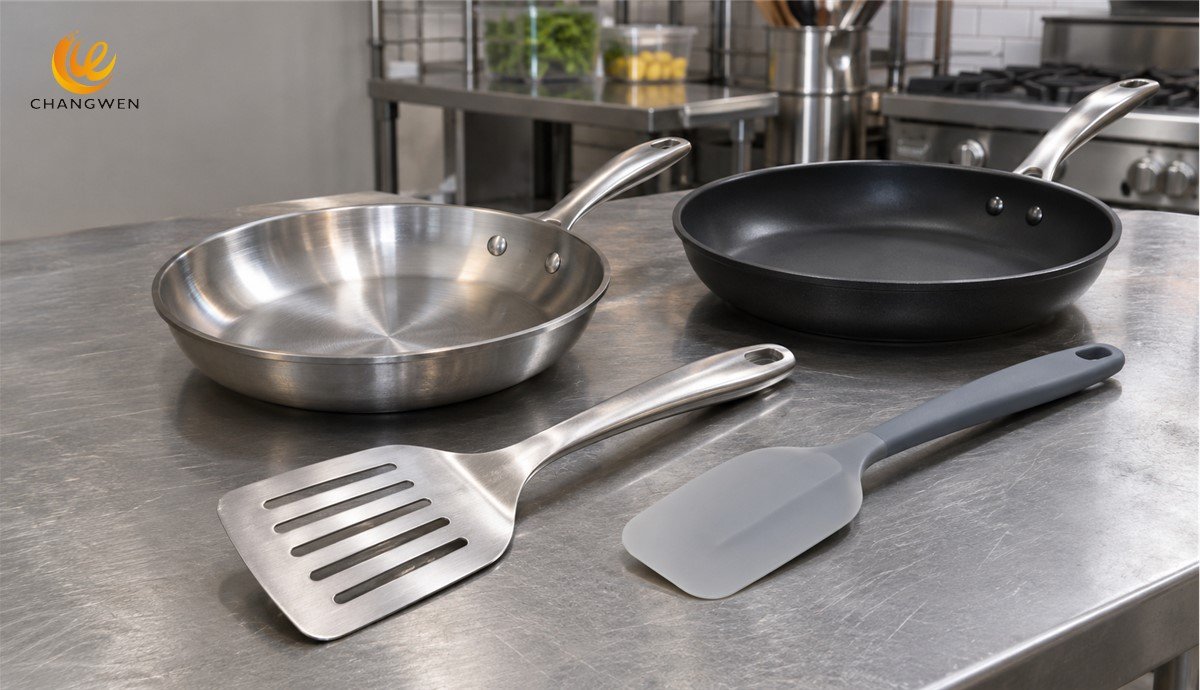
Choose the utensil head for the surface it touches and the work it performs. A rigid stainless steel turner suits lifting firm portions on an uncoated griddle that permits metal tools. A flexible silicone scraper suits collecting batter from a curved bowl and can suit a coated pan if the cookware instructions permit it. For hot use, check the finished utensil’s stated limit and the manufacturer’s conditions. A material name alone cannot tell you how the complete piece will behave.
| Head material | Useful starting point | Sample question |
|---|---|---|
| Stainless steel | Uncoated griddles, serving ladles, and rigid turners | Are the edges smooth where they should be, and does the head stay aligned under the intended load? |
| Silicone | Scraping bowls and working on compatible coated cookware | Does the edge flex enough to follow the curve while the head stays firm enough for the task? |
| Nylon or another specified polymer | Lightweight spoons or turners for compatible cookware | Which exact grade, temperature conditions, and cleaning method are documented? |
| Wood or bamboo | Mixing and stirring where the finish and care routine are suitable | Are the surface and edges smooth, and can the team follow the stated washing and drying instructions? |
For a stainless steel utensil, ask which parts are stainless and which grade and finish are specified for each relevant component. The blade and handle can have different construction, and a tong may include a separate spring or pivot. A thin but adequately supported turner can slide cleanly beneath food. A thicker tool may hold more load but need a bevel or a different approach angle. Evaluate the edge and the flex together with the cookware, since neither thickness nor a grade label describes how the utensil handles a portion.
For a silicone utensil, confirm whether the head contains a reinforcing core, where that core ends, and how the head attaches to the handle. A supported center can help a spatula move a thick mixture, while a soft perimeter can sweep the bowl wall. A head that flexes throughout its length can be excellent for folding a delicate mixture but frustrating when lifting a dense portion. Rely on the material and construction specification and a finished sample when the catalog photos look the same.
A nylon or other polymer utensil belongs in a program where its documented temperature and cleaning limits match the work. A lightweight spoon may be a good fit for stirring a sauce at moderate heat. A turner intended for frequent griddle work needs a specification suited to that exposure. Clarify whether the stated limit describes brief food contact or a longer period of use. Also check whether the handle, molded insert, or head-to-handle connection has a more restrictive limit than the head material.
Wood and bamboo utensils are most practical when operators can follow the manufacturer’s wash and dry instructions and inspect the finish routinely. A broad wooden spoon can be comfortable for stirring, but swelling, splits, or rough grain can create problems if a tool is routinely soaked or used outside its care instructions. For a venue with a single standardized wash process, compare every candidate against that process. A tool that needs special handling is useful only if the team can consistently provide it.
How do you specify a utensil handle and joint?
A utensil handle should allow the user to control the head without gripping harder than the job requires. Judge diameter, shape, texture, reach, and balance with the actual load. A short spoon can be easy to control in a shallow pan, while a longer handle can keep hands farther from the heat around a deep vessel. Extra length can also make a heavy portion feel harder to control. Test both positions if one utensil is meant to cover both stations.
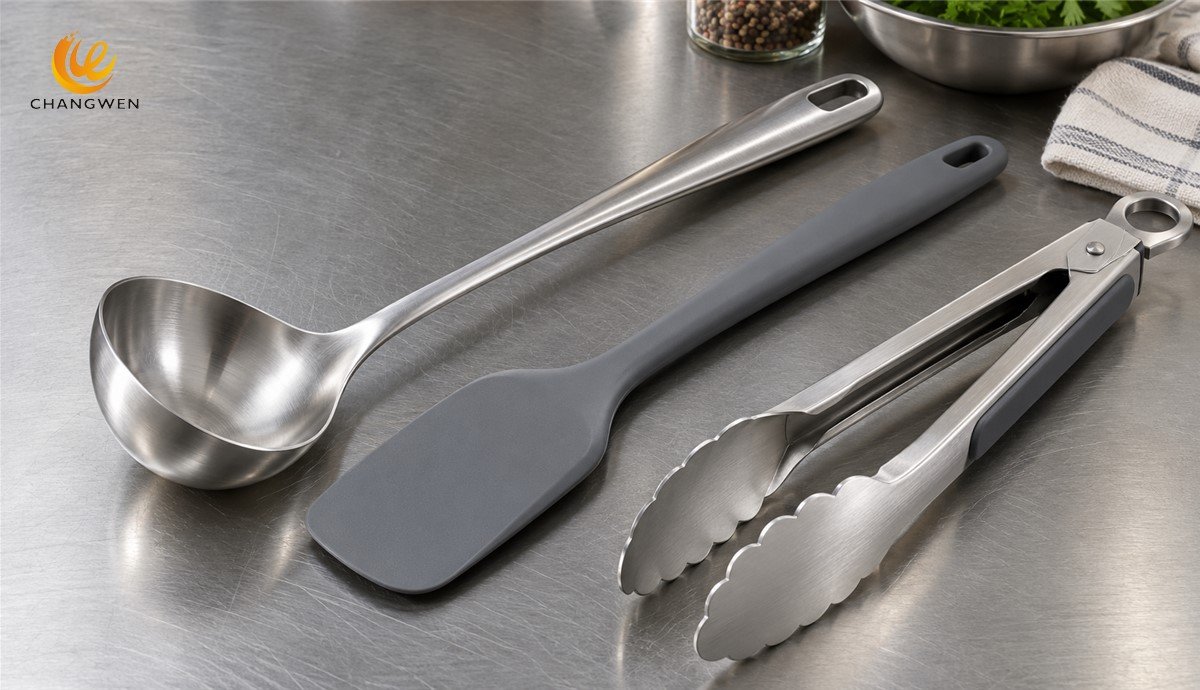
A one-piece stainless utensil can simplify inspection because the handle and head have no separate attachment to check. A molded or sleeved handle can offer a different grip and balance, but the transition needs its own inspection. Run a visual check along the seam and the hanging hole for gaps, raised edges, or finish defects. Ask how the assembled tool is meant to be washed, and repeat the check after the supplier’s agreed cleaning cycle if buyers will use the tool in that way.
A silicone spatula with a removable head may make head replacement possible if matching parts are available. A permanently molded head may suit a buyer who prefers a continuous exterior, provided the material transition is well finished and the assembly holds up in use. For either design, compare how easily the head twists under ordinary mixing and whether the joint shows a change after repeated washing. Record the intended replacement process in the specification when the head can be ordered separately.
Test wet grip on a cool sample before deciding that one handle profile suits an entire range. An oval or textured grip can make the head orientation easier to feel, while a smooth cylindrical grip can simplify wiping. A cook should be able to rotate a spoon, turn a fillet, or release a tong lock with the motion the tool requires. Try these actions with the gloves used at that station. A comfortable handle in a showroom can behave differently with wet hands or a loaded scoop.
Locking tongs and similar moving tools need a closer inspection than a solid serving spoon. Check jaw alignment, spring return, the force needed to hold an item, and whether the locking tab clears the user’s hand. A wide scalloped jaw can help grip larger portions, while narrow tips can make plating more precise. Choose the jaw and force for the actual item being held, and look for pinch points or unexpected movement during repeated use.
For a deep stockpot or tall food pan, measure handle reach with the vessel at its working height. A ladle that looks long enough on a table can force the user to reach over steam when the pot sits on a raised range. A longer ladle can restore clearance but may be harder to store and balance. Buy a dedicated long tool if the short one covers shallow vessels well and the deep vessel is a regular assignment.
Which tools belong in a wholesale kitchen utensil set?
Build a set from the tasks a customer performs in one workflow. A typical cooking starter set could include a solid spoon for stirring and serving, a slotted turner for lifting, a scraper for bowls, and tongs for gripping. A soup and sauce station might instead need two ladle sizes, a long spoon, and a scraper. Each additional piece should earn its place through a different job or through the frequency with which the same tool must be used at multiple stations.
| Buyer | Core pieces | Ordering decision |
|---|---|---|
| Line kitchen | Rigid turner, tongs, long spoon, and portion ladle | Stock the frequently used pieces as separate replenishment SKUs |
| Bakery prep station | Flexible scraper, stiff mixing spoon, whisk, and bowl scraper | Check head flex against the actual bowl and mixture |
| Consumer retail starter set | Solid spoon, slotted turner, silicone scraper, and tongs | State which cookware and care instructions apply to each piece |
| Buffet service | Serving spoon, slotted spoon, portion ladle, and serving tongs | Match head size and handle reach to the food pans and serving layout |
A portion ladle should be chosen by usable volume and control, especially where the served quantity affects food costs. Compare two samples using a measuring vessel and the fill level the staff actually use. Then check how each lip pours into the real container, and how much liquid remains in the bowl. For a wholesale range, identify the nominal volume and units on the order sheet and use consistent markings or SKU names so buyers can reorder the intended size.
A turner assortment works best when differences in head shape and stiffness are visible to the customer. A wider rigid blade can carry a larger item on an approved flat cooking surface. A narrow flexible blade can follow the edge of a pan and slip under a smaller portion. Listing both simply as turners invites customers to choose by appearance. The Changwen guide to flexible and rigid commercial spatulas explores that particular choice in more detail.
Stock individual units alongside popular set packs when the buyer expects uneven wear or loss. For example, a restaurant might receive matched tools at opening and then reorder tongs several times before it needs any additional scrapers. In a private-label program, identify which pieces will remain available as singles and confirm whether individual packs can use the same finish, color, and logo. A clear replenishment option can extend the useful life of the assortment and reduce the need to buy duplicate low-use tools.
Foodservice sets and retail sets should have different pack logic. A six-pack of matching tongs lets a distributor fill replacement orders without opening mixed boxes. A retail set can use a tray or dividers to present a range of tools at once. Ask the supplier which unit is counted in the quotation, how many units go in an inner pack and master carton, and whether unopened packs can be split for wholesale customers.
Size a first order for peak use as well as the number of stations. In an illustrative kitchen where three stations each need two tongs at peak and two more tongs are usually being washed, eight units are already occupied before any spare stock is counted. The right buffer depends on wash turnaround, breakage, and the speed of local replacement. Buying a few extra high-use tools can be more useful than ordering extra copies of a whole starter set.
How should a buyer compare and approve samples?
Start wholesale utensil sample approval with a test sheet that records the model code, head material, handle design, overall length, usable head dimensions, and weight. Name the station, vessel, intended food or load, and permitted cleaning method beside the dimensions. A measurement lets a buyer reject an obvious mismatch before cooking, while a defined task exposes a weakness that dimensions cannot show. Give each sample and any revised sample a unique reference so notes do not get attributed to the wrong build.

Compare two turners using the same approved pan and the same size of food. Check whether each edge slides under the portion, how far the head flexes when lifted, and whether the handle gives enough clearance over the pan wall. For a scraper, sweep the same curved bowl with the same amount and type of mixture and note where residue is left. A good result should be described in terms a second evaluator can reproduce, rather than a broad judgment such as premium feel.
Check utensils after cleaning as well as during use. Use the cleaning procedure supported by the manufacturer and agreed for the purchase, then inspect joints, edges, markings, and any moving parts. Visible changes such as a loose head, rough edge, corrosion, or a binding pivot merit a documented review. Agree with the supplier on the inspection method, frequency, and defect definitions. A kitchen trial is useful evidence about handling and care, while compliance testing has its own methods and documentation.
An approved sample and a signed specification serve different purposes. Keep a reference sample for shape, weight in the hand, and finish. Write objective tolerances for features like overall length, head width, and any critical fit so production inspectors can make repeatable decisions. Include controlled photos or drawings for visible details such as logo position and seam finish. Ask who must approve any substitution of material, core, handle, tooling, or factory process that could change performance or documentation.
Apply the same review to every size sold under a shared utensil name. A longer handle can increase leverage on a joint. A wider scraper may flex differently using the same material. A larger ladle can feel substantially heavier when filled even if its handle is unchanged. Approving one size is efficient for initial screening, but each critical variant should be checked against its own planned use before the purchase specification is finalized.
What evidence belongs in a food-contact and care file?
Request product-specific information for the intended destination market and use. Identify the components expected to contact food, the exact materials or formulations as applicable, and the proposed food types, contact times, and temperatures. Ask the supplier to identify the evidence that supports those conditions. The FDA guidance on the regulatory status of food-contact components and the European Commission food-contact legislation overview are starting points for the respective markets.
For a multicomponent utensil, match the evidence to the part and model it actually describes. A report for a metal shaft leaves open which evidence applies to a molded head, pigment, or tip covering. A related model may be covered if the supplier can document why the evidence applies, but a visually similar tool is a poor substitute for that explanation. Ask how a changed color, insert, or food-contact finish is assessed before a revised sample or purchase order is approved.
Use the care instructions as part of the purchase specification. If a tool is sold for an institutional dish area, check that the permitted washing method fits the buyer’s process. If different tools in a retail set have different care instructions, label them by piece so customers can apply the correct routine. Make sure the carton, product listing, and supplier documents describe the same conditions. A concise, supported instruction is easier for teams and consumers to follow than a general claim.
How do you compare wholesale quotes and prepare for reorders?
Ask suppliers to quote the same head material, handle design, pack configuration, and delivery terms. Keep tooling, sample fees, inspection, packaging, freight, and applicable destination costs visible as separate lines when comparing quotes. Include the carton dimensions and shipping weight so a bulky display pack can be compared with a compact case pack. A lower price per set can imply a higher cost per usable tool when it includes unwanted pieces or uses packaging that raises freight costs.
Confirm how the minimum order quantity applies to size, color, handle, logo treatment, and packaging. A factory may allow several head shapes in a coordinated order while requiring separate minimums for custom colors or printed boxes. Ask for a base quotation with existing tooling and a second quote for the changes you would actually pay for. For a first order, a stock construction with approved private-label packaging may make demand easier to test than a fully custom tool with multiple variant minimums.
Use a simple landed-cost check to compare offers. In an illustrative order, 500 sets at $6 per set and $750 in freight, inspection, and packaging charges come to $7.50 per set before other costs. If a second 500-set quote totals $3,650 on the same terms, it is $7.30 per set. Check spare-unit availability and service expectations before choosing on that 20-cent difference, since the savings may be smaller than the cost of replenishing the most used tools.
For a repeat utensil order, give the supplier the customer SKU, supplier model, approved revision, pack format, and most recent order reference. Require advance notice if the material, component source, tooling, color, or markings change. For mixed sets, specify whether a missing or defective piece can be replaced individually and who coordinates the replacement. The guide to sourcing kitchen smallwares covers the broader overseas purchasing process that surrounds those order details.
Give each item in a mixed utensil set a component code, even when the set has a single retail barcode. The component code lets a warehouse identify which replacement to ship when a buyer reports a missing scraper or a bent spoon. Agree how the supplier will label inner packs and share batch references before artwork approval. A barcode tells a scanner which commercial unit it is handling, while the component and batch references help the service team identify and trace the actual piece.
Ask for a packed sample before approving a private-label utensil order. Compare the presentation and fit with the final artwork, check whether moving tools are restrained, and inspect whether hard edges touch softer heads during transport. A packaging choice that looks attractive on a counter can still allow parts to rub in transit. Include the final pack dimensions and orientation in the order so the sample being approved is the one being priced and shipped.
Request a kitchen utensils wholesale quote from Changwen
Changwen supplies wholesale cookware and commercial kitchen smallwares and offers private-label and OEM/ODM services for distributors, brands, and foodservice buyers. Review the Changwen commercial kitchen utensils catalog for existing cookware and utensil options. Use existing models as a starting point when a catalog shape fits the task, or discuss a custom specification when the application calls for a different size, handle, finish, or branding.
Contact Changwen for a wholesale quotation, private-label options, or OEM sample discussion. Share the destination market, intended cookware and cleaning process, tool list, quantities by SKU, pack format, and any drawing or reference sample. Include logo placement and whether key pieces must be available as singles. A brief with those details gives Changwen a practical basis to discuss sample availability, options, minimum quantities, and a quote for the same specification you intend to buy.