
Stainless Steel Serving Trays Buying Guide
Compare stainless steel serving trays by size, shape, handles, load, finish, cleaning, stacking, quality tests, and wholesale specifications.

Compare stainless steel serving trays by size, shape, handles, load, finish, cleaning, stacking, quality tests, and wholesale specifications.

Match spatula blade stiffness to fish, eggs, burgers, griddles, coated pans, and bulk buying tests for safer, faster commercial kitchen work.

Set repeatable visual defect criteria for bulk commercial pots and pans using surface zones, defect classes, limit samples, sampling, and rework rules.

Compare QSR and full-service kitchen layouts to size smallwares by flow, station ownership, duplication, wash cycles, storage, and peak demand.

Match equipment to receiving, storage, prep, cookline, pass, and warewashing stations using clear ownership, capacity, and handoff rules.

Plan restaurant smallwares without overbuying. Set opening pars, purchase tiers, wash-cycle reserves, mock-service tests, and evidence-based reorders.

Map commercial kitchen equipment from receiving to the pass. Plan station handoffs, storage, cookware, holding, clean returns, and practical workflow checks.

Build a commercial kitchen smallwares list from a restaurant menu using production tasks, batch size, station ownership, par levels, and a quote-ready BOM.

A practical framework for building a coherent private label cookware line through positioning, SKU roles, design language, specifications, packaging, and controlled expansion.
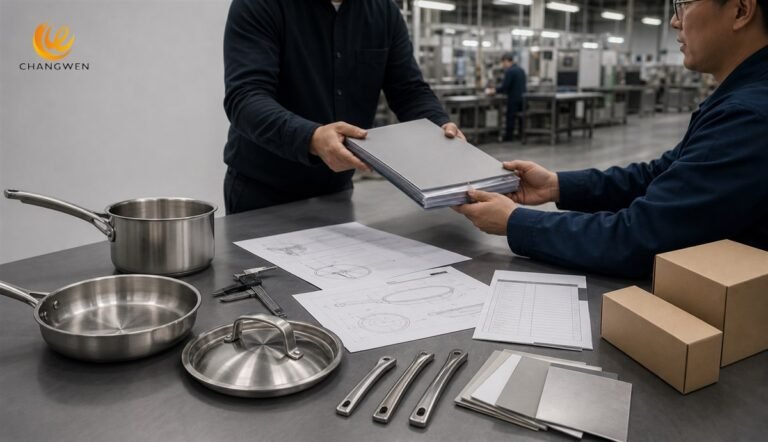
Learn what product specifications, quantities, quality requirements, packaging details, and commercial terms an OEM cookware factory needs for a comparable quote.
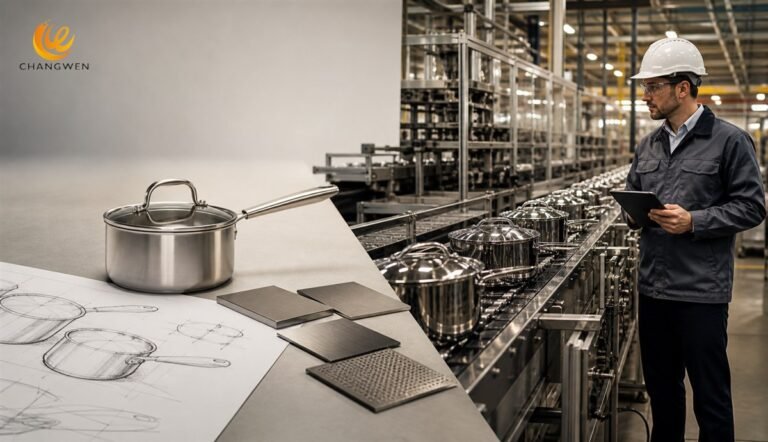
Follow a nine-gate OEM cookware process from design brief and DFM through tooling, validation, pilot production, mass production, and final release.

Learn how to calculate OEM cookware manufacturing cost by separating development, tooling, recurring factory cost, packaging, logistics, sellable yield, and execution risk.