Read time: 13 minutes
OEM cookware manufacturing does not have one reliable universal price because every project combines a different specification, quantity, tooling requirement, quality plan, packaging system, and delivery destination. The most useful cost answer is a formula: total cost per sellable unit equals amortized development cost plus recurring factory cost plus landed supply-chain cost plus an allowance for measurable execution risk.
A factory quotation usually displays only part of that formula. A low ex-factory unit price can still produce an expensive program when the buyer later adds molds, samples, laboratory work, inspection, replacement stock, freight, duties, financing, rework, or packaging changes. A complete OEM cookware budget therefore separates four cost layers before comparing suppliers.
This article uses a cost-model approach instead of publishing fixed market prices that can become inaccurate when metal markets, freight rates, currencies, duties, and specifications change. A buyer can insert current supplier quotations and market-specific charges into the model to produce a project-specific answer that remains useful during negotiation and repeat orders.
What is the complete OEM cookware cost formula?
The complete OEM cookware cost formula contains four layers: non-recurring engineering and setup, recurring ex-factory product cost, landed supply-chain cost, and expected execution cost. Each layer should be visible because a supplier can appear inexpensive by excluding work that another supplier includes.
Total cost per sellable unit = (development + tooling + samples + testing + packaging setup) / planned sellable units + recurring factory unit cost + logistics and import cost per unit + expected quality and delay cost per unit.
The denominator should be planned sellable units rather than ordered units. If inspection rejects products, transit damage reduces usable stock, or the buyer reserves spare units for warranty support, fewer units generate revenue. Dividing project cost by the usable quantity prevents a low apparent cost from hiding poor yield or inadequate protection.
| Cost layer | Typical contents | Best comparison unit | Main control document |
|---|---|---|---|
| Non-recurring cost | Engineering, prototypes, tooling, tests, artwork setup | Total project and amortized per unit | Development and tooling schedule |
| Recurring factory cost | Materials, conversion, components, finish, QC, packaging | Per approved sellable unit | Specification and itemized quotation |
| Landed cost | Freight, insurance, duties, clearance, inland delivery | Per unit delivered to the named location | Incoterm and logistics estimate |
| Execution cost | Defects, rework, delays, inspection, replacement stock | Expected cost per sellable unit | Quality plan and risk register |
Why can two OEM cookware quotations differ so much?
Two OEM cookware quotations can differ because the factories are not pricing the same product or the same commercial scope. One quotation may assume thinner walls, a different steel grade, an existing handle, a standard carton, limited testing, no pre-shipment inspection, or a more favorable payment schedule. Another quotation may include controlled materials, custom parts, stronger packaging, inspection records, and after-sales replacement support.
A buyer should normalize the product specification before comparing price. Material grade, thickness, construction, dimensions, weight, surface finish, handle and lid details, tolerances, test requirements, packaging, quantity by SKU, spare parts, and Incoterm should match. The article on questions to ask a cookware manufacturer before ordering provides a broader pre-deposit checklist for clarifying production and commercial assumptions.
A buyer should also normalize the quotation validity and adjustment mechanism. Metal prices, exchange rates, freight, and regulatory charges can move between inquiry and shipment. A transparent quotation identifies which inputs are fixed, which inputs can change, the reference date, the adjustment trigger, and the evidence required before a price revision.
What belongs in non-recurring OEM development cost?
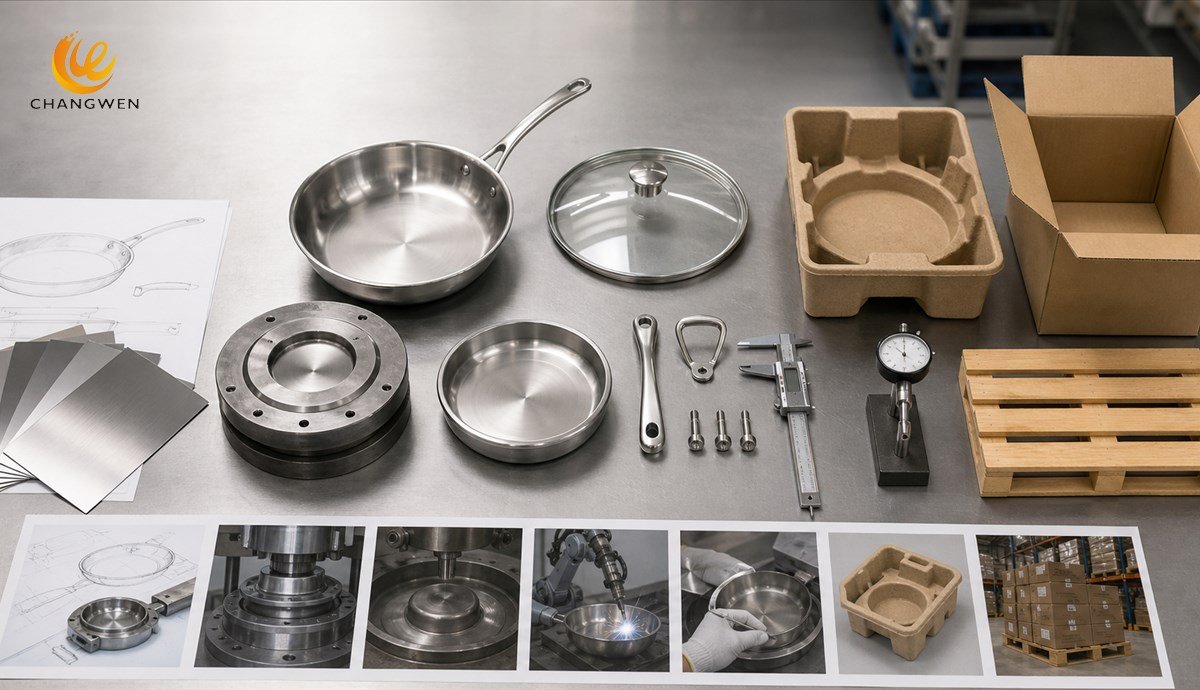
Non-recurring cost includes work that prepares one design for production but does not repeat in the same form for every unit. Product engineering, design-for-manufacturing review, drawings, prototypes, sample revisions, molds, dies, fixtures, gauges, packaging cutting tools, print setup, laboratory work, and pilot-run preparation can all belong in this layer.
Non-recurring cost should be separated from the recurring unit price even when the factory offers to amortize it. A hidden amortization can make future prices difficult to audit and can create disagreement about tooling ownership. The quotation should show the total setup charge, amortization quantity, amount included per unit, ownership terms, and the price after amortization ends.
Development cost should also include buyer-side work. Product management, industrial design, engineering review, legal review, packaging artwork, translations, travel, third-party inspection, and sample shipping consume real budget even when the factory does not invoice those services. A complete investment decision counts the cost required to reach an approved production baseline.
How does tooling affect OEM cookware cost?
Tooling affects OEM cookware cost through initial cash requirement, useful life, maintenance, production speed, achievable tolerance, and scrap rate. A custom body profile may require forming and trimming tools, while a unique handle may require casting, injection, forging, welding, bending, or inspection fixtures. Each tool should connect to a controlled product feature.
The simplest tooling calculation is tooling cost per unit = tooling investment / expected units produced before redesign or retirement. Expected units should be conservative because a design can change before a physical tool reaches its maximum life. A buyer that amortizes tooling across an unrealistic forecast will understate launch economics.
Tool ownership should be defined separately from tooling cost. A buyer-funded tool should have an asset identifier, location, maintenance responsibility, permitted use, expected life, storage rule, and transfer or release procedure. The related guide comparing OEM and ODM cookware models explains why custom tooling, design control, speed, and exclusivity change the program’s cost structure.
How do raw materials change the recurring unit cost?
Raw materials change recurring cost through grade, thickness, weight, construction, purchase format, yield, and commodity exposure. A steel grade with higher alloy content can cost more per kilogram, but the finished-unit difference also depends on how much metal the product contains and how efficiently the factory converts sheet or coil into acceptable parts.
Cookware material cost should not be compared only by grade name. A thicker 201 stainless steel body can use more material than a thinner 304 body, while a multi-layer structure includes bonding and conversion costs that a single-ply item does not. The guide to 201 versus 304 stainless steel cookware explains how composition, corrosion resistance, construction, and market position affect total value.
Material yield converts purchased metal into finished-product cost. Blanking layout, deep-drawing performance, trimming allowance, polishing loss, forming cracks, surface defects, and rework determine how much input becomes sellable cookware. A heavier quoted product may still have a competitive cost when the factory controls yield and process stability better.
How does cookware construction change manufacturing cost?
Cookware construction changes cost because every layer, forming operation, attachment, finish, and inspection adds material or conversion work. A single-ply stockpot, an impact-bonded base product, and a fully clad pan may share a stainless steel appearance but follow different process routes and cost structures.
Complexity should be connected to customer value. A thicker base can improve thermal stability, while an unnecessary decorative part can increase assembly, packaging, and failure risk without improving use. Cost engineering should preserve the product requirement and remove work that the target customer will not value.
Components also create cost interactions. A heavier handle may require stronger attachment, balance changes, a larger carton, additional protection, and another test. A lid profile can change nesting density and freight efficiency. A specification decision should therefore be costed across product, process, testing, and logistics instead of being treated as an isolated component price.
Why does order quantity change OEM cookware price?
Order quantity changes price because fixed production work spreads across the batch. Material purchasing, machine setup, line changeover, color preparation, tool installation, first-piece approval, inspection setup, packaging printing, and administration occur even when the order is small. A larger efficient run lowers the fixed-cost share per unit.
MOQ is not one universal number for the finished product. The body, coating color, handle, lid, carton, insert, barcode version, and accessory can each have a separate economic minimum. A factory may accept a low cookware quantity but require the buyer to purchase excess printed packaging or exclusive components.
The correct quantity decision compares unit-cost savings with inventory exposure. A larger run may reduce factory price while increasing cash tied up, storage, markdown risk, and the cost of discovering a design problem across more units. The first order should be large enough to represent normal production but small enough to protect the buyer while demand and quality performance remain uncertain.
How much should a buyer budget for samples and validation?
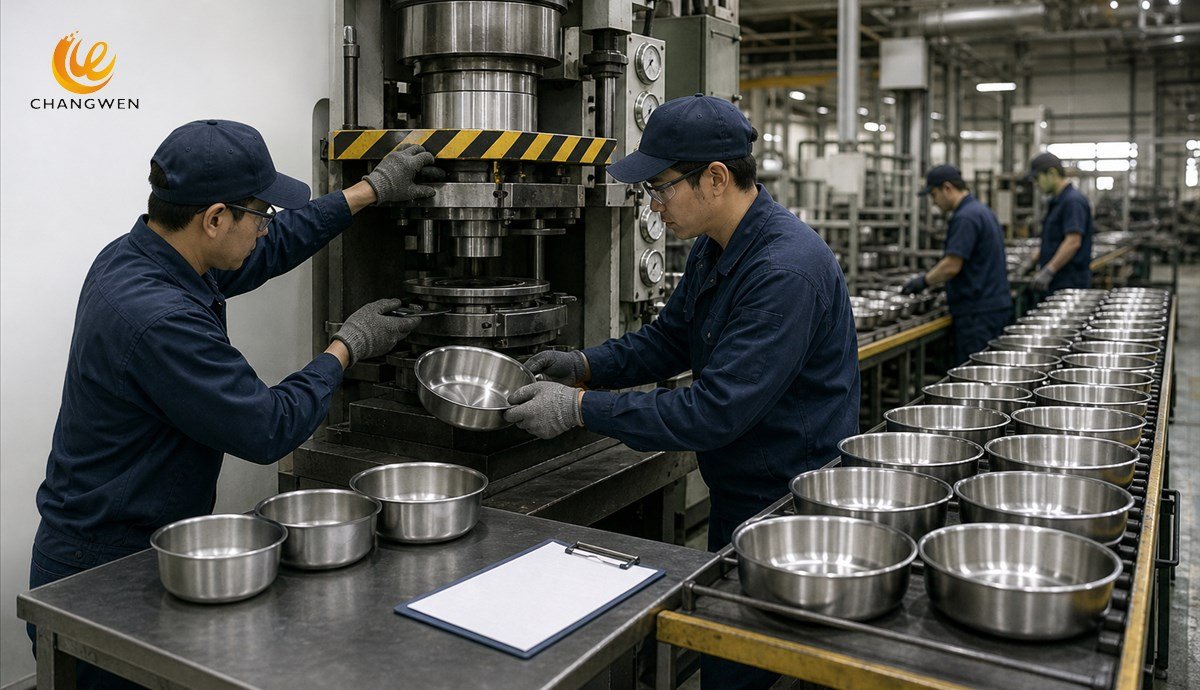
A buyer should budget for enough sample and validation work to retire the project’s important risks before mass production. The required budget depends on whether the product uses existing tooling, a modified platform, or a new design. Sample cost can include prototype labor, special material purchases, temporary tools, courier charges, test cooking, dimensional inspection, and repeated revisions.
Sample fees should be treated as learning cost rather than compared only with production unit price. A carefully documented sample round can prevent an expensive production correction. The buyer should agree whether sample fees are credited against an order, but a credit should not encourage approval of a sample that fails the product requirement.
Validation should match the product claim and destination market. Material identity, food-contact suitability, coating performance, handle attachment, base stability, corrosion exposure, thermal cycling, packaging protection, and labeling can require different evidence. Testing cost is controlled by defining the exact construction and claim before the laboratory scope is commissioned.
How do quality control and yield affect OEM cost?
Quality control adds visible cost through inspectors, equipment, records, sampling, and testing, but weak control creates less visible cost through defects, rework, claims, and delayed shipments. The right question is not whether inspection costs money. The right question is which prevention and verification activities reduce the expected cost of failure.
Yield should be measured at critical production stages instead of only at final inspection. Incoming-material rejection, forming failure, polishing defects, coating rejection, attachment rework, lid mismatch, and packaging damage reveal where cost is lost. A factory with a higher nominal conversion rate can still quote competitively when the factory produces more sellable units from the same input.
A buyer should connect quality requirements to the quotation. Inspection level, critical defects, measurement methods, testing frequency, retained samples, traceability, corrective action, and responsibility for failed goods should be agreed. The article on how retailers choose stainless steel cookware suppliers explains how evidence, samples, quality systems, compliance, and replenishment affect supplier value beyond price.
How do packaging choices change product and logistics cost?
Packaging changes cost through material, printing, tooling, assembly time, carton dimensions, damage protection, and loading efficiency. A premium color box may support retail positioning, but an oversized structure can increase freight and warehouse cost. A low-cost carton can become expensive when handles rub, lids break, or finished surfaces arrive scratched.
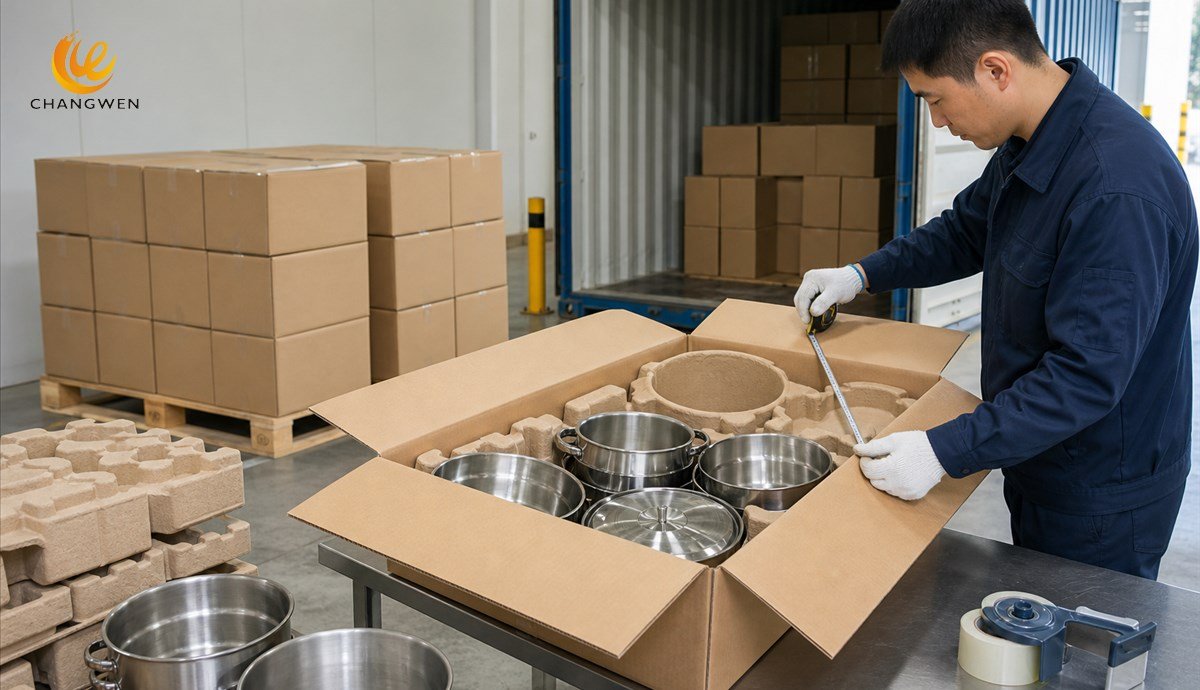
Packaging should be costed as a system. Retail box, inserts, separators, bags, manuals, labels, master carton, pallet requirements, drop testing, and loading quantity should be reviewed together. A packaging change can alter both unit packaging price and units per container, so the net effect should be calculated at the delivered-unit level.
Packaging MOQ can also differ from product MOQ. A buyer should ask how many unused boxes or printed inserts remain after the run, who owns that inventory, where it is stored, and what happens after an artwork change. Obsolete packaging is a real cost even when it never appears in the product invoice.
What belongs in landed OEM cookware cost?
Landed OEM cookware cost includes every charge required to move an approved product from the quoted factory point to the buyer’s specified receiving location. Freight, insurance, export handling, port charges, duties, taxes, customs brokerage, inspections, inland transport, and destination fees can all belong in the calculation depending on the route and Incoterm.
The Incoterm defines responsibility boundaries but does not guarantee the final cost. Two suppliers quoting FOB at different ports can create different inland and ocean costs. A DDP quote can simplify budgeting while hiding the assumptions used for customs classification, tax treatment, or service scope. Buyers should confirm the named place, version of the Incoterm, included charges, and exclusions.
Cookware is often more sensitive to volume than weight because pots and pans occupy significant carton space. Nesting design, handle orientation, lid placement, carton strength, mixed-SKU loading, and pallet rules affect container utilization. The guide to importing restaurant stock pots from China provides a product-specific view of specifications, Incoterms, duties, freight, documentation, and receiving inspection.
What is risk-adjusted OEM cookware cost?
Risk-adjusted cost adds the expected financial effect of defects, delays, specification drift, and supplier dependence. The calculation does not require invented precision. A buyer can compare scenarios by identifying each risk, estimating a reasonable probability range, estimating the consequence, and testing whether the supplier’s controls reduce either value.
Expected risk cost = probability of an event x financial consequence of that event. A late seasonal launch can create a larger consequence than a small unit-price difference. A material substitution can create testing, rework, claims, or lost-customer costs. A weak corrective-action system can make the same defect recur across repeat orders.
Risk allowances should remain separate from supplier price because risk is partly buyer-specific. The same delay can be manageable for a replenishment warehouse and severe for a promotional launch. The article on commercial cookware sourcing mistakes identifies common failure patterns involving low prices, material evidence, certification, samples, and pre-shipment inspection.
How can buyers compare OEM cookware quotations fairly?
Buyers can compare OEM cookware quotations fairly by issuing one revision-controlled RFQ and forcing every supplier response into the same cost architecture. Each line should identify specification, quantity, unit, Incoterm, lead time, tooling, sample cost, testing, packaging, inspection, payment terms, validity, exclusions, and adjustment conditions.
Every commercial assumption should be marked as confirmed, provisional, buyer-supplied, supplier-supplied, or excluded. A blank cell should never be treated as included. The comparison should also record the evidence supporting material, construction, capacity, packaging, and quality promises.
A normalized comparison should calculate first-order cash requirement, amortized cost per sellable unit, steady-state reorder cost, and delivered cost. First-order cost reveals launch capital, while steady-state cost shows whether the program remains competitive after development charges end.
How can OEM cookware cost be reduced without weakening quality?
OEM cookware cost can be reduced by simplifying nonessential variety, using existing proven process platforms, sharing components across SKUs, improving nesting, aligning packaging versions, setting realistic tolerances, and concentrating volume. These changes remove complexity without changing the customer-facing performance requirement.
Cost reduction should begin with a value hierarchy. Material identity, food-contact safety, structural integrity, critical performance, and required compliance should remain protected. Decorative details, redundant parts, excessive finish steps, low-value accessories, or fragmented packaging versions can then be challenged.
A supplier cost-reduction proposal should state the original requirement, proposed change, savings mechanism, affected tests, new risks, sample requirement, and approval owner. Quiet substitutions create risk; documented value engineering creates a controlled decision.
How should a buyer forecast repeat-order cost?
Repeat-order cost should begin with the approved specification and separate stable costs from indexed inputs. Tooling amortization may end, while metal, currency, packaging paper, energy, freight, and duties can change. The price-review mechanism should define reference data, review frequency, thresholds, direction of adjustment, and documentation.
Repeat-order forecasts should also include tool maintenance, replacement gauges, renewed test reports, packaging artwork changes, spare parts, and quality reserves. A product that sells for several years will experience operational costs that the first-order quotation cannot fully capture.
Supplier performance affects reorder economics. Stable lead time can reduce safety stock, reliable quality can reduce inspection and claims, and controlled documents can prevent reapproval work. A supplier with a slightly higher unit price may therefore produce a lower operating cost across the program.
Frequently asked questions
Can a factory quote OEM cookware without a detailed specification?
A factory can provide a preliminary range without a detailed specification, but the range is not a comparable final quote. Material, thickness, construction, finish, components, packaging, quantity, testing, destination, and Incoterm must be defined before price can support a purchasing decision.
Is tooling included in the OEM cookware unit price?
Tooling may be charged separately, amortized into the unit price, refundable after a volume threshold, or retained by the manufacturer. The quotation should state the structure, ownership, amortization quantity, maintenance, and post-amortization price.
Does a higher MOQ always reduce total cost?
A higher MOQ usually reduces factory cost per unit by spreading setup and purchasing costs, but a higher MOQ can increase inventory, financing, storage, and markdown exposure. The correct quantity minimizes total business cost rather than factory price alone.
Which cost should buyers compare: EXW, FOB, or landed cost?
Buyers should compare suppliers on the same responsibility boundary and should ultimately model cost at the same receiving location. FOB can support factory-side comparison, while landed cost determines the inventory value delivered to the buyer’s operation.
Why does custom packaging change OEM cookware cost so much?
Custom packaging affects artwork setup, print MOQ, inserts, assembly, master cartons, damage protection, carton size, and container loading. The correct comparison includes both packaging price and the packaging system’s effect on freight and sellable yield.
What is the fastest way to obtain an accurate OEM cookware quote?
The fastest route is a complete RFQ containing product drawings or reference samples, material and construction requirements, target dimensions, quantity by SKU, packaging, destination market, testing needs, delivery location, Incoterm, and decision schedule.
What is the final budgeting rule?
The final budgeting rule is to calculate OEM cookware cost at the sellable-unit level and to keep one-time, recurring, landed, and risk costs visible. A buyer should not accept a single blended number until the buyer understands which assumptions create that number and which events can change it.
An accurate OEM cookware budget is not the lowest quotation. An accurate budget is a controlled model that connects specification decisions to cash requirement, unit economics, delivery responsibility, and repeat-order performance. That model gives the buyer a reliable answer today and a disciplined way to update the answer when markets or product requirements change.