Quick answer: Before ordering cookware, buyers should ask questions that convert sales claims into measurable commitments. The manufacturer should identify the real production site, define every material and construction detail, explain quality and compliance controls, state realistic MOQ and lead-time assumptions, and document what happens if production differs from the approved sample. A useful answer includes evidence; a confident promise without evidence should not support a purchase order.
Read time: 13 minutes.
This guide is designed as a supplier-meeting script rather than another general sourcing checklist. Each section gives the question to ask, what a qualified answer should contain, which response signals risk, and what evidence the buyer should request. The framework applies to stainless steel, aluminum, carbon steel, coated, clad, and multi-component cookware projects.
How should buyers use these questions before placing an order?
Buyers should send the core questions before the supplier meeting so the manufacturer can involve engineering, quality, compliance, packaging, and production staff. Sales representatives can coordinate the response, but technical answers should come from the people who control the process. A manufacturer that cannot identify an accountable owner may struggle to resolve problems after a deposit is paid.
Every answer should be recorded in a specification, quotation, meeting note, drawing, test report, or purchase agreement. Informal messages can clarify a discussion, but critical requirements need a controlled document. The buyer should mark each item as accepted, open, conditional, or failed and assign an owner and deadline to every open point.
The buyer should not ask all questions with equal intensity. A simple catalog stockpot requires less development control than a pressure cooker or proprietary clad pan. The level of evidence should increase with safety risk, technical complexity, order value, customization, destination-market exposure, and the cost of a failed launch.
Question 1: Are you the actual manufacturer for this cookware?
A qualified answer identifies the legal company, production address, export entity, payment beneficiary, and exact processes performed at the site. A factory may legitimately use a separate export company or subcontract specialized work, but the relationship should be disclosed. The buyer needs to know who owns production decisions and who is contractually responsible.
A warning answer avoids the factory address, refuses reasonable verification, or claims every process is in-house despite a product range too broad for the visible equipment. The buyer should request business registration details, a live production review, a process map, and permission for an on-site or third-party audit when the order risk justifies it.
Question 2: Which products and processes do you specialize in?
A qualified manufacturer explains its main materials, constructions, forming methods, surface treatments, assembly processes, normal size range, and production bottlenecks. Specialization matters because stainless steel drawing, impact bonding, full cladding, die casting, hard anodizing, coating, and carbon steel seasoning require different equipment and controls.
A warning answer presents a large catalog as proof of capability but cannot explain critical process variables. Buyers should request comparable production samples, equipment information, recent process records, and examples of similar complexity without demanding confidential customer data. Relevant depth is more valuable than the number of catalog pages.
Question 3: What exact material will be used in every component?
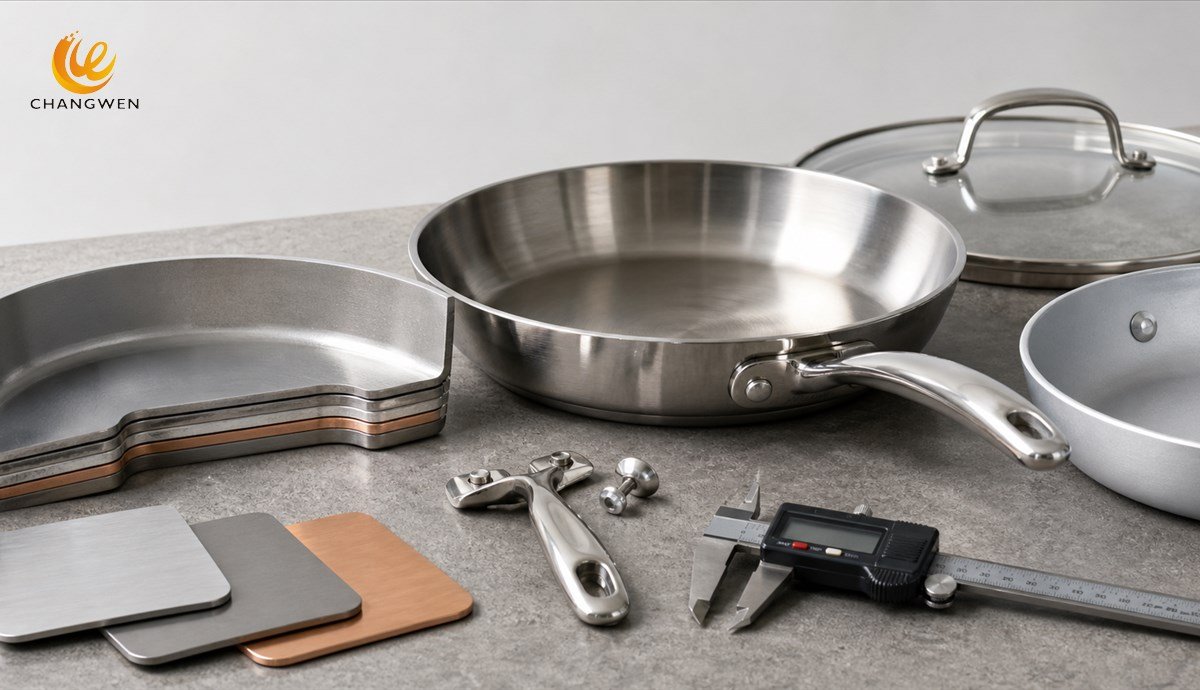
A qualified answer provides a component-level bill of materials. A cookware item can use different metals in the food-contact surface, conductive core, induction layer, body, handle, fastener, lid rim, and base plate. Terms such as “food-grade stainless steel” or “premium aluminum” are too broad to control production.
A warning answer relies only on a generic material name or refuses lot-linked documentation. Buyers should request alloy grade, temper where relevant, nominal thickness or weight, coating system, component specification, material certificate, and an agreed verification method. The 201 versus 304 stainless steel guide illustrates why grade identity changes corrosion performance and cost.
Question 4: What construction will the production cookware use?
A qualified answer defines whether the product is single-layer, capsule-base, impact-bonded, fully clad, cast, stamped, anodized, coated, or otherwise constructed. The answer should include layer materials, finished thickness or weight, bonded area, base diameter, wall profile, rim, handle attachment, and lid design. Construction controls cooking performance and manufacturing risk.
A warning answer uses marketing terms such as “multi-ply” without layer details or offers a lighter production tolerance after sample approval. Buyers should request a cross-section or drawing, measurable tolerances, weight range, and approved production sample. Comparable quotations require identical construction.
Question 5: Which processes are subcontracted, and how are they controlled?
A qualified answer identifies subcontracted coating, bonding, polishing, glass, handles, packaging, testing, or other operations and explains supplier approval, incoming inspection, traceability, and change notification. Outsourcing can provide specialist capability, but responsibility must remain visible.
A warning answer states that subcontracting is irrelevant because the finished factory performs final inspection. Final inspection cannot fully detect every hidden process failure. Buyers should request an approved-supplier process, incoming standards, traceability records, and the right to approve changes affecting critical components or evidence.
Question 6: What is your product-specific quality control plan?
A qualified answer names each critical characteristic, inspection method, frequency, equipment, acceptance limit, record, and reaction plan. Cookware controls can include alloy identity, thickness, base flatness, bonding coverage, coating cure, handle torque, lid fit, rim finish, induction response, appearance, cleanliness, labeling, and packaging.
A warning answer says “we inspect 100 percent” without defining what is inspected or how limits are chosen. Buyers should request the actual control plan, recent anonymized records, gauge calibration evidence, defect classification, and corrective-action examples. Prevention and in-process control are stronger than sorting defects at final inspection.
Question 7: How do you trace materials and production batches?
A qualified system connects material lots, components, production date, line or work order, inspection results, packing records, and shipment. Traceability allows the manufacturer to limit the scope of a problem and investigate its source. The required detail should match product and regulatory risk.
A warning answer can identify only the shipment or carton date. Buyers should request a sample trace from finished item back to material documentation and forward to affected cartons. Traceability that exists only on paper but cannot be demonstrated is not operational control.
Question 8: Which compliance requirements can you support?
A qualified answer begins with the destination market, exact product, materials, coating, claims, and sales channel. The manufacturer should provide relevant reports, declarations, material data, labeling inputs, and change-control commitments. Applicable requirements should be confirmed with a qualified laboratory or local adviser because they vary by market and product.
A warning answer sends a certificate without matching the tested sample to the offered product. Buyers should verify the report holder, factory, model, materials, test method, laboratory, date, geographic scope, and sample description. A real document can still be irrelevant.
Question 9: Will the production sample be identical to the tested sample?
A qualified answer explains how the tested sample, approved sample, bill of materials, drawings, process, and production work order share controlled revisions. The manufacturer should notify the buyer before changing alloy, thickness, coating, lubricant, bonding, handle, fastener, subcontractor, packaging, or production site.
A warning answer treats small substitutions as normal factory discretion. A visually similar change can affect food contact, corrosion, heating, durability, labeling, or test validity. Buyers should include written change approval in the purchase agreement.
Question 10: How should we test and approve samples?
A qualified manufacturer proposes production-relevant sample checks and accepts a written approval standard. Sample validation can cover dimensions, capacity, weight, flatness, lid fit, handle alignment, finish, induction recognition, heating, pouring, cleaning, durability, packaging, and applicable compliance tests.
A warning answer urges volume ordering after one visually attractive prototype. Buyers should test several units when variation matters and confirm whether hand finishing or temporary tooling was used. A signed golden sample is useful only when the specification defines what production must reproduce.

Question 11: What is the MOQ, and what drives it?
A qualified answer separates minimums by SKU, material, size, finish, color, component, printed packaging, production batch, and total order. The manufacturer should explain whether each minimum comes from setup time, raw-material purchasing, outsourced components, packaging print runs, or normal line economics.
A warning answer offers a low headline MOQ that later expands through hidden component requirements. Buyers should ask which minimums can be reduced through shared handles, common lids, neutral cartons, digital labels, standard finishes, or phased production. Lower MOQ usually increases unit cost, so the tradeoff should be explicit.
Question 12: How is the quoted price constructed?
A qualified quotation states the exact specification, quantity, currency, trade term, delivery point, packaging, accessories, testing responsibility, tooling, samples, validity period, and excluded costs. The buyer should be able to compare offers on the same basis.
A warning answer provides one unit price while leaving material weight, construction, packaging, or terms undefined. Buyers should calculate total landed cost, including tooling, testing, inspection, freight, duty, financing, inventory, expected defects, and claim handling. The lowest factory price is not always the lowest commercial cost.
Question 13: Who owns the tooling, drawings, and artwork?
A qualified answer defines who pays for tooling, who owns it, where it is stored, who maintains it, whether it is exclusive, and what happens at the end of the relationship. The agreement should also address drawings, packaging artwork, molds, samples, and confidential information.
A warning answer describes tooling as exclusive while refusing to document ownership or identification. Buyers should request tool numbers, acceptance criteria, maintenance responsibility, expected life, storage conditions, and retrieval or destruction terms. Ownership without practical access can be difficult to enforce.
Question 14: What is the realistic lead time from approval to shipment?
A qualified answer divides lead time into material procurement, tooling, sample approval, production, testing, inspection, packing, and shipment readiness. Each stage should state assumptions and dependencies. Peak season, new tooling, custom components, and failed tests can change the critical path.
A warning answer gives a short total without a schedule or capacity check. Buyers should request milestone dates, frozen-order windows, status reporting, and an escalation path. A supported 60-day plan is safer than an unsupported 35-day promise.
Question 15: What is your real capacity for this specific product?
A qualified answer identifies the bottleneck process and explains output by construction, shifts, utilization, maintenance, current commitments, and season. Press capacity alone does not prove polishing, bonding, coating, assembly, inspection, or packing capacity.
A warning answer quotes theoretical maximum monthly output without showing the product mix. Buyers should request a capacity model, production schedule, bottleneck explanation, and recent on-time performance. Capacity should be reserved or reconfirmed before a launch-critical order.
Question 16: How will the packaging be designed and validated?
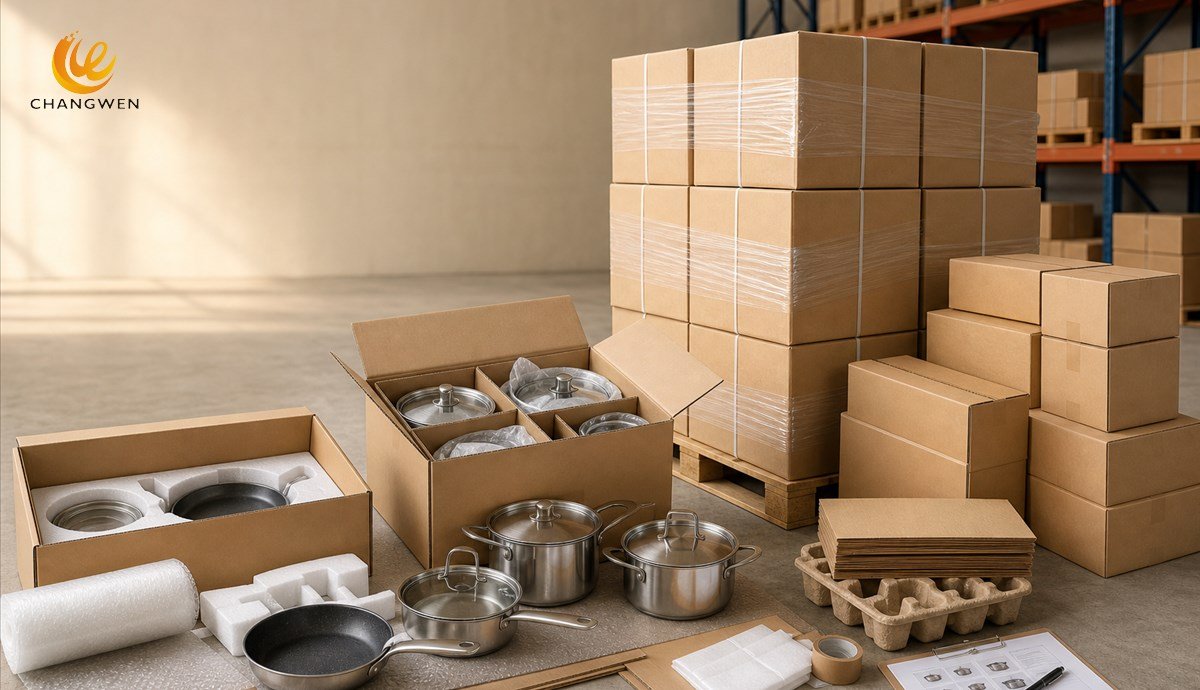
A qualified answer covers scratch protection, lid restraint, handle protection, carton strength, barcode placement, instructions, origin marking, pack dimensions, pallet plan, retail presentation, and channel-specific handling. Mirror finishes, glass lids, and long handles require different protection.
A warning answer approves packaging from an artwork PDF without a physical pack test. Buyers should request a signed packaging sample, artwork revision, barcode verification, drop or transport testing appropriate to the channel, and a master-carton specification. Packaging failures can make conforming cookware unsaleable.
Question 17: What inspection can occur before shipment?
A qualified manufacturer permits agreed inspections at appropriate production stages and provides access to records, random samples, packed goods, and shipment quantities. Inspection timing should allow corrective action before the shipping deadline.
A warning answer limits inspection to selected showroom samples or requires shipment before the report is available. Buyers should define sampling, defect categories, acceptance rules, test methods, reinspection, and release authority in advance. The commercial cookware sourcing mistakes guide explains why late or vague inspection creates avoidable risk.
Question 18: What happens if production fails inspection?
A qualified answer describes containment, sorting or rework, root-cause analysis, corrective action, reinspection, schedule communication, and financial responsibility. The remedy should match defect severity and the purchase agreement.
A warning answer promises that defects will never happen or offers replacement without investigating cause. Every manufacturing system can experience variation. Reliability is demonstrated by transparent containment and effective correction, not by claiming zero possibility of failure.
Question 19: How are warranty claims and repeat defects handled?
A qualified answer defines the claim window, evidence required, response time, investigation method, credit or replacement options, freight responsibility, and corrective-action follow-up. The agreement should distinguish isolated cosmetic claims from systematic functional or safety defects.
A warning answer discusses after-sales service only after a complaint occurs. Buyers should establish the claim process before ordering and track defect rate, claim closure time, corrective-action effectiveness, and repeat occurrence. Commercial accountability should continue after shipment.
Question 20: How will repeat orders stay consistent?
A qualified manufacturer retains controlled specifications, golden samples, tooling records, approved suppliers, process parameters, inspection plans, packaging files, and change history. Repeat-order lead time and component availability should be reviewed before inventory reaches the reorder point.
A warning answer relies on the salesperson’s memory or treats each order as a fresh quotation. Buyers should request document retention, written change notification, reorder minimums, peak-season planning, and continuity options. The retailer supplier scorecard provides a broader framework for monitoring quality and replenishment after approval.
Which documents should exist before the buyer pays a deposit?
Before a deposit, the buyer should have a complete quotation, product specification, bill of materials, drawings where needed, sample status, packaging specification, test plan, compliance responsibility, timeline, payment terms, trade term, tooling agreement, inspection rights, change-control rule, defect remedies, and named contacts. Not every project needs the same document depth, but critical assumptions should never remain only in conversation.
A purchase order should reference the controlled documents rather than repeat vague descriptions. If a conflict exists, the agreement should state which document takes precedence. Buyers placing a first overseas order can review the first-time overseas smallwares ordering guide for the broader sequence from supplier screening through delivery.
How can buyers score manufacturer answers?
Each answer can be scored from zero to three. Zero means no answer or refusal. One means a verbal claim without relevant evidence. Two means a generally acceptable answer with minor open items. Three means a product-specific answer supported by current evidence and a named owner. Critical questions about material, safety, factory identity, and change control should also have pass/fail gates.
| Score | Meaning | Buyer action |
|---|---|---|
| 0 | No credible answer | Stop or escalate before further cost |
| 1 | Claim without evidence | Request documents and set a deadline |
| 2 | Acceptable with manageable gaps | Record conditions before approval |
| 3 | Specific, evidenced, and controlled | Use as the approved basis for ordering |
A high total should not compensate for a critical failure. A manufacturer that cannot verify the offered material or refuses reasonable inspection should not win because it communicates quickly or quotes a low price. Scores support judgment; they do not replace it.
What should the pre-order meeting record contain?
The meeting record should begin with the project name, SKU list, target market, participants, document revisions, and decision deadline. Each question should have four fields: the manufacturer’s answer, supporting evidence, remaining risk, and next action. This format separates facts from promises and prevents an open issue from disappearing inside a long email thread.
The buyer should classify every action by commercial consequence. A missing cosmetic reference may delay artwork approval, while an unverified food-contact material should block the order. Priority labels help both teams focus resources on items that affect safety, legality, product performance, launch timing, or total cost.
The manufacturer should confirm the meeting record in writing. Silence should not be treated as approval when the topic changes price, specification, delivery, or responsibility. Any new answer that modifies the quotation should trigger an updated quotation or specification rather than an informal note.
A useful final review asks five questions: Is the product fully defined? Can the factory reproduce it? Is the evidence relevant to the destination market? Are cost and timing assumptions complete? Does the agreement explain what happens when reality differs from the plan? If one answer remains uncertain, the buyer should resolve it, limit exposure through a pilot order, or accept the risk explicitly.
Frequently asked questions
How many questions should a buyer ask in the first supplier meeting?
The first meeting should cover factory identity, product fit, material, construction, quality, compliance, MOQ, price, samples, and lead time. Detailed packaging, warranty, and continuity questions can follow when the supplier passes initial screening.
Should buyers ask for customer references?
References can support due diligence when provided with permission, but they should not replace audits, samples, tests, and records. Confidentiality may legitimately limit customer disclosure.
Is a perfect sample enough to place a large order?
No. A perfect sample proves that one unit can be made. Production approval also requires process evidence, tolerances, quality controls, traceability, and preferably a pilot batch when variation or order risk is significant.
What is the most important question to ask a cookware manufacturer?
The most important question is: “How will you prove that normal production matches the approved specification?” The answer connects materials, process control, testing, inspection, traceability, and corrective action.
Final ordering rule
Buyers should place a cookware order only when the manufacturer’s answers have been converted into verifiable product, process, commercial, and delivery commitments. Strong suppliers explain limitations, provide relevant evidence, and identify who owns each decision. Weak suppliers rely on broad promises, undefined specifications, and urgency.
A controlled pilot order is the best response when most answers are satisfactory but production consistency remains unproven. The pilot should use intended materials, normal equipment, standard operators, approved packaging, and the same inspection rules planned for volume. A pilot that relies on hand-selected or specially finished units does not measure normal factory performance.
The best pre-order conversation does more than collect information. It creates the operating agreement for samples, production, inspection, shipment, claims, and repeat orders. Asking precise questions before paying a deposit is less expensive than resolving ambiguous expectations after a container is produced.