Estimated reading time: 13 minutes.
A commercial kitchen smallwares list should be built by translating every restaurant menu item into preparation, cooking, holding, plating, and cleaning tasks. Each task creates an equipment requirement, while expected batch volume and simultaneous orders determine the required size and quantity. This method produces a usable purchasing list instead of a generic catalog of pots, pans, knives, and utensils.
The completed list should record five facts for every item: the job it performs, the station that owns it, the required capacity or dimensions, the number needed during peak service, and the specification that purchasing must preserve. A menu-derived list therefore connects culinary intent to an operational bill of materials, commonly called a BOM.
The most reliable planning sequence is menu item, production action, equipment function, capacity, concurrency, par level, and specification. A restaurant that follows this sequence can reduce missing tools, duplicated purchases, incompatible sizes, and emergency buying before opening day.
What is a menu-derived commercial kitchen smallwares list?
A menu-derived commercial kitchen smallwares list is a structured inventory created from the actual work required to produce and serve a restaurant menu. The list includes cookware, food pans, knives, utensils, strainers, mixing tools, measuring tools, storage components, and service items only when a menu task justifies them.
A category checklist asks whether the kitchen owns a saucepan, whisk, ladle, or GN pan. A menu-derived list asks which sauce uses the saucepan, how many liters are produced per batch, whether another dish needs the same vessel at the same time, and where the item goes after cooking. The second method reveals quantity, capacity, and workflow requirements that a category checklist cannot show.
A menu-derived list should complement, not replace, a complete category review. After the task-based list is finished, the purchasing team can use a broader restaurant smallwares buyer guide to check whether general sanitation, storage, measurement, and front-of-house needs were missed.
Why does a generic restaurant equipment checklist create purchasing errors?
A generic checklist creates errors because restaurants with similar seat counts can use smallwares in completely different ways. A noodle restaurant, grill concept, bakery cafe, banquet kitchen, and delivery-only kitchen may serve the same number of guests, but their cutting, mixing, heating, holding, and plating requirements are not interchangeable.
Generic lists often create overbuying when they assign one of every common item without measuring actual use. A kitchen may purchase several stock pots even though only one menu process requires batch boiling, while failing to purchase enough small saucepans for four sauces that must be held separately during service.
Generic lists also create hidden shortages when they ignore timing. One pair of tongs may technically perform several jobs, but it cannot serve raw preparation, hot-line cooking, allergen separation, and plating at the same moment. Peak concurrency, not catalog completeness, determines whether the kitchen can execute the menu without delays or unsafe tool sharing.

How should a restaurant convert its menu into a production matrix?
A restaurant should begin with a production matrix that places one menu item or base preparation on each row. The columns should identify prep actions, cooking method, batch timing, holding method, finishing step, portions per peak period, and responsible station. The matrix turns menu language into observable kitchen work.
Base preparations should be listed separately when several dishes share them. A tomato sauce used in pasta, braised dishes, and pizza should appear as one production component with its own batch volume, storage method, and reheating requirement. Treating the sauce as three unrelated tasks would inflate the apparent equipment need and hide the benefit of coordinated production.
Modifiers should remain separate when they change equipment or sanitation requirements. An allergen-sensitive version, a fried version, and a grilled version of the same ingredient may require separate utensils, containers, or work zones. Menu simplification does not automatically mean operational simplification.
| Production-matrix field | Question it answers | Smallwares consequence |
|---|---|---|
| Menu item or base | What is being produced? | Defines the equipment job |
| Prep action | Is food cut, mixed, strained, portioned, or marinated? | Identifies knives, bowls, strainers, scoops, and containers |
| Cooking method | Is food boiled, fried, sauteed, steamed, baked, or held? | Identifies vessel shape and heat-use requirements |
| Batch volume | How much is prepared at one time? | Determines usable capacity |
| Peak concurrency | Which tasks happen at the same time? | Determines minimum quantity |
| Station owner | Where must the item remain available? | Prevents accidental sharing across stations |
How are menu actions translated into smallwares functions?
Menu actions should be translated into functions before a specific product is selected. The action simmer does not automatically require one predetermined pot; it requires a stable vessel with suitable capacity, controlled heating, safe handling, and a lid strategy if evaporation must be limited. Functional language keeps the specification open long enough to compare practical options.
Every action should include its input, transformation, and output. Mixing a dressing requires a vessel large enough for the ingredients, a tool that creates the intended emulsion, and a container or dispenser for service. Recording only the mixing bowl would omit half of the workflow.
Transfer steps deserve special attention because they create many overlooked smallwares. Food may move from storage container to prep bowl, from prep bowl to pan, from pan to holding pan, and from holding pan to plate. Scoops, tongs, ladles, strainers, and compatible food pans often determine whether those transfers remain fast and controlled.
| Menu action | Required function | Possible smallwares | Key comparison |
|---|---|---|---|
| Portion | Repeat a controlled serving amount | Ladle, scoop, scale, measuring cup | Accuracy versus speed |
| Mix | Combine ingredients without overflow | Mixing bowl, whisk, paddle, spatula | Batch volume and viscosity |
| Boil | Heat liquid with safe working clearance | Stock pot, sauce pot, pasta basket | Usable capacity and burner match |
| Saute | Expose food to a broad heated surface | Frying pan, saute pan, turner, tongs | Cooking surface and handling weight |
| Hold | Protect prepared food until service | GN pan, lid, insert, serving utensil | Turnover speed and equipment compatibility |
| Strain | Separate solids from liquid safely | Colander, chinois, sieve, basket | Mesh, drainage rate, and batch weight |
How should batch size determine cookware capacity?
Cookware capacity should be based on the largest normal batch that the kitchen can produce safely and consistently, not on total daily sales. A restaurant that sells 120 soup portions per day may produce three 40-portion batches rather than one daily batch because freshness, storage, burner availability, lifting weight, and service timing favor smaller production cycles.
A basic volume estimate multiplies portion volume by portions per batch. If 40 portions each require 300 milliliters, the finished output is 12 liters. The selected vessel must provide additional working space for ingredients, stirring, foam, and movement, so nominal vessel capacity should not be treated as usable fill capacity.
Volume alone is insufficient when ingredients expand, foam, or require vigorous mixing. Pasta, grains, stocks, and thick sauces behave differently at the same liter volume. The kitchen should validate the proposed vessel with the real recipe and operating method before the purchasing quantity is finalized.
Teams that need detailed diameter, quart, liter, and handling comparisons can use the existing guide to stock pot sizes for restaurants. The menu matrix should establish the required batch first, while the size guide helps translate that requirement into a workable vessel.
How does peak concurrency determine the number of each item?
Peak concurrency is the maximum number of identical or incompatible tasks that occur at the same time. If three saute dishes can be active simultaneously and each requires a dedicated pan, the working minimum is three pans even if average demand would allow one pan to be washed and reused.
Station ownership increases the quantity when sharing would create delay or contamination risk. Separate prep, hot-line, pastry, and plating stations may each need tongs, bowls, or measuring tools. A single tool located in the building is not operationally available when staff must leave a station to find it.
Wash-cycle duration also affects quantity. A utensil that completes a two-minute task may remain unavailable much longer while it waits for collection, washing, sanitation, drying, and return. The quantity calculation should cover the full unavailable period, not only the time in direct use.
How should a restaurant calculate smallwares par levels?
A smallwares par level is the quantity required to operate through a defined service period without preventable shortages. A practical starting formula is peak simultaneous use plus wash-cycle coverage plus an approved contingency allowance. The contingency should reflect breakage, loss, delayed washing, and demand variability instead of using the same arbitrary percentage for every item.
High-criticality items need stronger coverage than easily substituted items. A missing ladle with a defined portion size can disrupt cost control and plating consistency, while one missing mixing bowl may be replaced temporarily by another compatible size. Criticality should influence the buffer even when purchase prices are similar.
Par levels should distinguish station par, clean backup, and central reserve. If a restaurant needs two tongs on the grill, one clean replacement during service, and one reserve for breakage, the purchasing quantity is four. Writing only a total of four hides where each unit belongs and makes inventory audits harder.

How should the list be organized by commercial kitchen station?
The smallwares list should be organized by station after the menu actions are mapped. Station organization establishes ownership, storage location, cleaning route, and accountability. It also exposes tools that have been assigned to several places at once without enough quantity to support the plan.
The receiving and storage area may need scales, scoops, labeled containers, and transport tools. The preparation area may need knives, cutting tools, bowls, colanders, strainers, and measurement tools. The hot line may need pots, pans, lids, turners, ladles, baskets, and heat-safe handling tools. The pass may need portion tools, plating utensils, and short-term holding components.
The menu should decide which stations exist. A restaurant without baking production does not need a bakery checklist, while a concept with extensive cold assembly may require more containers, lids, and portion tools than its hot line. The station structure must follow the operating model rather than a universal floor plan.
Work surfaces should also be checked against the assigned tools. A station with the correct utensils can still fail if it lacks safe landing, assembly, and temporary storage space. The restaurant prep-table guide provides additional criteria for surface dimensions, storage configuration, mobility, and construction.
How should GN pans be selected from the menu workflow?
GN pans should be selected according to where food moves through preparation, storage, cooking, holding, transport, and display. The menu determines the food volume and turnover rate, while the installed equipment determines which GN footprints and depths are compatible.
A deep pan may reduce refill frequency but can slow turnover or make portions harder to access. Several smaller pans can support separation and faster replacement but require more handling, lids, and storage positions. The correct choice balances batch size, holding time, station space, and replenishment labor.
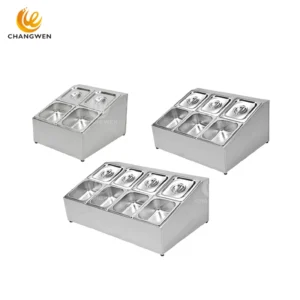
Material should follow the operating stage. Stainless steel and polycarbonate pans can serve different temperature, visibility, handling, and storage requirements. Buyers should confirm actual equipment compatibility and intended use rather than assuming every pan with the same nominal format is interchangeable.
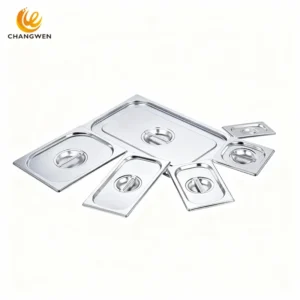
The existing explanation of GN pan standards and sizes can be used after the menu matrix identifies each holding and storage job. Changwen also supplies stainless steel GN pans for restaurant, hotel, catering, wholesale, and OEM programs.
What specifications should appear beside every smallwares item?
Every line item should contain enough information for two suppliers or internal buyers to quote the same functional requirement. A product name without size, material, construction, handle, finish, compatibility, and quantity leaves important decisions to interpretation.
Specifications should separate mandatory requirements from preferences. A required diameter may be dictated by a burner or lid, while a preferred finish may be negotiable. This distinction protects function while giving procurement room to manage availability and cost.
| BOM field | Example of the required decision | Why it matters |
|---|---|---|
| Item and function | Sauce pot for 12-liter finished batch | Connects the product to the menu task |
| Dimensions or usable capacity | Diameter, depth, and tested working volume | Prevents nominal-size assumptions |
| Material and construction | Food-contact material, body, base, and joints | Supports durability and compatibility review |
| Interface requirements | Burner, lid, rack, GN opening, or storage fit | Prevents isolated products from failing as a system |
| Station and par | Two in use, one clean backup, one reserve | Explains the purchasing quantity |
| Acceptance check | Dimensions, fit, finish, stability, and sample test | Defines how receiving confirms compliance |
How can a restaurant avoid duplicate and low-use purchases?
A restaurant can avoid duplicates by assigning every proposed item to at least one menu task and recording how often that task occurs. An item with no task should be removed or placed on a separate optional list. An item used rarely should be compared with an existing tool that can perform the job without harming output or safety.
Shared components can reduce unnecessary variety when compatibility is proven. Lids, GN pans, inserts, and storage components may work across several applications, but assumed compatibility can create fit and workflow failures. Standardization should be tested physically before it is used to reduce SKU count.
Specialty tools should be justified by measurable improvement. A tool may deserve a place when it reduces labor, improves portion repeatability, protects product quality, or enables a signature menu item. Novelty alone is not a commercial requirement.
How should multi-location restaurants standardize the list?
A multi-location restaurant should divide the list into core, conditional, and local items. Core items support menu processes shared by every location. Conditional items depend on equipment package, sales volume, or service format. Local items reflect approved regional dishes, regulations, or building constraints.
Each standard item should have a controlled specification and an approved alternative process. The alternative should define which dimensions, materials, interfaces, and performance characteristics cannot change. A substitute that looks similar but fails to nest, fit a rack, or match a portion tool is not operationally equivalent.
Par levels should remain adjustable within controlled ranges because a flagship restaurant and a lower-volume location may not need identical quantities. The specification can be fixed while quantity follows measured demand, wash capacity, and delivery frequency.
How should the final list be validated before purchasing?
The final list should be validated through a tabletop workflow review followed by a physical service simulation when possible. The tabletop review traces every menu item through receiving, prep, cooking, holding, plating, clearing, washing, and return. The physical simulation tests reach, fit, handling, batch size, transfer steps, and simultaneous use.
Validation should include the people who perform and support the work. Culinary staff can identify missing production tools, stewarding staff can identify cleaning and storage conflicts, purchasing can identify ambiguous specifications, and operations can confirm peak assumptions.
A pilot should record every borrowed tool, unplanned wash, delayed transfer, capacity shortage, and unused item. Those observations convert the initial list from a reasonable forecast into an operating standard. The list should be revised before a large order or multi-site rollout.
The validation record should explain why every final quantity changed. A higher par may be justified by simultaneous use, a long wash cycle, or a critical menu dependency, while a lower par may be justified by proven compatibility or low task frequency. Recording the reason makes future reviews faster because the next manager can distinguish a deliberate operating decision from an accidental number in a spreadsheet.

How can Changwen support a menu-derived smallwares program?
Changwen supplies commercial kitchen smallwares for restaurants, hotels, catering businesses, distributors, and foodservice projects. The available range includes commercial pots and pans, GN pans, kitchen utensils, knives, spatulas, buffetware, and related professional kitchen products. Buyers can review the broader Changwen kitchen smallwares range after the menu-derived BOM defines the required functions.
Changwen provides wholesale supply, private-label development, OEM, and ODM services. Customization can address product dimensions, materials, construction details, handles, finishes, logos, labels, packaging, assortment structure, and other project requirements that are confirmed during technical review.
A buyer should prepare the restaurant concept, menu, portions per peak period, batch sizes, station plan, target par levels, required standards, destination market, branding needs, estimated quantity, and delivery schedule before requesting a quote. A complete brief allows Changwen to compare the requested BOM with available products and identify components that require customization.
After the BOM is validated, buyers planning factory-direct procurement can review the guide to sourcing kitchen smallwares from China. To discuss a wholesale, private-label, OEM, or ODM commercial kitchenware project, contact Changwen for a project quotation.
Frequently asked questions
What should be included in a commercial kitchen smallwares list?
A commercial kitchen smallwares list should include every movable tool required for preparation, cooking, holding, storage, transfer, portioning, plating, and service. Each line should state function, station, size or capacity, material, quantity, and acceptance criteria.
Should a restaurant build the list from a generic checklist?
A generic checklist is useful as a final gap check, but it should not be the primary planning method. The restaurant menu, batch plan, station structure, peak concurrency, and wash cycle provide stronger evidence for product selection and quantity.
How is a smallwares par level calculated?
A practical par level combines peak simultaneous use, coverage while items are unavailable for washing, and a justified contingency for breakage, loss, or demand variation. Critical tools usually need stronger backup coverage than easily substituted items.
Who should approve the final smallwares BOM?
The final BOM should be reviewed by culinary, operations, stewarding or sanitation, purchasing, and the project team. Each group tests a different risk: menu execution, workflow, cleaning, specification clarity, cost, and installation readiness.
When should the smallwares list be updated?
The list should be updated when the menu, portion size, batch method, kitchen equipment, station layout, sales volume, cleaning process, or service format changes. Breakage and usage records should also inform scheduled par-level reviews.