Read time: 14 minutes
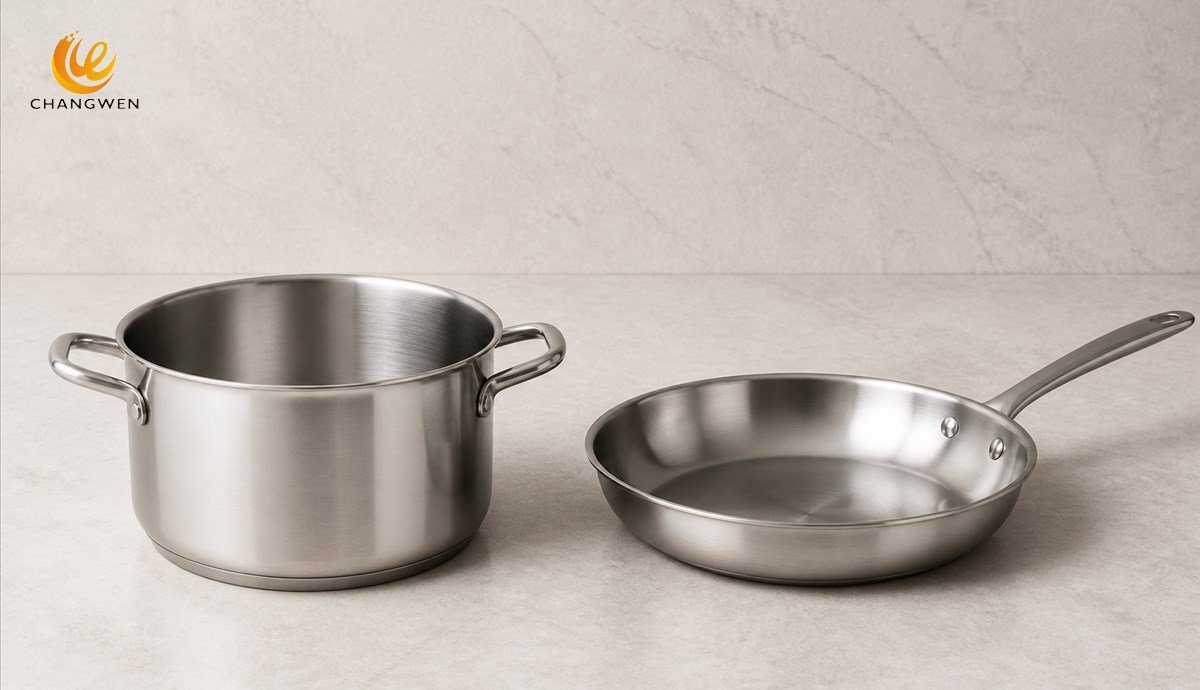
The main difference between a pot and a pan is geometry: a pot is usually deep with high sides and two short handles, while a pan is usually shallow with a wide cooking surface and one long handle. A pot contains liquid, limits evaporation, and supports boiling, simmering, and large-volume cooking. A pan exposes more food to direct heat, accelerates evaporation, and supports searing, frying, sauteing, and rapid temperature control.
A pot and a pan can sometimes perform the same task, but each shape makes a different heat-and-moisture environment. Soup can simmer in a deep frying pan, and vegetables can saute in a wide pot, yet both substitutions reduce control. Choosing between a pot and a pan should therefore start with the desired cooking process rather than the recipe name alone.
What Is a Pot?
A pot is a deep cooking vessel with relatively tall sides, a flat or slightly rounded base, and enough volume to hold liquid safely. Most pots have two loop handles because the total weight of water, food, and the vessel can be too heavy for one-handed control. A lid is common because many pot-based methods need controlled evaporation or sustained simmering.
A pot is designed to provide volume more than open surface area. High walls increase capacity without requiring an impractically wide burner, and the smaller opening slows moisture loss compared with a shallow vessel of the same volume. This shape makes a pot suitable for soup, stock, pasta, grains, beans, blanching, steaming, and long-cooked dishes.
Common pot types include stockpots, soup pots, saucepots, Dutch-oven-style vessels, pasta pots, and steamers. A saucepan is a partial exception because it is pot-shaped but normally has one long handle. The site’s stockpot and soup pot comparison explains how different pot proportions change evaporation, capacity, and market use.
What Is a Pan?
A pan is generally a wide, shallow cooking vessel that places a large food surface close to the heat source. Most frying pans have one long handle because the cook needs leverage for tilting, tossing, turning, and transferring food. Low or moderately sloped walls make a spatula easier to insert and allow steam to escape quickly.
A pan is designed to provide contact area more than liquid capacity. The broad base holds food in one layer, which supports browning because released moisture can evaporate instead of accumulating around the ingredients. This shape makes a pan suitable for eggs, steaks, fish fillets, cutlets, pancakes, stir-fried vegetables, pan sauces, and shallow frying.
Common pan types include frying pans, skillets, saute pans, grill pans, crepe pans, and roasting pans. A saute pan has higher vertical sides and two handles on larger models, so it can look more pot-like while retaining a broad base. A complete commercial frying pan guide provides more detail on pan materials, diameters, surfaces, and use cases.
Pot vs Pan: What Are the Key Differences?
| Comparison point | Pot | Pan | Practical consequence |
|---|---|---|---|
| Body shape | Deep with high sides | Wide and shallow | Pots contain volume; pans expose surface |
| Typical handles | Two short loop handles | One long handle, sometimes plus helper handle | Pots favor two-handed lifting; pans favor one-handed control |
| Evaporation | Slower | Faster | Pots retain liquid; pans concentrate and brown |
| Primary heat method | Moist heat | Dry or combination heat | Pots boil and simmer; pans sear and fry |
| Common lid use | Frequent | Optional | Pot lids conserve heat and moisture |
| Capacity measurement | Quarts or liters | Diameter in inches or centimeters | Pot buyers compare volume; pan buyers compare surface area |
| Food access | Restricted by high walls | Easy spatula access | Pans simplify flipping and rapid stirring |
The table describes typical designs rather than an absolute naming law. Regional terminology, manufacturer conventions, and specialized cookware can blur the boundary. A vessel’s shape, base area, depth, handle arrangement, and lid behavior provide a more accurate functional description than the word printed on its carton.
How Does Shape Change Cooking Performance?
Shape changes cooking performance by controlling the ratio between the heated base, the exposed opening, and the food volume. A shallow pan has a high surface-area-to-volume ratio, so moisture reaches the air quickly and the food surface can rise above the boiling point of water. A deep pot has a lower ratio, so it retains moisture and keeps more of the food surrounded by liquid or steam.
A pan’s sloped sides encourage evaporation and make tossing easier, but they reduce usable flat area compared with the top diameter. A pot’s vertical sides preserve more internal capacity above the base, but they can make a spatula difficult to angle under delicate food. The correct geometry depends on whether the cook needs containment or access.
Wall height also changes splatter management. A pot contains bubbling liquid and oil droplets more effectively, while a pan gives the cook better visibility and tool access. A saute pan offers a middle position because its broad base supports browning and its straighter, higher sides contain sauces better than a conventional frying pan.
Why Are Pots Better for Boiling and Simmering?
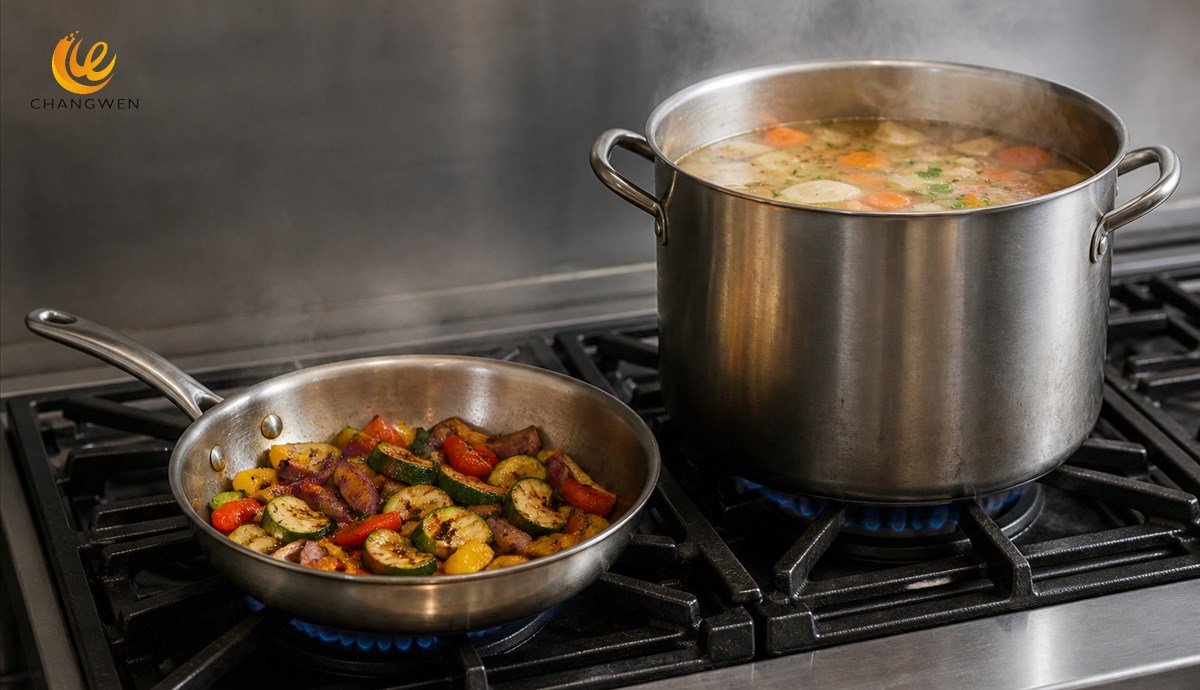
Pots are better for boiling because tall walls hold a large water volume above a burner-sized base. The high capacity leaves headroom for bubbling, pasta movement, and displaced water when ingredients enter. Two loop handles also distribute the load when hot liquid must be moved or drained.
Pots are better for simmering because a relatively narrow opening slows evaporation and a fitted lid can reduce it further. A stable liquid level helps soups, stocks, beans, and grains cook evenly over time. The deeper vessel also allows convection currents to move hot liquid upward and cooler liquid downward through the food.
A stockpot emphasizes height and total volume, while a soup pot may be wider and lower for easier stirring and reduction. The commercial stock pot guide explains how capacity, diameter, materials, and specialized features influence large-volume cooking.
Why Are Pans Better for Frying and Searing?
Pans are better for frying and searing because a broad base gives more food direct contact with hot metal. Direct contact transfers heat rapidly and supports the surface reactions that create browning. A pan that holds ingredients in one uncrowded layer also lets steam escape before it softens the crust.
Pans respond well to fast control because the cook can tilt the vessel, move fat, turn food, and remove portions with one hand. Low sides allow a spatula to approach at a shallow angle, which reduces damage to fish, eggs, pancakes, and cutlets. A pot can brown food, but high walls restrict access and trap more moisture.
A pan should not be overloaded because crowded food releases more moisture than the open surface can remove. Browning then shifts toward steaming even when the burner is powerful. Selecting the correct diameter and cooking in batches usually improves results more than simply increasing heat.
How Do Handles Differ Between Pots and Pans?
Pots usually use two short handles because a liquid-filled vessel is safest when lifted with both hands. The symmetrical grip keeps the load close to the body and reduces the twisting force on one wrist. Short handles also reduce the overall footprint of a high-capacity vessel on a crowded range or storage shelf.
Pans usually use one long handle because leverage helps with tossing, tilting, pouring, and quick repositioning. The long handle keeps the hand farther from the burner, but its balance becomes important as pan diameter and loaded weight increase. Large pans often add a short helper handle so the cook can use two hands when transferring food.
Handle material, attachment, clearance, and heat behavior matter more than handle count alone. Welded and riveted attachments can both perform well when engineered correctly, while a loose connection creates risk in either format. Commercial buyers should evaluate loaded lifting, not only the comfort of an empty sample.
Do Pots Always Have Lids and Pans Never Have Lids?
Pots commonly include lids because boiling, steaming, braising, and simmering often benefit from controlled heat and moisture. A lid reduces evaporation, shortens the time required to reach a boil, and limits splatter. The lid must still allow safe monitoring because vigorous boiling can create foam or pressure beneath a tight fit.
Pans can also use lids when a recipe combines browning with gentle finishing. Covering a frying pan helps melt cheese, steam the top of an egg, finish thick protein, or braise ingredients in shallow liquid. The same lid can reduce crust quality if trapped steam returns to a surface that should remain crisp.
Lid use therefore follows the cooking goal rather than the cookware label. Cover the vessel when heat and moisture retention improve the food, and uncover it when evaporation and browning are more important. A transparent lid improves visibility, while a metal lid may tolerate higher impact and oven conditions depending on its handle.
How Are Pots and Pans Sized Differently?
Pots are usually sold by volume because their main purpose is containing food and liquid. Quarts and liters indicate how much the vessel can hold, although safe working capacity is lower than brim capacity. Diameter and height still matter because two pots with equal volume can produce different evaporation rates and fit different burners.
Pans are usually sold by top diameter because cooking surface is the primary concern. An 8-inch pan supports a small portion, a 10-inch pan covers many one- or two-person meals, and a 12-inch pan provides family capacity. The flat base is smaller than the top diameter when sides slope outward, so buyers should compare the bottom contact dimension as well.
Pot size should match batch volume without approaching the rim, while pan size should match the food footprint without crowding. A large empty pot wastes heating time, and an oversized pan can scorch exposed oil or sauce. A small pot risks boil-over, while a small pan traps steam between crowded ingredients.
Can You Use a Pot Instead of a Pan?
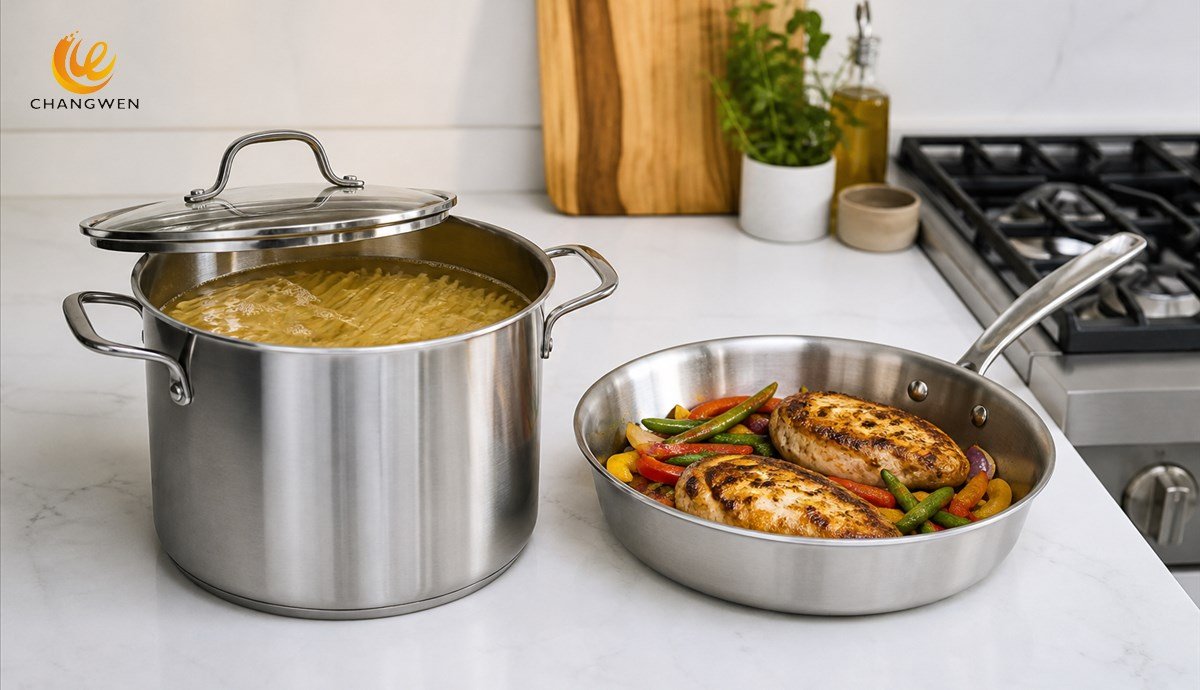
A pot can replace a pan for sauteing a small quantity, browning meat before a stew, shallow frying with careful oil control, or reducing a sauce. A heavy, broad pot performs these tasks better than a tall narrow stockpot because it provides more base area and more even access. The substitution remains slower and less convenient when food must be flipped repeatedly.
A pot is a poor pan substitute for pancakes, crepes, fried eggs, or delicate fish because tall sides block the shallow tool angle needed for clean release. Moisture also escapes less efficiently, so crisp surfaces are harder to maintain. A wide saucepot can work in an emergency, but a frying pan provides more predictable results.
Using one vessel for multiple tasks can reduce equipment count in a small kitchen, but versatility has limits. The article on why professional chefs use stainless steel pots and pans explains why commercial kitchens keep several forms even when the material is the same.
Can You Use a Pan Instead of a Pot?
A deep pan can replace a pot for a small batch of soup, rice, pasta sauce, or braised food when it has enough volume and a compatible lid. A straight-sided saute pan is especially adaptable because its broad base supports initial browning and its walls contain liquid during simmering. The cook must leave sufficient headroom to prevent spills.
A shallow frying pan is a poor pot substitute for boiling pasta, making stock, steaming large portions, or cooking foods that expand in liquid. The low rim limits capacity and increases spill risk, while the wide opening accelerates evaporation. Adding water repeatedly can disturb temperature and change seasoning concentration.
A saucepan provides the most direct bridge between categories because it combines pot-like depth with a pan-like long handle. The stainless steel saucepan buying guide explains sizes, pouring features, construction, and commercial applications for this hybrid form.
What Foods Should Be Cooked in a Pot?
A pot is the better tool for pasta because the food needs enough water to move as it hydrates and releases starch. High sides contain the active boil, and two handles support safer transfer to a sink or strainer. A pasta insert can simplify draining when it fits the vessel securely.
A pot is the better tool for soup, stock, beans, and stew because these foods require sustained liquid contact and controlled evaporation. The depth accommodates bones, vegetables, or expanding legumes, while a lid adjusts the rate of moisture loss. Broad soup pots reduce faster, whereas tall stockpots conserve more liquid over long cooking periods.
A pot is also suitable for grains, blanching, steaming, sauces in larger volume, and deep frying when the vessel is stable and deep enough to provide safe oil headroom. Deep frying requires temperature control and significant space above the oil because moisture makes the oil foam. A pan’s low walls rarely provide the same containment.
What Foods Should Be Cooked in a Pan?
A pan is the better tool for steaks, burgers, cutlets, and fish because each portion needs direct metal contact and surrounding space. Preheating the pan and controlling surface moisture support browning. Turning access is easier when walls are low and the handle allows quick repositioning.
A pan is the better tool for eggs, pancakes, crepes, and toasted sandwiches because these foods cook as thin layers and must be lifted or flipped cleanly. The shallow wall keeps the tool close to the cooking plane. A smaller pan also limits unnecessary empty surface when only one portion is prepared.
A pan is the better tool for sauteed vegetables and pan sauces because rapid evaporation concentrates flavor. After food browns, liquid can deglaze the surface and dissolve cooked deposits into a sauce. The pan can then reduce that liquid quickly because its opening is wide.
Does Material Matter More Than Pot or Pan Shape?
Material and shape answer different questions, so neither automatically matters more. Shape determines how moisture, access, and capacity behave, while material and construction determine heat distribution, responsiveness, durability, and food reactivity. A well-shaped vessel with poor heat distribution can cook unevenly, and excellent material in the wrong shape can still frustrate the intended technique.
Stainless steel provides a durable, non-reactive cooking surface, but stainless steel alone conducts heat less efficiently than aluminum or copper. Multi-layer bodies and bonded bases use a conductive core to spread heat while retaining a stainless food-contact surface. Construction coverage matters because a pan needs edge-to-edge distribution and a large pot needs a stable base under heavy volume.
Commercial cookware decisions should compare steel grade, body thickness, base design, handle attachment, rim strength, lid fit, and cooktop compatibility. The commercial stainless steel cookware selection guide provides a broader specification framework for buyers.
What Is the Difference Between a Saucepan, Saute Pan, and Stockpot?
A saucepan is a deep, relatively small vessel with one long handle, so its body behaves like a pot while its handle behaves like a pan. A saucepan is suitable for sauces, grains, reheating, and small liquid batches. Its narrow opening limits evaporation compared with a saute pan.
A saute pan has a broad base, straight medium-height sides, one long handle, and often a helper handle. A saute pan holds more liquid than a frying pan and provides more browning area than a saucepan. This balanced geometry supports searing, shallow braising, pan sauces, and one-vessel meals.
A stockpot is much deeper and normally has two loop handles. A stockpot prioritizes volume and liquid retention over direct access to the base. The three vessels overlap, but the saucepan favors small liquid tasks, the saute pan favors combined browning and simmering, and the stockpot favors large liquid batches.
How Should Home Cooks Choose Between a Pot and a Pan?
Home cooks should choose a pot when the food will be surrounded by liquid, needs room to expand, or must simmer with limited evaporation. Home cooks should choose a pan when ingredients need direct contact, rapid moisture loss, or frequent turning. This process-based rule remains useful even when a recipe uses inconsistent cookware terminology.
A basic small kitchen usually needs at least one medium saucepan or pot and one 10- or 12-inch frying pan. The pot covers grains, pasta, soup, and sauce, while the pan covers eggs, vegetables, and proteins. A larger stockpot and saute pan can be added when batch size and menu justify them.
Storage, burner diameter, oven clearance, loaded weight, and cleaning space should be checked before buying large vessels. A pot that exceeds the burner’s useful zone heats slowly, while a pan that blocks adjacent burners reduces range capacity. Practical fit is part of cooking performance, not a separate convenience issue.
How Should Commercial Buyers Build a Pot-and-Pan Assortment?
Commercial buyers should define each product by cooking task, capacity, and user rather than treating pots and pans as interchangeable metal containers. A restaurant assortment may need stockpots for volume, saucepots for reductions, saucepans for station work, saute pans for combined techniques, and frying pans for high-contact cooking. Clear task separation improves purchasing and staff training.
Retail assortments should show the functional progression in product names and specifications. Pots should list working capacity, diameter, height, lid, and handle load, while pans should list top diameter, flat-base diameter, depth, handle length, and helper-handle availability. Consistent measurements reduce returns caused by buyers expecting a different usable size.
Wholesale purchasers should verify food-contact material, bonding quality, base flatness, rim finish, handle attachment, lid fit, and induction compatibility where required. The vessel category determines which test receives priority: pots need loaded-lift and boil performance, while pans need flatness, heat spread, balance, and tool access.
Frequently Asked Questions
Is a saucepan a pot or a pan?
A saucepan is functionally closer to a pot because it is deep and designed for liquid, even though it has one long pan-style handle. The hybrid design gives one-handed pouring control while preserving the capacity and slower evaporation needed for sauces, grains, and small boiling tasks.
Is a skillet the same as a pan?
A skillet is a type of pan with a broad base and relatively low sides. The words skillet and frying pan are often used interchangeably, although some markets associate skillets with slightly deeper sides or heavier construction. Actual dimensions provide a more dependable comparison than the name.
Can you fry food in a pot?
A pot can fry food when its base heats evenly and the oil level remains safely below the rim. Deep pots offer useful containment for deep frying, while shallow frying is usually easier in a pan because food access and turning are better. Temperature control and headroom remain essential in either vessel.
Can you boil water in a frying pan?
A frying pan can boil a small amount of water, but its wide opening increases evaporation and its shallow walls limit capacity. A pot reaches the same goal with less spill risk and usually better heat retention, especially when a lid is used.
Why do pots have two handles?
Pots have two short handles because liquid and food create a heavy, shifting load. Two-handed lifting distributes the weight, reduces wrist torque, and improves stability. Large pans may add a helper handle for the same reason.
Final Answer: Choose Depth for Liquid and Surface for Browning
A pot is deep, high-sided, commonly covered, and usually lifted with two short handles; it is designed to contain liquid and support boiling or simmering. A pan is wide, shallow, commonly open, and usually controlled with one long handle; it is designed to expose food to hot metal and support frying, searing, sauteing, and reduction.
The most reliable choice follows a simple rule: choose a pot when capacity and moisture retention matter, and choose a pan when contact area and evaporation matter. Material, construction, size, burner fit, and handle quality then refine the decision. This sequence produces better results than choosing cookware from its name alone.