Read time: 14 min
Professional kitchens are not ordinary cooking environments. A restaurant range delivers 25,000–35,000 BTU per burner — two to four times the output of a typical home stove. Cookware is used dozens of times per day, washed in industrial dishwashers at 82°C (180°F), handled by multiple people under pressure, and expected to deliver consistent results through every service.
In this environment, cookware materials that work well at home often fail. Non-stick coatings degrade within weeks. Cast iron becomes impractical at scale. Reactive metals affect flavor and fail NSF compliance requirements.
Stainless steel pots and pans have been the professional kitchen standard for decades — not because they are easy to use, but because they are engineered for the specific demands of professional cooking. They survive the heat, tolerate aggressive cleaning, support the techniques that build flavor, and deliver the same performance on order 200 as on order 1.
This article explains the complete case for why professional chefs choose stainless steel cookware — from high-heat searing science to multi-ply construction engineering to commercial kitchen economics — and what it means for cookware manufacturers, retailers, and wholesale buyers building programs for the professional and serious home cook market.

What Makes Cookware Suitable for Professional Chefs?
Professional Kitchens Demand Consistent Results
A restaurant chef does not cook a dish once. They cook the same dish 80 times across a Friday dinner service and must produce the same result on the 80th as on the first. Cookware that performs inconsistently — with hot spots that produce uneven browning, bases that warp over time, or surfaces that change cooking behavior as they age — creates variability that translates directly into product inconsistency and guest dissatisfaction.
Professional cookware must provide predictable heating behavior that kitchen staff can learn, memorize, and replicate. The same preheating time, the same response to turning the burner down, the same fond development on the same protein. This repeatability is what makes stainless steel cookware valuable in the professional context — its behavior does not change over service cycles the way a degrading non-stick coating does.
Professional Cookware Must Handle Intensive Daily Use
Commercial kitchen conditions test cookware at extremes that most product tests never simulate:
- Repeated heating from cold to 300°C+ and back within minutes
- Daily washing in commercial dishwashers with alkaline detergents at 82°C
- Regular contact with metal utensils, tongs, and spatulas
- High-volume cooking where a sauté pan may be used 50 times per service
- Rapid movement between cooking stations, prep surfaces, and ovens
- Stacking, hanging, and storage in tight kitchen spaces
Cookware that does not survive these conditions generates ongoing replacement cost, inconsistency during the replacement period, and staff frustration that reduces kitchen efficiency. The durability of properly specified stainless steel cookware — service life measured in years rather than months — is a direct operational benefit.
Chefs Need Cookware That Supports Multiple Techniques
A single stainless steel sauté pan in a professional kitchen may be used for searing proteins, sautéing vegetables, building a pan sauce through deglazing and reduction, finishing with butter, and then transferred to the oven to complete cooking. No single technique defines its use — the pan must perform across all of them reliably.
This versatility is a defining requirement of professional cookware. The ability of stainless steel pots and pans to move from stovetop to high-temperature oven, support both dry-heat and liquid-based cooking methods, and transition seamlessly between techniques within a single preparation is a fundamental reason for their professional kitchen dominance.
Why Is Stainless Steel Well Suited to Professional Cooking?
Stainless Steel Provides a Durable Cooking Surface That Lasts Under Commercial Conditions
304 stainless steel (18% chromium, 8–10% nickel) forms a passive chromium oxide layer on its surface that continuously self-repairs when scratched or abraded. This passive layer is the mechanism behind stainless steel’s corrosion resistance — and it is not a coating that wears off, but a property of the material itself that regenerates as long as sufficient chromium is present.
In commercial kitchen terms, this means a stainless steel cooking surface does not lose functionality as it ages. Scratches from metal utensils are cosmetic. The cooking surface remains non-reactive and food-safe through years of daily use. A stainless steel sauté pan does not have a “replacement date” built into its material the way a nonstick coating does.
Stainless Steel Does Not Depend on a Surface Coating
The absence of a surface coating is one of the most practically important characteristics of stainless steel cookware in commercial kitchen environments. A non-stick coating, regardless of how advanced, is vulnerable to degradation through:
- High temperatures that exceed safe operating ranges (above 260°C for PTFE)
- Mechanical abrasion from metal utensils
- Aggressive alkaline dishwasher detergents
- Thermal shock during rapid temperature changes
- The cumulative effect of hundreds of daily cooking cycles
When a non-stick coating fails, the pan fails — it must be replaced or the diminished surface performance accepted. A stainless steel pan has no coating to fail. The cooking surface is the material, not a layer applied to it.
Stainless Steel Resists Corrosion in Busy Kitchen Environments
Professional kitchens combine the corrosion-promoting factors that affect stainless steel most aggressively: salt from seasoning, steam from cooking liquids, water from washing, acidic ingredients from fruit and wine-based preparations, and commercial cleaning products. The chromium content in 304 stainless steel provides excellent resistance to all of these factors under daily commercial kitchen conditions.
This corrosion resistance is what justifies the use of stainless steel in NSF/ANSI 2 food equipment certifications — the standard that commercial food service equipment must meet in most US jurisdictions. The material’s stability under food contact and cleaning conditions makes it the regulatory standard for commercial kitchen surfaces.
Stainless Steel Maintains a Professional Appearance Across Its Service Life
Visual presentation matters in professional cooking contexts — particularly in open kitchen restaurants, hotel dining rooms, and any setting where cookware is visible to guests. A brushed or mirror-polished stainless steel surface maintains its professional appearance through years of use, with consistent cleaning. Cast iron darkens and develops visible seasoning variations. Aluminum develops oxidation that cannot be reversed. Stainless steel’s appearance is stable and scalable across complete sets of matched cookware.
Why Do Chefs Value Stainless Steel for High-Heat Cooking?
Stainless Steel Supports Searing and Browning Through the Maillard Reaction
The Maillard reaction — the chemical reaction between proteins and reducing sugars under high heat — is responsible for the brown, flavorful crust on a seared steak, the caramelized surface of a roast chicken, and the golden crust on pan-cooked fish. This reaction occurs at surface temperatures above approximately 140–165°C (280–330°F) and requires direct, intense heat transfer from the pan surface to the food.
Stainless steel pans preheat rapidly to these temperatures on commercial burners and maintain them consistently when food is added. The high-heat capability of stainless steel — no upper temperature limit from a coating, no material change under searing temperatures — makes it the appropriate pan for any high-heat cooking application where Maillard browning is the objective.
Stainless Steel Helps Create Fond — the Foundation of Pan Sauces
Fond is the French term for the layer of browned, caramelized food particles that adhere to the bottom of a stainless steel pan after searing. It is one of the most flavor-dense elements in professional cooking — condensed protein, sugars, and fats that have undergone the Maillard reaction and caramelization simultaneously.
Professional chefs deliberately create and preserve fond, then use it as the flavor base of pan sauces through deglazing. The fact that stainless steel allows fond to develop and adhere — rather than releasing it immediately as a non-stick surface does — is a design feature, not a deficiency. The sticking is the flavor.
Stainless Steel Makes Deglazing More Effective
Deglazing is the process of adding a liquid — wine, stock, cream, or acid — to a hot pan after searing, which dissolves the fond from the pan surface and incorporates it into the liquid. This creates an immediate, concentrated sauce from the flavors developed during the searing step.
The process works specifically because:
- Protein or vegetables are seared at high heat, developing fond
- Flavorful, caramelized residue adheres to the pan surface
- Cold liquid is added to the hot pan, creating steam that lifts the fond
- The liquid is stirred and reduced into a concentrated sauce
- The sauce carries the concentrated Maillard flavors into the finished dish
This process requires a cooking surface that allows fond to develop and adhere. It is not possible with a non-stick surface, and it is significantly diminished on aluminum surfaces where the fond may not develop as richly.
Why Nonstick Cookware Cannot Always Replace Stainless Steel in Professional Kitchens
Non-stick cookware is valuable for specific professional applications: the egg station, the crêpe section, delicate fish where the cost of sticking is high. But it is not a general-purpose replacement for stainless steel in a professional kitchen, for four specific reasons.
First, non-stick coatings have temperature limits (typically 260°C for PTFE) that restrict their use in high-heat searing applications. Second, non-stick surfaces produce no fond, eliminating the sauce-building step that creates many of the most flavorful professional preparations. Third, commercial kitchen conditions degrade non-stick coatings within weeks to months. Fourth, metal utensils — the standard tools on a professional kitchen line — damage non-stick surfaces.
The appropriate professional kitchen approach uses non-stick cookware for specialist applications and stainless steel for the general commercial kitchen workload.
How Does Multi-Ply Construction Improve Stainless Steel Cookware?
Stainless Steel Alone Is Not an Efficient Heat Conductor
The thermal conductivity of 304 stainless steel is approximately 16 W/m·K — relatively low compared to aluminum (205 W/m·K) or copper (398 W/m·K). In practical terms, a single-ply stainless steel pan has low lateral heat spread from the burner contact point, creating concentrated heat zones directly above the flame or element that can scorch sensitive preparations while leaving edges cooler.
For stock pots and other large-volume liquid vessels, this limitation is less critical — liquid convection distributes heat throughout the vessel during cooking. For frying pans, sauté pans, and saucepans where even heat across the cooking surface is essential, the solution is a multi-layer construction that incorporates highly conductive aluminum or copper.
What Is Multi-Ply Stainless Steel Cookware?
Multi-ply cookware combines two or more materials bonded together in layers. The most common constructions are:
3-ply (tri-ply): Three layers — 304 stainless interior, aluminum core, magnetic stainless exterior. The aluminum provides heat distribution; the stainless provides food safety and surface durability.
5-ply: Five alternating layers — stainless/aluminum/stainless/aluminum/stainless or stainless/aluminum/copper/aluminum/stainless. Additional layers provide more even heat distribution and faster temperature response.
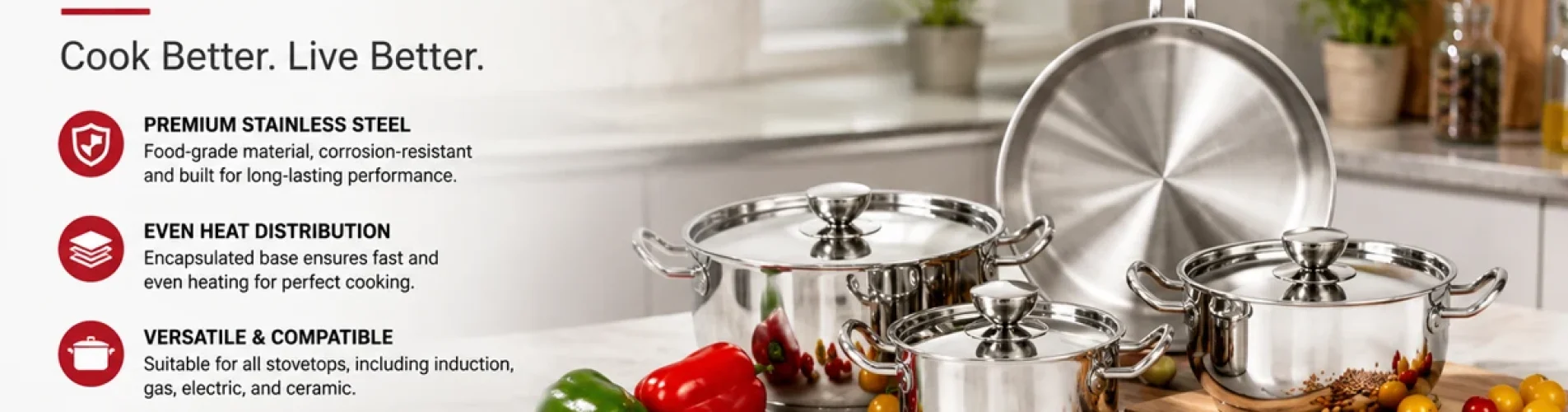
Encapsulated base (disc bottom): Stainless steel walls and base, with an aluminum disc hydraulically bonded to the bottom. The aluminum spreads heat laterally at the base but does not extend through the walls. More cost-effective than full-clad; suitable for mid-market commercial programs.
Fully clad: Conductive core material extends the full height of the pan walls, not just the base. This provides even heat distribution from base to rim — particularly important for sautéing and sauce work where food climbs the sides of the pan.
How Aluminum or Copper Cores Improve Heat Distribution
An aluminum or copper core within a stainless steel cookware piece spreads heat laterally from the burner contact point much faster than stainless steel alone. The practical effects:
- More even browning across the full pan base
- Fewer hot spots that create burned patches on one area while leaving another undercooked
- Faster temperature response when burner settings change
- More consistent sauce reduction across the whole pan bottom
- Better control during temperature-sensitive preparations
Fully Clad vs Encapsulated-Bottom Cookware
| Feature | Fully Clad Cookware | Encapsulated-Bottom Cookware |
|---|---|---|
| Conductive layer | Extends through base and sidewalls | Concentrated mainly in the base |
| Heat distribution | Strong across the full pan body | Strongest across the bottom only |
| Temperature response | Generally faster and more uniform | Dependent on base thickness |
| Weight | Moderate to heavy | Often heavier at the base, lighter walls |
| Cost | Higher | More cost-effective |
| Best positioning | Premium and professional lines | Mid-market and volume commercial programs |
Does More Ply Always Mean Better Cookware?
The number of layers alone does not determine total cookware performance. A 3-ply pan with a thick aluminum core and precise bonding will outperform a 5-ply pan with thin layers and poor material bonding. Performance also depends on the total weight and thickness, the quality of the bonding between layers, the pan geometry and handle balance, and the consistency of manufacturing.
When evaluating multi-ply claims, buyers should request: aluminum core thickness in millimeters, total pan weight (a proxy for material investment), base thickness specifications, and the bonding method used.
Why Is Temperature Control Important to Professional Chefs?
Chefs Must Respond Quickly to Changes in Heat
Professional cooking involves constant temperature management. A chef searing proteins needs to increase heat for the sear, reduce it immediately to prevent burning, maintain a specific simmer for a sauce, and respond rapidly to prevent scorching when a pan is momentarily unattended. The cookware’s ability to respond quickly to these heat changes directly affects cooking outcomes.
Multi-ply stainless steel cookware with a sufficient aluminum core responds more quickly to burner changes than single-ply or cast iron — aluminum’s high thermal conductivity means heat changes propagate rapidly through the pan body in both directions.
Even Heating Reduces Hot Spots and Food Waste
A hot spot in a pan — an area significantly hotter than the surrounding surface — produces uneven browning: burned in the hot zone, undercooked at the edges. In a professional kitchen producing 80 identical portions per service, a consistently hot-spotted pan creates product inconsistency that affects guest experience and increases food waste. A pan that distributes heat evenly allows consistent results across the full cooking surface, from the first portion to the last.
Responsive Cookware Improves Kitchen Efficiency and Reduces Error
When a pan responds quickly to heat adjustments, chefs can make corrections before burning occurs. When a pan is slow to respond — because it has high thermal mass or poor conductive core bonding — the cook must anticipate heat changes further in advance, increasing the cognitive load on an already demanding task. Professional-grade stainless steel cookware designed for responsive temperature control reduces this cognitive burden and gives chefs better outcomes under time pressure.
Why Is Stainless Steel Suitable for Acidic Foods?
Stainless Steel Is Non-Reactive with Acidic Ingredients
The passive chromium oxide layer on 304 stainless steel is chemically stable across the pH range encountered in cooking — from acidic preparations (wine, tomato, citrus, vinegar, pH 2–5) through alkaline cleaning products. This non-reactivity means stainless steel does not impart metallic flavors to acidic preparations and does not degrade under prolonged acidic contact.
This is a specific advantage over aluminum (which reacts with acids and can impart metallic taste) and bare cast iron (which reacts with acidic ingredients and creates a metallic flavor that affects wine- and tomato-based sauces). For professional kitchens preparing stocks with wine, tomato-based braises, vinegar-based sauces, and citrus preparations, stainless steel is the required material.
Why Reactivity Matters in Professional Cooking
A reactive surface affects multiple aspects of the finished dish simultaneously: flavor (metallic notes from dissolved metal ions), color (tomato sauces turning gray in reactive pans), and aroma (acidic preparations losing top notes when metal catalysis occurs). These effects are subtle in a single instance but cumulative across a preparation that may simmer for hours. Professional chefs minimize these effects by using non-reactive stainless steel for any prolonged acidic cooking.
Stainless Steel Supports Long Cooking Processes with Acidic Ingredients
Commercial food production involves preparations that maintain contact with stainless steel surfaces for hours: tomato sauces simmering for 4+ hours, wine-based braises running 3+ hours, stock reductions maintaining acidity across a 12-hour cooking period. The stability of stainless steel under these conditions is the material specification that makes these extended processes safe, compliant, and flavor-neutral.
Why Do Chefs Use Stainless Steel Across Multiple Cooking Methods?
Searing Proteins
A properly preheated stainless steel frying pan produces high surface temperatures that immediately begin the Maillard reaction when protein touches the surface. The protein initially adheres, then releases naturally as a crust forms — the natural release signal that tells the cook the protein is ready to turn. This behavior produces a better crust than non-stick surfaces, which prevent the initial adhesion that drives crust formation.
Best proteins for stainless steel searing: steak, chicken breast and thighs, salmon and firm fish, scallops, pork chops, lamb chops.
Sautéing Vegetables
Sautéing requires high heat and rapid movement of food across the pan surface to brown without steaming. Stainless steel’s high-heat tolerance and the way it allows moisture to evaporate quickly from the pan surface — rather than pooling as it sometimes does in non-stick surfaces — produces better browning and texture in sautéed vegetables.
Preparing Pan Sauces
The sequence of sear → fond development → deglaze → reduce → finish is one of the most important flavor-building processes in professional cooking. This entire sequence happens in a single stainless steel pan. No other cookware material supports this workflow as effectively.
Simmering Soups and Stocks
Large-capacity stainless steel stockpots are the commercial kitchen standard for soup, broth, and stock production. Non-reactive with acidic ingredients, large-capacity options available, easy to clean after long simmers, and compatible with all commercial burner types including induction. The standard NSF-compliant specification for any licensed commercial food service operation.
Boiling and Blanching
Pasta boiling, vegetable blanching, egg cooking, and grain cooking are high-volume applications in any restaurant. Stainless steel stockpots and saucepans handle all of these reliably — no reactivity concerns, no surface degradation from alkaline boiling water, and compatible with commercial dishwasher cleaning between uses.
Braising and Oven Finishing
High-quality stainless steel cookware with oven-safe handles (stainless steel or cast stainless) can transfer from stovetop to oven, making a single vessel suitable for the sear-and-braise technique fundamental to many restaurant preparations: sear the protein at high heat on the stovetop, add braising liquid, cover, and finish in the oven at lower temperature.
Stainless Steel vs Cast Iron: Which Do Professional Chefs Prefer?
Where Cast Iron Performs Well
Cast iron’s primary advantage is heat retention. Once heated to temperature, cast iron holds that temperature more stably than stainless steel — because its high thermal mass resists temperature change in both directions. This property makes cast iron valuable for:
- Steakhouse searing where a very hot, stable surface is needed for consistent crust development
- Slow-cooking applications where consistent gentle heat is more important than responsiveness
- Tableside or display cooking where the dramatic sizzle of a hot cast iron presentation plate is part of the service
Where Stainless Steel Offers Greater Flexibility
For most professional kitchen applications, stainless steel’s advantages outweigh cast iron’s:
Lower weight: A 12-inch cast iron skillet weighs 5–7 lbs; a comparable stainless steel pan weighs 2.5–3.5 lbs. Across a service where a line cook handles pans dozens of times, this weight difference matters ergonomically.
Faster response to heat changes: Cast iron’s high thermal mass means it responds slowly to burner adjustments — both heating and cooling. For sauce work and temperature-sensitive preparations, this is a liability.
Easier maintenance: Cast iron requires seasoning, cannot be cleaned with soap without re-seasoning, and rusts if stored wet. Stainless steel requires no seasoning, tolerates commercial dishwashers and cleaning agents, and does not rust under normal commercial kitchen conditions.
Non-reactivity with acidic ingredients: Cast iron reacts with wine, tomato, and citrus, imparting metallic flavor and degrading the pan’s seasoning. Stainless steel is non-reactive with all cooking ingredients.
Why Professional Kitchens Often Use Both
The professional kitchen that relies exclusively on either material is unusual. Cast iron appears in specific applications — the grill press, the service skillet, the display plate — where heat retention is specifically valuable. Stainless steel covers the general commercial kitchen workload. The materials complement rather than substitute for each other.
Stainless Steel vs Nonstick: Why Chefs Need Both
When Nonstick Cookware Is Useful in a Professional Kitchen
Non-stick cookware is valuable for specific applications where the physics of non-stick surfaces genuinely help the cooking outcome:
- Eggs at low temperature: Where gentle heat and easy release are the priority
- Delicate fish: Where thin fillets might tear without easy release
- Pancakes and crêpes: Where large flat surfaces with minimal sticking are essential
- Low-fat cooking: Where reduced oil is a dietary or health requirement
In these specific contexts, non-stick surfaces produce better results than stainless steel.
When Stainless Steel Is the Better Tool
For the majority of professional cooking applications, stainless steel produces superior outcomes:
- Searing proteins where crust development requires the surface adhesion that non-stick prevents
- High-temperature cooking above non-stick’s safe operating range
- Deglazing and sauce production that depends on fond development
- Any oven-finishing application above non-stick coating temperature limits
- Long-term heavy commercial use where non-stick coating durability fails
Why a Complete Professional Kitchen Uses Multiple Surface Types
The correct professional kitchen approach is not to choose between stainless steel and non-stick but to use each for its appropriate application. A credible analysis does not claim stainless steel replaces nonstick for every task — it describes where each material excels and how they complement each other in a complete professional kitchen equipment program.
Stainless Steel vs Aluminum Cookware
Advantages of Aluminum Cookware
Aluminum’s primary advantages are thermal conductivity (approximately 13× faster than stainless steel), light weight, and lower cost. These properties make aluminum the dominant material in commercial kitchens where cost efficiency and fast heat-up time are priorities — hotel banquet kitchens running large volumes of identical preparations, institutional food service, and high-volume casual dining operations.
Advantages of Stainless Steel Cookware
Stainless steel offers aluminum-based cookware what aluminum cannot match:
Non-reactivity: Bare aluminum reacts with acidic ingredients. Stainless steel does not. For any preparation involving wine, tomato, citrus, or vinegar, stainless steel is the correct material.
Surface durability: Aluminum scratches easily and develops oxidation under commercial cleaning conditions. Stainless steel resists both.
NSF compliance: Bare aluminum does not meet NSF food equipment standards in most US commercial kitchen licensing contexts. Stainless steel does.
Long-term appearance: Aluminum cannot maintain the consistent appearance of stainless steel over commercial kitchen timescales.
Why Multi-Ply Stainless Steel Incorporates Aluminum
The optimal commercial cookware construction combines both materials: stainless steel for the food-contact interior (non-reactive, durable, NSF-compliant) and aluminum for the conductive core (fast, even heat distribution). This is why tri-ply and multi-ply stainless steel cookware has become the professional standard — it is genuinely better than either material alone.
Why Can Food Stick to Stainless Steel — and Why That Is Not Always a Problem
Stainless Steel Is Not Naturally Non-Stick
Stainless steel’s surface does not have the low surface energy of PTFE or ceramic coatings. Food proteins, particularly eggs and white fish, can bond to a stainless steel surface through the same mechanism that creates fond — the denaturation and adhesion of proteins under heat.
Food is most likely to stick when:
- The pan is not sufficiently preheated before food is added
- Food is added before the surface is hot enough to begin immediate surface-protein denaturation
- The cooking surface is too cool to cause moisture between food and pan to flash to steam (which provides lift)
- Insufficient cooking fat is used relative to the food being cooked
- Protein is moved before the natural release point
Why Professional Chefs Do Not See Sticking as a Deficiency
The same surface property that allows food to stick is the property that allows fond to develop and adhere. For pan sauces, glazes, and reductions built on seared protein, the initial adhesion is the mechanism that creates the flavor-dense layer used to build the sauce. Professional chefs who understand this use controlled sticking deliberately.
The Professional Technique for Reducing Unwanted Sticking
When sticking is not desired (eggs, delicate fish, certain vegetables), professional technique reduces it:
- Preheat the empty pan over medium heat until the surface is hot — approximately 2–3 minutes on a commercial range
- Apply a small amount of cooking fat to the preheated surface and allow it to spread
- Wait until the fat shimmers but does not smoke
- Dry the surface of food before adding (wet food in a hot pan creates steam that impedes browning and increases sticking)
- Add food without overcrowding — crowding drops pan temperature and promotes steaming over browning
- Do not attempt to move protein before the natural release — protein adheres initially, then releases as the crust forms
The Leidenfrost effect further assists: a pan heated past approximately 190°C (375°F) causes water droplets to bead and glide rather than immediately evaporating — a visual cue that the surface is at a temperature where food will develop a crust and release cleanly from the surface.
How Does Stainless Steel Cookware Improve Commercial Kitchen Efficiency?
One Pan Performs Multiple Tasks
A stainless steel sauté pan in a professional kitchen may be used in a single service for searing proteins, sautéing vegetables, building a pan sauce through deglazing, finishing with butter and herbs, and transferring to an oven for finishing. This multi-function capability reduces the number of highly specialized cookware items a kitchen needs and simplifies station setup.
Durability Reduces Replacement Frequency and Total Cookware Cost
The commercial cost of cookware is not the purchase price alone — it is the purchase price divided by the service life, plus the operational disruption of mid-service equipment replacement. A properly specified stainless steel cookware program has a service life of 8–15+ years under daily commercial use. At this timescale, the higher upfront cost of quality stainless steel cookware produces a lower total ownership cost than cheaper alternatives replaced every 1–3 years.
Easy Cleaning Supports Faster Kitchen Turnover
Commercial stainless steel cookware tolerates the full range of professional kitchen cleaning methods: soaking, scrubbing with commercial cleaning compounds, and commercial dishwasher cycling with alkaline detergents. This tolerance reduces the cleaning complexity burden — no special protocols, no seasoning requirements, no surface restrictions on cleaning products.
Standardized Cookware Supports Staff Training
When all cooking stations use the same stainless steel cookware from the same manufacturer, kitchen training becomes more consistent. Staff can learn the preheating time, heat response, and technique requirements for one set of cookware and apply them across all stations. This consistency reduces errors during busy service periods and reduces the training time required when new staff join the kitchen.
Essential Stainless Steel Pots and Pans in a Professional Kitchen
Stainless Steel Frying Pan / Skillet (8–12 inch / 20–30cm)
The primary searing, browning, and shallow-frying tool. Also used for pan sauce production and egg cooking at the omelet station (in non-stick form for that specific application). Available in 8-inch, 10-inch, and 12-inch diameters to match different burner sizes and portion scales.
Stainless Steel Sauté Pan (2–4 quart / 2–4L)
Deeper than a frying pan with straight sides that retain liquids. Used for sautéing, braising small portions, reductions, and batch cooking preparations where liquid is added mid-process. The straight sides allow efficient stirring without spillage.
Stainless Steel Saucepan (1–4 quart / 1–4L)
The workhorse for sauce production, grain cooking, reheating, and small-batch liquid preparations. Available in 1-quart (single-portion sauce finishing), 2-quart (standard service sauce production), and 4-quart (larger batch sauces and soup warming).
Stainless Steel Stockpot (8–40 quart / 8–40L)
Essential for stock and broth production, pasta boiling, seafood boils, and large-volume liquid cooking. Restaurant stockpots typically range from 12-quart (small restaurant daily stock) to 40-quart (commercial batch production). NSF compliance required for licensed food service.
Stainless Steel Rondeau / Brazier
A wide, low-sided pot used for braising, shallow poaching, large-batch sautéing, and oven-finishing. The wide diameter allows high-volume sautéing without crowding and easy access for tossing and turning.
Stainless Steel Roasting Pan
A large, rectangular pan for oven roasting meats, poultry, and vegetables. Often used with a rack for air circulation beneath the protein. Also functions as the vessel for pan drippings used in gravy and jus production.
What Should Buyers Look for in Professional Stainless Steel Cookware?
Stainless Steel Grade
The food-contact interior of commercial cookware should be 304 stainless steel (18% chromium, 8–10% nickel) — the material specified by NSF/ANSI 2 for food equipment surfaces. The exterior base layer in induction-compatible cookware should be magnetic stainless steel (typically 430 grade) to respond to induction fields.
How to verify: Request a Mill Test Certificate (MTC) from the steel mill confirming chromium and nickel percentages of the production batch. Stainless steel grade is also field-testable with a magnet — 304 is non-magnetic (will not attract a magnet on food-contact interior surfaces).
Construction: Handle and Body Thickness
Professional cookware should specify: wall gauge in millimeters (1.0mm minimum for commercial use; 1.2mm for heavy-duty), base thickness (2.0mm minimum for encapsulated bases), and core material and thickness for multi-ply constructions. “Heavy gauge” is marketing language; the actual millimeter specification is objective.
Handle Strength and Design
| Feature | Riveted Handle | Welded Handle |
|---|---|---|
| Visual | Rivets visible inside | Cleaner interior |
| Strength | Strong when properly installed | Depends on welding quality |
| Cleaning | Food can collect around rivets | Smooth interior is easier |
| Market preference | Traditional professional | Modern hygienic appearance |
Handle attachment should be load-rated for full pan capacity. A 4-quart saucepan full of liquid weighs 4+ kg — the handle attachment must support this load through thousands of lifting cycles.
Base Flatness
A flat base ensures stable stovetop contact, maximizes heat transfer efficiency, prevents the pan from rocking, and is essential for effective induction heating. Request a flatness specification (typically ±0.3mm tolerance for commercial cookware) and verify with a precision straightedge on physical samples.
Cooktop Compatibility
Professional cookware may need to work across gas, electric, ceramic, and induction cooktops. Induction compatibility requires a magnetic exterior base layer — confirm the specification and test with a magnet.
Lid Fit
A well-fitted lid retains steam, maintains temperature during covered cooking, and indicates the dimensional precision of the manufacturing. Evaluate lid stability (should not rock), steam control (minimal gap around circumference), and handle temperature (should not transfer heat to the grip during oven use).
Why Is Induction Compatibility Increasingly Important?
Professional kitchens are increasingly installing induction cooking equipment for operational advantages: faster heat response, lower ambient kitchen temperature (induction generates no open flame or radiant heat), easier cooktop surface cleaning, and precise temperature control for delicate preparations.
Not all stainless steel cookware is induction-compatible. 304 stainless steel is austenitic — non-magnetic — and does not respond to induction magnetic fields. Induction-compatible stainless steel cookware requires a magnetic layer at the base, typically 430 stainless steel (ferritic, magnetic) bonded to the exterior base of the cookware.
Verification: Apply a kitchen magnet to the base of the cookware. Firm adhesion confirms induction compatibility. Zero adhesion on 304 stainless confirms the pan will not work on induction.
For wholesale buyers and cookware manufacturers building product programs, the growing penetration of induction equipment in professional kitchens makes induction compatibility an increasingly important standard specification rather than a premium option.
Common Misconceptions About Stainless Steel Cookware
“All Stainless Steel Cookware Performs the Same”
This is incorrect. The performance of stainless steel cookware depends on: steel grade (304 vs 201 vs 430), construction type (single-ply vs multi-ply), core material and thickness, bonding quality between layers, pan geometry and handle design, and manufacturing consistency. Two pans described as “18/10 stainless steel” may perform completely differently based on these factors.
“More Layers Always Mean Better Performance”
Layer count alone does not determine performance. A 3-ply pan with a 2.5mm aluminum core and consistent bonding quality will outperform a 5-ply pan with thin, inconsistently bonded layers. Buyers should evaluate layer thickness specifications and bonding quality, not just layer count.
“Heavy Cookware Is Always Higher Quality”
Excessive weight in professional cookware reduces ergonomic efficiency and can slow temperature response (high thermal mass resists change in both directions). Optimal weight balances material investment (more material means better heat performance to a point) with practical usability. The heaviest pan is not automatically the best pan.
“Stainless Steel Should Never Stick”
Stainless steel is not naturally non-stick. Controlled sticking that creates fond is a feature of stainless steel cookware that professional chefs use deliberately for sauce production. The goal is managing sticking intentionally — allowing it when fond development is desired, preventing it when clean release is required through proper preheating and technique.
“Stainless Steel Is Maintenance-Free”
Stainless steel requires less maintenance than cast iron (no seasoning) and nonstick (no coating restrictions) — but it is not entirely maintenance-free. It benefits from prompt removal of food residue, proper drying after washing to prevent water spot formation, avoidance of prolonged contact with salt water or harsh acids, and periodic polishing with stainless steel cleaner to maintain appearance on mirror-polish surfaces.
Frequently Asked Questions
Why do professional chefs prefer stainless steel pans over nonstick?
Stainless steel pans allow professional chefs to develop fond — the caramelized food residue used to build pan sauces through deglazing — which nonstick surfaces prevent. They also tolerate higher temperatures than nonstick coatings allow, support metal utensils, and survive commercial dishwasher cycles that would degrade nonstick coatings within weeks. Nonstick pans are used in professional kitchens for specific applications (eggs, delicate fish) but cannot replace stainless steel as the general commercial cooking surface.
Is stainless steel cookware good for searing?
Yes — stainless steel is among the best materials for searing. A properly preheated stainless steel pan reaches and holds the high surface temperatures required for the Maillard reaction, allows initial protein adhesion that drives crust formation, and produces the fond development that enables pan sauce production. Single-ply stainless may have hot spots; tri-ply or encapsulated-base construction distributes heat more evenly for consistent browning across the full searing surface.
Why does food stick to stainless steel pans?
Food sticks to stainless steel pans primarily when the pan is insufficiently preheated before food is added. The solution is proper preheating (2–3 minutes over medium heat on a commercial range), adding fat to the hot pan, and waiting until the fat shimmers before adding food. Protein will adhere initially, then release naturally as the crust forms — forcing it early tears the crust and increases sticking. This natural release point, where the protein lifts cleanly, is the cue to turn.
Is stainless steel better than cast iron for commercial kitchens?
Neither material is universally better in a commercial kitchen — they serve different applications. Stainless steel is better for: sauce production, acidic preparations, responsive temperature control, everyday high-frequency cooking, easy maintenance, and lightweight handling. Cast iron is better for: heat retention, specific searing applications where thermal stability is critical, and display or tableside presentations. Most professional kitchens use both.
What is the best stainless steel grade for professional cookware?
304 stainless steel (18% chromium, 8–10% nickel) is the commercial food equipment standard for food-contact surfaces in professional cookware. It is specified by NSF/ANSI 2 for commercial kitchen equipment and provides the necessary combination of corrosion resistance, chemical stability, and food safety compliance. Magnetic stainless steel (430 grade) is used for induction-compatible exterior base layers. Material grade should be verified with Mill Test Certificates on wholesale purchases — verbal or labeling claims alone are insufficient.
Can stainless steel pots and pans go in the oven?
Most stainless steel cookware with stainless steel handles and lids is oven-safe to at least 260°C (500°F). The maximum oven temperature depends on handle construction, lid material (glass lids typically limit oven use to 175–220°C), and any silicone or plastic handle grips. Fully stainless construction (body, handles, and lid knobs) typically allows oven use to the full operating temperature of a professional range oven. Always confirm oven safety rating in the product specification before use.
Is all stainless steel cookware induction compatible?
No. 304 stainless steel is austenitic (non-magnetic) and does not respond to induction cooktops. Induction-compatible stainless steel cookware requires a magnetic exterior layer — typically 430 stainless steel — at the base. Apply a kitchen magnet to the base to test compatibility. All properly induction-rated cookware should have this specification clearly stated in the product documentation.
Conclusion: Stainless Steel Gives Chefs Control, Versatility, and Long-Term Reliability
Professional chefs continue to rely on stainless steel pots and pans because the material is genuinely engineered for professional kitchen demands — not merely adapted from consumer cookware or positioned by marketing.
The core reasons are specific and interconnected:
Durability under intensity. Stainless steel survives commercial kitchen conditions — high heat, aggressive cleaning, daily high-frequency use — for years without surface degradation.
High-heat searing and browning. No coating limits, no reactivity concerns, full support for the Maillard reaction and fond development that defines restaurant-quality cooking.
Temperature control through multi-ply construction. Aluminum or copper cores in tri-ply and multi-ply constructions solve stainless steel’s thermal conductivity limitation, delivering even heat distribution and responsive temperature control.
Non-reactivity with all ingredients. The stability of 304 stainless steel across the pH range of cooking ingredients makes it the correct material for any professional kitchen handling acidic preparations.
Versatility across cooking methods. Searing, sautéing, braising, sauce production, oven finishing, boiling, blanching — stainless steel pots and pans handle all of them without technique modification or equipment change.
Commercial viability. The service life of properly specified stainless steel cookware makes it the lower total-cost-of-ownership option for any professional kitchen program — despite higher upfront cost.
For cookware manufacturers, retailers, and wholesale buyers building professional cooking equipment programs: the case for stainless steel pots and pans is not a preference or a tradition. It is a performance specification built on material science, commercial kitchen engineering, and decades of professional culinary practice.