Read time: 12 min
Stockpots and soup pots are two of the best-selling cooking pot categories in the global cookware market. They share a broadly similar form — a deep pot with two handles and a lid — but they serve different cooking functions, attract different buyer segments, and occupy distinct positions in both retail and commercial kitchenware catalogs.
For consumers, understanding the difference determines whether a pot performs well for daily meals or frustrates with limited capacity during a dinner party. For retailers, distributors, and importers, understanding the distinction shapes smarter product assortments: stocking the right cooking pot type for the right market prevents inventory mismatches and drives better sell-through.
This guide explains precisely what separates a stockpot from a soup pot — in design, function, material options, and market positioning — and provides a practical decision framework for cookware brands, wholesale buyers, and OEM kitchenware suppliers choosing between or combining both categories.
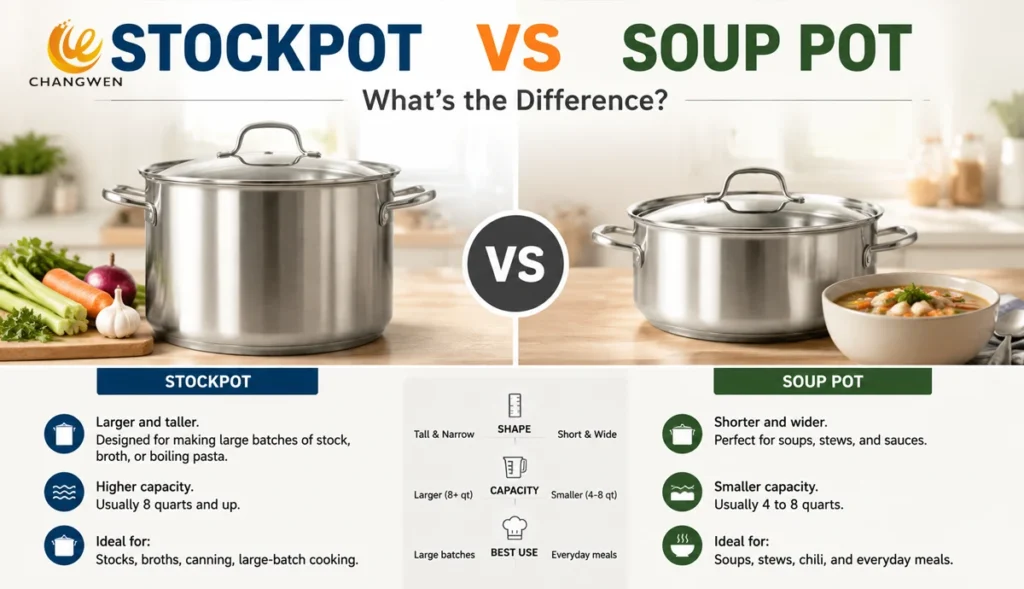
What Is a Stockpot?
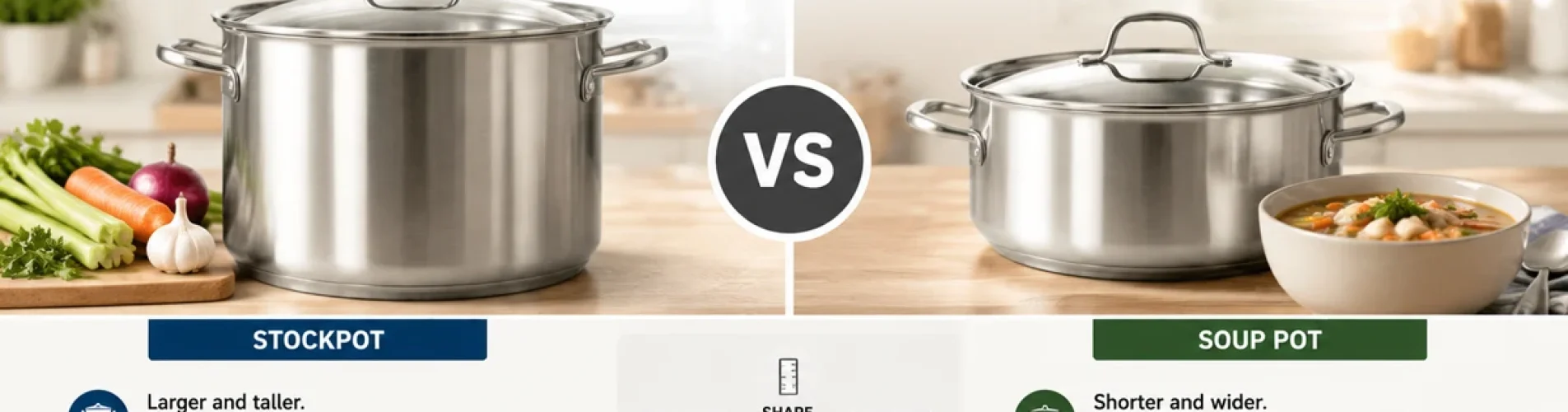
A stockpot is a large-capacity cooking pot specifically engineered for high-volume, long-duration cooking with large quantities of liquid. Its design geometry — tall walls relative to diameter — is the defining structural feature, and every performance characteristic flows from this shape.
Design and Physical Characteristics
A stockpot has tall, straight sides that rise significantly higher than its base diameter. This tall-narrow profile serves a critical cooking function: it minimizes the liquid surface area exposed to evaporation relative to the total liquid volume in the pot. During a 12-hour bone broth simmer or a 3-hour stock reduction, this geometry means that liquid level holds more stable — the broth or stock concentrates gradually through the long simmer rather than evaporating rapidly from a wide surface.
Most stockpots feature a flat, thick base for even heat contact with burners, two loop or D-ring side handles (rated for the significant weight of a full pot), and a tight-fitting lid that reduces evaporation further during covered cooking phases.
Common Capacities
Stockpots are available across a wide capacity range. The most commercially significant sizes are:
- 8 quart (7.5L):The smallest practical stockpot for home kitchen use. Handles moderate batch cooking.
- 12 quart (11.4L):The standard residential stockpot. Covers most home stock-making and pasta-boiling applications.
- 16 quart (15.1L):The crossover size between home and light commercial use. Popular in home entertaining and small catering setups.
- 20 quart (18.9L):The restaurant kitchen workhorse. Handles full-batch stock production and high-volume pasta service.
- 24 quart (22.7L) and above:Commercial and institutional scale, used in hotel kitchens, catering commissaries, and food service operations.
Typical Cooking Applications
The stockpot’s large volume and tall profile make it the correct tool for: making chicken, beef, veal, or vegetable stock; boiling large batches of pasta; seafood boils (lobster, crab, crawfish, shrimp); corn boils and large-scale vegetable blanching; home canning and preservation; and any commercial kitchen application where large liquid volumes must be maintained at temperature for extended periods.
Advantages of a Stockpot
Large volume capacity: A stockpot handles cooking tasks that no other standard pot can. A full batch of chicken stock for a restaurant’s weekly service requires 20+ quarts — only a stockpot provides this capacity in a single vessel.
Minimized evaporation during long cooks: The tall sidewall geometry restricts the evaporation surface. During a 6–12 hour simmer, this protects the cook from needing to constantly top off water and maintains consistent liquid volume throughout the cooking period.
Even heat distribution: Commercial-grade stockpots with encapsulated aluminum bases distribute burner heat across the full base area, preventing the hot spots that cause scorching in long-simmer applications.
Versatility across batch cooking tasks: One correctly specified stockpot covers stock production, pasta service, seafood boils, and batch chili production — making it one of the most versatile investments in any commercial kitchen equipment program.
Essential for commercial kitchens: Restaurants, hotel kitchens, catering operations, and institutional food service cannot function without stockpots. This commercial dependency makes the stockpot one of the most reliably recurring wholesale cookware purchases.
What Is a Soup Pot?
A soup pot is a medium-capacity cooking vessel with a wider base and shorter sidewalls than a stockpot of equivalent volume. This wider, shallower profile is specifically engineered for different cooking dynamics than the stockpot — and understanding why clarifies exactly when a soup pot is the better tool.
Design and Physical Characteristics
A soup pot is defined by its lower height-to-diameter ratio. Where a stockpot is significantly taller than it is wide, a soup pot’s height and diameter are more proportional — often approaching a 1:1 ratio at smaller sizes. This shape increases the liquid surface area exposed to heat, which accelerates evaporation and flavor concentration.
The wider cooking surface also facilitates easier stirring — important for soups and stews where ingredients settle to the bottom and require frequent agitation. A tall stockpot requires a longer ladle and more awkward arm positioning to reach the bottom; a soup pot allows comfortable access with standard kitchen utensils.
Typical Capacities
- 3 quart (2.8L):Small soup pot for 2-person meals, sauces, and single-serve soups.
- 5 quart (4.7L):Standard family soup pot for 3–4 servings.
- 6 quart (5.7L):The most versatile home soup pot size — large enough for a family dinner, manageable for daily cooking.
- 8 quart (7.6L):The upper end of the soup pot range, crossing into light stockpot territory. Suitable for larger households or modest catering use.
Typical Cooking Applications
A soup pot excels at vegetable soups, cream soups, chowders, chili, beef stew, chicken curry, French onion soup, and any one-pot meal where the food volume is manageable (under 6–8 quarts) and the recipe benefits from controlled evaporation and easy stirring access.
Advantages of a Soup Pot
Faster simmering from the wider base: The greater base diameter maximizes contact with the burner, bringing soup to temperature faster than a tall stockpot of equivalent volume.
Better flavor concentration through evaporation: The wider liquid surface accelerates evaporation, which concentrates flavors more rapidly during the cooking process. A cream soup or French onion soup develops deeper flavor in a soup pot than in a taller stockpot where evaporation is restricted.
Easier daily cooking and stirring: The lower sidewall height and wider diameter make the soup pot more intuitive for everyday kitchen use — stirring, checking contents, adjusting seasoning, and serving are all easier than with a deeper stockpot.
Appropriate for family meal volumes: Most household cooking involves 4–8 quart volumes. A soup pot sized for this range is neither too small (requiring multiple batches) nor unnecessarily large (wasting energy heating excess space).
Better suited for premium home cookware collections: The soup pot’s everyday utility makes it a core component of premium cookware sets targeting home cooks who value both performance and ease of use.
Stockpot vs Soup Pot: Key Differences
Size and Capacity Comparison
| Feature | Stockpot | Soup Pot |
| Shape | Tall, narrow, straight sides | Shorter, wider, lower profile |
| Height-to-Diameter | Taller than wide | More proportional or wider than tall |
| Capacity Range | Large: 8–24+ quarts | Medium: 3–8 quarts |
| Weight (full) | Heavier — designed for large liquid volumes | Lighter — more manageable for daily use |
| Evaporation Surface | Minimized relative to volume | Wider — facilitates flavor concentration |
| Best For | Bulk cooking, stock, pasta, seafood | Everyday soups, stews, sauces, curries |
Cooking Performance Comparison
The performance difference between a stockpot and a soup pot is a direct consequence of their geometry, not their material quality.
A stockpot is engineered for: Boiling and long simmering with minimal liquid loss. Stock and broth production where collagen extraction requires hours of gentle simmer. Pasta cooking where large water volumes prevent starch buildup. Seafood boils where the volume of shellfish must be fully submerged. Batch cooking for large groups where a single vessel must hold a complete service quantity.
A soup pot is engineered for: Daily household soup production where a 4–6 quart batch serves a family meal. Sauce reduction where controlled evaporation concentrates flavor. Stews and curries where ingredients sit in a shallower liquid layer and absorb flavors through direct contact. One-pot meals where vegetables, proteins, and liquid cook together in a manageable volume.
Heat Distribution and Evaporation Physics
The geometry of each pot creates different thermal and evaporative dynamics that matter to cooking outcomes.
A wider soup pot presents more base surface to the burner, which means heat transfers into the liquid faster and more evenly across a larger area. This accelerates the journey to boiling temperature and supports more consistent simmering across the base. At the same time, the wider top surface allows more steam to escape — meaning both faster evaporation and faster reduction.
A taller stockpot concentrates heat at the base (where burner contact occurs) and relies on convection to distribute warmth through the liquid column above. The narrow top surface restricts evaporation — which is precisely the design intent for long-simmer stock production where liquid volume must be maintained over many hours.
Neither design is superior in the abstract. Each is superior for its intended application.
Material Comparison: Stainless Steel, Aluminum, and Cast Iron
Both stockpots and soup pots are produced across multiple material categories. The correct material for any wholesale or OEM program depends on target market, price positioning, and cooking application.
Stainless Steel Stockpots and Soup Pots
304 stainless steel (18% chromium, 8% nickel) is the dominant material for commercial and premium cookware markets worldwide — and the correct specification for any hotel, restaurant, or professional kitchen supply program.
Why stainless steel dominates commercial cookware: Non-reactive with all food types including acidic stocks, tomato-based soups, and citrus preparations. Corrosion-resistant under daily commercial dishwasher cycling with alkaline detergents. Compatible with gas, electric, and induction cooktops (with magnetic base layer). Visually professional — the brushed or mirror finish signals quality appropriate for front-of-house and hotel buffet service.
Single-ply vs. encapsulated base vs. tri-ply: Single-ply stainless (one layer throughout) is cost-effective but creates hot spots at the burner contact point — limiting performance in applications requiring even heat distribution. Encapsulated base construction (aluminum disc bonded under the stainless base) dramatically improves heat distribution at the base. Tri-ply full-clad (stainless/aluminum/stainless throughout the walls) provides the most even heat distribution from base to sides — the premium specification for performance-demanding applications.
Best for: Premium retail cookware sets, hotel and restaurant supply programs, professional kitchen distribution, OEM brands targeting the upper market tier.
Aluminum Cooking Pots
Standard aluminum offers outstanding heat conductivity (approximately 13× faster than stainless steel), lightweight construction, and economical production cost. These properties make aluminum the practical choice for volume-tier wholesale programs where cost efficiency is the priority.
Hard-anodized aluminum significantly improves surface durability and reduces the reactivity concern of bare aluminum with acidic foods. It is appropriate for mid-market retail programs where performance expectations are higher than bare aluminum can reliably meet.
Limitation for commercial use: Bare aluminum does not meet NSF food equipment standards in most US commercial kitchen licensing contexts. Hard-anodized versions address the compliance concern.
Best for: Value-oriented retail markets, promotional cookware programs, budget-conscious consumer segments in developing markets.
Enamel and Cast Iron Soup Pots
Enameled cast iron soup pots occupy the premium specialty tier — significantly heavier and more expensive than stainless steel equivalents, but offering unique cooking characteristics:
Exceptional heat retention once at temperature. Oven-to-table presentation quality (a cast iron soup pot goes from the stovetop to the dinner table as a serving vessel). Slow, gentle simmer performance that suits stews, braises, and long-simmered soups where thermal stability is more important than fast heat-up.
Best for: Premium home cookware collections, specialty kitchen retailers, gourmet cookware brands, and gift market positioning.
Which Cooking Pot Is Better for Each Application?
Selecting the correct pot type for each cooking application is the practical resolution of the stockpot vs soup pot comparison.
Best Uses for Stockpots
A stockpot is definitively the better choice when:
Making stock, bone broth, or soup base: The large capacity holds the full quantity of bones, vegetables, and water required for a commercial or large-batch production. The tall walls minimize evaporation, maintaining liquid level across a 6–12 hour simmer without constant top-up. The result is a richer, more gelatinous stock than a soup pot can produce in the same timeframe.
Boiling pasta at commercial volume: The rule of 4–5 quarts of water per pound of dry pasta means that a restaurant producing 30 pounds of pasta per service needs 120–150 quarts of boiling water. Multiple large stockpots running simultaneously are the only practical solution.
Seafood boils: Whole lobsters, blue crabs, king crab legs, crawfish, and large shrimp boils require full submersion in seasoned boiling water. Only a stockpot of sufficient volume achieves this for any meaningful quantity.
Batch chili, braised meats, and large-batch stews for commercial kitchens: A food service operation preparing 200 portions of beef chili needs a vessel that holds the complete batch. The stockpot’s capacity is the enabling equipment.
Best Uses for Soup Pots
A soup pot is definitively the better choice when:
Making household soups and stews (4–8 quart volume): The wider base heats the soup faster, the lower sidewalls make stirring and checking more natural, and the controlled evaporation concentrates flavors more effectively than a tall stockpot.
Cream soups, bisques, and pureed soups: The wider shape accommodates immersion blenders more effectively than a tall stockpot — no need to ladle soup into a separate vessel for pureeing.
Curries and braised proteins at family scale: A 6-quart soup pot is the practical vessel for a family curry or a braised chicken dish — deep enough to hold a full family-size batch, wide enough for browning protein before adding liquid.
One-pot meals: The soup pot’s proportions make it ideal for dishes where vegetables and proteins cook together in a relatively shallow liquid layer — where the food is in the pot, not submerged beneath it.
How to Choose the Right Cooking Pot for Your Product Line
For cookware brands, wholesale distributors, importers, and OEM program managers, the stockpot vs soup pot decision extends beyond individual cooking function into product portfolio strategy.
Retail Market Programs
Target consumers: Home cooks purchasing for family use.
Recommended soup pot range: 5 quart and 6 quart as the primary SKUs. 3 quart for the value tier or supplemental purchase. 8 quart as the upsell option.
Recommended stockpot range: 8 quart for entry (covers pasta for 4, basic stock-making), 12 quart as the standard (the most versatile home stockpot), 16 quart as the upsell.
Key specifications for retail: Encapsulated aluminum base for even heat distribution, comfortable ergonomic handles, glass lid option for food visibility during cooking, attractive finish (brushed stainless or matte exterior) for shelf appeal.
Commercial Market Programs
Target customers: Restaurants, hotels, catering companies, institutional kitchens.
Recommended stockpot range: 20 quart and 40 quart as the core sizes for restaurant supply. 60–80 quart for institutional and catering programs.
Key specifications for commercial: 304 stainless steel with Mill Test Certificate, 1.0–1.2mm minimum wall gauge, encapsulated aluminum base, riveted handles, NSF/ANSI 2 food equipment compliance, commercial dishwasher-safe construction.
Soup pots for commercial: Less common in restaurant supply (the stockpot handles most commercial volume requirements), but relevant for hotel room service kitchens and hotel breakfast buffet use, where a 6–8 quart soup pot handles daily soup production for a moderate breakfast volume.
Premium Kitchenware Brands
Target market: Affluent home cooks, culinary enthusiasts, premium retail channels.
Product approach: Tri-ply full-clad stainless steel construction for both soup pots and stockpots. Attractive design language — flared rims, elegant handle profiles, beautiful polished or matte finishes. Complete the line with lid options (stainless or borosilicate glass), custom OEM branding, and premium packaging that justifies the price point.
What Buyers Should Check Before Bulk Purchasing
For any wholesale, retail, or OEM buying program, the following evaluation criteria determine whether a cooking pot supplier can deliver what they claim.
Material Quality
Request the Mill Test Certificate (MTC) for the stainless steel used in production. This document, issued by the steel mill, confirms the actual chromium and nickel percentages of the batch. A MTC confirming ≥18% chromium and ≥8% nickel verifies 304 grade. Any supplier who cannot provide this document cannot verify the steel grade they are claiming.
Check 430 stainless applications: 430 grade (ferrite, no nickel) is appropriate for pot exteriors in induction-compatible constructions and for non-food-contact components. Confirm that all food-contact surfaces — the pot interior — are 304 grade.
For tri-ply programs: Confirm the aluminum core thickness (2.0mm commercial standard) and full-wall coverage (not just base clad).
Food-grade certification: FDA food contact compliance (US market), LFGB test report (EU/German market), NSF/ANSI 2 (commercial kitchen distribution).
Manufacturing Quality
Base thickness: For encapsulated-base pots, the aluminum disc should be a minimum of 2.0mm. For single-ply pots, the base should be at least 1.0mm (commercial standard).
Wall gauge: 1.0mm minimum for commercial-grade soup pots and stockpots. 1.2mm for heavy-duty commercial specifications.
Handle strength: Request load testing specifications. A 20-quart stockpot full of stock weighs approximately 20 kg. Both handles must be riveted (not welded only) and rated for the full loaded weight of the pot.
Weld quality: All welds at handle attachments, rim reinforcements, and base seams should be clean, fully penetrated, and polished flush. Visible rough welds, gaps, or incomplete fusion are production quality failures.
Lid fit: The lid should seat fully around the circumference without rocking. A rocking lid allows steam to escape at the gap, defeating the purpose of covered simmering.
Polishing consistency: Interior and exterior finish should be consistent across the full surface — no unfinished patches, visible grinding marks, or inconsistent sheen areas.
OEM & Private Label Options
For brands and importers building proprietary product programs, the following customization options should be discussed with any prospective manufacturer before committing to a program:
Logo and branding: Laser engraving on pot body or lid handle (permanent, dishwasher-resistant), screen print (cost-effective for color logos), or adhesive plate (simplest, lowest cost).
Color coating: PVD coating for black, gold, or other colors on exterior surfaces. Powder coat on pot exterior.
Lid variants: Stainless steel lid (standard), borosilicate glass lid (allows food monitoring during cooking), silicone-sealed lid (enhanced steam retention).
Packaging: Individual color box (standard retail), gift box with foam insert (premium presentation), bulk master carton (cost-efficient for commercial supply).
Custom capacity: Non-standard sizes require new tooling (die modification), which adds development time and minimum order requirements.
Handle styles: Standard loop handles, helper-handle configurations, silicone-sleeve grips, and specialty handle profiles for brand differentiation.
Market Potential: Stockpot or Soup Pot?
For retail buyers, distributors, and OEM cookware brands deciding where to focus product development, understanding the market dynamics of each pot category guides strategic investment.
Stockpot Market Trends
The global stockpot market benefits from several converging demand drivers in 2026:
Commercial kitchen expansion: Hotel and restaurant growth across Asia, the Middle East, and Southeast Asia continues to generate institutional procurement demand for large-capacity stainless steel stockpots.
Batch cooking and meal prep culture: The growth of batch cooking among home consumers — driven by nutrition-conscious eating habits, meal planning programs, and the popularity of bone broth — has expanded the residential stockpot market beyond its traditional commercial kitchen base.
Cookware set anchor piece: Premium cookware set programs (5-piece, 7-piece, 10-piece) routinely include a 12-quart stockpot as the large-capacity anchor piece. As cookware set sales grow, stockpot volume follows.
Soup Pot Market Trends
Everyday household use is the largest market segment: More households use a soup pot daily than own a stockpot. The soup pot’s relevance to everyday family cooking (soups, stews, one-pot pasta) positions it as the higher-frequency purchase in the residential market.
Premium cookware collections: The premium home cookware market — tri-ply construction, beautiful design, retail price points above $80 per piece — prioritizes the soup pot as a centerpiece piece. Consumers purchasing a premium 6-quart soup pot for daily use represent a growing and high-value market segment.
Healthy cooking demand: Growing consumer interest in homemade soups, plant-based stews, and scratch-cooked meals drives soup pot demand across multiple global markets.
For cookware brands and distributors: Offering both soup pots and stockpots in a coordinated product line covers the full range of consumer cooking pot needs — everyday meals and large-batch cooking — and maximizes the product portfolio’s appeal to retailers seeking complete cookware programs.
Frequently Asked Questions
Can a stockpot be used as a soup pot?
Yes, a stockpot can be used as a soup pot when the cooking volume warrants it. A family making a large batch of soup for a dinner party of 8–10 people will find that a 12-quart stockpot handles the volume naturally. However, for everyday household soups of 4–6 quart volume, a stockpot creates unnecessary ergonomic inconvenience — the tall sides make stirring less comfortable, and a large pot heating a small volume of soup wastes energy. The reverse is clearer: a soup pot cannot substitute for a stockpot when the required volume exceeds its capacity. A 6-quart soup pot cannot replace a 20-quart stockpot for restaurant stock production or pasta boiling at commercial scale.
Which pot is better for bone broth?
A stockpot is the better choice for bone broth production in virtually every context. Bone broth requires long simmering — typically 12–24 hours for maximum collagen extraction — during which liquid loss through evaporation is a practical concern. The stockpot’s tall, narrow geometry minimizes evaporation surface relative to liquid volume, maintaining consistent liquid level through the extended simmer without frequent top-up. A 12–16 quart stockpot is the practical home bone broth vessel; commercial bone broth production uses 20–40 quart stockpots. A soup pot’s wider evaporation surface would require more frequent liquid addition and closer monitoring during a long simmer.
Do I need both a stockpot and a soup pot?
For a complete home kitchen: yes, ideally — they serve genuinely different cooking needs. A soup pot (5–6 quart) handles everyday family soups, stews, and one-pot meals. A stockpot (12–16 quart) handles pasta boiling, seasonal stock-making, and large-batch cooking for gatherings. The two vessels together cover the complete range of liquid-based cooking tasks.
For retail buyers and cookware brands: offering both categories is the correct product strategy. A retailer stocking only stockpots misses the significant everyday household soup pot market. A retailer stocking only soup pots misses the batch cooking and commercial kitchen segment. Complete cookware programs include both pot types in coordinated designs and finishes.
For restaurant and commercial kitchens: stockpots are the commercial kitchen foundation piece. Soup pots appear in hotel in-room kitchens and residential-format cooking contexts. Commercial kitchen purchasing programs should prioritize stockpot procurement.
Final Thoughts
The stockpot vs soup pot comparison resolves to a simple framework:
Choose a stockpot for large-volume cooking, long-duration simmering, commercial kitchen supply, and any application where the quantity exceeds what a soup pot can hold. The stockpot’s tall-narrow profile is an engineering solution to the problem of maintaining liquid volume over long cooking times.
Choose a soup pot for everyday household cooking, flavor-concentrating soups and stews at family scale, and premium home cookware programs where daily usability is the primary consumer value.
For cookware manufacturers, wholesale buyers, and OEM program managers: both categories belong in a complete product strategy. The stockpot anchors commercial supply programs and large-batch home cooking. The soup pot captures the everyday household market and premium cookware collection segment. Together, they provide complete coverage of the liquid cooking pot market.
We manufacture and supply stainless steel stockpots, soup pots, and complete cookware sets for wholesale buyers, retail distributors, hotel procurement groups, and OEM/ODM cookware brands worldwide. Our cookware is produced in 304 food-grade stainless steel with encapsulated base and tri-ply construction options, available with full certification documentation (NSF, FDA, LFGB, ISO 9001).
Request Wholesale Pricing & Catalog