Read time: 11 min
Introduction
Every restaurant owner faces the same decision eventually: which cookware to buy, and how much to spend on it. Get it wrong in one direction and you’re replacing pans every six months. Get it wrong in the other and you’ve spent $3,000 on equipment that doesn’t perform any better than a $400 set.
Commercial stainless steel cookware sits at the center of this decision for most professional kitchens — and for good reason. It outlasts aluminum under high heat and daily punishment, requires none of the maintenance overhead of cast iron or carbon steel, and handles acidic foods, delicate sauces, and high-sear applications equally well.
But “stainless steel” is not a single product. The grade of steel, the construction method, the ply count, the handle design, the NSF certification status, and the pan size all determine whether you’re buying the best commercial stainless steel cookware for your operation — or a set that will warp, discolor, and fail in a busy service environment.
This guide covers every factor a restaurant owner, chef, or equipment buyer needs to know to make a confident, well-informed decision on commercial grade stainless steel cookware — from steel grades to construction types, material comparisons, NSF requirements, and the specific pan sizes your kitchen actually needs.
Key Takeaways
- 304 stainless steel (18/8 or 18/10) is the commercial kitchen standard — it offers the best balance of corrosion resistance, food safety, durability, and cost for restaurant use.
- Construction matters as much as material — a tri-ply or full-clad pan with an aluminum core distributes heat far more evenly than a single-ply stainless pan, eliminating hot spots that cause sticking and uneven cooking.
- NSF certification is non-negotiable for commercial use — it confirms the cookware meets food safety, sanitation, and durability standards required by most health codes and institutional buyers.
- Stainless steel, aluminum, and carbon steel each have distinct roles — the best commercial kitchens use all three strategically, not just one material for everything.
- A commercial cookware set standardized across your kitchen (matching lids, compatible sizes, same brand) reduces maintenance costs and simplifies staff training.
- Knowing how to use a stainless steel pan correctly — preheating, the water droplet test, proper oil application — dramatically reduces sticking and extends pan life in commercial use.
Why Stainless Steel Dominates Commercial Kitchens
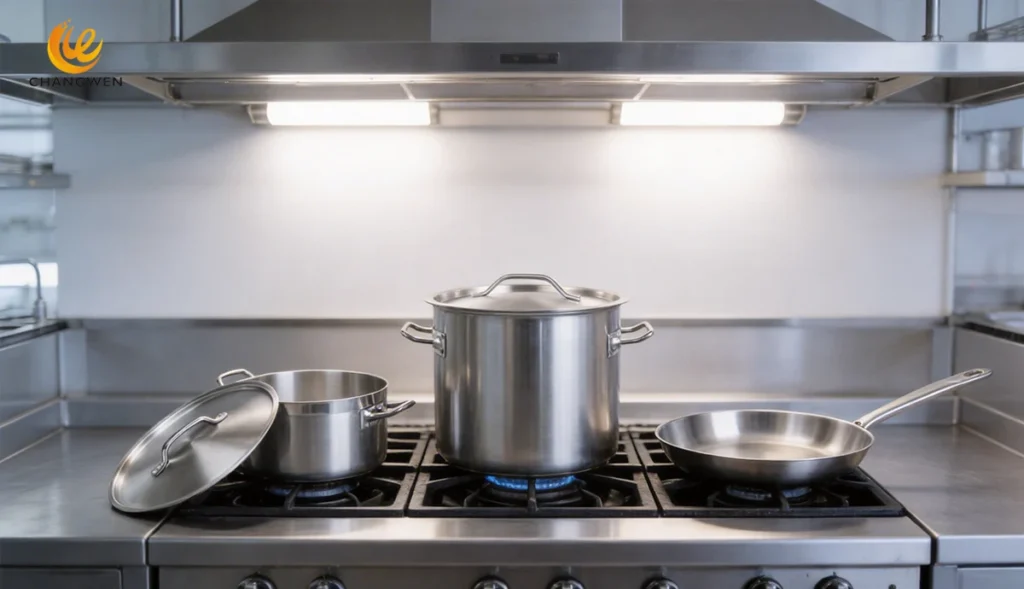
Walk into any professional kitchen — from a neighborhood taqueria to a Michelin-starred restaurant — and you’ll find commercial stainless steel cookware as the backbone of the batterie de cuisine. This isn’t coincidence. It’s the result of decades of professional use confirming that stainless steel outperforms every other material across the factors that matter most in a commercial environment:
Non-reactive surface. Unlike aluminum or bare cast iron, stainless steel does not react with acidic ingredients — tomato sauces, wine reductions, citrus, vinegar — which means no metallic taste transferring to food and no discoloration of delicate sauces. This is critical for restaurant stainless steel cookware used across diverse menus.
Durability under commercial demand. A quality commercial grade stainless steel cookware piece withstands the thermal cycling, mechanical abuse, dishwasher frequency, and stack storage of a working kitchen for 5–15 years. The same environment destroys nonstick coatings in 12–18 months and warps lightweight aluminum in under a year.
No maintenance protocol. Cast iron requires seasoning, careful drying, and rust prevention. Carbon steel requires the same. Stainless steel requires none of it. Wash it, dry it, put it back to work. In a kitchen where every minute of a chef’s time has a cost, this matters.
Compatible with all heat sources. Commercial stainless steel cookware works on gas, electric, and — with a magnetic base — induction. A single cookware investment covers all current and future equipment configurations.
NSF certifiable. Stainless steel — particularly the 304/316 grades — meets NSF International food safety standards, which most commercial kitchens require by law or health code.
Steel Grades Explained: 304, 316, 18/8, 18/10 — What Actually Matters
Not all stainless steel is equal. The grade determines corrosion resistance, longevity, food safety, and price. Here is what every buyer needs to know:
The Grading Systems
Stainless steel cookware uses two overlapping grading systems:
- SAE/AISI system: Three-digit numbers (304, 316, 430) indicating alloy composition
- Flatware/cookware notation: Ratios like 18/8 or 18/10, representing chromium % / nickel %
These systems overlap: 18/8 and 18/10 are both part of the 304 stainless steel family. When you see “18/10” stamped on a pan, you’re looking at 304-grade steel with 18% chromium and 10% nickel.
304 Stainless Steel (18/8 or 18/10) — The Commercial Standard
304 stainless steel is the most widely used grade in commercial cookware — and for most restaurant applications, it’s the right choice. It contains:
- 18% chromium — forms a passive oxide layer that resists rust and corrosion
- 8–10% nickel — enhances durability, polish retention, and resistance to acidic environments
It is non-magnetic, highly corrosion-resistant, non-reactive with food, and NSF-certifiable. The 18/10 variant (higher nickel) offers slightly better corrosion resistance and shine than 18/8 — the practical difference in daily commercial use is minimal, but 18/10 is the premium specification for best stainless steel cookware buyers.
316 Stainless Steel — For High-Salt and High-Acid Environments
316 stainless steel adds molybdenum to the 304 composition, significantly increasing resistance to chloride-induced corrosion. If your menu is heavy on seafood, salty brines, or highly acidic sauces, 316-grade cookware is worth the higher cost. Also recommended for kitchens near coastal environments where salt air accelerates corrosion.
430 Stainless Steel (18/0) — Economy Grade, Limited Application
430 stainless steel contains 18% chromium and no nickel, making it less expensive but also more prone to corrosion over time. It is magnetic (making it induction-compatible without a separate base layer) but not suitable as the interior food-contact surface of commercial cookware. Often used for the exterior layer of induction-compatible tri-ply pans or for lower-grade utility items.
201/202 Stainless Steel — Avoid for Commercial Cookware
200-series stainless steel replaces nickel with manganese, reducing corrosion resistance significantly. Common in budget cookware. Not recommended for commercial kitchens where longevity and food safety compliance are required.
Quick Grade Reference
| Grade | Chromium | Nickel | Corrosion Resistance | Commercial Use |
|---|---|---|---|---|
| 304 (18/8) | 18% | 8% | Excellent | ✅ Standard |
| 304 (18/10) | 18% | 10% | Excellent+ | ✅ Premium standard |
| 316 | 16–18% | 10–14% | Superior (salt/acid) | ✅ High-acid menus |
| 430 (18/0) | 18% | 0% | Good | ⚠️ Exterior layer only |
| 201/202 | 13–15% | 1–6% | Moderate | ❌ Not recommended |
NSF requirement: To obtain NSF certification, stainless steel food equipment must contain a minimum of 16% chromium. All 304 and 316 grade cookware meets this threshold.
Construction Types: Single-Ply, Tri-Ply, and Full-Clad
The grade of steel tells you about corrosion resistance. The construction of the pan tells you about heat performance. These are separate questions, and both matter.
Single-Ply Stainless Steel
One layer of stainless steel throughout. Inexpensive, lightweight, and simple to manufacture. The problem: stainless steel alone is a poor heat conductor compared to aluminum or copper. Single-ply pans develop hot spots — areas of intense heat directly above the burner — that cause food to burn unevenly.
Single-ply is acceptable for stock pots, steam table pans, and utility applications where precise heat control is less critical. It is not recommended as the primary frying pan or sauté pan in a commercial kitchen that values cooking consistency.
Encapsulated Base (Impact-Bonded)
A layer of aluminum is bonded or “encapsulated” into the base of an otherwise stainless steel pan. This improves heat distribution at the bottom of the pan significantly — a major upgrade over single-ply — but the aluminum core only extends through the base, not up the sides. Good for everyday commercial use; entry-level for serious professional cooking.
Tri-Ply (3-Ply) — The Commercial Minimum Standard
Three bonded layers: stainless steel interior / aluminum core / stainless steel exterior. The aluminum core extends from base through the full height of the pan sides, conducting heat evenly across the entire cooking surface. This eliminates hot spots and delivers consistent, controllable heat — the hallmark of commercial grade stainless steel cookware used in serious kitchens.
Tri-ply is the recommended minimum construction for restaurant frying pans, sauté pans, and sauce pans used in daily commercial service.
5-Ply and 7-Ply — Premium Commercial Performance
Five or seven alternating layers of stainless steel and aluminum (or copper). Greater thermal mass, better heat retention, and superior responsiveness to temperature changes. Used in high-end restaurant cookware sets and by professional chefs who demand precise thermal control. Heavier than tri-ply, which increases fatigue over a long service but delivers measurably better cooking performance for precision work.
Full-Clad vs. Encapsulated Base
Full-clad means the conductive core extends up the full height of the pan sides — the entire cooking surface benefits from even heat. Encapsulated base means only the bottom benefits from the conductive layer. For commercial sauté pans and frying pans, full-clad is the correct choice. For stock pots where the primary cooking happens at the base, encapsulated base is adequate and less expensive.
Material Comparison: Stainless Steel vs. Aluminum vs. Carbon Steel
A complete commercial cookware arsenal rarely uses only one material. Understanding each material’s strengths and limitations helps you build the right set for your specific menu.
Stainless Steel
Best for: Sauces, stocks, braises, searing, all-purpose cooking; acidic dishes
Pros:
- Non-reactive — handles wine, tomato, citrus, vinegar without flavor contamination
- No maintenance protocol — no seasoning, no special drying
- Dishwasher-safe — passes high-temperature commercial sanitizing cycles
- NSF-certifiable in 304/316 grades
- Long service life (5–15+ years with proper use)
- Compatible with all heat sources
Cons:
- Poor thermal conductor without aluminum/copper core
- Sticking occurs if preheating and oil technique are incorrect
- Higher cost than aluminum
Bottom line: The backbone of a professional kitchen’s cookware collection. Use for anything that requires non-reactive surfaces, high heat, or oven transfer.
Aluminum Pans
Best for: High-volume cooking, rapid heat applications, budget-conscious operations
Pros:
- Excellent heat conductor — heats faster and more evenly than single-ply stainless
- Lightweight — reduces cook fatigue during high-volume service
- Lower cost than stainless — budget-friendly for operations that replace equipment frequently
Cons:
- Reactive with acidic foods — tomato sauces, wine, citrus can pit aluminum and transfer a metallic taste
- Not NSF-approved for direct food contact in many jurisdictions unless anodized or coated
- Warps under extreme or repeated thermal shock
- Shorter service life than stainless steel
Anodized aluminum addresses the reactivity and durability issues significantly — hard-anodized aluminum pans are NSF-compliant, more durable, and non-reactive, making them a legitimate commercial choice at a lower cost than tri-ply stainless.
Bottom line: Best for high-volume, budget-conscious operations, or for non-acidic cooking tasks. Not suitable for sauce work or acidic dishes.
Carbon Steel Pans
Best for: Searing, browning, high-heat wok cooking, oven-to-stovetop applications
Pros:
- Lighter than cast iron with similar heat retention — wields most of cast iron’s advantages at a fraction of the weight
- Develops a natural seasoned surface over time — improves non-stick performance with use
- Handles very high heat — ideal for searing proteins and stir-fry
- Faster heat-up and cool-down than cast iron — better for delicate foods requiring temperature control
Cons:
- Requires seasoning and careful drying to prevent rust
- Reactive with acidic ingredients until fully seasoned
- More maintenance than stainless steel
- Not dishwasher-safe
Bottom line: An excellent complement to stainless steel in professional kitchens, particularly for searing, stir-fry, and any application where cast iron is too heavy. Not a replacement for stainless.
Full Material Comparison Table
| Feature | Stainless Steel | Aluminum Pans | Carbon Steel Pans |
|---|---|---|---|
| Heat conductivity | Low (needs core) | Excellent | Good |
| Reactivity with acid | None | High (bare) | Medium (unseasoned) |
| Maintenance | Low | Low | Medium-High |
| Durability | Excellent | Moderate | Good |
| NSF compliance | ✅ 304/316 | ✅ Anodized | ✅ Seasoned |
| Induction compatible | With magnetic base | With SS base | ✅ Yes (magnetic) |
| Best use | All-purpose | High-volume budget | Searing, wok |
How to Use Stainless Steel Pan Correctly in a Commercial Kitchen
One of the most common complaints about commercial stainless steel cookware — “food sticks to stainless steel” — is almost always a technique problem, not a product problem. Knowing how to use a stainless steel pan correctly eliminates sticking and extends pan life significantly.
The Three-Step Commercial Method
Step 1 — Preheat the pan properly. Place the stainless steel pan on medium-high heat for 2–3 minutes before adding oil or food. Stainless steel needs to reach the right temperature before it releases food cleanly. A cold pan — or oil added before the pan is hot — causes immediate sticking.
Step 2 — The water droplet test (Leidenfrost effect). Flick a few drops of water into the preheated pan. If the droplets evaporate immediately, the pan is not hot enough. If the water forms rolling mercury-like beads that skitter across the surface, the pan is at the correct temperature. Add oil now — it will shimmer and coat the surface evenly within seconds.
Step 3 — Don’t move food too early. Proteins naturally release from the stainless surface when they’ve formed a proper sear crust. If a chicken breast or steak resists when you try to move it, leave it alone for another 60–90 seconds. It will release cleanly when the Maillard reaction is complete. Forcing early release tears the food and creates sticking residue.
Commercial Kitchen Maintenance Tips
- Deglaze immediately after use — hot stainless steel releases stuck-on fond easily with a splash of liquid and a wooden spoon. Waiting for the pan to cool makes cleaning significantly harder.
- Bar Keepers Friend for stubborn stains — the oxalic acid in BKF restores stainless steel’s polish without scratching. Standard commercial cleaning practice.
- Avoid chlorine-based cleaners — bleach and chlorine attack the chromium oxide layer that makes stainless steel corrosion-resistant. Use non-chlorine commercial cleaners.
- Clean along the grain — use a soft cloth or brush along the directional finish of brushed stainless to avoid micro-scratches that can accumulate over time.
What to Look for in a Commercial Cookware Set
A commercial cookware set standardizes your kitchen’s equipment — matching lids, compatible sizes, consistent material grade, and uniform handle design — reducing the friction of working with mismatched equipment across a multi-person kitchen team.
Key Criteria for Selecting a Commercial Cookware Set
Material grade consistency. Every piece in a commercial stainless steel cookware set should be the same grade — ideally 304/18/10 throughout. Mixed-grade sets save money upfront but deliver inconsistent performance and lifespan.
Construction uniformity. Match the construction type to the intended use. A set built for a high-volume sauté station needs full-clad tri-ply across all pieces. A set for a stock and sauce station can use encapsulated base for the stock pots and full-clad for the sauce pans.
NSF certification of the complete set. Confirm that the NSF commercial cookware certification applies to every piece in the set, not just selected items. Certification documentation should be available per piece.
Handle design and attachment. In commercial use, handles are subjected to repeated lifting, high heat, and mechanical stress. Riveted handles (attached by metal rivets through the pan wall) are significantly more durable than welded handles. Long handles on larger pans reduce burn risk. Stay-cool handle design — handles that remain manageable temperature during stovetop use — reduces the need for towel-wrapping and speeds up service.
Lid compatibility. Confirm that lids from the set fit multiple pan sizes where possible. Universal lids or graduated sizing that allows one lid to fit multiple pan diameters reduces clutter and replacement cost.
Compatible with your heat source. Confirm the set works with your kitchen’s heat source — gas, electric, induction. For induction, the exterior base must be magnetic (typically 430-grade exterior on tri-ply construction).
Recommended Commercial Cookware Set Composition
A foundational commercial cookware set for a full-service restaurant typically includes:
- 2–4 × Sauté pans (8″, 10″, 12″) — tri-ply full-clad
- 2–3 × Sauce pans (1.5 qt, 2 qt, 3 qt) — tri-ply full-clad
- 1–2 × Straight-sided sauté pans / Windsor pans — tri-ply
- 2 × Stock pots (8 qt, 12 qt) — encapsulated base acceptable
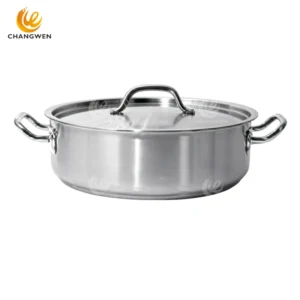
- 1 × Rondeau / braising pan — for oven and stovetop braising
- 1 × 16-inch stainless steel pan — large-format sauté for high-volume service or family-style presentations
Brand consistency simplifies maintenance, replacement ordering, and staff training. Well-regarded commercial brand cookware in the stainless steel category includes Vollrath, Winco, Browne Foodservice Thermalloy, and AllClad Commercial — all offering NSF-certified product lines with verified 304 construction.
NSF Certification: Why It Matters and What to Require
NSF International (formerly the National Sanitation Foundation) is the independent testing and certification body that sets food equipment safety standards globally. NSF commercial cookware certification is not just a marketing label — it has direct regulatory and operational implications.
What NSF Certification Confirms
- Material safety: The materials used do not leach harmful chemicals into food at commercial use temperatures
- Sanitary design: The product can be adequately cleaned and sanitized — no porous surfaces, crevices, or design features that trap food particles and bacteria
- Durability: The product withstands commercial use conditions without degradation that compromises food safety
- Chromium content compliance: NSF requires a minimum of 16% chromium in stainless steel food equipment
Why It Matters Operationally
Most state and local health codes in the US require NSF-certified equipment in commercial kitchens. Health inspectors check for NSF markings on cookware and food equipment. Non-certified cookware can result in citations, failed inspections, and required replacement — at a higher cost than buying certified equipment in the first place.
For wholesale buyers and distributors, NSF commercial cookware certification is also the key differentiator when supplying institutional buyers (hospitals, schools, military) who require certification documentation in procurement specifications.
What to Request
- NSF Listing Number for the specific product or product line
- Certification scope confirmation — which materials and configurations are covered
- Current certification validity — NSF certifications require periodic renewal
Commercial Nonstick Pan vs. Stainless Steel: When to Use Each
Commercial nonstick pans have a specific and limited role in a professional kitchen. Understanding when nonstick adds value — and when stainless steel is the correct choice — prevents expensive coating failures and food safety issues.
When to Use a Commercial Nonstick Pan
- Eggs and delicate proteins — eggs, fish fillets, and other proteins that require low-stick performance and lower cooking temperatures benefit from nonstick surfaces
- Crêpes and pancakes — thin batters that require perfect release without added fat
- Low-heat sauce work — reheating or finishing delicate sauces that would scorch on stainless
Key limitations of commercial nonstick: PTFE (Teflon) and ceramic nonstick coatings degrade under high heat — typically above 500°F (260°C) for PTFE. They scratch easily with metal utensils, chip over time, and require replacement far more frequently than stainless. In a commercial kitchen, a nonstick pan’s realistic service life is 12–24 months under daily use.
Never use a commercial nonstick pan for: High-heat searing, deglazing, oven work above 450°F, or any application where metal utensils are unavoidable.
When Stainless Steel Is the Correct Choice
- Searing and browning — the Maillard reaction requires high, dry heat that degrades nonstick coatings
- Deglazing and pan sauces — stainless develops fond (the browned bits that form the base of pan sauces) where nonstick doesn’t
- Acidic cooking — wine, tomatoes, citrus — all fine in stainless, all potentially damaging to nonstick surfaces
- Oven transfer — stainless handles oven temperatures that destroy nonstick coatings
- High-volume, high-frequency use — stainless outlasts nonstick by years in daily commercial service
The practical rule: Use nonstick for the 10–15% of cooking tasks where delicate release is the priority. Use stainless steel for everything else.
Choosing the Right Pan Size: Including the 16-Inch Standard
Pan size selection in a commercial cookware context is driven by service volume, burner compatibility, and specific cooking tasks — not home kitchen logic.
Standard Commercial Pan Sizes and Applications
| Pan Size | Primary Application | Notes |
|---|---|---|
| 8″ | Sauces, single portions, sautéed garnishes | Station staple |
| 10″ | 2–3 portion sauté, eggs, small proteins | Most versatile size |
| 12″ | 4–6 portion sauté, large proteins, family-style | High-demand service pan |
| 16″ Stainless Steel Pan | High-volume service, large batch sauté, family-style presentations | Requires large commercial burner |
| 18″+ | Industrial volume cooking, large-batch production | Commissary / institutional |
The 16-Inch Stainless Steel Pan
The 16 in stainless steel pan (also referenced as a 16-inch commercial sauté pan) is the large-format workhorse of high-volume restaurant kitchens. It handles:
- Large batch protein cooking — multiple chicken breasts, fish portions, or steaks in a single pan reduces ticket time during service rushes
- Family-style and large-format presentations — restaurant concepts that serve large tables benefit from a pan that can plate or present at scale
- Pasta station finishing — tossing large batches of pasta with sauce in a single pan is standard practice in Italian restaurants
- Reduction and sauce concentration — the large surface area of a 16 in stainless steel pan accelerates liquid evaporation for sauce reduction
Burner compatibility note: A 16-inch pan requires a commercial burner with sufficient BTU output and grate diameter to support stable, even heating across the full plate. Confirm compatibility with your range before ordering large-format commercial cookware.
FAQ
What is the best grade of stainless steel for commercial cookware?
304 stainless steel (18/8 or 18/10) is the commercial kitchen standard. It contains 18% chromium and 8–10% nickel, providing excellent corrosion resistance, non-reactive food contact, NSF certifiability, and long service life under daily commercial use. For kitchens with heavy seafood menus or highly acidic cooking, 316 stainless steel (which adds molybdenum) provides superior corrosion resistance to salt and acid. Avoid 200-series steel (201, 202) in commercial cookware — it substitutes manganese for nickel and delivers inferior corrosion resistance.
What does NSF certification mean for commercial cookware?
NSF International certifies that a cookware product meets food safety, sanitation, and material standards for commercial food service use. For stainless steel, NSF certification confirms: minimum 16% chromium content, no harmful chemical leaching into food, sanitary design that can be adequately cleaned, and durability under commercial conditions. Most state and local health codes in the US require NSF-certified equipment in commercial kitchens. Always request the NSF Listing Number — not just a marketing claim — before purchasing NSF commercial cookware.
How to use a stainless steel pan without food sticking?
The key is proper preheating. Heat the empty pan on medium-high for 2–3 minutes. Test readiness with the Leidenfrost test: flick water droplets into the pan — if they form rolling beads that skitter across the surface (rather than immediately evaporating or splattering), the pan is at the correct temperature. Add oil, let it shimmer and coat the surface (about 30 seconds), then add food. Never move proteins immediately — let them sear until they release naturally from the surface, usually 2–4 minutes. Forcing early movement causes tearing and sticking. This single technique change eliminates 90% of sticking complaints with commercial stainless steel cookware.
What is the difference between a commercial cookware set and a standard cookware set?
A commercial cookware set (or commercial grade stainless steel cookware set) is built to different specifications than consumer cookware: heavier gauge metal, riveted rather than welded handles, NSF certification, higher heat tolerance, dishwasher-rated construction, and conforming to commercial kitchen size standards. Consumer cookware is designed for home use — lighter construction, lower heat ratings, and often without NSF certification. Using consumer cookware in a commercial kitchen typically results in rapid warping, handle failure, coating degradation, and potential health code violations.
When should I use aluminum pans instead of stainless steel in a commercial kitchen?
Use aluminum pans in commercial kitchens when speed of heating is the priority and the menu doesn’t involve acidic ingredients. Aluminum conducts heat significantly faster than stainless steel, making it ideal for high-volume cooking where rapid temperature changes are needed. Hard-anodized aluminum pans are non-reactive and NSF-compliant, suitable for most commercial applications. Avoid bare aluminum for acidic sauces, wine, tomato, or citrus dishes — the metal reacts with acid, pitting the pan and potentially affecting flavor. Carbon steel pans are preferred over aluminum when high-heat searing or wok-style cooking is the goal.
What size commercial stainless steel pan does a restaurant need?
Most commercial kitchens maintain a core collection of 8″, 10″, and 12″ pans for daily service — these cover single-portion, multi-portion, and medium-batch cooking. High-volume restaurants add a 16 in stainless steel pan for large-batch production and family-style service. Sauce pans typically range from 1.5 to 4 quarts; stock pots from 8 to 20 quarts depending on volume. The correct size selection depends on your menu, service volume, and burner size. When building a commercial stainless steel cookware set, prioritize the 10″ and 12″ sizes for station deployment and keep the 16″ for specific high-volume applications.
Conclusion
Choosing commercial stainless steel cookware for your restaurant is a long-term investment decision — not a one-time purchase. The right cookware, bought to the right specification, serves your kitchen for a decade or more. The wrong cookware — under-spec steel, poor construction, no NSF certification — costs far more in replacement cycles, food quality issues, and staff frustration than the initial price difference.
The framework is straightforward:
- Start with 304 (18/10) stainless steel as your baseline material — it’s the commercial standard for good reason
- Choose tri-ply full-clad construction for sauté and sauce work; encapsulated base is acceptable for stock pots
- Require NSF certification on every piece in your commercial kitchen
- Use aluminum and carbon steel strategically to complement stainless, not replace it
- Build a consistent commercial cookware set — same brand, same grade, matching lids — to simplify training, maintenance, and reordering
- Learn to use stainless steel correctly — proper preheating eliminates sticking and is the most valuable single technique change for any kitchen staff working with stainless
We manufacture and export commercial stainless steel cookware — tri-ply full-clad sets, individual pans from 8″ to 16″, stock pots, sauce pans, and complete commercial cookware sets in NSF-compliant 304 stainless — with over 20 years of experience supplying restaurants, hotel chains, and equipment distributors worldwide. Request full specifications, NSF documentation, and wholesale pricing using the contact form below.