Estimated reading time: 13 minutes.
An outdoor propane deep fryer is a good purchase when its usable oil volume, real batch throughput, burner input, temperature controls, and safety system match a defined menu and service peak. A large pot or a high BTU label alone cannot establish that fit. A wholesale buyer should ask for a model-specific specification sheet, compare performance under the same test load, and confirm that the supplied gas train and documentation match the destination market.
This guide is for importers, distributors, private-label brands, caterers, and operators evaluating complete outdoor propane deep fryers. It turns four commonly advertised features – capacity, BTU, thermostat, and safety – into questions that can be answered before an order is placed. Changwen's broader introduction to outdoor propane fryers covers general types and uses; this article focuses on how to compare a quotation, sample, and final specification.
Start with the menu and peak service, not a nominal fryer size
The right fryer size depends on the largest food load per batch, the number of batches needed during the busiest period, and the oil volume required to keep food submerged safely. A fryer for occasional wings has a different job from a twin-tank event station that must serve fish and fries at once. The buyer should define those jobs before comparing catalog capacities.
Write a one-hour peak service case with the menu item, portion weight, target servings, frying time per basket, and expected gap between batches. Divide the required food weight by the planned batch load to estimate the number of drops. Then add time for loading, draining, and oil recovery. This calculation is a planning model, not a claim that a stated fryer can actually achieve the output; the sample must be tested with the intended food.
For example, an event operator planning 24 kilograms of fried food in one busy hour with a 2-kilogram test batch needs 12 successful batches. If the product takes four minutes to cook and one minute to load and drain, the station already needs 60 minutes before allowing for any temperature recovery or interruptions. The example shows why a larger basket or a second independent tank may be necessary. It does not establish a universal kilograms-per-hour rating for any fryer.
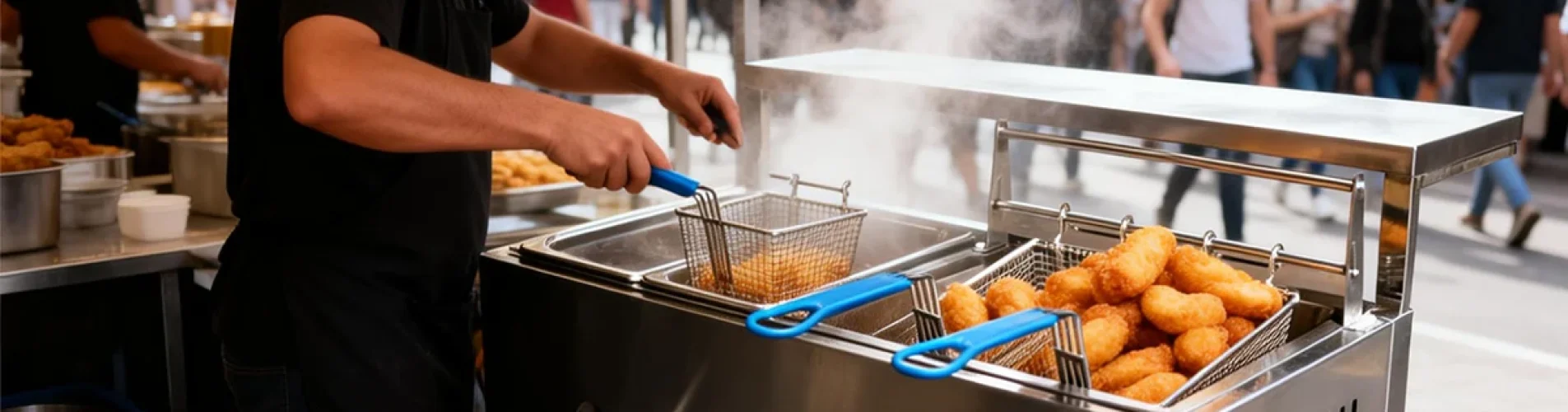
A single tank with two baskets can split one oil bath into smaller loads, but both baskets still share the same oil temperature. Two independent tanks can hold different oils or temperatures and isolate flavor transfer. The extra tank also increases oil inventory, footprint, cleaning time, and gas demand. Buyers should choose the configuration from the menu and operating rhythm, then compare the total system cost.
What does fryer capacity actually measure?
Outdoor fryer listings may state pot volume, maximum oil fill, basket capacity, or food output per hour as if the numbers were interchangeable. They are not. Pot volume describes the vessel to its brim; maximum oil fill is a lower, model-specific safe limit; batch load describes food placed in the basket; hourly output depends on heat recovery, cooking time, and workflow. A useful quotation labels all four separately.
| Capacity measure | What it answers | What to request |
|---|---|---|
| Pot or tank volume | How large is the physical vessel? | Internal dimensions and nominal volume, with units |
| Working oil range | How much oil may be used safely? | Marked minimum and maximum fill levels for the stated food and accessory |
| Basket or food load | How much product fits one drop? | Basket dimensions, rated load, and test-food definition |
| Measured hourly output | What can one station serve repeatedly? | Test method, food condition, setpoint, recovery criterion, and observed result |
Oil headroom matters because food displaces oil and wet food can make it bubble. A 30-quart pot does not authorize 30 quarts of oil. The maximum mark, food-size limit, and operator manual govern filling. The U.S. Consumer Product Safety Commission's fryer guidance warns against overfilling and gives a water-displacement method for a whole turkey when manufacturer instructions are unavailable. The vessel must be completely emptied and dried before oil is added; buyers should prioritize the manufacturer's model-specific instructions.
Basket geometry can limit throughput before vessel volume does. A narrow, deep basket may immerse a bulky item but prevent food from spreading into a thin layer. An open basket may take two smaller portions but offer better drainage. Request the basket's inside width, depth, handle reach, and fit with the stated oil level. For food that changes shape or clumps, test the actual product rather than assuming that two baskets double output.
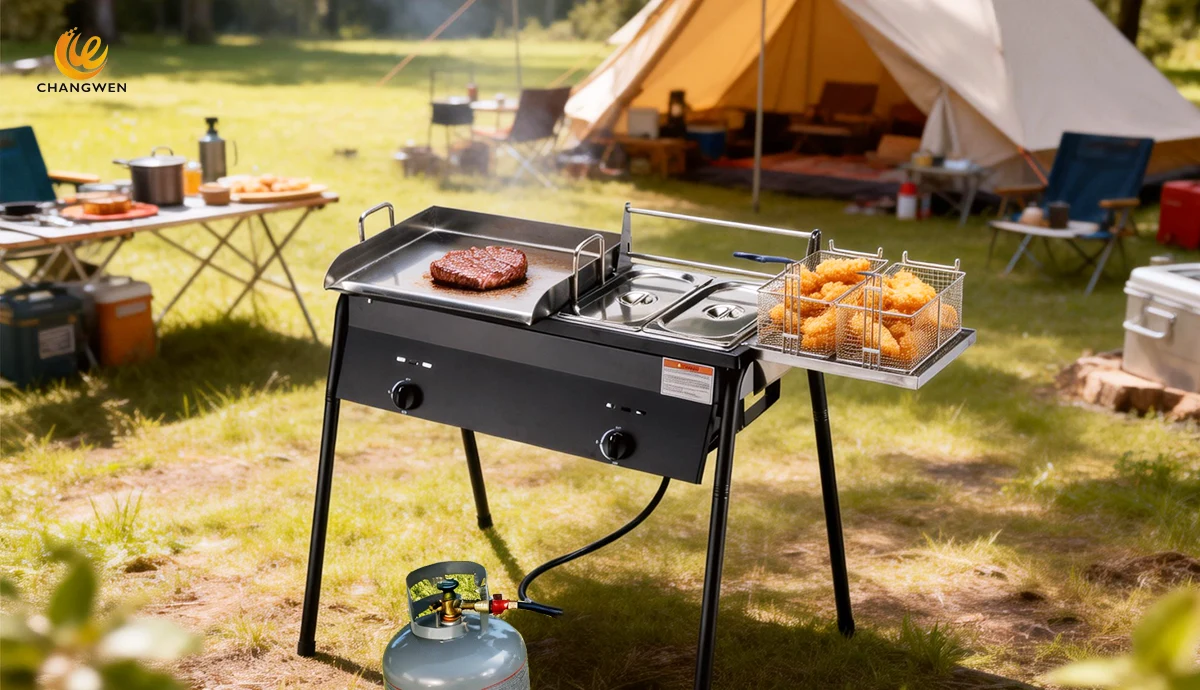
Large capacity has an operating cost as well as a purchasing cost. More oil takes time to heat, space to store, and a safe process to filter, cool, and dispose of. A buyer should compare cost per usable batch rather than assuming the biggest tank is the most economical. The calculation includes oil per fill, propane use under the intended duty cycle, cleaning labor, and the number of successful servings produced before an oil change.
How should buyers compare BTU ratings?
A BTU per hour rating states the burner's nominal fuel input rate, not heat delivered to the oil or food. Two fryers with the same stated input can have different heat-up and recovery times because burner geometry, pot material, oil volume, wind exposure, and control behavior differ. A high input may shorten delays, but it can also increase fuel demand and make temperature overshoot harder to control if the system lacks adequate regulation.
Ask whether the BTU figure applies to one burner or the complete appliance, and whether it is a maximum or a continuous rated input. For a twin-tank unit, request the input for each tank and the combined simultaneous demand. Confirm the specified fuel, operating pressure, regulator, hose, connector, and cylinder arrangement. A matching thread or hose diameter alone does not prove that a gas supply is suitable for the burner.
Compare performance with a repeatable test: state oil volume, starting oil temperature, target temperature, food mass and starting temperature, ambient conditions, and acceptable recovery endpoint. Record time to first setpoint, temperature drop after one batch, time back to setpoint, and behavior over several consecutive batches. A single fast preheat result cannot show whether the fryer keeps up with a busy service period.
Consider a hypothetical 80,000 BTU/h fryer and a 100,000 BTU/h fryer using the same tested oil volume. If the higher-input unit recovers only a little faster but consumes more propane under the service pattern, the lower-input unit may be the better choice. If the higher-input unit prevents a long queue without overshoot, it may earn its cost. This is why a buyer should request measured recovery and fuel-use data rather than rank models by BTU alone.
Fuel math provides an upper-bound planning check, not a runtime promise. The U.S. Energy Information Administration lists propane at about 91,452 BTU per U.S. gallon. At a hypothetical constant 90,000 BTU/h input, fuel energy demand is about 0.98 gallon per hour at full fire. Real burners cycle, cylinders have usable limits, and ambient temperature affects vapor delivery, so field consumption must be measured for the planned duty cycle and supply setup.
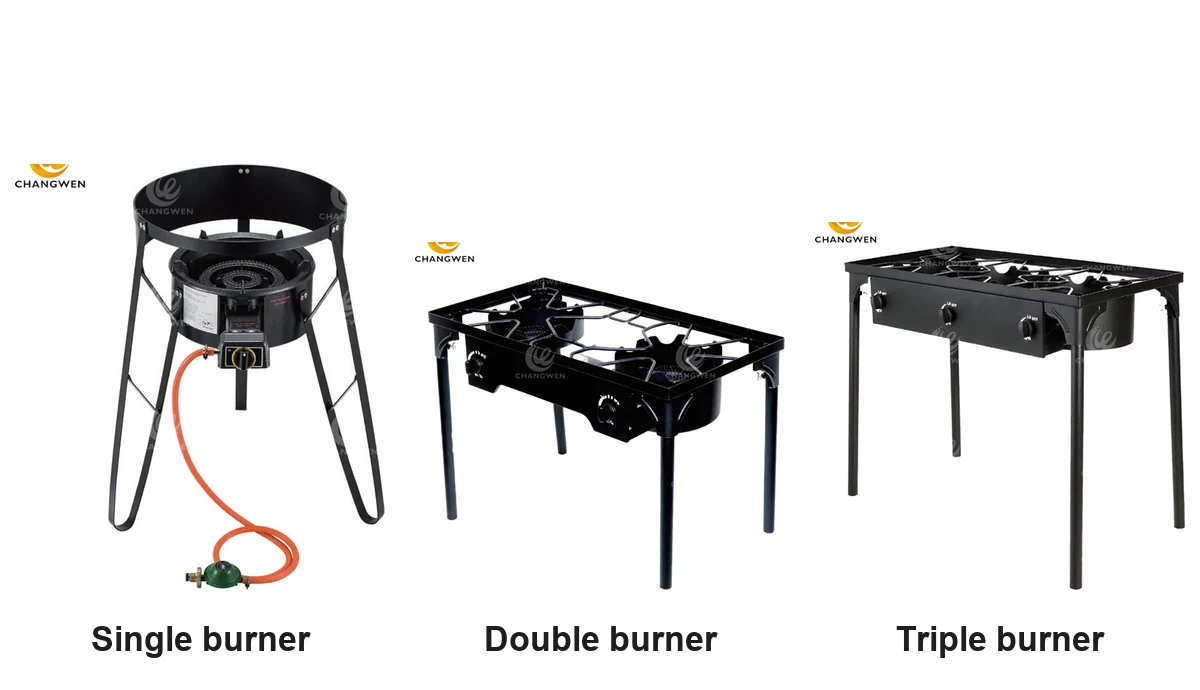
A separate Changwen burner configuration guide explains how independent heat zones affect outdoor cooking stations. A fryer purchase still needs a complete, approved fryer assembly: burner, vessel, stand, controls, hose, and regulator must be matched under the model's instructions.
Thermostat, thermometer, and high-limit control: what is the difference?
A thermometer displays or measures oil temperature; it does not necessarily turn the burner down. An operating thermostat senses temperature and controls heat around a selected setpoint. A high-limit device is a separate protective function intended to interrupt fuel if temperature exceeds a specified limit. A product listing that says "temperature control" may refer to any one of these, so the buyer should request a control diagram and component list.
Manual-valve fryers require an operator to watch a suitable oil thermometer and adjust the flame. Thermostat-controlled fryers can reduce routine adjustment, but they still require an operator and a functioning gas system. The presence of a dial does not prove its accuracy, and the presence of a display does not prove a high-limit shutdown. Buyers should verify the sensing point, operating range, setpoint tolerance, and response to a failed sensor or extinguished flame.
For a sample test, place an independent calibrated probe in the oil at a defined location and record temperature over several heat-and-load cycles. Compare the displayed value and the actual oil reading at low, middle, and high setpoints used by the menu. Record overshoot, undershoot, and recovery time. Agree on pass limits before testing; no single tolerance is suitable for every fryer design and destination requirement.
The high-limit device should be assessed as a safety component, not as a substitute for normal temperature control. Ask the manufacturer what event activates it, whether it cuts the gas supply, how it resets, and what happens after sensor failure or power loss if the model has electrical controls. Any functional test must follow the manufacturer's documented procedure and be performed by competent personnel; buyers should not create an unsafe overheat condition to prove a marketing claim.
Independent tanks need independent answers. If a dual-tank fryer has two setpoint knobs, confirm whether each tank also has its own temperature sensor and protective cutoff. A shared control may limit different-menu operation even when the appliance has two baskets. If a vendor cannot identify the actual control architecture in writing, compare the sample as an unverified configuration rather than assuming the feature exists.
Which safety features belong in the purchase specification?
The first safety decision is whether the equipment is intended for the proposed setting. An outdoor propane fryer must be used outdoors in an open, properly separated location under its manual and local rules. A product promoted as portable is not thereby suitable for a tent, garage, porch, enclosed trailer, or any indoor food-service space. If an operator needs an indoor installation, the buyer must specify a different appliance and have the site assessed under the applicable rules.
For outdoor use, specify a stable stand, secure vessel support, accessible gas shutoff, compatible regulator and hose, clear oil-level markings, legible instructions, and basket handles that keep hands away from the hot well. Evaluate wind protection only as a manufacturer-approved design feature; improvised wind screens can interfere with combustion or heat clearances. Where available, document flame-failure protection and independent high-limit shutdown as separate functions rather than listing a generic "safety system."
The CPSC's current cooking advice tells users to follow the manufacturer, avoid overheated or overfilled oil, keep the fryer away from the house, and stay with it while cooking. CPSC also warns that frozen or wet food can cause violent splashing, and that water must not be applied to a grease fire. The buyer should make these instructions visible in the manual, on product labels where appropriate, and in operator training; a control device cannot remove the need for supervision.
Oil draining is a safety and maintenance issue. A drain valve can reduce lifting of a full vessel, but it introduces a potential leak point. Check valve location, guard, cap, seal, accessibility, and whether the outlet can be opened inadvertently. Test for leakage according to the approved procedure at the intended temperature and after repeated cycles. Operators should drain or move oil only under the model's cooling instructions, never because a valve makes hot oil look convenient to handle.
A wheeled cart can make an empty fryer easier to move, yet movement during frying or while oil remains hot is a different risk. Specify wheel locks, load rating, handle position, and a storage arrangement for the cylinder. Verify that the appliance remains stable on the intended surface. The site plan should protect the public from hot oil, exposed hose runs, and traffic around the operator; a busy event requires more than an equipment-level checklist.
Do not treat a broad certification statement on a supplier website as proof that the quoted model is approved for a target market. Request the exact model identifier, gas configuration, applicable test or listing documents, certificate holder, scope, and expiration or validity conditions where relevant. Confirm requirements with the destination authority or a qualified local professional. A logo on a component does not establish approval of the full fryer assembly.
Safety information should travel with the product. A wholesale order should define the language of instructions, data plate details, warnings, carton marking, replacement-part numbers, and the process for design changes. Private-label artwork must not hide operating limits. A buyer should approve the final manual and labels alongside the sample, because a correctly built unit with unclear gas or fill instructions is still a weak market offer.
How should a wholesale buyer test a sample?
A sample evaluation should compare the delivered unit with the written specification before any cooking test. Check model and serial identification, vessel dimensions, materials, basket fit, welds, stand stability, drain assembly, regulator and hose markings, control locations, and label legibility. Photograph discrepancies and resolve them against drawings or approved limit samples. This prevents a good-looking demonstration unit from silently defining an incomplete production standard.
Functional testing should use a controlled outdoor location and competent operators. Record the oil fill, test-food mass, starting temperature, setpoint, ambient conditions, and times for preheat and repeated recovery. Check whether the thermometer and thermostat agree within the agreed criterion and whether the system responds as specified to ordinary shutoff and relighting steps. Confirm gas connections and protective functions only through the manufacturer's approved procedures.
Include an end-of-service evaluation: how the operator shuts down the gas, protects the cooling unit, filters or drains oil after safe cooling, cleans the tank, and stores the cylinder and accessories. If the model requires special tools, difficult access, or fragile parts for routine cleaning, that burden belongs in the buying decision. A product with fast heat-up can still be expensive to own if the service cycle is slow or hazardous.
For a pilot order, repeat the same checklist across multiple units instead of relying on one sample. Check consistency of dimensions, control behavior, gas components, packaging protection, and documents. Record defect types and corrective actions before volume release. The purchase agreement should state which changes require buyer approval; a substituted hose, regulator, valve, or sensor can materially change both performance and compliance.
A practical RFQ matrix for outdoor propane deep fryers
A useful request for quotation makes competing offers comparable. State the intended country, buyer type, food menu, peak-hour output, available outdoor footprint, cylinder arrangement, and target price position. Ask suppliers to respond to the same fields rather than accepting different marketing brochures. Changwen's outdoor propane fryer range shows possible product formats, while the final RFQ should define the exact model and configuration.
| RFQ field | Buyer question | Evidence to request |
|---|---|---|
| Capacity | What are nominal vessel volume, marked oil range, and tested basket load? | Drawing, fill markings, basket dimensions, manual |
| Heat input | Is BTU/h per tank or total, and at what fuel pressure? | Data plate, gas-train specification, test conditions |
| Temperature | Is there a thermometer, operating thermostat, and independent high limit? | Control diagram, component list, sample test record |
| Safety | What protects against flame loss, oil overflow, leaks, and instability? | Functional descriptions, instructions, relevant model documents |
| Commercial terms | What is included, customized, tested, and supported? | Bill of materials, artwork proof, packaging, spares, warranty terms |
Quote comparison should include the same accessories. One offer may include baskets, a thermometer, hose, regulator, drain assembly, and labeled cartons, while another prices them separately. Freight dimensions, packed weight, spare parts, sample approval, and testing costs can change the landed cost. A buyer should compare a complete, usable system and reject any line item that remains ambiguous.
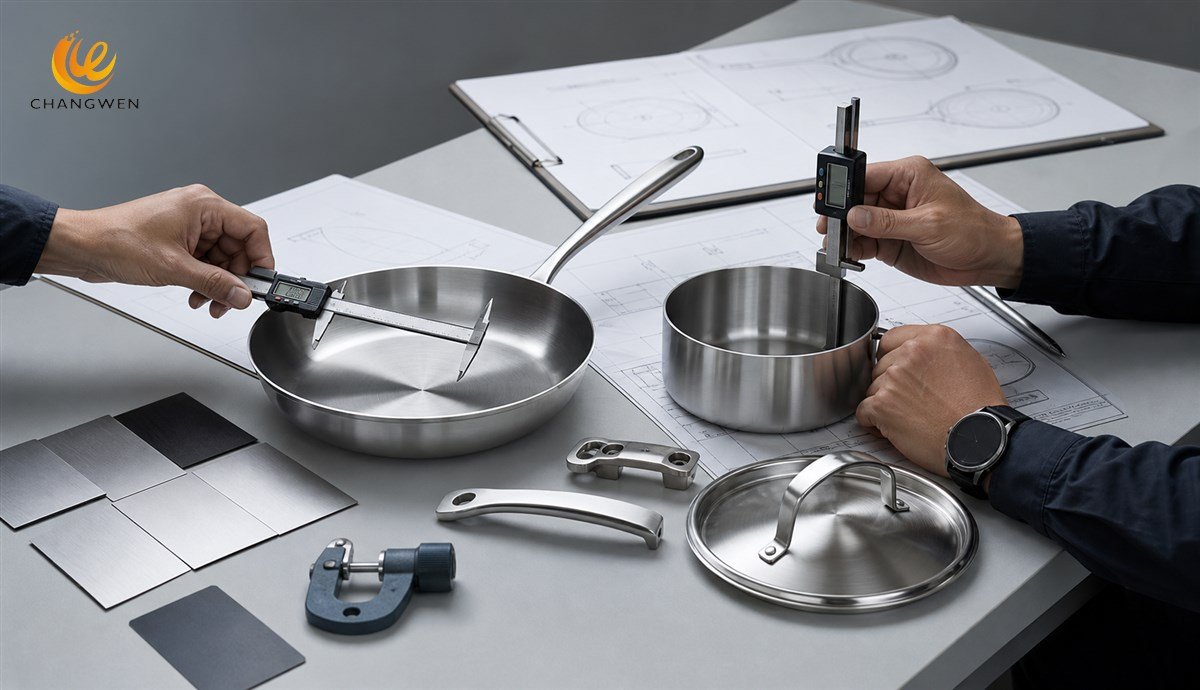
Private-label and OEM choices should be specified by component. A logo or carton design can use an established platform; a new vessel, control layout, burner, or gas configuration may require new engineering review, tooling, testing, and documentation. Ask which changes are cosmetic and which alter the approved model. For broader sourcing questions, Changwen's manufacturer sourcing overview can help frame supplier due diligence, but the actual quoted configuration still needs independent verification.
Frequently asked buying questions
Can two baskets replace two independent tanks?
Two baskets improve portion handling in one oil bath, but both share one temperature and one oil flavor profile. Two independent tanks can support different foods or setpoints, at the cost of more equipment, oil, cleaning, and gas demand. Choose from the menu's simultaneous tasks and test the complete station during peak service.
What should a buyer approve before a bulk order?
Approve a production-representative sample, exact model and bill of materials, marked oil range, gas-train specification, temperature-control design, relevant market documents, manuals, labels, packaging, and acceptance criteria. Record the agreed performance test and change-control rules. A catalog photograph or generic certification claim cannot replace these approvals.
Build a verifiable fryer specification with Changwen
Changwen supplies commercial kitchen equipment and supports wholesale, private-label, and OEM/ODM projects for importers, distributors, brands, and catering buyers. Its product range includes outdoor cooking equipment alongside cookware and food-service smallwares. A buyer can discuss vessel size, configuration, branding, packaging, and a model-specific sample plan without assuming that every option or certification applies to every variant.
Send Changwen your destination market, menu, peak service target, intended oil range, preferred tank layout, desired BTU and control functions, safety-document requirements, branding plan, quantity, and launch schedule. Ask for a written specification and sample acceptance method before committing to volume. Contact Changwen for a wholesale or OEM fryer quotation that can be reviewed against the same criteria used in this guide.