Quick answer: A single propane burner suits one large pot or comal and the lowest cost per station. A double burner is the standard choice for caterers and food stalls that need two heat zones at once. A triple burner fits high-volume menus that run three pots or a griddle plus pots at the same time. Choose the burner count from how many pots must be on high heat at the same moment, then size the BTU, propane supply, frame height and footprint around that number.
This guide is written for restaurant owners, caterers, food truck and street food operators, event cooks and the distributors who supply them. It compares single, double and triple propane burners for commercial outdoor cooking and adds the planning details that most buying guides leave out: propane consumption math, cylinder sizing, pot and load matching, footprint and layout, and the specifications wholesale buyers should confirm before ordering. For connector types and pressure systems, see our ultimate propane burner buying guide.
What do most propane burner buying guides cover, and what do they miss?
The top-ranking propane burner guides explain that higher BTU heats faster, that a bigger burner suits bigger pots, that square and shorter stands are more stable than tall round ones, and that a double burner allows multitasking. They also recommend stainless or heavy steel construction, reliable ignition, a wind guard and leak testing with soapy water. Most of this advice is written for backyard or outdoor kitchen use.
Commercial buyers need more than that. The common guides rarely show how to convert BTU into propane consumption, how long a cylinder will last, how to size the burner count to a menu, how much weight a frame must carry with a full stock pot, or what a distributor should specify for wholesale and private label orders. This guide answers those questions with tables and worked examples.
What is the difference between single, double and triple propane burners?
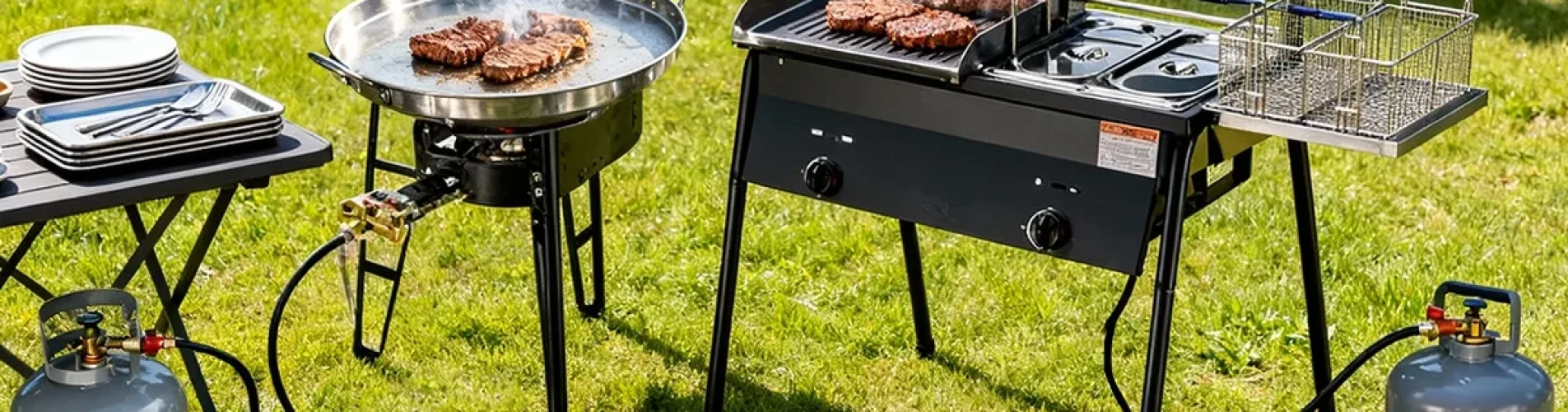
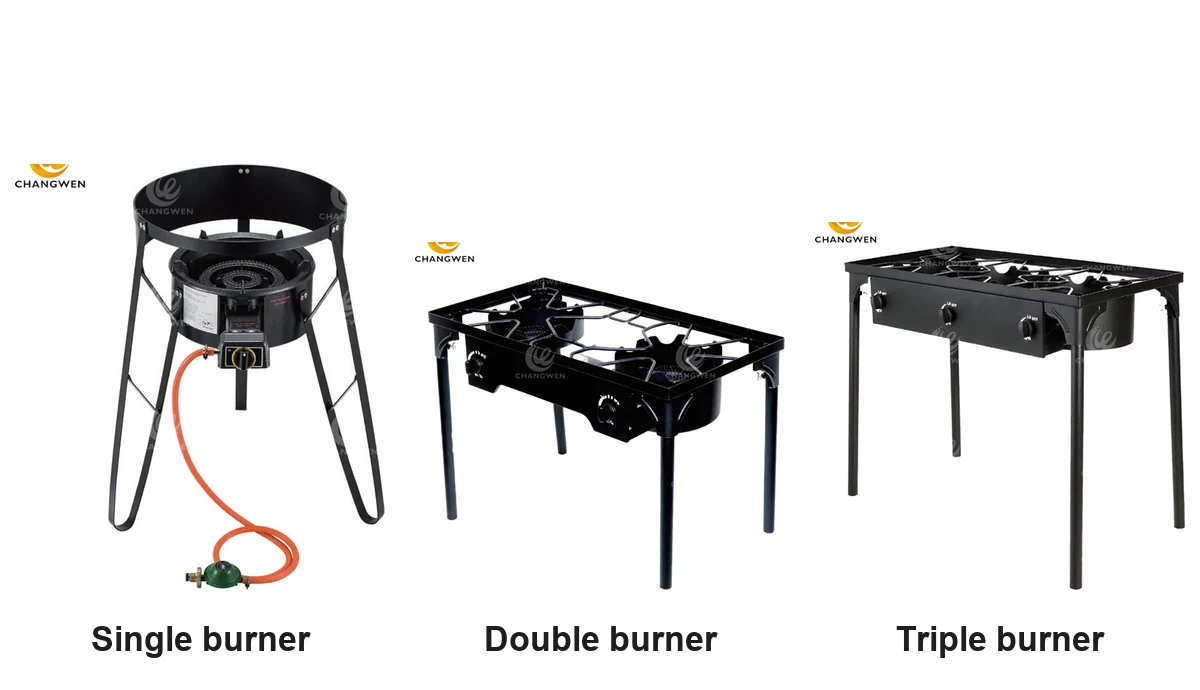
The difference between single, double and triple propane burners is the number of independent heat zones on one frame. A single burner has one burner head and one control valve, a double burner has two, and a triple burner has three. Each additional burner adds cooking capacity and flexibility, but it also adds width, weight, propane demand and cost.
| Feature | Single burner | Double burner | Triple burner |
|---|---|---|---|
| Heat zones | 1 | 2 | 3 |
| Example size (Changwen model) | 310 x 310 x 400 mm (CKP-X086) | 785 x 400 x 740 mm (CKP-X079) | 875 x 450 x 740 mm (CKP-X080) |
| Best for | One large stock pot, comal, wok or fryer pot | Two pots, or a pot plus a griddle or comal | Three pots, or a griddle plus two pots |
| Typical users | Seafood boils, brewing, taco stands, backup station | Caterers, food stalls, event kitchens | High-volume caterers, festivals, camp kitchens |
| Propane demand | Lowest | Medium | Highest |
| Portability | Easiest to move and store | Moderate, usually with removable legs | Heaviest and widest |
Low single burners, such as a 400 mm high stand, keep heavy stock pots close to the ground, which makes them safer for boiling large volumes of liquid. Double and triple burners usually stand at a working height of about 740 mm, which is more comfortable for stirring, flipping and moving pans during long service periods.
How many propane burners does a commercial outdoor operation need?
A commercial outdoor operation needs one burner for every pot or pan that must be on direct high heat at the same moment during peak service. Count the simultaneous tasks on the busiest part of the menu, not the total number of dishes. A menu with ten items may only need two burners if most items are held warm, while a menu with four items can need three burners if they all cook to order.
Adding one spare heat zone is often worth the cost. A spare burner lets staff bring a new batch to temperature while the current batch is still being served, which removes the gap that slows lines during busy periods.
| Operation | Typical simultaneous tasks | Recommended setup |
|---|---|---|
| Seafood boil or crawfish service | One large boil pot | Single burner, low stand, plus a backup single |
| Taco or tortilla stand | Comal plus one pot of fillings | Double burner, or a single burner with a comal set plus a second single |
| Event catering | Rice or pasta pot plus sauce or protein pan | Double burner per menu line |
| Festival or high-volume stall | Griddle plus two pots | Triple burner, or a double plus a single |
| Camp or work-site kitchen | Three meal components at once | Triple burner |
| Home brewing or canning business | One large kettle | Single heavy-duty burner |
Two single burners can replace one double burner when flexibility matters more than footprint. Separate singles can be placed at different heights, moved independently and kept running if one unit needs service. A double or triple burner, on the other hand, gives a single stable worktop and fewer hoses and connections to manage.
How much BTU does each propane burner need?
The BTU each propane burner needs depends on pot size, liquid volume and how fast the food must come to temperature. Boiling a large pot of water or frying in deep oil needs high output, while simmering sauces, holding food warm or cooking on a comal needs moderate, well-controlled heat. A burner that can be turned down smoothly is often more useful than a burner with a very high maximum rating.
Always check whether a BTU figure is quoted per burner or for the whole unit. A triple burner rated at a combined total delivers only one third of that figure under each pot. Also check whether the burner is a high-pressure or low-pressure design, because the regulator and connection type change both the output and the applications. Our single burner propane stove guide explains how one burner head is sized for different tasks.
| Cooking task | Heat requirement | Burner choice |
|---|---|---|
| Boiling large stock pots, seafood boils | Very high, sustained | High-pressure burner, low stand |
| Deep frying in a pot | High, with stable control | High-pressure burner with an adjustable valve |
| Stir frying in a wok | High, concentrated flame | Single burner with a wok ring |
| Comal and griddle cooking | Moderate, even heat | Burner matched to the plate diameter |
| Sauces, beans, holding | Low to moderate | Any burner with good low-flame control |
How do you calculate propane consumption for single, double and triple burners?
Propane consumption is calculated by dividing the total BTU per hour of the burners in use by the energy content of propane. One pound of propane contains about 21,600 BTU, and one US gallon contains about 91,500 BTU. A burner running at 60,000 BTU per hour therefore burns about 2.8 pounds of propane per hour at full output.
Burners rarely run at full output for the whole service. Multiplying by a duty factor, for example 50 percent for a mix of boiling and simmering, gives a more realistic figure. The table below uses an example rating of 60,000 BTU per burner to show how burner count changes cylinder runtime. Replace the rating with the actual specification of your burner.
| Setup (60,000 BTU per burner example) | Total BTU per hour | Propane at full output | 20 lb cylinder at full output | 20 lb cylinder at 50 percent duty |
|---|---|---|---|---|
| Single burner | 60,000 | About 2.8 lb per hour | About 7 hours | About 14 hours |
| Double burner | 120,000 | About 5.6 lb per hour | About 3.6 hours | About 7 hours |
| Triple burner | 180,000 | About 8.3 lb per hour | About 2.4 hours | About 4.8 hours |
This calculation shows why a triple burner on a single 20 lb cylinder can run out of fuel in the middle of a lunch service. High-volume operators should plan propane supply in the same way they plan food stock, with a calculated quantity for each event and at least one full spare cylinder on site.
Which propane cylinder size works best with each burner type?
The best propane cylinder size depends on total burner demand and service length. A 20 lb cylinder is convenient for a single burner or short events. A 30 lb or 40 lb cylinder suits double burners and full-day service. Triple burners and multi-burner stations often run more reliably from a 100 lb cylinder or from several cylinders, one per unit.
| Cylinder size | Approximate energy content | Best match |
|---|---|---|
| 20 lb | About 432,000 BTU | Single burner, short events, backup supply |
| 30 lb | About 648,000 BTU | Double burner, half-day to full-day service |
| 40 lb | About 864,000 BTU | Double or triple burner, full-day service |
| 100 lb | About 2,160,000 BTU | Triple burners and fixed outdoor stations |
Cylinder size also affects how much gas can vaporize per hour. A small cylinder feeding a large burner load can lose pressure, and the effect is stronger in cold weather when the cylinder surface frosts. If flames weaken during long high-output cooking, the cause is often vapor supply rather than the burner, and a larger cylinder or a separate cylinder per burner usually solves it.
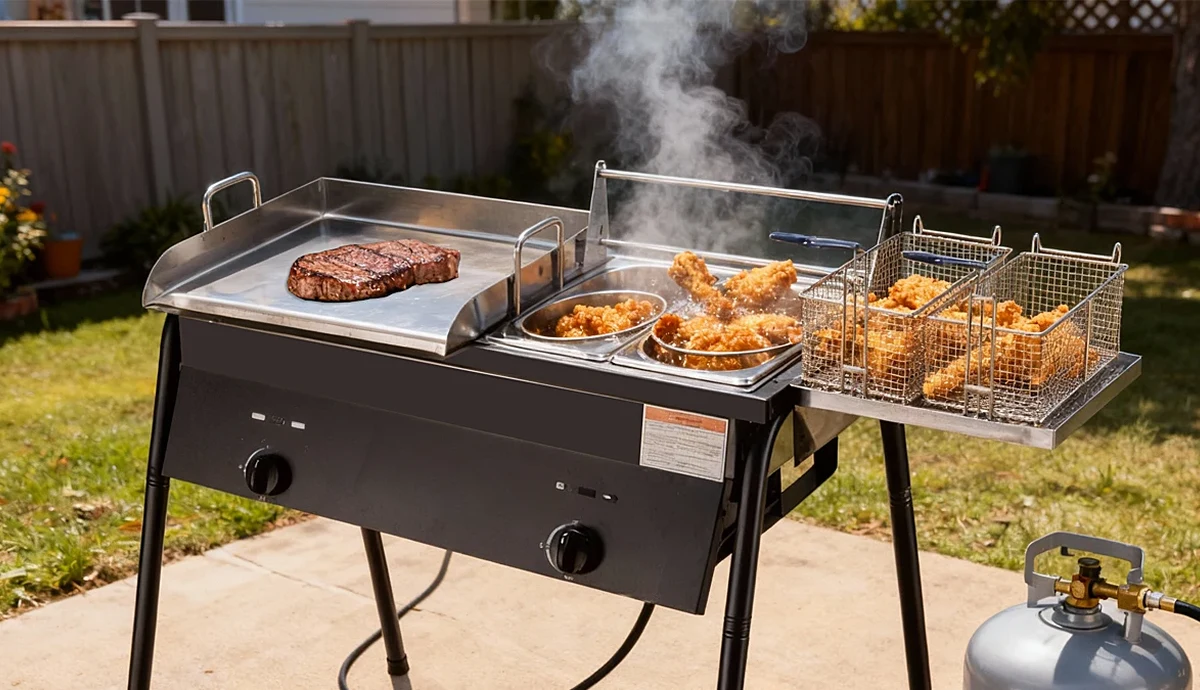
What pot sizes and loads can each propane burner handle?
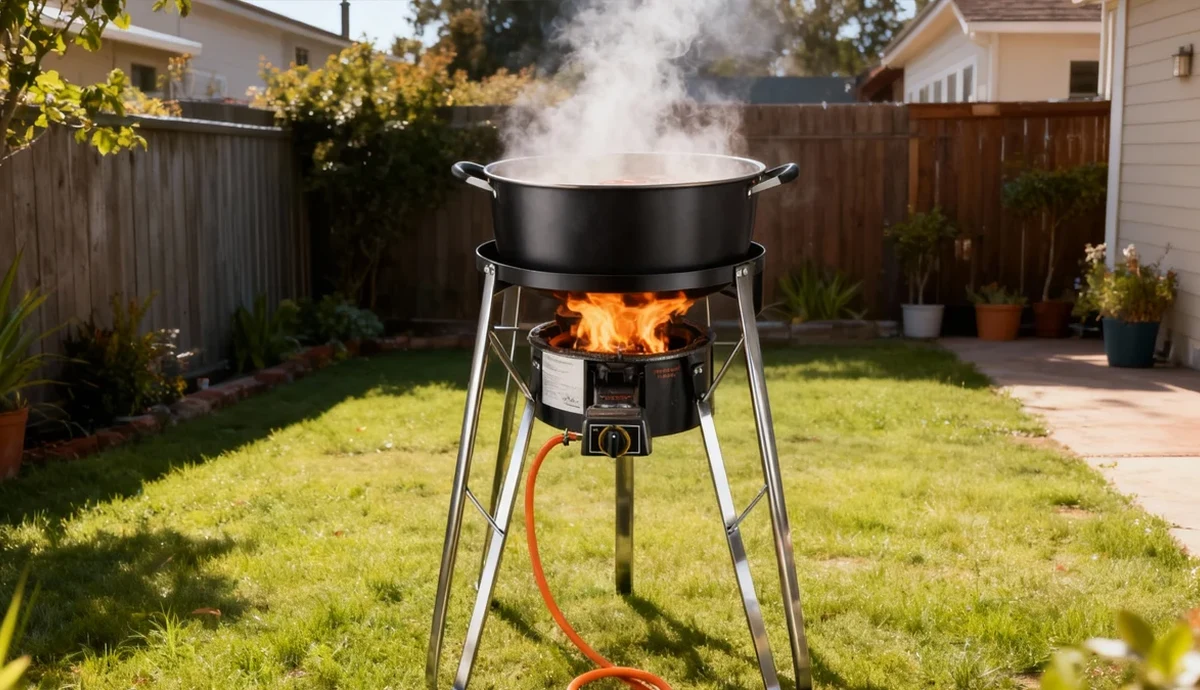
The pot size a propane burner can handle depends on the burner head diameter, the support ring or grate, and the load the frame can carry safely. Water weighs about 1 kilogram per liter, so a 60 quart stock pot filled with liquid weighs about 57 kilograms plus the weight of the pot itself. A frame that is stable with an empty pot can become unstable when the pot is full and staff are stirring it.
| Stock pot size | Approximate liquid weight when full | Recommended burner type |
|---|---|---|
| 20 to 30 quart | About 19 to 28 kg | Any burner zone on a double or triple unit |
| 40 quart | About 38 kg | Single burner or the center zone of a sturdy frame |
| 60 to 80 quart | About 57 to 76 kg | Low single burner with a wide, square stance |
| 100 quart and above | About 95 kg or more | Low heavy-duty single burner only |
Matching the pot base to the burner ring also improves efficiency. A pot that is much smaller than the flame wastes heat up its sides, and a pot that is much larger than the ring heats unevenly. Our guide to stock pot sizes for restaurants helps operators choose pot capacity, and the commercial stock pots buying guide explains material and base thickness.
How much space does a single, double or triple burner station need?
A propane burner station needs space for the unit itself, the cylinder, the operator and a clear safety zone around open flames. The footprint of the burner is only the starting point. Staff need room to move heavy pots, and cylinders need to sit upright, away from direct heat and foot traffic.
Using the Changwen models as examples, a compact single burner occupies about 310 x 310 mm, a double propane burner about 785 x 400 mm and a triple propane burner about 875 x 450 mm. Two separate single burners plus their cylinders usually take more total space than one double burner with one cylinder.
- Place burners on level, non-combustible ground or a stable surface.
- Keep the cylinder upright and positioned so the hose does not cross walkways or hot surfaces.
- Leave clear space between burners, tents, walls and other combustible materials according to the manufacturer instructions and local fire rules.
- Use wind guards or position the station so wind does not blow flames sideways or out.
- Keep a suitable fire extinguisher within reach of every cooking line.
Which construction details matter in a commercial propane burner?
The construction details that matter most in a commercial propane burner are the burner head material, frame thickness and bracing, valve and regulator quality, and the finish that protects the frame outdoors. A burner that is used every day at events or food stalls is exposed to heat cycles, heavy loads, spills and weather, so small differences in build quality become large differences in service life.
| Component | What to look for | Why it matters |
|---|---|---|
| Burner head | Cast iron or heavy-gauge steel, even flame ports | Resists warping and gives an even flame pattern |
| Frame and legs | Thick steel, cross bracing, secure leg fixing | Carries full pots without wobbling |
| Grate or pot support | Wide contact area matched to pot sizes | Keeps pots stable and centered over the flame |
| Control valves | One valve per burner with smooth adjustment | Allows independent heat control in each zone |
| Regulator and hose | Correct pressure and connector for the market | Ensures safe, consistent gas supply |
| Finish | Heat-resistant coating on steel parts | Slows rust in outdoor use |
Heavy cast iron burner heads, such as a cast iron single propane burner, hold heat well and tolerate long high-output use. For portable work, removable legs reduce storage space and shipping volume without weakening the frame when they are assembled correctly.
What safety checks should commercial users run before each service?
Commercial users should check the hose, regulator, connections and cylinder before every service, because most outdoor propane incidents start with a damaged hose, a loose fitting or a cylinder placed too close to heat. A short routine takes only a few minutes and protects staff, customers and equipment.
- Inspect the hose for cracks, kinks and heat damage, and replace it if any damage is found.
- Check that the regulator matches the burner and that all fittings are tight.
- Test new or disturbed connections with soapy water and look for bubbles before lighting.
- Light the burner with the valve at a low setting and confirm a steady blue flame.
- Never leave a burner running unattended, especially with oil.
- Turn off the cylinder valve first at the end of service, then the burner valves.
Many markets also require specific product certifications or approvals for gas appliances used in commercial settings. Operators should confirm local rules, and distributors should confirm the certification and labeling requirements of each destination market before ordering.
What should distributors specify when buying propane burners wholesale?
Distributors buying propane burners wholesale should specify the burner count and model, burner head material, frame dimensions and finish, regulator pressure and connector type for the destination market, hose length, packaging and labeling, and the spare parts supplied with each order. A written specification prevents a factory from changing a regulator, coating or frame gauge between orders without notice.
| Specification item | Example decision | Reason to fix it in writing |
|---|---|---|
| Model range | Single, double and triple burners from one frame family | Shared parts simplify stock and service |
| Regulator and connector | Matched to the destination market | Avoids returns and safety issues |
| Hose length | Fixed length per model | Affects layout and compliance |
| Finish and color | Heat-resistant black or custom color | Keeps the product line consistent |
| Packaging | Knock-down legs, foam protection, printed carton | Reduces freight volume and damage |
| Labeling | Model, warnings, brand and batch information | Supports traceability and market rules |
| Spare parts | Regulators, hoses, knobs, burner heads | Allows fast after-sales service |
Before a bulk order, distributors should test samples under real conditions: light each burner, run it at full and low output, load the frame with a full pot and check the flame in wind. For the documents a factory needs to quote accurately, see what an OEM RFQ must contain and questions to ask a manufacturer before ordering.
Single, double or triple propane burner: which one should you choose?
Choose a single propane burner when one large, heavy pot or a comal is the main cooking task, when portability matters most, or when you need a backup station. Choose a double burner when service needs two heat zones at the same time, which covers most catering and food stall menus. Choose a triple burner when three components cook to order at once or when a griddle and two pots must run side by side.
| Decision factor | Single | Double | Triple |
|---|---|---|---|
| Simultaneous high-heat tasks | 1 | 2 | 3 |
| Heaviest pots | Best (low stand) | Good | Good on a braced frame |
| Propane planning | Simple | Moderate | Needs larger supply |
| Space needed | Smallest | Medium | Largest |
| Upfront cost per unit | Lowest | Medium | Highest |
| Cost per heat zone | Highest | Lower | Lowest |
Frequently asked questions
Is a double propane burner better than two single burners?
A double propane burner is better when you want one stable worktop, one cylinder connection and a fixed working height. Two single burners are better when you need to place heat zones at different heights or locations, or when one unit must keep running while the other is moved or serviced.
How long does a 20 lb propane cylinder last on a triple burner?
A 20 lb propane cylinder holds about 432,000 BTU. On a triple burner rated at 60,000 BTU per burner, that is about 2.4 hours with all three burners at full output, or about 4.8 hours at an average of 50 percent output. Higher-rated burners shorten the runtime.
Can a triple propane burner hold three large stock pots at once?
A triple propane burner can hold three pots only if the pot diameters fit side by side and the frame is rated for the combined weight. Very large pots of 60 quarts and above are safer on a low single burner, while a triple burner works best with medium pots, pans and a griddle.
Which propane burner is best for a taco or tortilla business?
A taco or tortilla business usually works best with a double burner or with a single burner and comal set plus a second burner for fillings. The comal needs even, moderate heat across its surface, while the second zone keeps meat or beans hot. See our commercial comal buying guide for plate options.
Can propane burners be used indoors in a restaurant?
Outdoor propane burners are designed for open-air use and should not be used indoors, because they need ventilation to remove combustion gases and they are not built to indoor kitchen appliance standards. Indoor kitchens need appliances installed and approved for indoor commercial use.
Can propane burners be made under my own brand?
Yes. Factories that offer OEM and ODM service can produce single, double and triple propane burners with your logo, color, packaging and regulator configuration for your market. Confirm the specification, samples and packaging artwork in writing before mass production. Our article on OEM vs ODM explains which model suits your brand.
Source single, double and triple propane burners from Changwen
Changwen (Jiangmen Changwen Cookware and Kitchenware Co., Ltd.) is a commercial kitchen equipment manufacturer in Xinhui District, Jiangmen, Guangdong, China. The company integrates research and development, design, manufacturing and sales, and supplies outdoor kitchen equipment, stainless steel cookware, buffet equipment, service carts and complete restaurant kitchen solutions to foodservice buyers worldwide.
For distributors, importers, catering suppliers and brand owners, Changwen offers:
- A full propane burner range, including compact single burners, single burners with stands, cast iron burners, double and triple propane burners and comal sets.
- Matching outdoor equipment such as outdoor propane deep fryers and commercial stock pots, so one supplier can cover a complete outdoor cooking program.
- Wholesale supply for distributors and importers.
- OEM and ODM customization, including private label logos, colors, packaging and market-specific regulator and connector configurations.
- Samples for testing before bulk orders.
To plan your burner range or request a quote, send us the models you need, your target market, order quantity and branding requirements. Contact Changwen on WhatsApp at +86-18022963948, email info@cwchangwen.com, or use the contact page. You can also learn more about Changwen and our factory.