When it comes to preparing large batches of soup, stock, or pasta in a professional kitchen or serious home setup, a commercial-grade stainless steel stock pot is indispensable. Whether you’re searching for large commercial stainless steel stock pots, options with convenient spigots, or the best commercial grade stainless steel pots for your budget, this comprehensive guide covers everything you need to make an informed decision.
In today’s professional kitchens, the right commercial stockpot can mean the difference between efficient meal preparation and constant frustration. From small cafes to large catering operations, chefs rely on these workhorses daily to create flavorful stocks, hearty soups, and bulk preparations. This guide will walk you through sizes, materials, special features, top brands, and everything else you need to know to choose the perfect commercial stock pot stainless steel for your needs.
What is a Commercial Stock Pot and Why Stainless Steel?
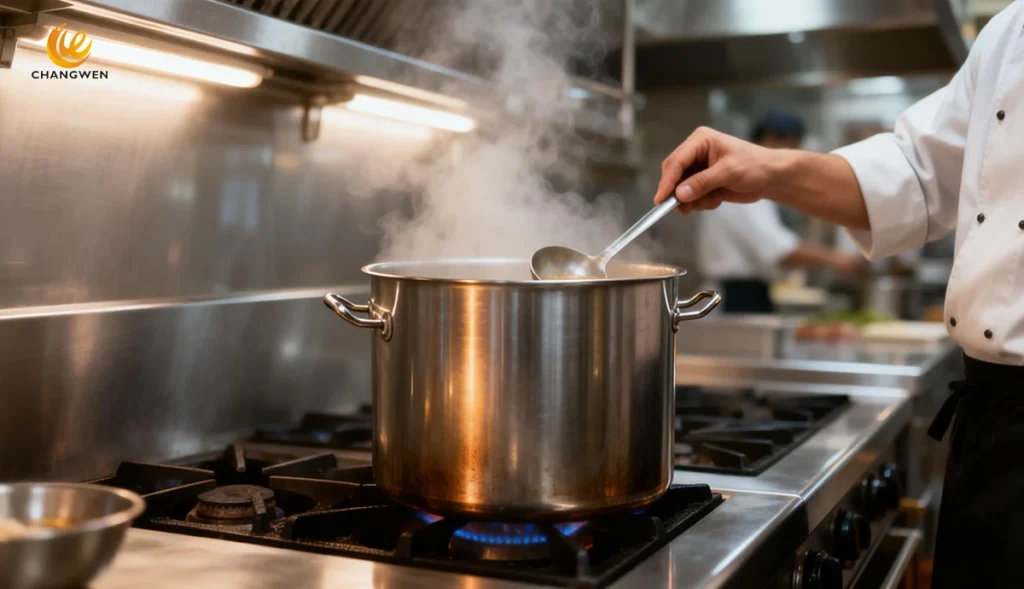
A commercial stock pot is a large, deep cooking vessel designed specifically for high-volume liquid-based cooking. Unlike standard home cookware, commercial stock pots are built to withstand the rigorous demands of professional kitchens, where they may be used multiple times daily, every single day.
Key Features of Commercial Stock Pots
Commercial stock pots are characterized by their distinctive design elements. They feature tall, straight sides that minimize evaporation during long cooking sessions, a flat bottom for stability and even heating, and two sturdy handles designed to safely support heavy loads when filled with liquid. Most importantly, they come with tight-fitting lids that trap heat and moisture, essential for developing deep, rich flavors in stocks and broths.
Why Choose Stainless Steel?
Stainless steel has become the gold standard for commercial stock pots, and for good reason. This material offers exceptional durability that can withstand years of heavy use without warping or degrading. Unlike aluminum or copper, stainless steel is completely non-reactive, meaning it won’t alter the flavor of acidic ingredients like tomatoes, wine, or citrus. It’s also remarkably easy to clean and maintain, resistant to rust and corrosion, and safe for use on all heat sources including induction cooktops.
Commercial grade stainless steel pots typically use 18/8 or 18/10 stainless steel, which refers to the composition of chromium and nickel. The 18/10 designation means 18% chromium and 10% nickel, offering superior corrosion resistance and a brilliant shine that lasts through years of use. Many professional chefs prefer stainless steel because it allows them to see the true color of their ingredients and monitor cooking progress without material interference.
Commercial vs. Home Stock Pots
The difference between commercial and home-grade stock pots goes far beyond just size. Commercial stock pot stainless steel options feature significantly thicker gauge metal, typically 14-16 gauge compared to 18-20 gauge in home versions. This heavier construction prevents warping and provides more consistent heat distribution.
Commercial pots also have reinforced handles that are riveted or welded more securely, capable of supporting the weight of gallons of liquid. They often meet NSF (National Sanitation Foundation) certification standards, ensuring they’re safe for commercial food preparation. While home pots might work fine for occasional large-batch cooking, commercial stock pots are engineered for daily professional use and will outlast consumer-grade options by many years.
Commercial Stock Pot Sizes: A Complete Guide
Choosing the right size commercial stockpot is crucial for both efficiency and storage. Here’s a comprehensive breakdown of available sizes and their ideal applications.
Small Commercial Stock Pots (6-12 Quarts)
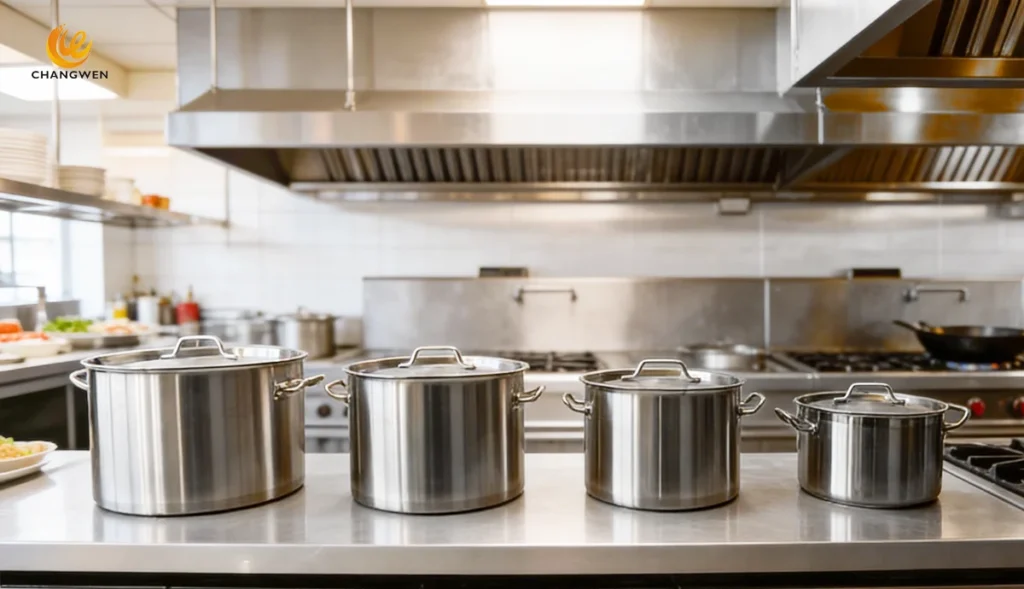
Small commercial stock pots are perfect for sauce preparation, cooking grains, or making smaller batches of soup. A 6-quart pot is ideal for cafes and small restaurants that need to prepare sauces or sides in limited quantities. The 8-quart size works well for small-batch stock preparation or cooking pasta for 10-15 servings. The 12-quart option represents the upper end of “small” commercial pots and is versatile enough for most small to medium restaurant needs.
These sizes are particularly useful in operations where storage space is at a premium or in establishments that need multiple pots for different preparations running simultaneously. They’re also easier to handle when full, reducing the risk of spills or burns.
Medium Commercial Stock Pots (16-24 Quarts)
Medium-sized commercial stock pots represent the sweet spot for many restaurants and catering operations. A 16-quart pot can handle soup for 30-40 servings or stock preparation using one whole chicken or small roast. The 20-quart size is one of the most popular in professional kitchens, offering excellent versatility for both stock making and soup preparation. The 24-quart option provides capacity for larger batch cooking while remaining manageable for one person to handle.
These sizes are ideal for busy restaurants, hotels, and catering companies that need to prepare food in substantial quantities without the unwieldy nature of extremely large pots. They strike a balance between capacity and practicality.
Large Commercial Stock Pots (32-60 Quarts)
Large commercial stainless steel stock pots are the workhorses of high-volume kitchens. A 32-quart pot can produce stock from large quantities of bones or prepare soup for 60-80 servings. The 40-quart size is perfect for institutional kitchens, large catering operations, or restaurants with high soup turnover. The 60-quart option represents serious commercial capacity, suitable for banquet facilities, hotels, or operations serving hundreds of people daily.
These large pots often feature additional reinforcement and may include helpful features like volume markings on the interior and helper handles for easier maneuvering. When filled, they’re extremely heavy, so proper handling procedures and often two-person lifting are required.
Extra Large Commercial Stock Pots (80-200+ Quarts)
Extra large commercial stock pots are specialized equipment for specific high-volume applications. Options ranging from 80 to 120 quarts are common in institutional settings like hospitals, schools, and military facilities. Some commercial operations use pots up to 200 quarts for brewing, seafood boils, or preparing massive quantities of stock.
These enormous pots often come with special features like commercial stock pot with spigot or tap attachments, making it easier to drain or dispense contents without lifting. Many are designed for use on dedicated stock pot ranges with extra-high BTU burners capable of bringing such large volumes to temperature efficiently.
How to Choose the Right Size
When selecting your commercial stock pot size, consider your typical batch sizes, adding 20-30% capacity as a buffer to prevent boil-overs. Think about your storage space, both when in use and when stored. Consider your heat source capacity, as larger pots require more powerful burners. Factor in handling safety, remembering that a full pot can weigh 100+ pounds in larger sizes.
As a general rule, if you find yourself regularly filling a pot to within an inch of the top, you need a larger size. Conversely, if you’re consistently using less than half the pot’s capacity, you might benefit from a smaller size that heats more efficiently and takes up less storage space.
Understanding Stainless Steel Grades and Construction
Not all stainless steel is created equal. Understanding the differences in grades and construction methods will help you choose commercial grade stainless steel pots that meet your specific needs.
Stainless Steel Grades: 18/8 vs. 18/10
The numbers 18/8 and 18/10 refer to the composition of the stainless steel alloy. Both types contain 18% chromium, which provides corrosion resistance and helps maintain the metal’s shine. The difference lies in the nickel content: 18/8 contains 8% nickel, while 18/10 contains 10% nickel.
The 18/10 stainless steel offers slightly better corrosion resistance, particularly important when cooking acidic foods like tomato-based sauces or dishes with wine or citrus. It also has a slightly more lustrous appearance and is less likely to show water spots. However, 18/8 stainless steel is perfectly adequate for most commercial applications and often comes at a lower price point.
Many professional chefs prefer 18/10 for its premium feel and performance, but 18/8 provides excellent value without significant compromise in quality. Both grades are food-safe, durable, and suitable for commercial kitchens.
Gauge Thickness Matters
For commercial stainless steel stock pots, material thickness is a critical factor in durability and long-term performance. The industry standard thickness typically ranges from 0.8 mm to 1.2 mm. Thinner pots at the lower end of this range are more prone to warping, deformation, and denting, especially under high heat, heavy loads, or frequent commercial use.
Our stock pots are manufactured with a full 1.2 mm stainless steel thickness, providing superior structural strength, improved heat stability, and enhanced resistance to deformation. This added thickness ensures consistent performance in demanding commercial kitchens, making the pot more reliable for high-volume cooking and extended service life.
Tri-Ply and Multi-Ply Construction
While many commercial stock pots feature stainless steel bodies with aluminum or copper core bottoms, some premium options offer tri-ply or even 5-ply construction throughout the entire pot. Tri-ply construction typically consists of an aluminum core sandwiched between two layers of stainless steel. This design combines the excellent heat conductivity of aluminum with the durability and non-reactive properties of stainless steel.
Full-clad construction (where the multi-layer design extends up the sides of the pot, not just the bottom) provides the most even heating but comes at a significant price premium. For stock pots, which primarily involve simmering liquids where heat distribution is less critical than in sauté pans or skillets, a quality encapsulated base is usually sufficient and more cost-effective.
Aluminum vs. Stainless Steel: A Comparison
While this guide focuses on stainless steel, it’s worth understanding how aluminum compares. Aluminum stock pots heat up quickly and distribute heat well, making them efficient for bringing large volumes of liquid to temperature. They’re also significantly lighter than stainless steel, making handling easier when pots are full.
However, aluminum is reactive with acidic and alkaline foods, which can affect flavor and potentially leach into food. Anodized aluminum solves this problem but adds to the cost. Aluminum also dents more easily and doesn’t have the longevity of stainless steel in commercial settings.
For commercial kitchens prioritizing durability, food safety, and long-term value, commercial grade stainless steel pots remain the superior choice despite the higher initial investment.
Special Features: Spigots, Strainers, and More
Modern commercial stock pots offer various specialized features that can significantly improve efficiency and convenience in busy kitchens.
Commercial Stock Pot with Spigot or Tap
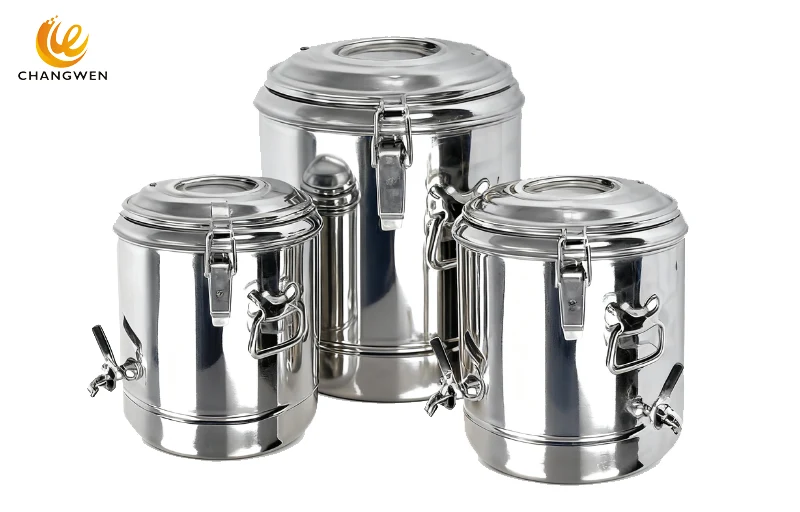
A commercial stock pot with spigot (also called a tap or faucet) features a valve near the bottom of the pot that allows you to dispense liquid without lifting or pouring. This feature offers tremendous advantages in professional settings.
Spigot-equipped pots eliminate the need to lift heavy pots when draining or serving, reducing the risk of burns and spills. They allow for easy portion control when dispensing soups or stocks, and make it simple to drain off liquid while leaving solid ingredients in the pot. They’re particularly useful for serving lines where soups are dispensed throughout service.
Commercial stock pot with tap options typically range from 32 quarts to 100+ quarts. The spigots are usually made from stainless steel or food-grade brass and feature secure mounting with gaskets to prevent leaks. Some models include a strainer basket that works in conjunction with the spigot, allowing you to brew stocks that can be dispensed clear without additional straining.
When choosing a pot with a spigot, look for models with the tap positioned 2-3 inches from the bottom to maximize usable capacity while preventing sediment from being dispensed. Ensure the valve is easy to operate with one hand and can be completely disassembled for thorough cleaning.
Commercial Stock Pot with Strainer
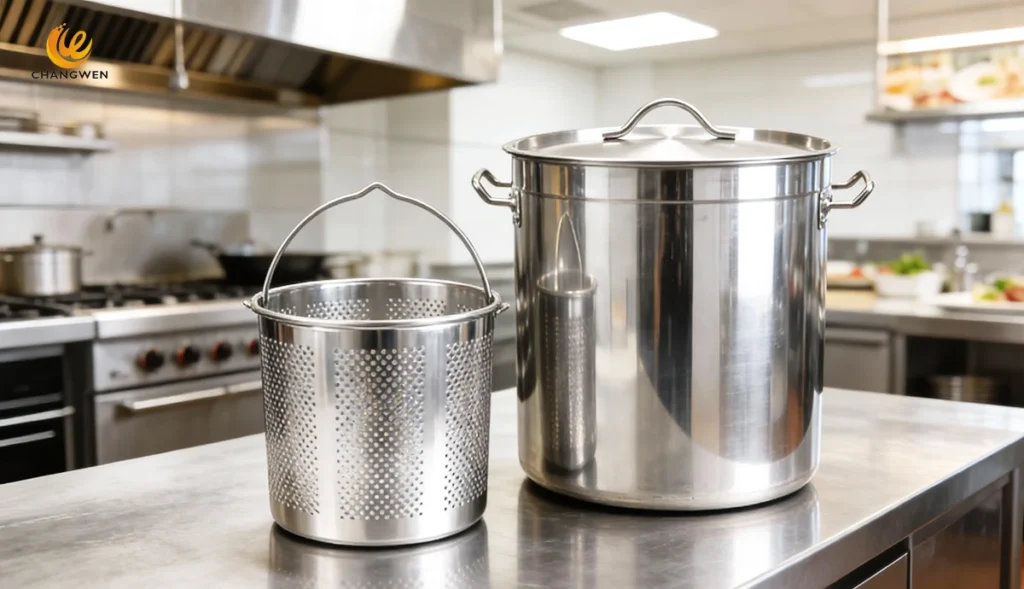
A commercial stock pot with strainer typically includes a perforated insert basket that fits inside the main pot. This design provides incredible versatility for various cooking tasks.
The strainer insert allows you to cook pasta, vegetables, seafood, or other items and lift them out in one motion, leaving the cooking liquid behind. For stock preparation, you can add bones and vegetables to the insert, then simply lift out all the solids when the stock is finished. These pots work excellently for seafood boils, corn on the cob, or blanching large quantities of vegetables.
Some models feature multi-level inserts, allowing you to cook different items simultaneously at different depths. For example, you might steam vegetables in the top basket while cooking seafood in the bottom section. High-quality strainer inserts feature reinforced handles and sturdy construction to support heavy loads when lifted.
Steamer Inserts and Accessories
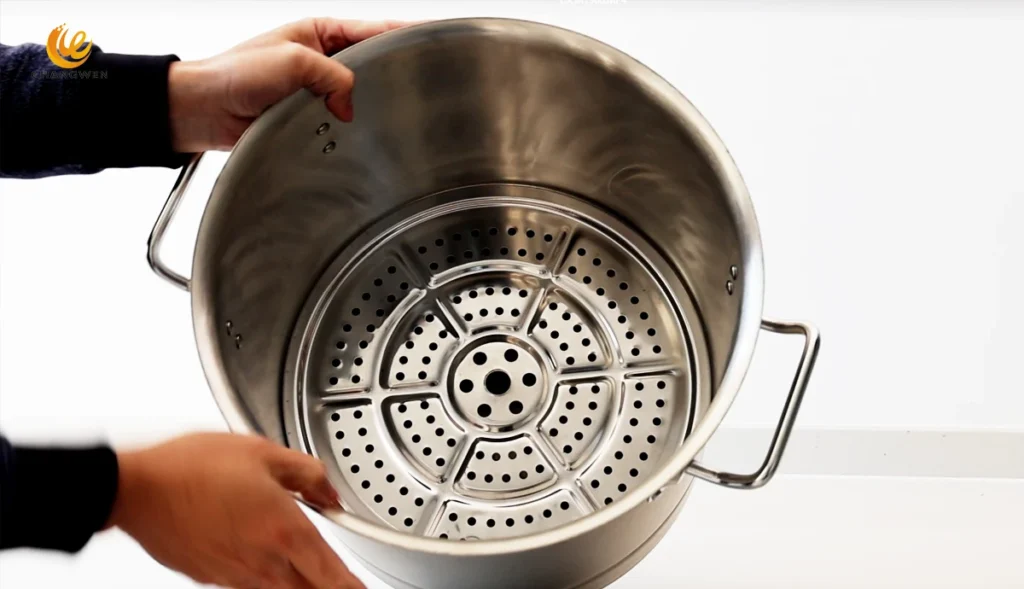
Beyond strainers, many commercial stock pots can accommodate steamer inserts that sit above the liquid level. These turn your stock pot into a large-capacity steamer, perfect for dim sum, tamales, vegetables, or seafood. Some commercial operations use large stock pots with steamer inserts as their primary steaming equipment, finding this more versatile and cost-effective than dedicated steamers.
Volume Markings
Interior volume markings are incredibly useful in commercial settings where recipes need to be precisely scaled. Look for markings that are stamped or etched into the metal rather than painted, as these won’t wear off over time. Markings in both metric (liters) and imperial (gallons/quarts) measurements offer maximum flexibility.
Induction Compatibility
If your kitchen uses induction cooking equipment, ensure your commercial stock pot has an induction-compatible base. This typically means an encapsulated bottom with a magnetic stainless steel or iron core. Induction-compatible pots will work on all heat sources, while non-magnetic stainless steel pots won’t work on induction.
Commercial Stainless Steel Stock Pots – Specifications & Style
Stainless steel saucepans are designed for commercial kitchens, catering companies, hotels, and food factories. They are available in a variety of capacities and sizes, made of food-grade stainless steel, and are sturdy and durable, suitable for long-term cooking.
Tall Commercial Stainless Steel Stock Pots
Tall stockpots are suitable for large-capacity cooking and long-term stewing, and are commonly used in restaurants, hotels and food factories.
| Model (MM) | Capacity (L) | Body Thickness (MM) | Bottom Thickness (MM) | Description |
| Φ200×H200 | 6 | 0.8 | 3.8 | Small size, light cooking |
| Φ250×H250 | 12 | 0.8 | 3.8 | Medium-small, daily use |
| Φ280×H280 | 17 | 0.8 | 3.8 | Medium size for soups & stocks |
| Φ300×H300 | 20 | 0.8 | 3.8 | Medium size, versatile |
| Φ320×H320 | 25 | 0.8 | 4.8 | Medium-large, hotels |
| Φ360×H360 | 36 | 1.0 | 5.0 | Large capacity, commercial use |
| Φ400×H400 | 48 | 1.0 | 5.0 | Large pot for catering |
| Φ450×H450 | 70 | 1.0 | 5.0 | Large volume, heavy-duty |
| Φ500×H500 | 98 | 1.2 | 5.8 | Extra-large, long cooking |
| Φ500×H600 | 118 | 1.2 | 5.8 | Extra-large, professional kitchen |
| Φ550×H550 | 128 | 1.2 | 5.8 | Heavy-duty, high volume |
| Φ550×H600 | 139 | 1.2 | 5.8 | Extra-large for catering |
| Φ550×H700 | 163 | 1.2 | 5.8 | Maximum volume, professional use |
| Φ600×H600 | 160 | 1.2 | 5.8 | Extra-large, hotel kitchens |
| Φ600×H700 | 186 | 1.2 | 5.8 | Large capacity, food factories |
| Φ600×H800 | 213 | 1.2 | 5.8 | Maximum capacity for industrial use |
Short Commercial Stainless Steel Stock Pots
The low-profile soup pot is suitable for cooking small to medium-sized food, and is applicable to restaurants, central kitchens, and food processing scenarios.
| Model (MM) | Capacity (L) | Body Thickness (MM) | Bottom Thickness (MM) | Description |
|---|---|---|---|---|
| Φ250×H180 | 8 | 0.8 | 3.8 | Small, light cooking |
| Φ300×H200 | 13 | 0.8 | 3.8 | Medium-small, versatile |
| Φ320×H220 | 17 | 0.8 | 4.8 | Medium size for soups & stocks |
| Φ360×H240 | 24 | 1.0 | 5.0 | Medium-large, catering |
| Φ400×H260 | 31 | 1.0 | 5.0 | Large capacity, professional |
| Φ450×H280 | 44 | 1.0 | 5.0 | Large, heavy-duty |
| Φ500×H300 | 59 | 1.2 | 5.8 | Extra-large, hotel kitchens |
| Φ550×H350 | 81 | 1.2 | 5.8 | Heavy-duty, industrial use |
| Φ600×H400 | 106 | 1.2 | 5.8 | Maximum capacity, commercial kitchens |
Commercial Stockpot Style
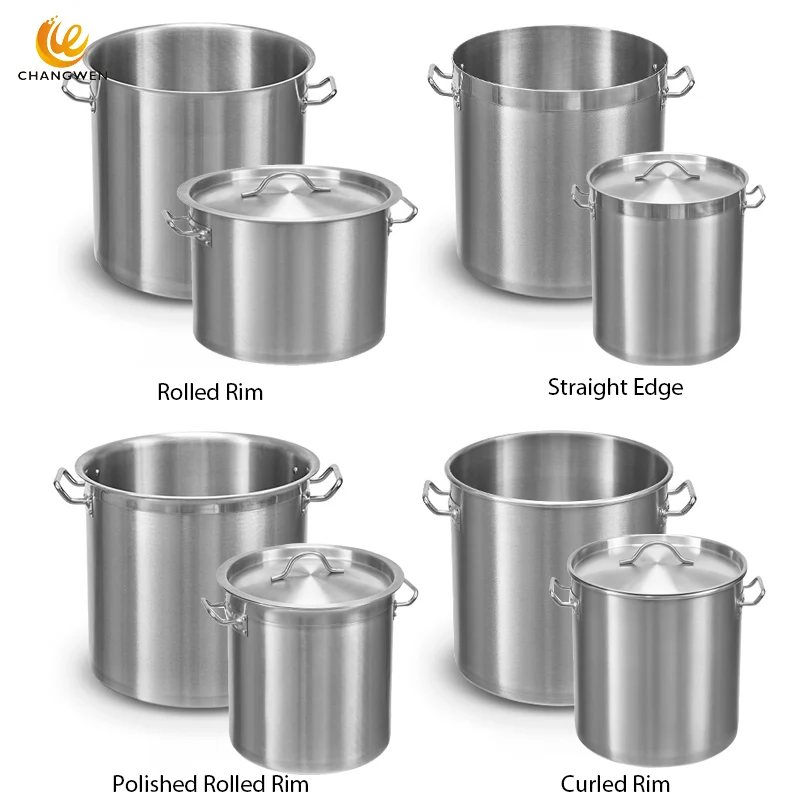
Commercial stainless steel stock pots are available with rolled rim, polished rolled rim, straight rim, and curled rim designs. Each rim structure offers different advantages in durability, safety, appearance, and cost, allowing foodservice professionals to choose the most suitable option for their kitchen needs.
Rolled Rim
Features a reinforced flanged rim that increases structural strength and prevents deformation. Designed for heavy-duty commercial kitchens, this stock pot offers improved durability, safer handling, and reliable performance for high-volume cooking applications.
Polished Rolled Rim
Designed with a polished rolled rim that combines strength and visual appeal. The smooth, bright edge enhances the pot’s professional look while providing reinforced durability, easy cleaning, and safe handling in commercial kitchen environments.
Straight Edge
Built with a straight rim for a clean and practical design. Lightweight and cost-effective, this stock pot is easy to stack and store, making it ideal for basic food preparation and everyday commercial kitchen use.
Curled Rim
Features a curled rim that creates a smooth, rounded edge for safer handling. This design improves comfort during lifting and pouring while reducing the risk of cuts, making it a popular choice in professional kitchens.
Using Your Commercial Stock Pot: Best Practices
Proper use of your commercial stockpot ensures better results and longer equipment life. Here are professional techniques for getting the most from your investment.
Preparing Rich, Flavorful Stocks
For the best stocks, start with cold water and gradually bring to temperature. This allows proteins to coagulate slowly and rise to the surface for skimming. Never boil stock vigorously; maintain a gentle simmer with just a few bubbles breaking the surface. This prevents the stock from becoming cloudy and keeps fats emulsified.
Add aromatics like onions, carrots, and celery during the last hour of cooking to keep their flavors bright and distinct. If added too early, these vegetables can become bitter or break down completely. Use your stock pot’s volume markings to maintain consistent liquid levels, adding water as needed to compensate for evaporation.
Pasta Cooking in Large Batches
When cooking pasta in a commercial stock pot range, use approximately 4-6 quarts of water per pound of pasta. This ratio ensures pasta has room to move and cook evenly without sticking. Salt the water generously (it should taste like seawater) before adding pasta.
For multiple batches during service, maintain the same cooking water rather than changing it for each batch. The starch that releases into the water actually helps season and thicken sauces. However, replace the water when it becomes too cloudy or after 10-12 batches.
Soup Preparation and Service
When making soups for service, prepare them in advance and cool them properly before refrigerating. Large commercial stainless steel stock pots retain heat for extended periods, so never place a hot pot directly in the refrigerator. Instead, use an ice bath or transfer soup to smaller, shallow containers for faster cooling.
During service, maintain soups at 140°F or higher to prevent bacterial growth. If using a stock pot with spigot, position it on a warming station or use a heating element beneath it. Stir occasionally to prevent scorching on the bottom and ensure even heating throughout.
Cleaning and Maintenance
Despite stainless steel’s reputation for easy cleaning, commercial stock pots require proper care to maintain their appearance and performance. Clean pots promptly after use, before food residue can dry and harden. For everyday cleaning, use hot water and commercial dish soap with a non-abrasive scrubber.
For stubborn stains or discoloration, create a paste from baking soda and water, apply it to affected areas, and let sit for 15-30 minutes before scrubbing. For mineral deposits from hard water, use a solution of white vinegar and water (1:3 ratio) to restore shine.
Avoid using steel wool or harsh abrasives that can scratch the surface, creating places for bacteria to hide. Never use bleach or chlorine-based cleaners, as these can pit and damage stainless steel. After washing, dry pots thoroughly to prevent water spots and maintain their appearance.
Common Mistakes to Avoid
Never overcrowd your stock pot. Leave at least 2-3 inches of space at the top to prevent boil-overs and allow for stirring. Avoid extreme temperature changes (like adding cold water to a hot pot), which can cause warping even in heavy-gauge stainless steel. Don’t use metal utensils aggressively, especially on the bottom, as this can scratch and damage the surface.
Never store food in stainless steel pots for extended periods, particularly acidic foods. While stainless steel is non-reactive, prolonged contact with very acidic foods can potentially affect flavor. Always transfer leftovers to proper storage containers.
Where to Buy Commercial Stock Pots for Sale
Finding the right commercial stock pots for sale requires knowing where to look and what to expect in terms of pricing and availability.
Restaurant Supply Stores
Professional restaurant supply stores offer the best selection of commercial stock pot stainless steel options. These specialized retailers stock brands like Vollrath, All-Clad, and Winco, allowing you to see and handle pots before purchasing. Staff at these stores typically have professional kitchen experience and can provide valuable advice.
Major chains like Restaurant Depot (membership required) offer competitive pricing on commercial-grade equipment. WebstaurantStore operates primarily online but provides excellent pricing, detailed specifications, and customer reviews. Central Restaurant Supply combines online ordering with physical locations in major cities.
Online Marketplaces
Amazon carries many commercial stock pot brands, often at competitive prices. However, be cautious of third-party sellers offering “commercial-grade” pots that don’t meet professional standards. Read reviews carefully and verify specifications like gauge thickness and NSF certification.
Specialty online retailers like KaTom Restaurant Supply and Wasserstrom offer extensive selections with detailed product information and comparison tools. These sites often provide volume discounts for restaurants purchasing multiple items.
Direct from Manufacturers
Some manufacturers sell directly to restaurants, offering the best prices but often requiring minimum order quantities. This works well for chain restaurants or large operations outfitting multiple locations. Changwen is a professional manufacturer of commercial soup buckets. Contact us for detailed product information.
Used Equipment Dealers
For operations on tight budgets, used restaurant equipment dealers offer significant savings on commercial kitchen stainless steel pots and pans. Quality stainless steel pots can last decades, making used options viable if properly inspected. Check for warping, damaged handles, and excessive wear on the bottom.
Look for restaurant auctions when establishments close, where you can find premium equipment at fraction of retail cost. However, remember that used equipment typically carries no warranty and may have unknown history of use and care.
Local Options: Commercial Stock Pot Near Me
Searching for “commercial stock pot near me” can reveal local restaurant supply stores, which offer the advantage of immediate availability and the ability to inspect items personally. Local dealers may also provide better support for warranty issues or returns.
Check with local commercial kitchen equipment repair services, as they often know where to find quality used equipment. Join local restaurant industry groups on social media, where members frequently buy, sell, and trade equipment.
Price Ranges and What to Expect
Commercial stock pot pricing varies significantly based on size, brand, and construction quality. Small pots (8-12 quarts) from budget brands start around $40-70, mid-range brands cost $80-150, and premium brands run $150-300.
Medium pots (16-24 quarts) range from $80-120 for budget options, $150-250 for mid-range, and $300-500 for premium brands. Large pots (32-60 quarts) cost $150-250 for budget brands, $300-500 for mid-range, and $500-1,000+ for premium options.
Extra large pots with special features (spigots, strainers) can exceed $1,000, particularly in sizes over 80 quarts. However, these represent serious commercial equipment that will last 15-20 years with proper care.
Getting the Best Deals
Time your purchases around major sales events. Restaurant supply stores often have significant discounts during industry trade shows or end-of-year clearances. Consider purchasing complete sets if outfitting a new kitchen, as manufacturers often offer bundle discounts.
Join industry buying groups or associations that offer member discounts at major suppliers. Many restaurant associations provide access to purchasing programs that can save 10-30% on equipment. Don’t overlook used equipment from reputable dealers, which can provide 50-70% savings on high-quality pots.
Care, Maintenance, and Longevity
Proper care ensures your commercial grade stainless steel pots and pans last for decades of professional use.
Daily Cleaning Procedures
Establish a consistent cleaning routine for your commercial stock pots. After each use, empty the pot completely and rinse with hot water to remove loose particles. Wash with hot, soapy water using a commercial degreaser if necessary. For best results, clean pots while still warm but not hot.
Use appropriate scrubbers for stainless steel, avoiding steel wool that can scratch surfaces. Nylon scrubbing pads or specialized stainless steel scrubbers work effectively without damaging the finish. Pay special attention to corners and the area where handles attach, as food can accumulate in these spots.
Rinse thoroughly to remove all soap residue, then dry completely with a clean towel. Air drying can leave water spots, particularly in areas with hard water. Proper drying also prevents mineral buildup that can affect the pot’s appearance and performance.
Dealing with Stains and Discoloration
Even with proper care, stainless steel stock pots can develop stains over time. Rainbow-colored heat tints result from overheating and, while harmless, affect appearance. Remove these with white vinegar or a specialized stainless steel cleaner. White, chalky residue from hard water dissolves easily with vinegar and water solution.
Dark, stubborn stains from burnt food require more aggressive treatment. Create a paste with baking soda and water, apply to stained areas, and let sit for 30 minutes. Scrub with a non-abrasive pad, then rinse and dry. For severe burning, boil a solution of water and baking soda in the pot to loosen carbonized residue.
Blue or brown discoloration on the bottom often results from overheating. While this doesn’t affect performance, it can be unsightly. Commercial stainless steel cleaners specifically formulated for cookware can restore the original finish.
Preventing Damage
Protect your investment by avoiding common damaging behaviors. Never plunge a hot pot into cold water, as thermal shock can cause warping even in heavy-gauge steel. Always allow pots to cool gradually to room temperature. Avoid dropping pots or banging them against hard surfaces, which can dent or damage the bottom.
Don’t use extremely high heat unnecessarily. While commercial stock pot ranges can deliver tremendous BTUs, medium heat is sufficient for most stock pot applications. Excessive heat wastes energy and can damage the pot over time. When cooking, avoid letting pots boil dry, as this can cause permanent damage to the bottom.
Store pots properly to prevent damage. Hanging from pot racks is ideal, preventing the weight of stacked pots from denting or scratching surfaces. If stacking is necessary, place cloth or silicone protectors between pots.
Maintaining Special Features
For commercial stock pots with spigot attachments, regularly disassemble and clean the valve mechanism to prevent buildup that could harbor bacteria or affect function. Remove the valve assembly according to manufacturer instructions, clean all components thoroughly, and reassemble with fresh gaskets as needed.
Strainer baskets should be cleaned immediately after use to prevent food from drying in the perforations. Soak in hot, soapy water if needed, then scrub with a brush to clear all holes. Check periodically for bent wires or weakened welds that could cause failure.
When to Replace
With proper care, commercial grade stainless steel pots can last 15-25 years in professional use. However, several signs indicate it’s time for replacement. Significant warping that prevents the pot from sitting flat on the heat source affects cooking performance and creates safety hazards.
Damaged or loose handles pose serious safety risks when pots are full and must be addressed immediately. If handles cannot be re-secured, replacement is necessary. Deep scratches or pitting on cooking surfaces can harbor bacteria and compromise food safety. Cracks or holes in the pot body obviously require immediate replacement.
For pots with special features, if spigots leak and cannot be repaired with new gaskets, or if strainer baskets are significantly damaged, consider whether replacement parts are available and cost-effective compared to buying a new pot.
Frequently Asked Questions
What size commercial stock pot should I buy for my restaurant?
For most restaurants, a 20-24 quart commercial stock pot provides optimal versatility. This size handles stock preparation from one chicken or 8-10 pounds of bones, cooks soup for 40-50 servings, and boils pasta for 15-20 portions. Assess your menu and typical batch sizes. If you frequently serve soup as a featured item or prepare large quantities of stock, consider adding a 40-60 quart pot to your equipment lineup. Smaller operations or those with limited storage might find 12-16 quart pots more practical.
Is 18/8 or 18/10 stainless steel better for stock pots?
Both 18/8 and 18/10 stainless steel perform excellently for commercial stock pots. The difference lies in nickel content, with 18/10 containing 10% nickel versus 8% in 18/8. The additional nickel in 18/10 provides slightly better corrosion resistance and a more lustrous appearance, but 18/8 offers excellent durability at a lower cost. For most commercial applications, 18/8 provides outstanding value and performance. Choose 18/10 if your budget allows and you want the premium option, but don’t hesitate to select quality 18/8 pots from reputable manufacturers.
Should I buy a stock pot with a spigot or tap?
A commercial stock pot with spigot makes sense for specific applications. If you regularly dispense soups or stocks during service, particularly in cafeteria-style settings or buffet lines, a spigot eliminates constant lifting and ladling. For operations that frequently need to drain large quantities of liquid while retaining solids, spigots provide significant convenience and safety benefits. However, spigoted pots cost more, require additional cleaning and maintenance, and have slightly reduced usable capacity. For standard stock preparation and soup making where you’ll transfer contents to smaller serving containers, a traditional pot without spigot often proves more practical and cost-effective.
How do I prevent my stainless steel stock pot from staining?
Prevent staining by cleaning your commercial stainless steel stock pot promptly after each use, before food residue dries and bonds to the surface. Avoid using extremely high heat, which can cause rainbow-colored heat tints. Don’t let water evaporate completely, leaving mineral deposits that create chalky white stains. For acidic foods like tomato sauces, avoid extended storage in the pot, though brief cooking poses no problem. Regular cleaning with appropriate products maintains the steel’s protective chromium oxide layer, which naturally resists staining and corrosion. If stains do develop, address them promptly with baking soda paste or commercial stainless steel cleaner rather than allowing them to set permanently.
Can I use commercial stock pots on induction cooktops?
Most commercial stock pot stainless steel options work on induction cooktops, but verification is essential. Induction cooking requires magnetic material in the pot’s base. Test by placing a magnet on the bottom; if it sticks firmly, the pot is induction-compatible. Many commercial stock pots feature an encapsulated base with an aluminum or copper core sandwiched between magnetic stainless steel layers. These work perfectly on induction. However, some specialty pots use entirely non-magnetic stainless steel and won’t work on induction. When purchasing, specifically confirm induction compatibility if your kitchen uses this cooking technology. Fortunately, induction-compatible pots work on all other heat sources, making them the most versatile choice.
What’s the difference between a stock pot and a soup pot?
While the terms are sometimes used interchangeably, stock pots and soup pots have distinct design differences. Stock pots feature taller, narrower proportions that minimize surface area and reduce evaporation during long simmering required for stock preparation. This tall design develops deep flavors by maintaining consistent liquid levels. Soup pots are typically shorter and wider, facilitating easier stirring and allowing ingredients to be added and observed more conveniently. The wider design also promotes faster heating for soups that don’t require extended cooking. For commercial kitchens, stock pots prove more versatile, as they handle both stock preparation and soup cooking effectively. The deeper design actually benefits soup service by reducing splashing and making it easier to ladle portions without mess.
How do I clean burnt food from the bottom of my stock pot?
For burnt-on food in commercial grade stainless steel pots, start by filling the pot with hot water and adding several tablespoons of baking soda. Bring to a boil and simmer for 15-20 minutes to loosen carbonized residue. Pour out the water and use a non-abrasive scrubber to remove loosened material. For stubborn spots, create a paste from baking soda and water, apply to affected areas, and let sit for 30 minutes before scrubbing. Alternatively, use commercial stainless steel cleaner following product directions. Avoid harsh abrasives or steel wool that can scratch the surface. For extremely stubborn burning, repeat the process or let the baking soda solution soak overnight before scrubbing again.
Are aluminum or stainless steel stock pots better for professional use?
For professional kitchens, commercial stock pot stainless steel options generally provide superior long-term value despite aluminum’s advantages. Stainless steel offers unmatched durability, lasting 15-25 years in commercial use compared to aluminum’s shorter lifespan. It’s completely non-reactive with acidic or alkaline foods, ensuring consistent flavor without metallic tastes. Stainless steel maintains its appearance better and meets NSF certification standards more readily. Aluminum heats faster and distributes heat more evenly, making it efficient for quickly bringing large volumes to temperature. It’s also lighter, reducing handling strain. However