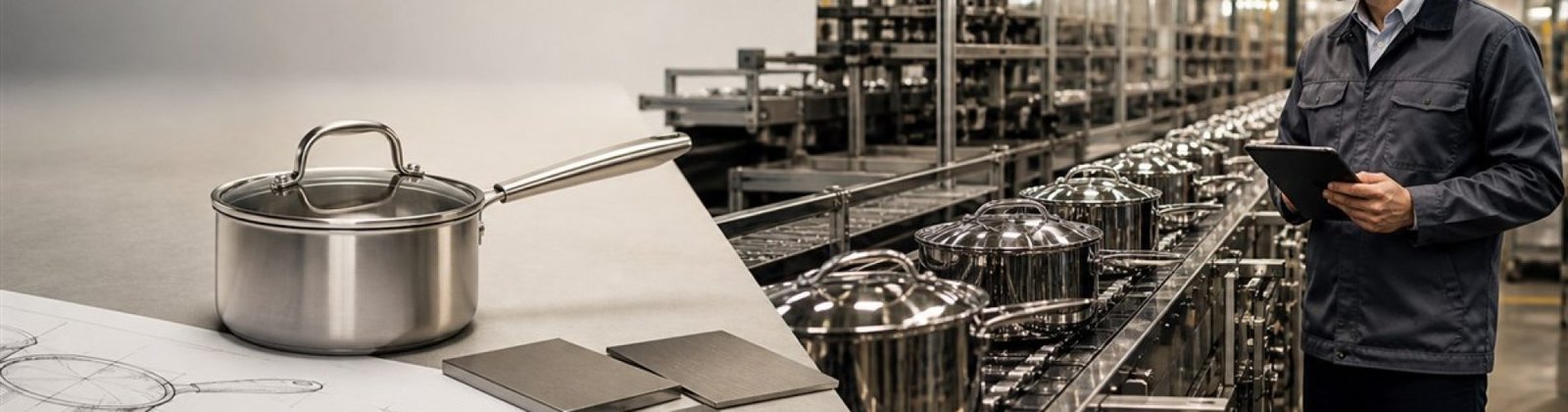
The OEM cookware manufacturing process converts a product idea into a repeatable production system through nine control gates: product brief, design-for-manufacturing review, specification freeze, tooling, engineering samples, validation, pilot production, mass production, and final release. Mass production should begin only after the buyer and manufacturer have approved measurable requirements, a production-representative reference sample, packaging, tests, and process controls.
Read time: 14 minutes
The most important distinction in OEM cookware is the difference between making one attractive sample and producing thousands of consistent units. A hand-finished prototype can demonstrate shape and appearance, but it may not prove that forming, bonding, polishing, coating, assembly, or packaging can repeat the result. A stage-gate process reduces this gap by requiring evidence before each irreversible commitment.
Practical rule: Every OEM cookware stage should end with a named deliverable and an approval decision. If the specification, reference sample, test method, packaging file, or change record is missing, the project is not ready for the next gate even when the calendar says production should start.
What Is OEM Cookware Manufacturing?
OEM cookware manufacturing means a factory produces cookware according to a buyer-controlled design, specification, performance target, and branding requirement. The buyer defines what the product must be, while the manufacturer converts those requirements into tooling, materials, processes, inspections, packaging, and production records. The exact division of design ownership and engineering responsibility must be written into the project agreement.
OEM is different from selecting an existing product and changing only the logo or box. A catalog-based program uses proven body shapes and established tooling, so development can focus on material options, finishes, branding, and packaging. A full OEM program can introduce proprietary geometry, handles, lids, construction, or performance requirements, which creates more engineering, validation, tooling, cost, and schedule risk. Buyers can compare these paths in the OEM versus ODM cookware decision guide.
What Are the Nine Control Gates from Design to Mass Production?
| Gate | Question to answer | Required output | Release decision |
|---|---|---|---|
| 1. Product brief | What must the cookware do, and for which market? | Approved requirements brief | Scope is commercially and technically clear |
| 2. DFM review | Can the design be manufactured repeatedly? | Feasibility report and revised drawings | Risks and compromises are accepted |
| 3. Specification freeze | What exactly will be measured and controlled? | Product specification and bill of materials | A controlled design baseline exists |
| 4. Tooling | Can production equipment create the defined design? | Approved tooling plan and tool trial | Tools produce usable first parts |
| 5. Engineering sample | Does the physical product meet design intent? | Measured sample and issue list | Design corrections are closed |
| 6. Validation | Does the product meet intended-use and market requirements? | Test results and approved reference sample | Performance and compliance are accepted |
| 7. Pilot run | Can the production process repeat the approved result? | Pilot report, control plan, and limits | The process is released for scale |
| 8. Mass production | Is every batch controlled during manufacture? | Traceable production and inspection records | Conforming units proceed to packing |
| 9. Final release | Is the finished order complete and shipment-ready? | Final inspection and shipping documents | Authorized goods are released |
Gate 1: How Should the Buyer Define the Product Brief?
The product brief should define the user, cooking task, sales channel, target market, price position, expected volume, launch date, and non-negotiable product requirements. A restaurant stock pot and a consumer frying pan may both be stainless steel, but their capacity, handling, durability, packaging, and inspection priorities differ. The brief prevents the factory from solving the wrong commercial problem correctly.
A useful brief identifies measurable outcomes rather than subjective adjectives. “Premium handle” is ambiguous, while a required handle material, attachment method, temperature expectation, balance target, and appearance reference give engineers something to evaluate. Reference images can clarify intent, but they should not replace dimensions, materials, construction, or performance requirements.
The buyer should also state the destination market before design work begins. Food-contact requirements, labeling, packaging language, test scope, and documentation can affect materials and construction. Adding a market after tooling approval can force redesign because a component accepted in one region may not satisfy another buyer’s compliance plan.
Gate 2: What Happens During Design for Manufacturing?
Design for manufacturing, or DFM, tests whether the concept can be produced consistently with available materials, tooling, machines, tolerances, and inspection methods. The factory reviews body depth, draw ratio, wall transition, rim geometry, base construction, handle attachment, lid fit, finishing access, assembly sequence, and packaging constraints. DFM is not a request to weaken the design; it is a structured comparison between design intent and repeatable production.
A good DFM review presents trade-offs explicitly. Increasing wall thickness may improve perceived solidity but can change forming force, weight, heating behavior, cost, and shipping. A highly sculpted handle may strengthen visual identity but require exclusive tooling and more difficult polishing. The buyer can then choose which benefit justifies the additional production constraint.
Material decisions belong inside DFM because grade and construction affect both product performance and manufacturing behavior. Stainless steel, aluminum, carbon steel, and multi-material structures use different forming, joining, surface-treatment, and testing routes. For stainless products, the 201 versus 304 stainless steel cookware guide explains how material selection connects to corrosion environment, product position, and manufacturing cost.

Gate 3: What Must Be Frozen in the Product Specification?
The specification freeze creates the controlled baseline that engineering, purchasing, production, and quality teams must follow. The specification should define dimensions and tolerances, material for every food-contact and structural component, body and base construction, thickness, weight range, finish, color, handle and lid fit, logo method, performance tests, appearance limits, packaging, labels, and approved artwork.
The bill of materials should identify every component rather than only the visible body. A pan can use the approved steel yet fail because its handle, rivet, base plate, coating, knob, insert, or carton changed. Component-level control exposes substitutions before production.
Specification freeze does not mean no later change is possible. It means every later change must be documented, assessed, approved, and linked to a new revision. The change record should state what changed, why it changed, which samples or tests must be repeated, which inventory is affected, and when the new revision becomes effective. Uncontrolled verbal changes are a common cause of sample-to-production mismatch.
Gate 4: How Are Cookware Tools Developed and Approved?
Cookware tooling can include forming dies, trimming tools, bonding fixtures, handle molds, welding fixtures, polishing fixtures, gauges, and packaging dies. The required tools depend on whether the design uses an existing platform, modifies an existing component, or introduces a new geometry. A tooling list should identify ownership, expected use, storage, maintenance, revision, and acceptance criteria.
Tool approval should evaluate the parts produced by the tool, not only the tool’s appearance. Trial parts reveal springback, thinning, distortion, trim consistency, surface marks, lid fit, handle alignment, and other issues that a drawing cannot fully predict. Correcting a tool before validation is usually less disruptive than compensating for its error through manual finishing during mass production.
Tooling cost should be separated from recurring unit cost so buyers can understand the investment and compare offers fairly. The OEM cookware manufacturing cost model explains how development, tooling, materials, quality, packaging, and logistics form different cost layers. A low tool quotation is not automatically better if it produces unstable parts or lacks ownership terms.
Gate 5: What Is an Engineering Sample Supposed to Prove?
An engineering sample proves that the physical design can meet defined dimensions, assembly relationships, appearance goals, and basic function. The sample should be measured against the frozen specification, and every deviation should be recorded. Approval based only on photographs cannot adequately confirm weight, balance, finish texture, flatness, fit, or handling.
Different sample types answer different questions. A visual mockup can confirm proportion and styling, a functional prototype can test use, and a production-tool sample can demonstrate the actual manufacturing route. Buyers should label each sample type so that approval of an appearance model is not mistaken for authorization to begin mass production.
The sample review should produce a closed issue list. Each issue needs a responsible party, corrective action, deadline, affected document, and verification result. Comments such as “improve polishing” are too vague; the review should identify the location, defect type, allowable boundary, and approved comparison standard.
Gate 6: How Are Design Verification and Product Validation Different?
Design verification asks whether the product was built according to the specification. Product validation asks whether the specified product works for its intended user and market. A saucepan may pass dimensional inspection yet still feel unstable on a target cooktop or have a handle that is uncomfortable under realistic load. Both questions must be answered before the sample becomes a mass-production reference.
Testing should be selected from the product’s material, construction, risk, intended use, destination requirements, and buyer protocol. Relevant checks may address material identity, dimensions, capacity, base flatness, handle attachment, lid fit, thermal behavior, corrosion exposure, coating performance, impact, packaging protection, or label accuracy. The article should not assume that every test applies to every cookware type; the agreed test plan defines the correct scope.
A reference sample becomes meaningful only when it is linked to the same specification revision and test results used for production. The buyer and manufacturer should identify, seal, sign, photograph, or otherwise control the approved reference according to their quality system. An unlabeled sample on a factory shelf cannot reliably control future batches.
Gate 7: Why Is a Pilot Run Necessary Before Mass Production?
A pilot run tests the production process rather than merely repeating sample work. The pilot uses intended tooling, materials, operators, settings, assembly sequence, inspection methods, and packaging to reveal problems that appear only when multiple units move through the line. The pilot therefore answers whether the approved design can be reproduced at a stable rate.
Pilot evaluation should compare variation across units, not just the best unit. Inspectors should examine dimensional spread, surface consistency, base flatness, component alignment, lid interchangeability, logo placement, packaging fit, and defect patterns. A process that produces one excellent item among many unstable items is not ready for mass production.
The pilot report should record actual settings, yield, issues, corrective actions, inspection frequency, sampling plan, and release limits. If the pilot requires extensive hand correction, the team should determine whether that work is a controlled production step or evidence that tooling and process capability remain inadequate. Hidden rework makes scale less predictable.
What Must Be Approved at the Mass-Production Release Gate?
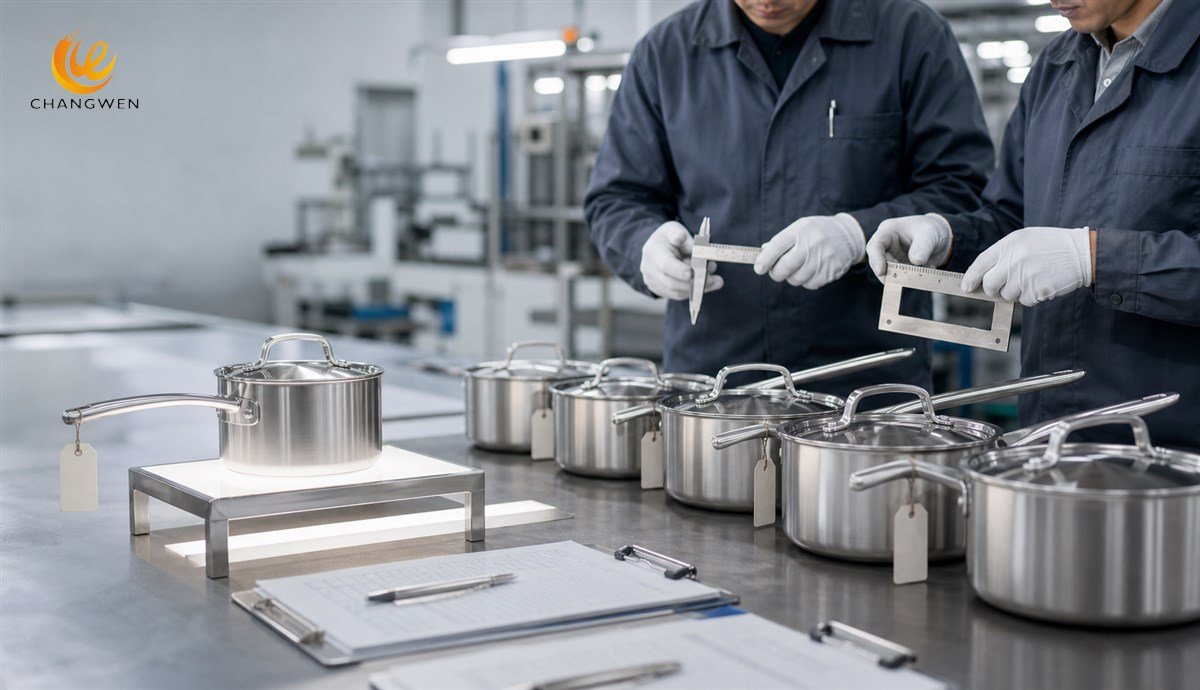
Mass-production release requires an approved specification, bill of materials, production reference sample, test results, tooling status, process flow, control plan, inspection instructions, packaging files, order quantity, schedule, and change record. Commercial approval is insufficient while technical evidence remains open.
The control plan should connect each important requirement to a production stage, inspection method, frequency, equipment, limit, record, and reaction. Material identity belongs at incoming inspection; dimensions may be checked after forming; bonding or flatness may need process checks; finish and assembly require visual and functional criteria; packaging needs SKU and quantity verification. End-of-line inspection cannot reconstruct control that was missing upstream.
The buyer should also confirm how nonconforming material will be identified, isolated, reviewed, reworked, or rejected. A defined reaction plan prevents questionable units from re-entering the production flow without authorization. Traceability should connect raw material and component batches with the relevant finished-goods production record at a level appropriate to the project.
Gate 8: How Does Cookware Move Through Mass Production?
Mass production begins with approved materials and components. Incoming control verifies that metal, handles, lids, fasteners, coatings, packaging, and labels match the bill of materials and required documentation. Starting with unverified inputs creates defects that later appearance inspection may not detect.
The body-production route depends on cookware construction. Common metalworking stages can include blank preparation, forming or drawing, trimming, base joining, machining, welding or riveting, grinding, polishing, coating or surface treatment, cleaning, assembly, marking, and inspection. The actual route should be product-specific because stainless steel cookware, aluminum cookware, carbon steel cookware, and clad constructions do not share one universal process.
Process inspection should occur near the operation that creates the characteristic. Formed dimensions are most useful before downstream assembly hides the cause; handle alignment should be checked when the attachment can still be corrected; finish defects should be detected before packing adds cost. Earlier detection reduces the amount of value added to a nonconforming unit.
Mass-production records should show the product revision, batch, date, line or process, inspection result, and authorized disposition. Records are not paperwork for its own sake; they allow the manufacturer to identify where variation began and which finished units may be affected. This capability is especially important for repeat orders because consistency must be demonstrated over time, not only during the launch.
Gate 9: What Happens During Final Inspection and Shipment Release?
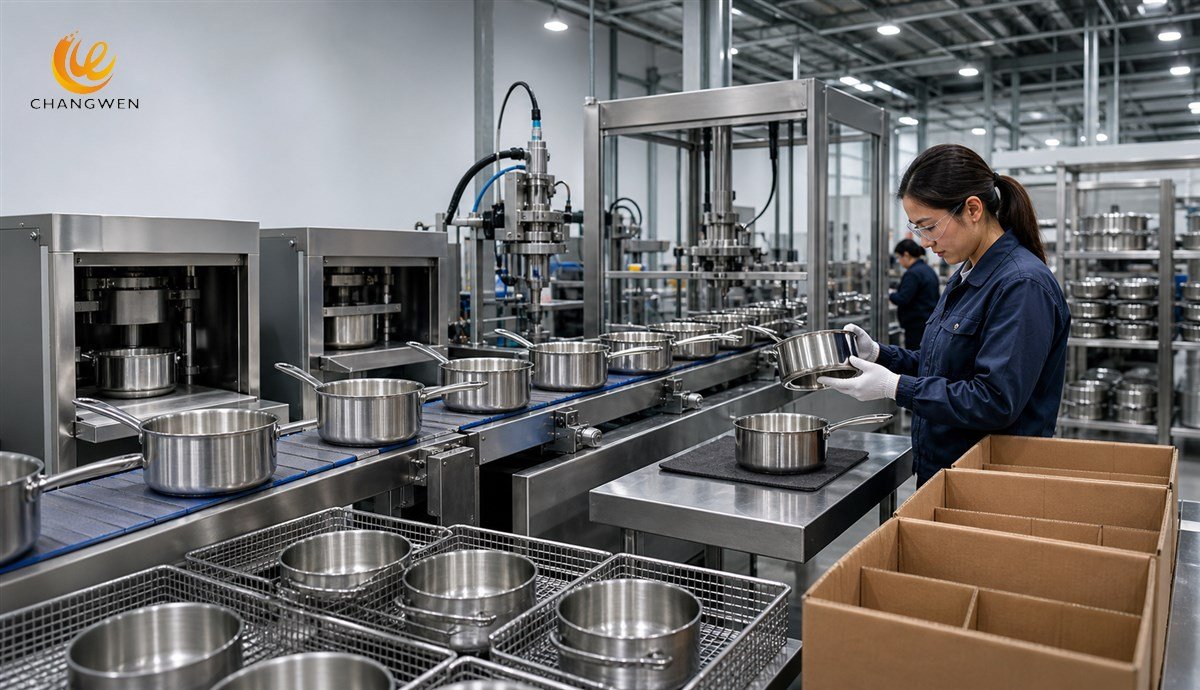
Final inspection verifies that the completed order conforms to the approved product, packaging, labeling, quantity, and workmanship requirements before shipment. The inspection plan should define the lot, sampling method, defect categories, acceptance rules, measurements, functional checks, packaging checks, and reporting format. A generic statement that goods “passed QC” does not provide enough evidence for release.
Final inspection supplements process control rather than replacing it. Some characteristics cannot be economically or reliably verified after packaging, and a passed sample cannot prove that an uncontrolled process was stable. Strong production control prevents defects; final inspection estimates whether the finished lot meets the agreed release rules.
Shipment release should also confirm commercial invoice, packing list, carton count, marks, product and test documents, destination labels, and agreed shipping terms. Packaging validation matters because a conforming pan that arrives scratched, deformed, wet, or mislabeled is still a failed delivery. The approved pack must protect the product through the intended distribution route.
How Can Buyers Prevent Sample-to-Production Drift?
Sample-to-production drift is prevented by controlling the specification, bill of materials, reference sample, process settings, approved sources, and changes as one system. A sample alone cannot define hidden material, tolerance, or process details. The factory and buyer need a consistent evidence chain from design revision to shipped batch.
Buyers should ask who can authorize substitutions and how approval will be documented. A replacement handle, metal source, coating, insert, or box can affect performance, appearance, compliance, or fit even when the product name remains unchanged. No substitution should enter production merely because it appears similar.
Supplier capability also influences drift risk. The retailer guide to choosing cookware suppliers explains why a sample must be evaluated alongside process capability, quality systems, communication, capacity, and replenishment reliability. A beautiful sample is evidence about one unit, not proof of long-term supply performance.
Who Approves Each OEM Cookware Stage?
The buyer should own product intent, market requirements, commercial decisions, and final approvals. The manufacturer should own manufacturability analysis, process design, tooling execution, production control, and internal quality records. Outside specialists may provide evidence, but responsibility remains with the contracting parties.
A responsibility matrix can identify who prepares, reviews, approves, and receives each deliverable. This simple tool prevents a product manager from assuming that a sourcing agent approved engineering tolerances, or a factory engineer from assuming that the buyer approved an artwork revision. Named authority makes gates enforceable.
Before paying a deposit, buyers can use the cookware manufacturer pre-order questions to clarify materials, subcontracting, quality, testing, tooling, lead time, packaging, inspection, and repeat-order control. Answers should be attached to project records when they affect the final specification or contract.
What Common Mistakes Delay OEM Cookware Projects?
- Starting tooling before requirements are frozen: later design corrections become expensive tool changes.
- Approving a sample without measurements: subjective approval gives production no usable tolerance.
- Confusing a visual prototype with a production sample: hand finishing can hide process limitations.
- Leaving packaging until the end: unverified dimensions, artwork, or inserts can block shipment.
- Changing components by message only: undocumented substitutions break traceability and sample control.
- Skipping the pilot run: scale-related variation appears during the buyer’s paid mass-production order.
- Relying only on final inspection: defects created upstream become costly or impossible to correct.
- Comparing timelines without scope: a catalog sample and a full OEM tool trial are not equivalent milestones.
How Long Does the OEM Cookware Manufacturing Process Take?
The total schedule depends on design maturity, tooling, sample revisions, testing, material availability, customization, order quantity, packaging, factory capacity, and buyer response time. A universal lead-time promise is unreliable because an existing-platform private label order and a proprietary full-OEM product do not contain the same work.
The most credible completion date is calculated after the product path and open risks are known. A factory that identifies dependencies may appear less optimistic than one giving an immediate date, but dependency-based planning is easier to control. Schedule quality comes from visible assumptions and release gates, not from the shortest number.
FAQ About the OEM Cookware Manufacturing Process
Can mass production begin after the first sample is approved?
Mass production should begin only when the approved sample is production-representative and all release documents are complete. A first visual or engineering sample may still require tooling corrections, validation tests, packaging approval, and pilot-process confirmation.
What is a golden sample in cookware manufacturing?
A golden sample is a controlled approved reference used to compare production appearance, construction, fit, and workmanship. The golden sample must be linked to the current specification and cannot replace measurable dimensions, materials, performance requirements, or inspection rules.
Is a pilot run the same as a small order?
A pilot run is an engineering and process-validation activity using intended production conditions. A small commercial order is primarily a quantity decision. A pilot can produce usable goods, but its main purpose is to measure repeatability, identify variation, and establish process controls.
Who owns OEM cookware tooling?
Tool ownership depends on the written commercial agreement. The agreement should identify who paid for the tool, who owns it, where it is stored, who may use it, how it is maintained, and what happens when the supplier relationship ends.
Can the material be changed after sample approval?
A material change should follow formal change control. The buyer and manufacturer must assess performance, appearance, manufacturing, compliance, cost, inventory, and retesting consequences before authorizing a revised specification and reference sample.
What documents should buyers receive before shipment?
The required documents depend on the order and market, but the release package commonly includes an approved specification reference, final inspection report, packing list, commercial invoice, agreed test or compliance documents, and shipping documents. The contract should define the exact list.
How should a buyer compare two OEM cookware factories?
A buyer should compare design support, process capability, tooling control, material traceability, sample discipline, validation support, production quality, change control, capacity, communication, packaging, and repeat-order reliability under the same specification. The lowest quotation is not comparable when the process scope is different.
What Is the Final Rule for Moving from Design to Mass Production?
The final rule is that evidence, not momentum, should release each stage. A clear brief releases design work; an accepted DFM review releases the specification; controlled drawings release tooling; measured samples release validation; a stable pilot releases mass production; and conforming records release shipment.
A well-controlled OEM cookware process does more than produce the first order. It creates a repeatable baseline for reorders, supplier communication, cost control, quality investigation, packaging revisions, and future product extensions. When every gate has a question, deliverable, owner, and approval, the path from design to mass production becomes visible, auditable, and commercially manageable.