Read time: 11 min
Introduction
Here’s what happens in most commercial kitchens at some point during service:
The soup is done. Eighty portions need to come out over the next two hours. Someone has to ladle from a full, heavy stock pot — repeatedly — while managing the rest of a busy line.
Or: the broth needs to be drained and separated from solids. The pot weighs 30+ kilograms full. Someone has to lift it, tilt it, strain it.
Both scenarios are slow, unsafe, and completely avoidable with the right equipment.
A stainless steel stock pot with spigot — a stock pot fitted with a valve near the base that lets you dispense liquid without lifting, tilting, or ladling — solves this problem definitively. It’s one of those pieces of equipment that professionals who have used it never go back from.
But here’s the catch: the market is full of them, and the quality variation is enormous. A correctly specified 304 stainless steel stock pot with spigot will handle daily commercial service for a decade. A poorly specified one — wrong steel grade, weak valve, thin walls — fails within months.
This guide covers every decision point: steel grade, spigot design, size, construction, and how to verify quality before committing to a wholesale purchase. No generic advice. No brand recommendations. Just the specifications that actually matter — and why.

Key Takeaways
- A stainless steel stock pot with spigot (also called a stock pot with tap, stock pot with faucet, or stock pot with valve) eliminates heavy lifting during liquid service and dispensing — one of the most significant ergonomic improvements in any commercial soup, stock, or beverage service operation.
- 304 stainless steel is the non-negotiable commercial standard. 201-grade steel looks identical and costs less, but corrodes under frequent cleaning and acidic liquid contact — typically showing failure within 12–18 months of daily use.
- Spigot placement matters: The valve should be positioned 2–3 inches above the pot base to maximize usable capacity while preventing sediment from being dispensed with the liquid.
- Spigot valve material: Stainless steel ball valves are the commercial standard. Brass valves are acceptable in non-acidic applications. Plastic valves are for home use only — they degrade under heat and frequent cleaning cycles.
- Composite (clad) bases significantly outperform single-ply stainless for even heat distribution — essential for large-volume cooking where hot spots cause scorching at the bottom.
- Common sizes for commercial use: 20L (approx. 21 qt), 30L (approx. 32 qt), 45L (approx. 48 qt), 65L (approx. 69 qt). Sizes below 15L are primarily for home or small-batch use.
- Wholesale sourcing from China (primarily Guangdong Province — Jiangmen, Chaozhou) delivers the best cost-to-quality ratio at verified factory-direct pricing.
What Is a Stock Pot with Spigot — and Why Does the Spigot Change Everything?
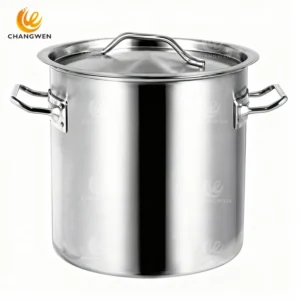
A stock pot with spigot is a standard deep-walled cooking pot (typically 304 stainless steel) fitted with a drain valve — a tap or faucet — mounted through the pot wall near the base. The valve opens to allow controlled dispensing of liquid from the pot without moving the pot.
The Components of a Complete Unit
A well-specified stainless steel stock pot with spigot consists of:
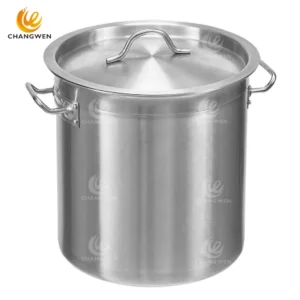
- Pot body: Stainless steel with composite or single-ply base
- Lid: Tight-fitting with handle or side-hang capability
- Handles: Riveted side loop handles, load-rated for full capacity
- Spigot assembly: Ball valve + fitting + gasket seal mounted through the pot wall
- Valve handle: Lever or knob control for one-handed operation
Why the Spigot Transforms Workflow
The operational advantages are immediate and measurable:
Eliminates heavy lifting during service. A stock pot filled with 30L of bone broth weighs approximately 35–38 kg. Lifting and tilting this to ladle into portions — repeatedly over a two-hour service — is a significant ergonomic hazard. The spigot removes the need entirely. Open the valve, fill the bowl, close the valve.
Enables controlled portioning. On a soup service line, consistent portion control is critical for food cost management. A valve allows a kitchen worker with no specialized skill to dispense consistent portions quickly and accurately without ladle training.
Allows liquid–solid separation without straining. When making stock, the liquid can be dispensed through the spigot while solids remain in the pot — no need for a separate straining operation.
Supports self-serve and beverage applications. Beyond cooking, stainless steel stock pots with spigots serve as large-format beverage dispensers — hot drinks, water dispensing, coffee or tea service at scale — in catering, institutional, and event applications.
Reduces spill and burn risk. Tilting a full stock pot is one of the most common causes of kitchen burns. The spigot eliminates this risk entirely for liquid dispensing operations.
Stainless Steel Grade: 304 vs 201 vs Aluminum-Clad
This is the most consequential specification decision in the purchase — and the one most frequently skimped on in low-cost products.
304 Stainless Steel: The Commercial Standard
304 stainless steel (also expressed as 18/8 — 18% chromium, 8% nickel) is what every serious commercial kitchen uses for liquid-contact cookware. Here’s why:
- Chromium content: 18% — forms a passive oxide layer that continuously re-seals micro-scratches and resists corrosion
- Nickel content: 8–10% — provides luster retention, acid resistance, and structural stability
- Performance: Handles repeated daily dishwasher cleaning, high-acid stocks (tomato, wine, citrus), and thermal cycling without degradation
- Compliance: Meets NSF food contact standards; required for commercial kitchen certification in most jurisdictions
- Service life: With proper care, 10–15 years in daily commercial use
For a stock pot with spigot specifically, 304 is even more critical because the pot holds liquids for extended periods — often acidic stocks and broths — in direct contact with the steel. Any downgrade in corrosion resistance shows up faster in this application than in standard cookware.
201 Stainless Steel: Know What You’re Buying
201 stainless steel is a 200-series alloy that substitutes manganese for some of the nickel in the 304 formula. The result:
- Chromium: 13–16% (vs 18% in 304)
- Nickel: 1–4% (vs 8–10% in 304)
- Cost: Significantly cheaper than 304
- Appearance: Identical to 304 when new
- Corrosion resistance: Moderate — adequate for occasional light use, unsuitable for daily acid exposure and commercial cleaning cycles
The failure pattern: A 201 stainless pot used daily in a commercial kitchen for stock-making typically shows rust spots at weld points and on the water-contact surface within 8–18 months. This is not a cosmetic problem — rust contamination in a food product is a health code violation.
The sourcing problem: Many products in the market are listed as “stainless steel” without specifying grade. In wholesale purchasing, always request the Mill Test Certificate confirming 304 grade. This is non-negotiable.
Aluminum-Clad / Tri-Ply Construction
Some stock pots with spigots use a composite base or full clad construction — stainless steel exterior and interior bonded around an aluminum core. This construction addresses one of stainless steel’s inherent limitations: poor thermal conductivity.
- Single-ply stainless: Conducts heat slowly, creates hot spots directly above burner elements, potential for scorching in large-volume cooking
- Aluminum-clad base (encapsulated): Aluminum layer bonded into the base improves heat distribution at the bottom significantly
- Tri-ply / full-clad: Aluminum core runs the full height of the pot sides — the most even heat distribution, important for preventing scorching in very large pots
For a stock pot with spigot used primarily for holding and dispensing (where the pot is filled with pre-cooked liquid and maintained at temperature), an encapsulated base is adequate. For pots that are also used for cooking stock from raw ingredients over extended periods, a tri-ply base is worth the additional cost.
430 Stainless: The Induction-Compatible Note
430 stainless steel (18% chromium, 0% nickel) is a ferrite grade — magnetic, making it induction-compatible without a separate aluminum layer. Less corrosion-resistant than 304 but used as the exterior layer of induction-ready tri-ply constructions. Not suitable as the interior food-contact surface for acidic liquids.
Spigot Design: The Spec That Most Buyers Get Wrong
The spigot is a small component, but it’s where most quality failures in this product category occur. Here is what to specify.
Spigot Placement (Height from Base)
The most critical dimensional spec: the valve center should be positioned 2–3 inches (5–7.5 cm) above the pot base.
Why this range matters:
- Too high (4″+): You leave significant liquid below the valve level — unusable capacity that can’t be dispensed without tipping the pot
- Too low (1″ or less): Sediment, fat, solids that settle at the bottom get dispensed with the liquid — defeating the purpose of using a spigot for clean stock service
The 2–3 inch placement is the professional standard, validated across commercial kitchen use cases for stock and broth dispensing.
Valve Type
Stainless steel ball valve — the only commercial choice.
A ball valve uses a spherical closure element with a bore through it. When the handle is turned 90°, the bore aligns with the flow path and liquid flows freely. When turned back, the sphere blocks flow completely. Key characteristics:
- Near-zero leakage when closed
- Full-bore opening (no restriction, full flow rate)
- Easy one-hand operation
- Fully disassemblable for cleaning
- No moving parts to wear under thermal cycling
Brass ball valves are an acceptable alternative for non-acidic applications (water dispensing, non-acid beverages). Brass has excellent mechanical durability but can react with highly acidic stocks or citrus-based liquids over time. For general commercial soup service, brass is typically adequate. For high-acid applications, specify all-stainless.
Avoid: Plastic/nylon valves (degrade under heat), compression fittings without proper sealing (leak-prone), valves that cannot be fully disassembled (fail NSF sanitary design requirements).
Valve Mounting Method
How the spigot is attached to the pot wall determines long-term leak resistance. There are two approaches:
Threaded weldless fitting (compression gasket): The spigot assembly passes through a drilled hole in the pot wall and is secured by a nut and silicone or food-grade rubber gasket on the interior. Advantages: replaceable components, field-repairable, allows valve replacement without replacing the pot. Disadvantage: the gasket must be inspected and replaced periodically.
Welded fitting: The spigot fitting is welded directly to the pot wall. Advantages: no gasket to maintain, no risk of leak at fitting connection. Disadvantage: if the valve fails, it’s more difficult to replace.
For commercial kitchen use, either approach is acceptable if executed correctly. The critical requirement is a tight seal — verify by filling the pot to above the valve level and checking for any seepage around the fitting before putting into service.
Valve Handle Operation
The valve should be operable with one hand while wearing commercial kitchen gloves. Test this:
- Full open-to-close in a single 90° wrist motion
- Handle should not be positioned in a way that requires reaching underneath the pot
- The handle should have a clear visual indicator of open vs closed position (perpendicular to the pipe = closed; parallel = open)
Size Guide: From 10L to 160L
Stock pot with spigot sizes are typically expressed in liters in export markets, and quarts or gallons in the US. Here is the practical size reference:
Commercial Stock Pot with Spigot Size Chart
| Liters | US Quarts (approx.) | Diameter × Height | Weight Full (approx.) | Best Application |
|---|---|---|---|---|
| 10L | 10.6 qt | 25×25 cm | 12–14 kg | Small batch broth, countertop service, home |
| 17L | 18 qt | 25×40 cm | 20–22 kg | Light commercial, small café soup service |
| 20L | 21 qt | 30×30 cm | 23–26 kg | Restaurant daily soup service, small catering |
| 25L | 26 qt | 30×40 cm | 28–32 kg | Mid-volume soup service, catering events |
| 30L | 32 qt | 35×35 cm | 34–38 kg | Hotel soup stations, catering |
| 45L | 48 qt | 40×40 cm | 50–56 kg | Large-scale catering, institutional kitchens |
| 56L | 60 qt | 40×50 cm | 62–68 kg | Hospital/school food service, large catering |
| 65L | 69 qt | 45×45 cm | 72–78 kg | Commissary, institutional bulk production |
| 90L+ | 96 qt+ | 50×50 cm+ | 100+ kg | Industrial food production, military, central kitchen |
How to Choose the Right Size
For daily restaurant soup service (serving 100–200 covers): The 20L–30L range handles most full-service restaurant soup programs. At 30L, the pot holds enough finished broth or soup for 100–120 portions at 250ml (8.5 oz) each, with 20% headspace maintained for service.
For catering operations (50–500 guests per event): The 30L–65L range covers most catering requirements. For large events above 300 guests with soup service, 45L–65L units with a dedicated floor burner are the standard.
For beverage service (hot drinks, dispensing programs): Smaller units (10L–20L) are appropriate for beverage service. The spigot is particularly valued here for self-serve tea, hot water, or bulk coffee dispensing at events and in institutional settings.
The safety consideration at large sizes: At 45L and above, a full pot weighs 50–80 kg. The spigot becomes even more critical — the whole point of this size is that you never need to lift the pot. Ensure your installation includes a stable pot rest at a comfortable dispensing height (approximately 80–90 cm from floor to valve centerline for standing service).
Construction Features That Separate Commercial from Consumer Grade
Beyond steel grade and spigot design, these construction details determine how long a stock pot with spigot actually lasts in daily commercial use.
Wall Thickness (Gauge)
Wall thickness directly determines heat retention, warp resistance, and mechanical durability. Standard reference for commercial use:
- 0.5–0.6mm: Economy/consumer grade — acceptable for light home use, unsuitable for daily commercial service
- 0.8–1.0mm: Light commercial — suitable for low-frequency catering use
- 1.0–1.2mm: Commercial standard — appropriate for daily restaurant and hotel use
- 1.2–1.5mm: Heavy commercial — for high-frequency institutional use, daily cleaning cycles, rough handling
Always request the wall gauge in writing when sourcing wholesale. “Heavy duty stainless steel” is marketing language; the millimeter spec is objective.
Base Construction
- Single-ply flat base: Adequate for holding and reheating pre-cooked liquids. Not ideal for cooking from raw over extended periods.
- Composite/encapsulated base (3-layer): Aluminum layer bonded into the base dramatically improves heat distribution. The commercial minimum recommendation for any cooking application.
- Tri-ply full-clad: Full-height aluminum core. Maximum heat uniformity. For stock pots used for initial cooking (not just holding), this is the premium choice.
Handle Attachment
- Riveted handles: Stainless steel rivets through the pot wall are the commercial standard. Rivets distribute load across the joint and resist fatigue over thousands of lift cycles.
- Welded handles: Acceptable if the weld is full-penetration and properly executed. Spot welds or partial welds fail under repeated load — inspect carefully.
- Handle load rating: For large pots (45L+), confirm the handle assembly is rated for the full loaded weight. A 45L pot full of liquid weighs approximately 50–56 kg. Both handles must be rated for this load with a safety margin.
Lid Design
- Tight-fitting lid with steam vent: Prevents moisture loss during long simmers while allowing pressure to equalize safely
- Side-hang capability: Some lid designs include a notch or lip that allows the lid to hang on the pot rim during service — keeps the lid accessible without setting it on the counter
- Silicone or stainless seal gasket: Improves heat retention if the pot is used for holding temperature without an active burner
Rim Treatment
The pot rim should be rolled or flanged, not raw-cut. A raw-cut rim creates a sharp edge that:
- Cuts gloves and hands during handling
- Catches food residue in the microscopic groove — a sanitation problem
- Can eventually crack under repeated thermal stress
A properly rolled rim has no sharp edges and is smooth on all exterior surfaces.
Applications by Industry
Understanding where stainless steel stock pots with spigots are used clarifies what specifications matter most for each application.
Restaurant Soup Service
The daily workhorse application. Large batch of house soup or broth prepared in the pot; pot transferred to a warming station; service team dispenses bowls via the spigot throughout service without lifting. Key spec priorities: 304 steel, ball valve with easy one-hand operation, 20–30L size, composite base, stable base/stand configuration.
Hotel Breakfast and Banquet Service
Hotels often run multiple stock pots with spigots simultaneously — hot water dispensing, oatmeal stations, soup stations, consommé service. Key spec priorities: Mirror or brushed finish for presentation, 20–30L for individual stations, uniform appearance across units, hydraulic/soft-close lid for guest safety.
Catering and Events
Caterers transport these pots to off-site venues pre-filled with hot liquid. Key spec priorities: Secure lid with gasket (prevent spill during transport), robust handle attachment rated for transport loads, 25–45L size, tight-fitting lid, spigot valve that locks in closed position during transport.
Institutional Food Service (Schools, Hospitals, Military)
Volume is the driver. These kitchens operate at scale and may use 45L–90L+ units daily. Key spec priorities: Heavy-gauge walls (1.2mm+), welded fittings, full-bore ball valve for high-flow service, NSF certification, compatibility with institutional cleaning equipment.
Home Brewing and Fermentation
A separate but growing application. Home brewers use stock pots with spigots as brew kettles — the spigot drains wort from the kettle into the fermenter. Key spec priorities: 304 stainless throughout (including spigot), ball valve with removable strainer insert to filter hop matter, size 20–40L, thermometer port (additional fitting), weldless assembly for field cleaning access.
Beverage Dispensing (Catering Events)
Used as large-format hot drink dispensers — hot water for tea service, mulled wine at events, hot chocolate, bulk coffee. Key spec priorities: Presentation-quality finish, insulation layer (double-wall construction for hot-hold applications), 10–20L for most event uses.
How to Verify Quality Before You Buy Wholesale
If you’re purchasing stainless steel stock pots with spigots in wholesale quantities, these are the steps that protect your investment.
Step 1: Demand the Mill Test Certificate
Request the Mill Test Certificate (MTC) for the stainless steel coil used in production. This document is issued by the steel mill and confirms the actual elemental composition — chromium, nickel, carbon content — of the batch.
A legitimate 304 stainless steel product comes with an MTC confirming ≥18% chromium and ≥8% nickel. A supplier who cannot or will not provide this document is almost certainly using 201-grade steel or a lower alloy.
This is the single most important verification step for any stainless steel cookware sourcing.
Step 2: Request a Physical Sample
Before committing to bulk quantities, request 1–3 physical samples. Evaluate:
- Weight: 304 commercial-grade pots feel substantially heavier than 201 or thin-walled alternatives of the same stated capacity
- Wall gauge: Measure with calipers or request the gauge specification in writing. 1.0mm minimum for commercial use.
- Spigot operation: Fill with water to above the valve, operate 20–30 open/close cycles, check for leakage at valve and fitting
- Sediment behavior: Fill with settled water (let it sit for 30 minutes), open valve — observe whether the valve height allows clear liquid dispensing before sediment-level is reached
- Handle stress test: Full load test — do handles flex under simulated full-load lifting?
- Weld inspection: All weld points should be clean, full-penetration, and without voids or cracks
Step 3: Verify the Spigot Assembly Materials
Request the specification for the spigot fitting separately:
- Valve body material (stainless 304 or brass — both acceptable commercially)
- Gasket material (food-grade silicone or EPDM — both NSF acceptable)
- Confirm the valve is fully disassemblable for cleaning inspection
If the supplier cannot specify these separately, the spigot assembly is likely a generic import of unknown specification.
Step 4: NSF Compliance Verification
For commercial use in the US, all food-contact equipment should be NSF-listed or at minimum NSF-compliant in material specification. Request:
- NSF Listing Number (for listed products)
- OR documentation confirming food-grade material compliance for unlisted products
For EU markets: LFGB food contact material compliance.
Step 5: Pre-Shipment Inspection for Bulk Orders
For wholesale orders above 50 units or $5,000 USD, commission a third-party pre-shipment inspection. An independent inspector visits the factory before shipment and checks:
- Quantity against purchase order
- Random unit sampling for dimensional accuracy and quality
- Spigot assembly on sample units (fill test, cycle test)
- Packaging integrity
Cost: approximately $250–450. This step prevents a full container of non-conforming product from clearing customs.
FAQ
What is a stainless steel stock pot with spigot used for?
A stainless steel stock pot with spigot is used for cooking and dispensing large volumes of liquid — soups, stocks, broth, broths, hot beverages, and water — without lifting or tilting the pot. The spigot (a ball valve fitted near the pot base) allows controlled dispensing directly into serving vessels. Commercial applications include restaurant soup service lines, hotel buffet beverage stations, catering events, and institutional food service. The same product is used in home brewing as a brew kettle, where the spigot drains wort into the fermenter.
What is the difference between a stock pot with spigot and a regular stock pot?
A regular stock pot has no dispensing valve — liquid is removed by ladle or by tipping and pouring. A stock pot with spigot adds a ball valve near the base, enabling controlled liquid dispensing without lifting. The functional difference is significant in commercial applications: eliminating heavy lifting during service, enabling consistent portion control, and allowing liquid–solid separation during stock-making. The structural difference is the added spigot assembly and its mounting through the pot wall, which requires a proper seal to prevent leakage.
What stainless steel grade should I look for in a stock pot with spigot?
304 stainless steel (18/8 — 18% chromium, 8% nickel) is the commercial standard. It provides excellent corrosion resistance against the acidic stocks, broths, and cleaning chemicals a commercial stock pot encounters daily. 201 stainless steel looks identical but has lower chromium and nickel content — it corrodes faster under commercial conditions and is not suitable for daily professional use. Always request a Mill Test Certificate confirming 304 grade for any commercial purchase.
Where should the spigot be positioned on a stock pot?
The optimal spigot position is 2–3 inches (5–7.5 cm) above the pot base. This height:
- Keeps the valve above the sediment layer that settles at the bottom during long simmers
- Maximizes usable dispensable capacity (vs. a high-mounted valve that leaves significant liquid below the valve)
- Allows practical access to the valve handle without reaching underneath the pot
Avoid valves positioned at 1″ or less (too much sediment risk) or 4″+ (too much unusable capacity below the valve).
What size stock pot with spigot do I need for a restaurant soup service?
For a restaurant serving 100–200 covers with soup, the 20L–30L range (approximately 21–32 quarts) is the standard commercial specification. A 30L pot holds approximately 120 portions at 250ml (8.5 oz) per serving with 20% headspace maintained. For higher volume operations or catering, scale up to 45L (approx. 48 qt) or 65L (approx. 69 qt). For institutional use above 300 portions, 90L+ units are typical.
Can a stainless steel stock pot with spigot be used on induction cooktops?
Yes — if the pot is specified with a magnetic base layer. Pure 304 austenitic stainless steel is non-magnetic and will not work on induction cooktops. For induction compatibility, the pot must have either a ferritic stainless (430) or magnetic composite base. Most modern commercial stock pots with spigots designed for restaurant use include an aluminum-clad composite base with a magnetic outer layer, making them induction-compatible. Always confirm induction compatibility explicitly in the product specification.
Is the spigot valve safe for food contact?
For commercial use, the valve must be made from food-safe materials: 304 stainless steel or food-grade brass for the valve body, and food-grade silicone or EPDM rubber for the gasket. Valves with plastic components are designed for home/light-use applications and are not appropriate for commercial kitchen use — they degrade under high temperatures and frequent commercial cleaning. Verify valve material in the product specification; request documentation for NSF or LFGB food contact compliance on any commercial wholesale purchase.
Conclusion
The stainless steel stock pot with spigot is one of those products that immediately improves kitchen workflow — every professional who uses one for soup service or large-batch stock work wonders why they didn’t have it sooner.
But it’s also a product where the specification gap between acceptable and unacceptable is almost invisible at point of purchase. A 201-grade pot and a 304-grade pot look identical. A plastic-valve unit and a stainless ball-valve unit look similar. The difference only becomes apparent over months of use — and by then you’ve already bought the wrong thing.
The decisions that matter:
- 304 stainless steel — always. Require the Mill Test Certificate.
- Stainless or food-grade brass ball valve. Never plastic for commercial use.
- Spigot at 2–3 inches from base. Not lower, not significantly higher.
- Wall gauge of 1.0mm minimum for any commercial application.
- Composite base for any cooking application (not just holding).
- Riveted handles rated for the full loaded weight.
Get these specs right and you have a piece of equipment that serves your kitchen well for years. Get them wrong and you’re replacing it within 12–18 months.
Changwen is a manufacturer of stainless steel stock pots with spigot, producing commercial 304 stainless steel stock pots in various sizes.commercial stainless steel stock pots with spigots in 304 grade, across all standard sizes from 10L to 160L, with stainless and brass ball valve options, composite and tri-ply base configurations, and full NSF-compliant material documentation. Factory-direct wholesale pricing available from 50 units.