Quick answer: Grade 304 is usually the strongest all-around choice for a cookware food-contact surface because it combines corrosion resistance, formability, and broad manufacturing familiarity. Grade 430 is magnetic and is commonly valuable in an induction-compatible exterior layer or base plate, but it has lower corrosion resistance than 304. Grade 201 can reduce material cost in suitable components and use conditions, but its lower nickel and higher manganese content generally provide less corrosion margin than 304. The best cookware construction may use more than one grade because every component has a different job.
Read time: 13 minutes.
This guide focuses on component architecture rather than repeating a basic 201-versus-304 comparison. Cookware buyers will learn where 201, 304, and 430 can be used, why magnetic behavior differs, how steel grade interacts with aluminum heat-spreading layers, and how to specify and verify each component in an OEM order.
What do 201, 304, and 430 stainless steel mean?
Stainless steel grades are alloy families with different chromium, nickel, manganese, carbon, and other element ranges. Those differences change corrosion resistance, magnetism, formability, weld behavior, surface appearance, cost, and response to manufacturing. A grade number is therefore a technical specification, not a simple quality rank.
Grades 201 and 304 belong to the austenitic stainless steel family. Austenitic grades are usually nonmagnetic or only weakly magnetic in an annealed condition, although forming can create some magnetic response. Grade 430 belongs to the ferritic family and is normally magnetic, which makes it useful where induction coupling is required.
The grade alone does not determine cooking performance. Stainless steel conducts heat much less effectively than aluminum, so high-performing cookware often combines stainless steel with an aluminum core or bonded disc. Steel grade mainly affects corrosion, food-contact durability, magnetism, forming, surface behavior, and cost within that construction.
How do 201, 304, and 430 compare at a glance?
| Attribute | 201 stainless steel | 304 stainless steel | 430 stainless steel |
|---|---|---|---|
| Family | Austenitic | Austenitic | Ferritic |
| Typical magnetic behavior | Usually low; may increase after forming | Usually low; may increase after forming | Magnetic |
| Relative corrosion margin | Lower than 304 in demanding exposure | Strong general-purpose performance | Lower than 304, especially in aggressive conditions |
| Common cookware role | Budget-sensitive bodies or exterior components where validated | Food-contact interiors and durable general-purpose bodies | Induction exterior layers, base plates, and selected components |
| Main buying advantage | Material cost control | Balanced durability and corrosion resistance | Magnetism and cost-efficient induction function |
| Main limitation | Reduced corrosion reserve compared with 304 | Higher alloy cost than 201 or 430 in many markets | Lower corrosion resistance and different forming behavior |
The table describes general tendencies, not a compliance guarantee. Actual performance depends on alloy conformity, surface condition, forming, welding, passivation, contaminants, food chemistry, cleaning, storage, and product design. Buyers should validate the finished cookware for the intended market and use.
Why is 304 stainless steel widely used for cookware interiors?
Grade 304 offers a practical balance of corrosion resistance, formability, weldability, finish quality, and supply availability. Those characteristics make it a common choice for food-contact interiors exposed to moisture, salt, acids, heat cycles, detergents, and repeated cleaning.
Grade 304 contains more nickel than 201 in typical commercial specifications, which supports its stable austenitic structure and corrosion performance. Chromium helps form the passive surface film that gives stainless steel its resistance to rust. The finished surface still requires proper processing and care because no stainless grade is completely immune to staining or corrosion.
Grade 304 should not be described as the only safe or legal cookware alloy in every market. Food-contact suitability depends on the finished product and applicable requirements, not a grade nickname. Manufacturers should provide relevant material documentation and finished-product test evidence where required.
The existing 201 versus 304 cookware manufacturing guide provides deeper coverage of their cost and corrosion differences. The present article expands the decision by adding 430 and component-specific design.
When can 201 stainless steel make sense in cookware?
Grade 201 can make sense when cost targets are important, the intended environment is not highly aggressive, the component is designed and finished correctly, and the product specification is transparent. It can be used in selected cookware bodies, exterior shells, lids, handles, or other parts depending on construction and market requirements.
Grade 201 replaces part of the nickel contribution with higher manganese and nitrogen in its alloy design. The economic advantage can be meaningful when nickel prices are high, but the material generally offers less corrosion margin than 304. That difference becomes more important with salty residues, acidic foods, chlorides, humid storage, harsh detergents, poor rinsing, or damaged passive surfaces.
A buyer should not accept 201 as an undisclosed substitute for an approved 304 component. Even if the finished products look identical, alloy substitution changes the specification, cost, corrosion risk, documentation, and possibly the validity of test evidence. Written change approval should be mandatory.
What makes 430 stainless steel different?
Grade 430 is a chromium-containing ferritic stainless steel with little or no nickel compared with common 304 specifications. Its ferritic structure is magnetic, which allows an induction hob’s changing magnetic field to generate heat in the cookware base.
Grade 430 can cost less than 304 because its alloy design does not depend on similar nickel content. However, the economic advantage should be judged by component function. Using 430 as an induction exterior can add useful magnetism without requiring the food-contact interior to give up the corrosion advantages of 304.
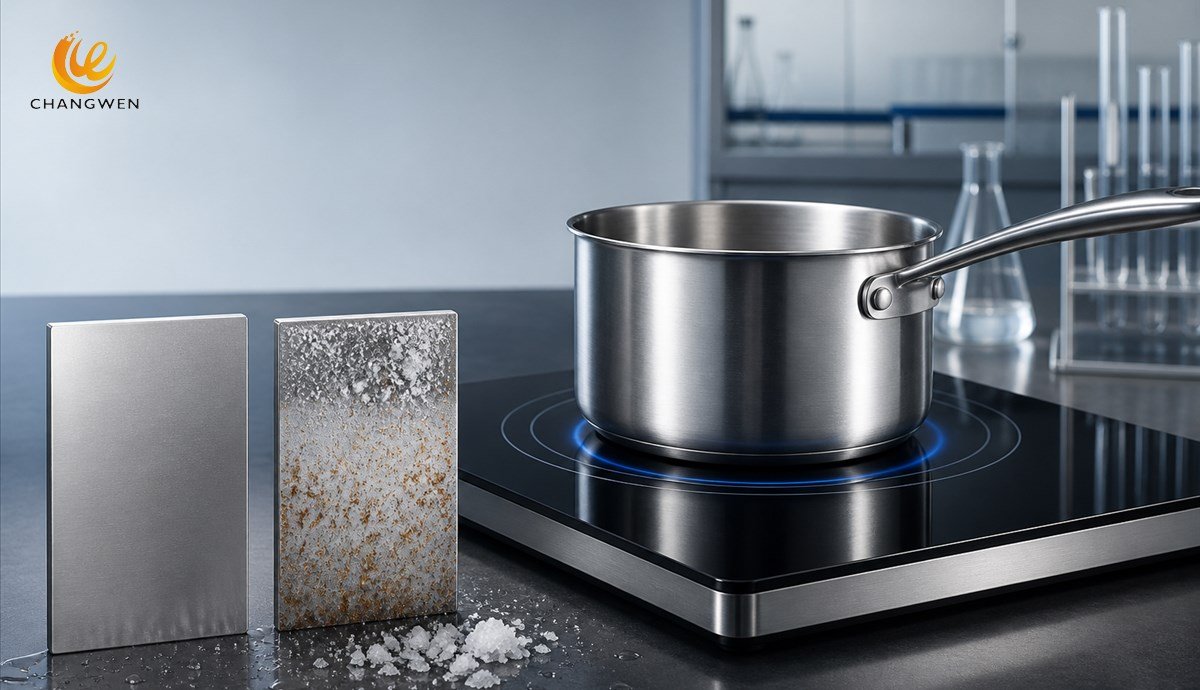
Grade 430 has lower corrosion resistance than 304 in many demanding environments. Water trapped under a pan, salt deposits, chloride cleaners, humid storage, and incomplete cleaning can create staining or corrosion. Finish, passivation, design drainage, drying instructions, and cleaning guidance influence real performance.
Why can one cookware item use multiple stainless steel grades?
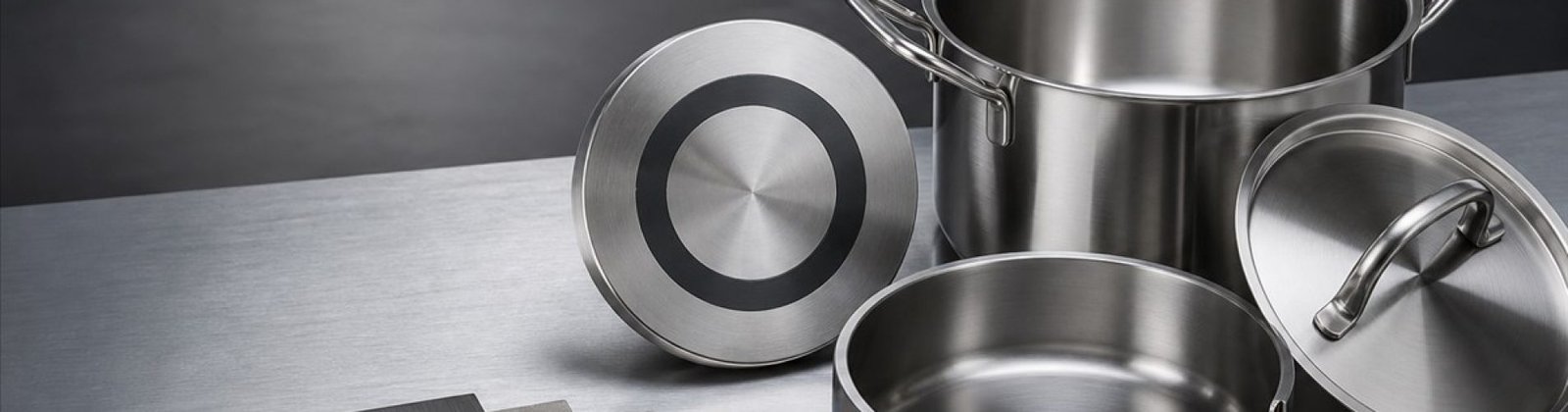
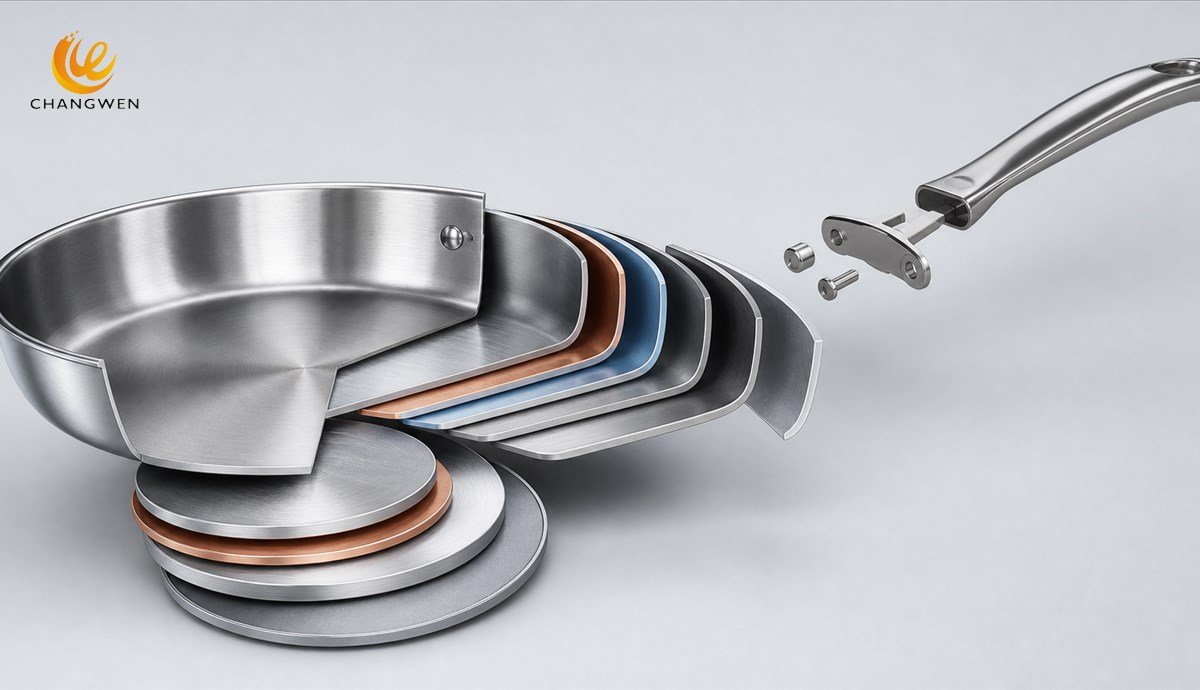
A multi-grade design assigns each material to the function it performs best. A common conceptual architecture uses 304 stainless steel on the food-contact interior, aluminum in the middle for heat distribution, and magnetic 430 stainless steel on the exterior for induction. The layers may cover the full body or appear in a bonded base, depending on the product.
The interior layer needs corrosion resistance, cleanability, formability, and a durable cooking surface. The aluminum layer needs thermal conductivity and sufficient thickness or coverage. The exterior layer needs compatibility with the heat source, mechanical durability, finish quality, and acceptable corrosion performance for the expected environment.
Handles, lid rims, fasteners, and base plates can use other grades than the body. Those decisions are not automatically shortcuts. A component can legitimately use the most appropriate alloy when the bill of materials is clear, the interfaces are controlled, and the finished product meets performance and market requirements.
Where should each grade be used in a cookware specification?
| Cookware component | Common design priority | Possible grade approach |
|---|---|---|
| Food-contact interior | Corrosion resistance and cleanability | 304 is a common strong default; alternatives require validation |
| Exterior body | Appearance, durability, cost, and heat-source needs | 304, 201, or 430 depending on design and environment |
| Induction layer or base plate | Magnetic response and bond integrity | 430 or another validated magnetic stainless grade |
| Handle | Strength, temperature, corrosion, and forming | 201, 304, 430, or other specified grade by design |
| Lid rim | Fit, spring behavior, finish, and corrosion | Grade selected for forming and exposure conditions |
| Rivets or fasteners | Strength, corrosion compatibility, and assembly | Specified separately; must not be assumed from body grade |
The component table is a design framework, not a universal recipe. A commercial stockpot, clad frying pan, steamer, saucepan, and pressure vessel experience different loads and exposure. The manufacturer should justify each component through engineering and testing.
Is 430 stainless steel always required for induction cookware?
Induction cookware requires a base that interacts effectively with the induction field, but 430 is not the only possible magnetic material. Manufacturers may use other ferritic stainless grades or magnetic base solutions. The relevant requirement is verified induction response across the intended hob range.
A magnet test provides a quick indication of magnetic behavior but does not prove cooking performance, alloy grade, bond quality, or corrosion resistance. A strongly magnetic base can still heat unevenly if its diameter, flatness, conductive layer, or bonding is poorly designed.
Buyers should specify minimum effective base diameter, flatness, induction recognition, heating behavior, noise expectations where relevant, and durability after thermal cycling. A material name without functional tests is incomplete.
Does magnetic stainless steel mean lower quality?
Magnetism does not mean lower quality. Magnetic behavior reflects alloy structure and processing, not a universal quality ranking. Grade 430 can be the correct material for an induction layer, while weakly magnetic 304 can be the correct material for the cooking interior.
Cold working can make austenitic 201 or 304 somewhat magnetic, especially around heavily formed areas. A consumer magnet test can therefore produce confusing results. The test cannot distinguish grade reliably and should not replace material verification.
Quality should be evaluated by component function, alloy conformity, construction, surface processing, performance tests, and consistency. A mixed-grade pan can be better engineered than a single-grade pan when each layer has a defined purpose.
How do the grades affect corrosion in real kitchens?
Corrosion risk increases when stainless steel experiences chlorides, salt deposits, acidic residues, high temperature, scratches, iron contamination, harsh cleaners, prolonged moisture, or poor rinsing and drying. Grade 304 generally offers a larger corrosion reserve than 201 or 430, but correct care and manufacturing remain important for every grade.
Pitting appears as localized attack rather than uniform rust. Crevices around handles, rims, bonded edges, or trapped deposits can create conditions different from an open polished surface. Product design should avoid water traps and difficult-to-clean joints where practical.
Surface finishing and passivation help stainless steel establish a clean passive condition after forming, welding, polishing, or contamination. Passivation cannot turn the wrong alloy into the right alloy, and it cannot compensate for embedded iron, defective joints, or unsuitable exposure.
How should cookware buyers verify 201, 304, and 430?
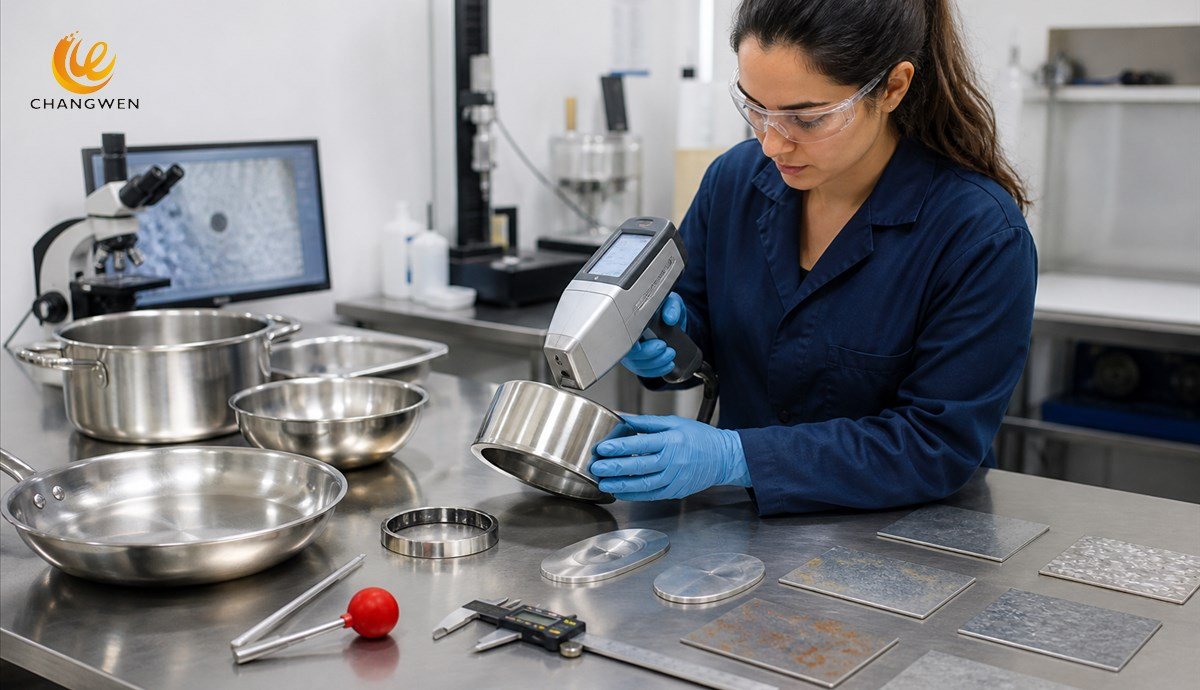
Buyers should begin with a component-level bill of materials and material certificates linked to actual lots. The documentation should identify the supplier, grade, specification, heat or lot reference, and relevant composition results. A certificate from an unrelated shipment provides weak assurance.
Positive material identification can verify alloy chemistry using suitable analytical equipment. The method, calibration, measurement location, sample preparation, and interpretation should be appropriate to the component. Thin layers, curved surfaces, coatings, and clad structures can complicate measurement, so a qualified laboratory or inspector may be necessary.
A magnet can screen magnetic versus nonmagnetic response but cannot confirm 201 versus 304 and cannot prove 430 composition. Spark tests, chemical spot tests, and appearance judgments have limitations and should not be treated as definitive for high-risk orders.
Buyers should combine material verification with thickness, weight, layer, bond, corrosion, induction, and finished-product checks. Alloy identity is necessary, but it does not prove that the cookware construction performs correctly.
What tests matter beyond chemical composition?
Finished cookware testing can include corrosion exposure appropriate to the market, food-contact migration where applicable, thermal cycling, base flatness, bonding integrity, handle strength, lid fit, surface-cleaning behavior, dishwasher durability, and induction recognition. Test scope should follow product claims and foreseeable use.
Corrosion tests should be interpreted carefully. Accelerated conditions help compare samples but may not reproduce every kitchen environment. The test method, solution, temperature, duration, sample preparation, acceptance criteria, and evaluation should be agreed before results are compared.
Dishwasher claims require more than identifying 304 steel because detergents, rims, fasteners, mixed-metal interfaces, finishes, and trapped water influence the result. Component design can fail even when the main body alloy performs well.
How do steel grades affect cookware price?
Raw alloy cost affects price, but finished cookware cost also depends on thickness, weight, yield, forming difficulty, polishing, bonding, tooling, handles, lids, packaging, testing, and order volume. A lighter 304 pan can cost less than a heavier multi-layer design that uses lower-cost grades.
Using 430 only where magnetism is needed can create an efficient induction design. Using 201 in an appropriate exterior component can support a budget target. Using 304 on the food-contact interior can preserve corrosion performance where exposure is highest. Value comes from architecture, not from maximizing one grade everywhere.
Buyers should compare quotations using identical component specifications. If one manufacturer offers 304 and another offers 201 or 430 without stating the difference, the prices do not describe equivalent products.
Can 201 stainless steel be used for food-contact cookware?
Grade 201 is used in some food-contact products, but suitability cannot be decided from the grade number alone. The finished product must match the destination market’s applicable requirements and the expected food, cleaning, temperature, and corrosion exposure.
A buyer should evaluate relevant migration or food-contact evidence, corrosion behavior, material consistency, surface processing, and labeling. A low-cost product designed for mild home use has different exposure from restaurant cookware repeatedly contacting salty or acidic foods.
Grade 304 provides more corrosion margin in many demanding conditions, which can justify its higher material cost. The correct decision should connect alloy choice to the actual customer promise and risk rather than describe one grade as universally safe or unsafe.
Can 430 stainless steel touch food?
Grade 430 can appear in food-related products, but food-contact suitability depends on the finished component, intended conditions, and applicable requirements. Its lower corrosion resistance compared with 304 may make it less attractive for demanding cooking interiors even when regulatory requirements can be met.
Using 430 on an exterior induction layer allows the material to provide magnetic function while limiting direct food exposure. This architecture demonstrates why component location matters more than a whole-product grade label.
Buyers should avoid marketing a multi-grade product as entirely 304 when the exterior or base uses 430. Accurate component claims reduce customer confusion and support traceable documentation.
How should an OEM specification describe multiple grades?
An OEM specification should list every component in a bill of materials with grade, standard, nominal thickness or weight, finish, supplier control, and verification method. A drawing should identify layer order and component boundaries so the factory, buyer, laboratory, and inspector evaluate the same construction.
The specification should define tolerances rather than only nominal values. Body weight, layer thickness, base diameter, bonding coverage, handle material, fastener grade, and finish can affect performance and cost. The approved golden sample should not replace measurable limits.
Purchase terms should require written approval before material, thickness, supplier, process, finish, or factory changes. The supplier should retain lot traceability and material records for an agreed period. The pre-order cookware manufacturer questions provide a practical framework for confirming these controls before a deposit.
What labeling and marketing claims should buyers avoid?
Buyers should avoid whole-product claims that hide component differences. A statement such as “304 stainless steel cookware” can be misleading when only the interior is 304 unless the construction is explained. More precise language identifies the 304 cooking surface and magnetic stainless exterior.
Terms such as “surgical steel,” “food grade,” “premium steel,” or “rust proof” should not replace a grade specification and evidence. “Rust proof” is especially risky because all stainless steels can stain or corrode under sufficiently aggressive conditions.
Induction-compatible claims should be supported by functional testing, not only a magnetic material certificate. Dishwasher-safe claims should reflect complete product testing, including mixed-metal joints, handles, rims, and finishes.
How should retailers choose a grade architecture by market position?
A premium durability line may favor 304 food-contact interiors, robust conductive layers, carefully finished magnetic exteriors, and tighter corrosion and cosmetic limits. A value line may use 201 or 430 strategically in noncritical or exterior components while protecting required performance through design and validation.
Commercial cookware should prioritize the actual service environment. Frequent salt exposure, long holding times, aggressive cleaning, and humid storage can justify greater corrosion margin and stronger inspection. Home cookware may have lower intensity but greater emphasis on finish, induction compatibility, and dishwasher claims.
Retailers should compare expected lifetime, return risk, customer education, and price position rather than only raw steel cost. The site’s guide to how retailers choose stainless steel cookware suppliers connects material decisions with quality, packaging, delivery, and replenishment.
What common mistakes occur when sourcing stainless cookware grades?
The first mistake is specifying only the body grade and ignoring base plates, handles, lids, and fasteners. The second is using a magnet as proof of alloy identity. The third is accepting a material certificate without connecting it to the production lot. The fourth is assuming a grade guarantees induction or dishwasher performance.
The fifth mistake is optimizing nickel cost without modeling corrosion exposure and returns. The sixth is describing mixed-grade cookware with an inaccurate whole-product claim. The seventh is approving a sample without checking whether production uses the same material and layer thickness.
A controlled bill of materials, approved sample, lot traceability, composition verification, functional testing, and written change notification address most of these risks. The process should be proportional to order value and product risk.
Frequently asked questions
Which stainless steel grade is best for cookware?
Grade 304 is a strong general choice for food-contact cookware interiors, while 430 is useful for magnetic induction layers and 201 can support cost-sensitive components where validated. The best product may use several grades.
Is 430 stainless steel magnetic?
Yes. Grade 430 is ferritic and normally magnetic, which is why it is commonly considered for induction-compatible exterior layers and base plates.
Can a magnet distinguish 201 from 304?
No. Both are austenitic grades and can show low or work-induced magnetism. Reliable identification requires suitable composition verification and traceable documentation.
Does 304 stainless steel work on induction?
Annealed 304 is usually not sufficiently magnetic by itself for reliable induction use. Cookware often adds a magnetic exterior layer or base plate while retaining a 304 cooking surface.
Why does 430 sometimes rust?
Grade 430 has lower corrosion resistance than 304, and staining can occur with salt, chlorides, trapped moisture, contamination, harsh cleaners, or damaged surfaces. Correct design, finishing, cleaning, and drying reduce risk.
Final verdict
Grades 201, 304, and 430 should be chosen by component function rather than ranked as one universal winner. Grade 304 offers a strong corrosion-resistant cooking surface, grade 430 provides useful magnetism for induction, and grade 201 can control cost in suitable validated applications.
The buyer’s real task is to define the architecture, verify every component, test the finished cookware, and prevent unapproved substitution. A transparent multi-grade design can deliver better performance and value than a vague claim that the entire product uses one premium steel.