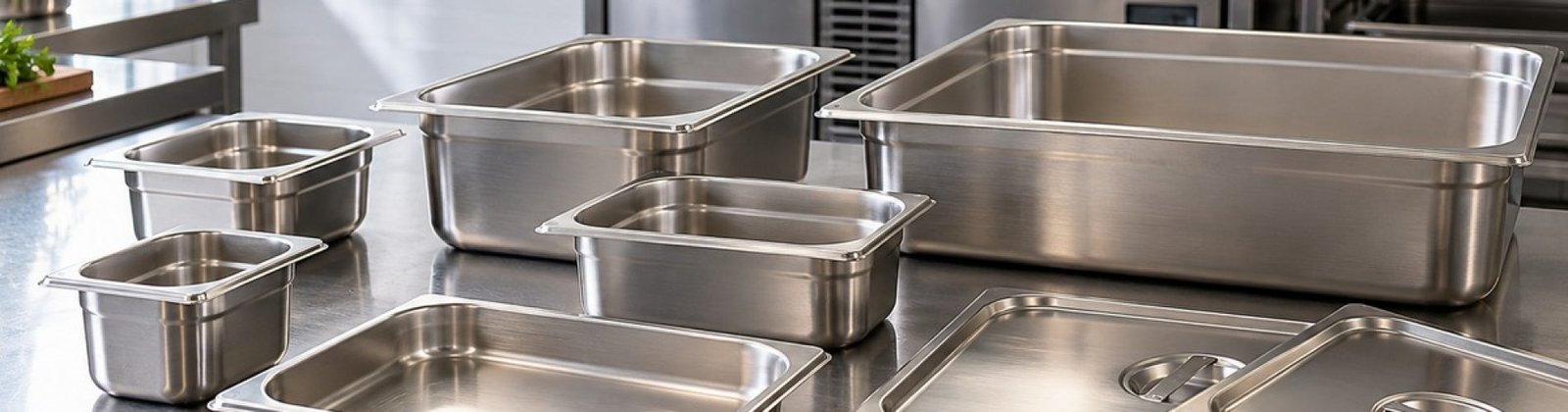
Which GN pan should a buyer order? Choose the pan’s nominal top-rim footprint first, then its depth, and finally verify the actual pan, lid, support bars, and equipment together. GN 1/1 measures 530 x 325 mm at the nominal outside rim; GN 1/2 is 325 x 265 mm, and GN 1/9 is 176 x 108 mm. A fraction identifies a modular footprint, not a guaranteed food capacity or a promise that any lid will fit. The chart below gives the common sizes from GN 1/1 through GN 1/9, while the rest of the guide turns those dimensions into an RFQ and a repeatable sample check.
This guide is for foodservice buyers, distributors, and private-label teams specifying GN pans for prep lines, buffets, chillers, transport, and commercial kitchens. Changwen already has a general Gastronorm insert overview and a short introduction to GN standards. This article adds the purchasing decisions those introductions do not resolve: how to compare the exact rim and usable depth, how to plan mixed-size layouts, and how to reject a sample that looks standard but does not work in the buyer’s equipment.
Estimated reading time: 13 minutes. The photographs illustrate selection and inspection; the dimension table, not the photographs, is the numeric reference.
What does a GN fraction actually specify?
A Gastronorm fraction describes the nominal top-rim module of a food pan relative to GN 1/1, the 530 x 325 mm base footprint. The published EN 631-1 standard summary from AFNOR says the standard covers dimensions for flanged containers, perforated containers, and lids based on that module. This is why a GN designation is useful for planning a system of pans and equipment, rather than simply naming a container’s volume.
Fractions do not translate into a fixed litre value. A GN 1/2 pan with a 65 mm depth and a GN 1/2 pan with a 150 mm depth share a nominal rim footprint, but their capacity, weight when filled, reach, and equipment clearance differ. Even at the same GN fraction and depth, internal volume can vary with wall taper, corners, rim geometry, and the maker’s measurement method. Request the actual model drawing and measured capacity when those values determine the order.
GN dimensions are also not the dimensions of a cutout a buyer should machine into a counter. The pan rim, support frame, bridge bars, and appliance opening form one fit system. An equipment manufacturer should provide the opening and support specifications; a pan supplier should supply the exterior drawing and tolerance range. A sample trial is the safest way to confirm that the two match.
Complete GN 1/1 to GN 1/9 size chart: what are the nominal rim dimensions?
The following chart lists the common fractional footprints used in commercial foodservice, including GN 2/3 and the long narrow GN 2/4. Dimensions are nominal external length x width at the rim in millimetres; orientation can be rotated in some equipment. Approximate inches are conversion aids, not separate manufacturing tolerances. Availability of a particular material, depth, or lid must be checked by SKU.
| GN size | Nominal rim (mm) | Approx. rim (in) | Buyer use case |
|---|---|---|---|
| GN 1/1 | 530 x 325 | 20.9 x 12.8 | Full-size cooking, holding, or transport position |
| GN 2/3 | 354 x 325 | 13.9 x 12.8 | Large component beside a GN 1/3 position |
| GN 1/2 | 325 x 265 | 12.8 x 10.4 | Two half-size positions in a full module |
| GN 1/3 | 325 x 176 | 12.8 x 6.9 | Separated side dishes, sauces, or line ingredients |
| GN 2/4 | 530 x 162 | 20.9 x 6.4 | Long narrow display or service position |
| GN 1/4 | 265 x 162 | 10.4 x 6.4 | Compact buffet or prep ingredient position |
| GN 1/6 | 176 x 162 | 6.9 x 6.4 | Small topping or condiment position |
| GN 1/9 | 176 x 108 | 6.9 x 4.3 | Very small garnish or portion-control position |
These rim dimensions are consistent with Changwen’s existing stainless GN dimension guide; the 2/3 dimension is stated here as 354 x 325 mm because another older page on the site rounds it differently. For production acceptance, write the chosen drawing revision and tolerance into the purchase order. Do not settle an incoming-inspection disagreement from a rounded blog table.
GN 2/1, at 650 x 530 mm, is a larger module outside the title’s GN 1/1-to-1/9 range. Special fractions such as GN 1/12 may also appear in some catalogs, but they should be specified by a supplier drawing and confirmed against the intended frame. Calling every possible fraction “standard stock” would overstate what is actually available in a given product line.
How do common GN depths change the buying decision?
Depth is the second half of a usable GN specification. Buyers commonly encounter 20, 40, 65, 100, 150, and 200 mm depths in stainless-steel ranges, but a given footprint may not be offered at every depth. Shallow pans improve visibility and access to thin layers; deeper pans can hold more product but add reach, mass, and clearance demands. The task and the equipment must determine depth together.
| Nominal depth | Comparison question | Likely application | Verify before ordering |
|---|---|---|---|
| 20 mm | Is a thin layer more useful than volume? | Display, pastry, portion presentation | Whether this footprint is stocked at 20 mm |
| 40 mm | Will staff need frequent access? | Shallow holding and fast-turnover display | Food cover and lid clearance |
| 65 mm | Is moderate capacity enough for service? | General buffet, prep, and holding | Working fill level and service frequency |
| 100 mm | Does the recipe need more working volume? | General cooking, prep, chilled storage | Equipment depth and handle reach |
| 150 mm | Can staff safely reach and lift the contents? | Batch prep and storage | Filled weight, cleaning access, cover height |
| 200 mm | Will the appliance and workflow accept a deep pan? | High-volume holding or back-of-house storage | Chiller shelf, oven rack, and transport clearance |
The depth table is a selection framework, not a universal availability or performance guarantee. For example, a small GN 1/9 pan is often requested at 65 or 100 mm, while a 20 mm version may not be stocked. The phrase “GN 1/9 x 200 mm” is a dimension request, not proof that a particular seller manufactures it. Confirm the SKU list before committing to a display layout or packaging artwork.
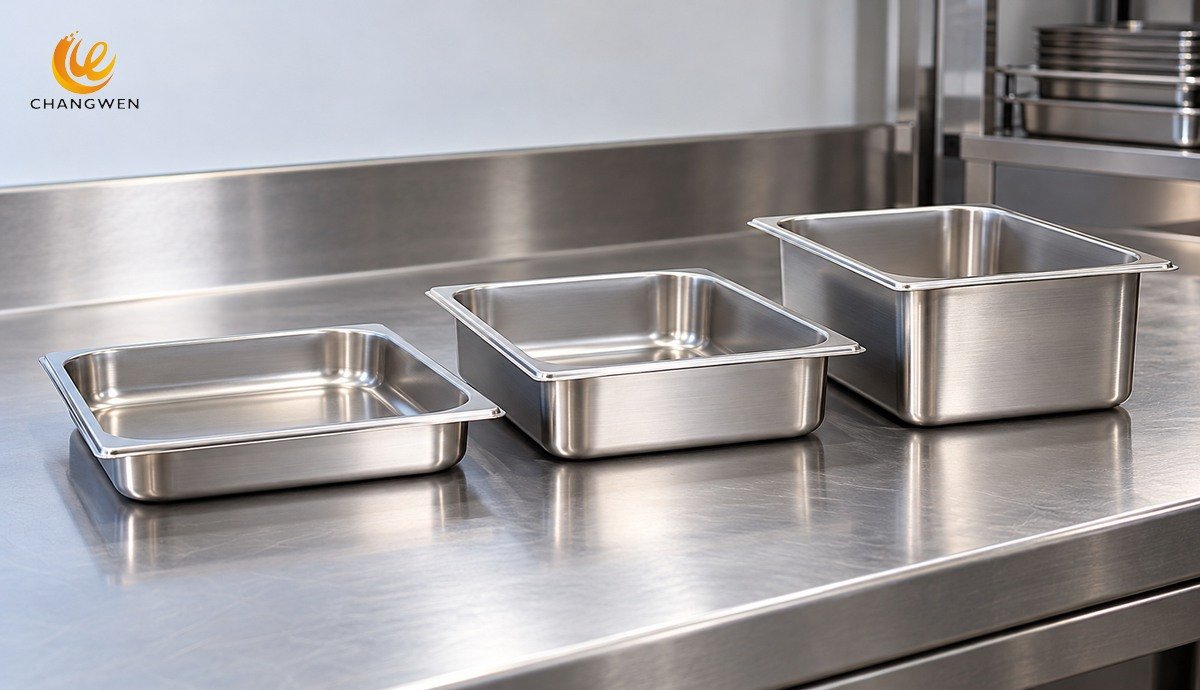
Why can two pans with the same GN code hold different amounts of food?
The GN code and depth name describe nominal external geometry, while usable capacity depends on the internal shape and the safe fill level for a particular task. A rounded bottom corner and tapered wall reduce internal volume compared with a rectangular box made from the same outside measurements. The space left above soup during transport or above a bubbling sauce during heating reduces working capacity further. A catalogue litre figure should therefore identify whether it is brim-full, measured to a marked line, or recommended for operation.
Do not multiply the external rim length by width and depth to publish a capacity claim. That calculation treats the flange and wall as empty internal space and ignores radii and taper. It may give a rough geometric envelope for thought, but it is not a product measurement. Buyers should request a capacity test with a defined fill line and record the actual mass or volume of water used in that test.
A simple service calculation can precede the physical trial. If a station needs forty 180 ml servings before replenishment, its liquid demand is 7.2 L before solids, ladle losses, and headspace. The buyer can then shortlist candidate size-depth combinations and test a representative recipe at the planned fill height. The calculation identifies the question; it does not certify that a nominally rated pan will safely contain the batch.
Which smaller GN pans can share a GN 1/1 position?
GN fractions help a buyer sketch a modular layout before ordering inserts. Two GN 1/2 pans, three GN 1/3 pans, or one GN 2/3 beside one GN 1/3 are familiar nominal arrangements within a GN 1/1 module. The word “nominal” matters: a real service well may require bridge bars, support rails, lid clearance, and an appliance-specific layout. The pan edges do not necessarily support one another safely without the designed hardware.
| Possible GN 1/1 layout | What the fraction suggests | What the buyer must confirm |
|---|---|---|
| 2 x GN 1/2 | Two equal service zones | Central support and lid clearance |
| 3 x GN 1/3 | Three narrow ingredient zones | Frame and bridge-bar positions |
| 1 x GN 2/3 + 1 x GN 1/3 | One large and one small zone | Actual 2/3 drawing and support geometry |
| 2 x GN 2/4 | Two long narrow zones | Orientation and access from the service side |
| 4 x GN 1/4 | Four small zones | Bar layout and handling space |
| 6 x GN 1/6 | Six condiment zones | Appropriate small-pan support grid |
| 9 x GN 1/9 | Nine very small zones | Whether a suitable frame is available |
A layout is only successful when staff can use it. Nine tiny pans may maximize the number of ingredients in one footprint, yet slow service if lids collide or utensils have nowhere to rest. A GN 2/3 plus GN 1/3 layout may be better for one high-volume dish and one lower-volume side. Choose the number of zones from menu turnover and replenishment frequency, then verify the frame rather than maximizing fractional arithmetic.
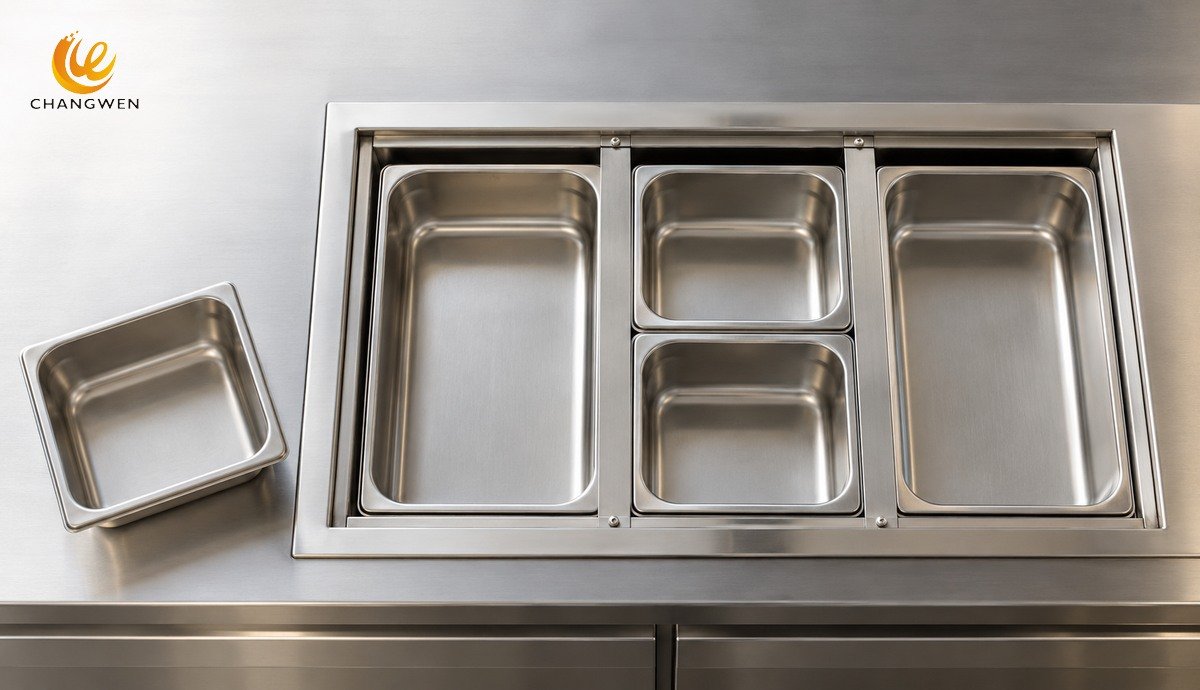
How do buyers verify equipment compatibility beyond the GN label?
A pan can carry the correct GN fraction yet interfere with an oven rail, refrigerator shelf, buffet well, or transport trolley. The likely causes include rim profile, manufacturing tolerance, bent flanges, handle geometry, lid height, or a deep body that reaches below the usable opening. The buyer should compare the pan drawing with the equipment manufacturer’s support and clearance dimensions, then test a production-representative sample.
For a combi oven, test insertion and removal on the intended rails with the pan at the planned depth and load. Check that the rim sits on both supports, that the door closes, and that the appliance maker’s spacing and airflow instructions can still be followed. For a prep refrigerator, check shelf clearance, chilled-air circulation, drain path, and whether the lid can be removed without striking a shelf.
For a buffet well, verify that the rim is supported continuously or at the intended points and that staff can lift a hot pan without pinching fingers against adjacent pans. For a trolley or insulated carrier, check loaded stability, corner contact, lid security, and the route through doors and turns. The same nominal footprint can pass one station and fail another because the supporting equipment is different.
A practical fit test should use the exact proposed combination: pan, lid, bridge bars, support frame, and equipment. Record the equipment model and drawing revision alongside the pan SKU. A verbal statement that a pan “fits standard GN equipment” is useful for shortlisting, but the procurement record should state the verified combination and any exceptions.
What should buyers ask about stainless steel, polycarbonate, and perforation?
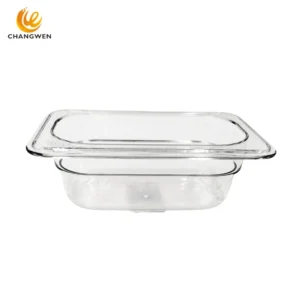
Stainless steel GN pans are a common choice for hot processes and repeated commercial handling, while clear polycarbonate containers can be useful when visibility and lighter handling are important in suitable temperature conditions. Neither material should be declared suitable for every appliance from its name alone. Confirm the exact grade or polymer, the manufacturer’s permitted temperature and cleaning conditions, and the intended food-contact use of the finished SKU. Changwen’s polycarbonate GN guide discusses that separate material family.
A perforated GN pan serves drainage or steam-flow tasks, but its holes change the use case completely: it cannot hold liquid on its own. A buyer selecting perforated inserts should specify hole pattern, edge finish, and a receiving solid pan or equipment configuration where required. Changwen lists a perforated GN 1/1 option; its actual dimensions and availability should be confirmed for the intended purchase.
For sales into the European Union, food-contact documentation needs to correspond to the actual materials and intended use. The general framework is Regulation (EC) No 1935/2004; buyers should identify the applicable market requirements and request supporting information for the finished pan, lid, and any coating or seal. A generic claim about “food-grade” material is not a substitute for model-specific documentation.
Why must lids, notches, and stacking be specified separately?
A GN lid is not automatically interchangeable merely because its label matches the pan’s fraction. Lid seating depends on the rim profile, corner radii, handle height, and whether the lid has a notch for a utensil. If a lid is part of the order, specify its material, fit, notch, handle, stacking behavior, and packing arrangement as a separate line item. Changwen’s stainless GN pan catalog lists both plain and notched lids alongside pans.
Stacking is another independent check. Nesting empty pans can save transport and storage space, but tight nests may jam or abrade the finish. Lids stacked over filled pans need enough vertical clearance and a stable contact surface. Ask for a real stack-height measurement for a specified number of pans and lids, rather than assuming that ten units occupy ten times one nominal depth.
What belongs in a GN pan wholesale or OEM RFQ?
A comparable RFQ should name the exact GN fraction and depth for every SKU, then attach a drawing or request one. State the required external rim dimensions and tolerances, internal or working capacity method, wall material and thickness, rim profile, corner finish, surface finish, lid configuration, and whether the pan is solid or perforated. If an option is left open, ask suppliers to quote it as a separate variant so the unit prices remain comparable.
The RFQ should also describe the operating environment. List the equipment models or their opening drawings, hot or cold use, cleaning process, intended food types, and whether a support frame or bridge bars are required. These details tell the supplier what the pan must do, rather than merely what it should be called. A 100 mm pan for chilled garnish storage and a 100 mm pan for hot liquid holding may need different tests and accessories.
For a private-label program, specify artwork ownership, logo placement, permanent product marks if any, carton and inner protection, barcode rules, language requirements, and the approval process for samples. Request the minimum order quantity, sample charge, tooling charge if applicable, unit price at stated quantities, delivery terms, and the documents needed for the destination market. Price is only comparable when each quotation covers the same pan, lid, packaging, and test obligations.
A concise RFQ line can read: “GN 1/2 x 100 mm stainless pan; external-rim drawing and tolerance to be supplied; measured brim-full and working-fill capacities reported separately; plain matching lid quoted separately; fit trial in specified prep well; brushed finish; individual protective packing; sample approval before bulk production.” The line is a template, not a claim about a current Changwen SKU. Replace its open fields with your actual equipment and market requirements.
How should a buyer approve a GN pan sample and bulk lot?
Approve a reference sample only after checking its outside rim, depth, corner shape, flatness, and fit with the named appliance and support hardware. Measure the same points on several samples if the order is large. Record the measuring method, equipment used, tolerance, and drawing revision, because a bare pass/fail note cannot settle a later disagreement about production variation.
Inspect lids and accessories at the same time as pans. Check that the lid seats without excessive rocking, the notch works with the intended utensil, and the stack does not jam. Run a cleaning trial that covers the rim, underside, and any perforations. If staff will lift a loaded pan, test a representative filled weight using the workplace’s safe-handling procedure; an empty showroom sample hides that constraint.
For incoming bulk inspection, agree on critical, functional, and cosmetic defects before production. A sharp edge, unstable rim, or failed fit is not equivalent to a minor appearance mark in a non-contact area. Link inspection photos and measurement records to the approved reference sample. The acceptance plan should describe sample size and decision rules appropriate to the order; it should not be invented after a shipment arrives.

Frequently asked buyer questions
Can two GN 1/2 pans replace one GN 1/1 pan in every appliance?
Not automatically. The footprint relationship suggests a possible layout, but the equipment may need a center bridge bar or a different frame, and lid or rail clearance may vary. Test the exact two-pan arrangement with the appliance and support hardware before ordering at scale.
Does EN 631-1 certify every GN pan for food contact?
No. The cited standard summary concerns container, perforated-container, and lid dimensions. Food-contact suitability, construction quality, and use conditions must be addressed through the relevant material and market requirements for the actual product. A dimensional designation does not replace those checks.
Buyer conclusion and Changwen wholesale inquiry
The most useful GN pan chart is not just a list of fractions. It connects nominal rim dimensions to depth, measured working volume, support hardware, appliance fit, and a documented sample. Use GN 1/1 through GN 1/9 as a shortlisting language, then make each selected SKU verifiable in the equipment where it will actually work.
Changwen offers stainless GN pans and related lids and describes wholesale, private-label, and OEM/ODM services on its site. To request a comparable quote, send your GN size-depth matrix, quantities by SKU, equipment opening or model, material and finish, lid and bridge-bar needs, target market, packaging artwork, and sample-acceptance criteria. Use the Changwen contact page to ask for current availability, drawings, samples, and a quotation matched to your specification.