An OEM cookware factory needs five connected information sets to prepare a useful quotation: project and SKU identity, measurable product specifications, quality and compliance requirements, customization and packaging details, and commercial and delivery terms. The buyer does not need to finalize every design decision before requesting a quote, but every unknown must be marked clearly so the factory can separate confirmed scope, assumptions, alternatives, and exclusions.
Read time: 14 minutes
A strong request for quotation, or RFQ, is not a long email asking for the lowest unit price. An OEM cookware RFQ is a controlled package that tells the factory what product is being estimated, how many units are required, what evidence must be delivered, and where engineering recommendations are welcome. When several factories receive the same controlled package, their offers become more comparable.
Minimum quote-ready information: cookware type and size, material and construction, body thickness or weight target, handle and lid, finish and logo, quantity per SKU, packaging level, destination market, testing expectations, trade term, delivery destination, and target timing. Add drawings, a bill of materials, reference samples, or photographs whenever fit, geometry, or appearance affects price.
What Is the Difference Between an Inquiry and an OEM Cookware RFQ?
An inquiry asks whether a factory can make a general product, while an RFQ asks the factory to price a defined scope. “Can you make stainless steel frying pans?” is an inquiry because the body, material, thickness, base, handle, finish, quantity, packaging, and destination remain unknown. “Quote this controlled 28 cm frying pan specification at three quantity tiers” is an RFQ because the estimator can connect cost with an identifiable product.
An inquiry is appropriate during early supplier discovery, but its price can only be indicative. A factory may use a familiar catalog model, standard packaging, or assumed material to provide a rough reference. A buyer should not compare an indicative number with a firm quotation because the two answers carry different levels of engineering review and commercial commitment.
A quote-ready RFQ does not require the buyer to dictate every manufacturing method. The buyer should define required outcomes and fixed characteristics, while allowing the factory to recommend feasible processes where appropriate. This division protects product intent without preventing design-for-manufacturing improvements.
Which RFQ Maturity Level Matches Your Project?
| RFQ level | What the buyer can provide | What the factory can return | Best use |
|---|---|---|---|
| Exploratory | Use case, product category, approximate size, target market, expected quantity, price position, and reference images | Feasibility comments, catalog options, major cost drivers, and an indicative range | Choosing a product route before detailed engineering |
| Budgetary | SKU matrix, preliminary specifications, materials, construction, components, finish, packaging concept, and quantity tiers | Budget price, tooling estimate, MOQ, sample plan, lead-time assumptions, and open questions | Business case, supplier shortlist, and design trade-offs |
| Production-ready | Revision-controlled drawings, bill of materials, tolerances, quality plan, artwork, packaging, compliance scope, exact quantities, and delivery terms | Firm scope-based quotation with inclusions, exclusions, schedule, payment terms, and validity | Final supplier selection and commercial negotiation |
The three levels should not be confused. An exploratory request helps the buyer learn, while a production-ready RFQ helps the buyer commit. Asking for a firm price with exploratory information forces the factory either to stop for clarification or to add assumptions that make comparison unreliable.
What Should File 1: The RFQ Cover Sheet Contain?
The RFQ cover sheet should identify the buyer, project, product family, RFQ number, revision, issue date, response deadline, technical contact, commercial contact, and confidentiality status. These identifiers keep every drawing, spreadsheet, email, and quotation connected to the same request. A revision number is especially important when several product changes occur during quotation.
The cover sheet should state the project stage and the decision the quotation will support. A buyer seeking an indicative price for a concept needs different evidence from a buyer choosing a factory for approved production files. The factory can allocate engineering effort more effectively when the expected quotation accuracy is explicit.
What Should File 2: The SKU and Quantity Matrix Contain?
The SKU matrix should give every product, size, color, finish, handle, lid, logo, and packaging version a unique line and identifier. A 24 cm saucepan and a 28 cm saucepan are separate SKUs when they use different bodies, lids, cartons, or labels. A second color can also create a separate SKU because finishing and packaging must be scheduled independently.
Each SKU line should show quotation quantity, expected order quantity, credible forecast, and possible reorder pattern. Quantity should never appear only as one mixed-assortment total because the factory needs units per production configuration. The OEM cookware cost model explains how quantity affects setup, component purchasing, yield, packaging, and unit cost.
Buyers should request two or three realistic quantity tiers when volume is not yet fixed. Quantity tiers reveal where setup, material, component, and packaging economics change. Unrealistic high-volume tiers may produce attractive prices that the buyer cannot actually order, so each tier should correspond to a credible launch or reorder scenario.
The SKU matrix should distinguish pieces, sets, inner packs, and master-carton quantities. “1,000 sets” is ambiguous when a set contains several cookware pieces and accessories. Listing the contents of one sellable unit prevents the factory from interpreting the same quantity in a different way.
What Should File 3: The Technical Product Specification Contain?
The technical product specification should convert the product name into measurable requirements. At minimum, it should define cookware type, nominal size, key diameters, height, capacity, body material, material grade, construction, wall or layer thickness, weight target, base type, cooktop compatibility, rim, handle, lid, finish, logo, and any required accessory.
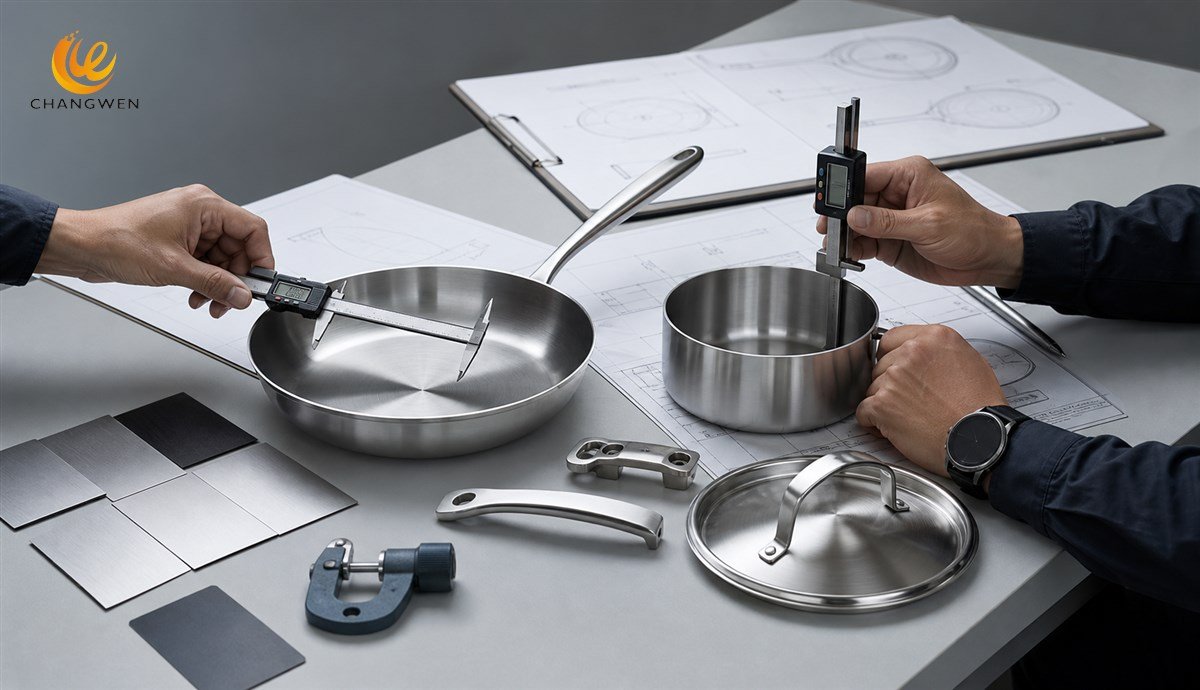
Dimensions should state how and where they are measured. Diameter at the rim is not always the same as cooking-surface diameter, and nominal capacity can differ from usable fill capacity. A drawing or marked reference image removes ambiguity when geometry affects tooling, lid fit, carton size, or material consumption.
Material descriptions should cover every important component rather than only the cookware body. The interior, exterior, base plate, aluminum core, handle, rivet, bracket, lid rim, glass, knob, coating, and silicone part can use different materials. The 201, 304, and 430 cookware grade guide shows why one cookware item can use several stainless steel grades for different functions.
Construction should be defined separately from material. “Stainless steel pan” does not reveal whether the item is single-ply, uses an impact-bonded base, or has a multi-layer body. Construction changes material input, tooling, bonding, forming, thermal behavior, quality checks, weight, and price.
Which Drawings and Reference Files Should Buyers Send?
Buyers should send current 2D drawings when critical dimensions, tolerances, interfaces, or logo positions matter. A 3D model can clarify complex geometry, but a model alone may not communicate tolerances, materials, finishes, inspection points, or drawing notes. The RFQ should state whether the drawing or model controls if the two files differ.
A physical reference sample can improve understanding when the buyer wants a similar balance, rim, handle feel, lid action, polish, or packaging experience. The buyer should not assume the factory may copy protected design features. The RFQ must identify the buyer-controlled design requirements and any intellectual-property restrictions.
Every file should have a stable name, product identifier, and revision. Files named “final,” “new final,” and “final latest” do not establish which document controls. A simple revision register prevents the estimator from combining an old drawing with a new quantity sheet or artwork file.
How Should Handle, Lid, Base, and Accessory Requirements Be Described?
Handle information should include material, shape or reference, length, attachment method, finish, logo, oven-use expectation, and any grip or temperature requirement. The factory also needs to know whether an existing handle is acceptable or an exclusive design is required. A custom handle can introduce tooling, MOQ, sample, and component lead-time costs.
Lid information should identify material, diameter, rim construction, vent requirement, knob or handle, fit expectation, and whether the lid is included in the sellable unit. “Glass lid” is incomplete because glass shape, rim, vent, knob, and fit can change both cost and performance.
Base information should define the required construction and cooktop use rather than relying only on the word “induction.” A factory needs to know whether the product uses a magnetic base plate, impact-bonded structure, full-clad construction, or another approved route. Flatness, diameter, decorative pattern, and logo may also affect tooling and inspection.
Accessories should be listed in the bill of materials and packaging plan. Steamer inserts, racks, utensils, protectors, spare parts, manuals, care cards, and replacement knobs create their own materials, quantities, tests, and pack space. Omitting an accessory from the RFQ can make an initially low price rise after supplier selection.
How Should Finish, Color, and Branding Be Specified?
Finish requirements should identify the surface, finish type, direction, appearance zone, and approved reference. Mirror polish, satin, brushed, hammered, coated, and untreated surfaces use different processes and inspection criteria. A finish name without a reference can produce different interpretations among factories.
Color requirements should include a recognized color reference when an exact match matters, plus gloss, texture, location, and acceptable variation method. The RFQ should state whether color development and approval samples are included in the quote. A screen image is not a dependable physical color standard.
Branding requirements should identify the artwork file, logo size, position, orientation, application method, color, and durability expectation. Laser marking, stamping, etching, printing, embossing, and applied badges use different equipment and costs. The buyer should also identify branding on handles, lids, bases, cartons, labels, manuals, and master cartons as separate items.
What Should File 4: The Quality and Compliance Brief Contain?
The quality brief should define which characteristics matter, how they will be checked, and what evidence the buyer expects. Relevant controls can include material identity, dimensions, weight, capacity, base flatness, handle attachment, lid fit, finish, appearance defects, coating performance, packaging integrity, labeling, and quantity. The correct scope depends on product construction, intended use, destination, and buyer policy.
Acceptance criteria should be measurable wherever practical. “Good polishing” is subjective, while an approved finish reference, defined appearance zones, lighting condition, defect descriptions, and acceptance rule give the factory a usable standard. The OEM cookware manufacturing process guide explains how specifications, samples, pilot production, process controls, and final release preserve the intended result at scale.
The compliance brief should state the destination market, sales channel, applicable product claims, buyer protocols, required test standards, report requirements, and responsible party. The RFQ should not ask for a vague “all certificates” package because cookware requirements vary by material, construction, market, and retailer.
Buyers should state whether testing, first-article inspection, pre-production samples, sealed reference samples, third-party inspection, material documents, traceability, or certificates of conformity must be quoted. These items can create fixed costs and schedule dependencies that are invisible in a unit-price-only request.
What Should File 5: Packaging and Logistics Requirements Contain?
The packaging file should define one sellable unit, protection method, unit box or bulk pack, inserts, sleeves, bags, manuals, labels, barcode requirements, master-carton quantity, carton marks, and distribution channel. A retail shelf, restaurant distributor, e-commerce parcel network, and palletized wholesale shipment expose cookware to different handling and presentation requirements.
Packaging dimensions and artwork may remain preliminary during an early RFQ, but the quotation must state the assumed structure. The final pack affects material cost, packing labor, carton volume, freight utilization, and damage risk. A lower unit price based on export cartons is not comparable with a quote that includes printed retail boxes and protective inserts.
The destination country or port, delivery address when known, requested trade term, shipping mode, and required delivery window should be listed separately. EXW, FOB, CIF, and delivered terms cover different cost boundaries. The factory cannot provide a meaningful freight-inclusive price without knowing the destination, cargo estimate, and service basis.
What Commercial Information Should the Buyer Provide?
The commercial request should identify quotation currency, quantity tiers, expected MOQ structure, target order timing, desired payment terms, requested trade term, price-validity period, and whether tooling, samples, testing, inspection, packaging, spare parts, freight, and taxes should be included or shown separately. These fields define the quote boundary.
A target price can be useful when it reflects a real retail and margin model, but it should not replace the specification. The factory can propose value-engineering options when the target and non-negotiable features are clear. A target price without product requirements encourages the factory to guess which quality or construction choices may be reduced.
A target launch or delivery date should be linked to a location and milestone. “Need urgently” provides no planning basis, while “goods required at destination warehouse” or “ready for inspection at factory” defines different deadlines. Tooling, sampling, approval, production, inspection, and logistics must be scheduled backward from the correct milestone.
How Should Buyers Define Fixed Requirements and Open Options?
Every major RFQ field should be marked as fixed, preferred, open to equivalent alternatives, or not yet determined. This classification prevents the factory from treating a preference as a mandatory cost driver or replacing a critical requirement with a cheaper interpretation. It also makes engineering feedback more useful.
A fixed requirement must be quoted as written or identified as infeasible. A preferred requirement can be priced with an alternative. An open field invites the factory to recommend a route, while a not-yet-determined field must remain an explicit assumption. Silence should never be treated as buyer approval.
Alternative quotations should preserve comparison. If a factory proposes a different steel grade, body thickness, handle, base, finish, package, or MOQ, the offer should identify that alternative as a separate option rather than quietly changing the base quote. The OEM and ODM decision framework helps buyers decide where existing factory platforms are beneficial and where proprietary control matters.
What Must the Factory Return in a Complete Quotation?
A complete factory quotation should reference the buyer’s RFQ number and revision, describe the quoted product and SKU, state quantity and MOQ, identify unit price and currency, list tooling and one-time costs, define sample and production lead times, state payment and trade terms, and give price validity. The quotation should also list assumptions, alternatives, exclusions, and open technical questions.
The quotation should separate recurring unit costs from non-recurring development costs. Tooling, custom color development, testing, samples, artwork setup, or special gauges should not be hidden inside a unit price unless the allocation is explained. Separation helps the buyer understand repeat-order economics.
The factory should identify what is included in each sellable unit and packing level. A lid, insert, manual, spare part, individual box, and master carton must not be assumed. A clear inclusion list prevents disputes after the buyer compares headline prices.

How Can Buyers Compare Several Cookware Quotations Fairly?
Buyers should normalize every offer against the same SKU, specification, quantity, packaging, quality evidence, test scope, currency, trade term, and delivery basis. A price difference is meaningful only after the buyer identifies whether the factories quoted the same product and commercial boundary.
A comparison sheet should include material and construction, body thickness or weight, components, finish, packaging, MOQ, unit price, tooling, samples, testing, inspection, lead time, payment, trade term, validity, exclusions, and risks. The retailer supplier-selection guide shows why price should be assessed alongside process capability, evidence, communication, quality control, capacity, and replenishment reliability.
The lowest number should not automatically receive the highest score. A quote can be low because it assumes thinner material, existing tools, simpler packaging, fewer tests, a higher MOQ, or a narrower delivery term. The buyer should first reconcile scope, then compare cost and supplier value.
What Information Is Safe to Leave Open in an Early RFQ?
An early RFQ can leave manufacturing method, exact tooling solution, certain component selections, packaging optimization, and process tolerances open when the buyer wants factory engineering input. However, the intended use, target market, product size, performance objective, quantity, price position, and non-negotiable brand requirements should be clear enough to guide recommendations.
Open items should be converted into named assumptions in the factory response. An indicative quote might assume an existing body, standard handle, common finish, protective export carton, and regular inspection. Those assumptions must be replaced by confirmed specifications before the quotation supports a production order.
The buyer should request a second quote revision after major technical decisions are made. Quote revision control is safer than treating the first indicative number as permanent while the design becomes heavier, more customized, or more demanding.
Which RFQ Mistakes Cause Slow or Inaccurate Quotes?
- Sending only a product photograph: the factory must guess material, construction, dimensions, and hidden components.
- Providing one total quantity for many SKUs: MOQ, changeovers, packaging, and component economics remain unclear.
- Using general words such as premium or heavy: estimators cannot convert subjective positioning into material input.
- Omitting packaging: offers may assume completely different protection and presentation levels.
- Requesting all certificates: the factory cannot define testing without product, market, and standard scope.
- Mixing file revisions: the quoted configuration may not match the buyer’s current design.
- Leaving trade terms unspecified: factory-gate and delivered prices appear to be comparable when they are not.
- Asking for the lowest price first: the response may optimize an assumption the buyer never intended to change.
FAQ About Sending an OEM Cookware RFQ
What is the minimum information needed for an OEM cookware quote?
The minimum information is cookware type, size, material and construction, body thickness or weight target, handle and lid, finish and logo, quantity per SKU, packaging level, destination market, testing expectation, requested trade term, destination, and target timing.
Can a factory quote from a reference photo?
A factory can provide an indicative quote from a reference photo if major assumptions are stated. A photo cannot define hidden construction, exact material, thickness, dimensions, components, quality criteria, or packaging, so it is not sufficient for a firm production quote.
Should buyers send a target price?
Buyers can send a realistic target price together with the specification and fixed requirements. The target helps the factory recommend value-engineering choices, but it should not replace the product definition or invite unapproved quality reductions.
Should the RFQ include annual forecast volume?
A credible annual forecast helps the factory evaluate tooling, components, capacity, and repeat-order economics. The forecast should be identified as planning information rather than a guaranteed order unless the commercial agreement states otherwise.
What file formats should buyers send?
Buyers commonly use spreadsheets for SKU and quantity data, PDF drawings or specifications for controlled review, vector artwork for branding, and 3D files where geometry requires them. Every file should carry a product identifier and revision.
How many quantity tiers should an RFQ request?
Two or three credible quantity tiers usually show how price changes with volume without creating unnecessary estimation work. Each tier should be possible for the buyer to order and should list quantities per SKU rather than only a collection total.
How can buyers receive faster quotations?
Buyers receive faster quotations by sending one complete package, marking fixed and open fields, using consistent revisions, providing SKU-level quantities, defining the quote boundary, naming one technical contact, and answering clarification questions promptly.
What Is the Final Rule for a Quote-Ready Cookware Brief?
The final rule is to remove accidental ambiguity while preserving intentional flexibility. A quote-ready brief defines the product, quality evidence, quantity, packaging, and delivery boundary in measurable terms, then asks the factory to identify every assumption and alternative.
A complete OEM cookware RFQ does more than produce a price. It creates the first controlled baseline for design review, supplier comparison, sampling, tooling, quality planning, packaging, negotiation, and eventual production. When the same revision reaches every factory, the buyer compares real choices instead of comparing different interpretations of an incomplete request.