Read time: 12 min
Introduction
Three buyers walk into the same procurement problem from three different directions.
A hotel group’s purchasing director is writing off $18,000 in corroded stock pots across fifteen properties this year. Every pot came from a different supplier. No two are the same gauge. The kitchen managers have stopped trusting the equipment budget because nothing lasts. She needs a single verified source, consistent specifications, and documentation that survives a facilities audit.
A restaurant chain’s operations manager is opening his eighth location. The stock pots in location one — the ones the executive chef spec’d three years ago — are performing perfectly. He ordered the same size and “same spec” from a different supplier for locations five through seven. They are not the same. Wall thickness is off by 0.2mm, the handle attachment is different, and he now has two separate cooking behaviors across his kitchen network. He needs one manufacturer producing one consistent spec across all future locations.
An Amazon FBA seller has found a high-demand stock pot keyword cluster and needs a product that photographs well, ships reliably, arrives in retail-quality packaging, and generates positive reviews. She needs a manufacturer who understands both the product and the e-commerce supply chain — certifications, listing documentation, FBA-ready packaging — not just a factory that can make a pot.
These are not hypothetical problems. They are what wholesale buyers tell us when they find Changwen. And they are the reason we built specific supply programs for each buyer profile — not a single one-size-fits-all catalog, but structured solutions that address what each of these buyers actually needs.
This article describes those three solutions, the stock pot specifications that underpin all of them, and how Changwen operates as a stainless steel stock pot manufacturer with over 20 years of commercial-grade production experience.
Key Takeaways
- Wholesale stock pot purchasing fails most consistently for one of three reasons: inconsistent material specifications across supplier batches, inadequate documentation for commercial compliance requirements, or packaging and delivery infrastructure that does not match the buyer’s distribution channel.
- Changwen manufactures wholesale stock pots in the full commercial size range — from 6-quart residential-grade up to 120-quart industrial production capacity — all in verified 304 stainless steel with encapsulated aluminum base construction and riveted handles as the commercial standard specification.
- Hotels and hospitality groups need batch consistency across multiple properties, documentation supporting facilities management audits, and NSF food safety compliance. These requirements need a manufacturer relationship, not a spot purchasing arrangement.
- Restaurant chains expanding across multiple locations need a manufacturer who maintains identical specifications across every re-order — wall gauge, base construction, handle geometry — so kitchen behavior is consistent regardless of which location is cooking.
- E-Commerce brands need a factory that understands retail packaging, listing-ready photography support, FBA-compatible carton dimensions, and certification documentation that supports product listings on regulated platforms.
- Changwen’s standard MOQ for wholesale stock pot programs is 100 units. Custom configurations with new tooling require 10,00 units. OEM branding (logo engraving, custom packaging) is available from the 100-unit standard MOQ.
Why Wholesale Stock Pot Supply Fails — and How to Fix It
Most wholesale buyers have experienced at least one version of the same problem: the second order is not quite the same as the first. Or the supplier who performed well on 200 units cannot maintain quality at 2,000. Or the product that passed visual inspection at receipt fails in service three months later.
These failures trace back to three structural weaknesses in how wholesale stock pot sourcing is typically approached.
Failure Mode 1: Specification Drift Across Batches
A specification written into a purchase order is not a guarantee of what arrives. When a factory sources steel from different mills across different production runs, wall gauge varies within the tolerance band. When a factory changes its base encapsulation supplier, heat distribution behavior changes. When a production run is large enough to require two shifts, finish quality may vary across shifts.
Buyers who do not require Mill Test Certificates with each batch, do not commission pre-shipment inspections, and do not measure random samples on receipt discover specification drift when kitchen staff notice the new pots behave differently — which happens at the worst possible moment.
The fix is documentation requirements written into the purchase contract: MTC per batch, pre-shipment inspection for orders above 500 units, and dimensional sampling on receipt.
Failure Mode 2: Compliance Documentation Gaps
A hotel chain buying stock pots for its food service operations needs documentation that survives a facilities management audit: NSF food equipment listing, FDA food contact compliance, BSCI social compliance certification. A restaurant group with US health code obligations needs the NSF listing number verifiable at nsf.org. An Amazon FBA seller needs certification documentation uploaded to the product listing.
Suppliers who cannot provide this documentation are not supplying to a professional buyer — they are supplying to someone who has not yet been asked for it. The moment the hotel’s facilities audit lands or the Amazon listing is flagged for missing certifications, the compliance gap becomes an expensive operational problem.
Failure Mode 3: Channel Mismatch in Packaging and Logistics
A stock pot that performs perfectly in a restaurant kitchen may arrive at an Amazon FBA warehouse in packaging that fails FBA intake — wrong carton dimensions, incorrect labeling, inadequate protection for a drop test. A hotel that orders 200 stock pots for a property renovation needs individual poly-bag protection and master cartons marked with the property name and item code for asset tracking. A restaurant chain ordering for twelve locations simultaneously needs labeled cartons that route to the right property without manual sorting.
These are not product problems. They are supply chain problems that a manufacturer who understands only production — not distribution — cannot solve.
Changwen’s Stock Pot Range: Specifications Across Every Commercial Size
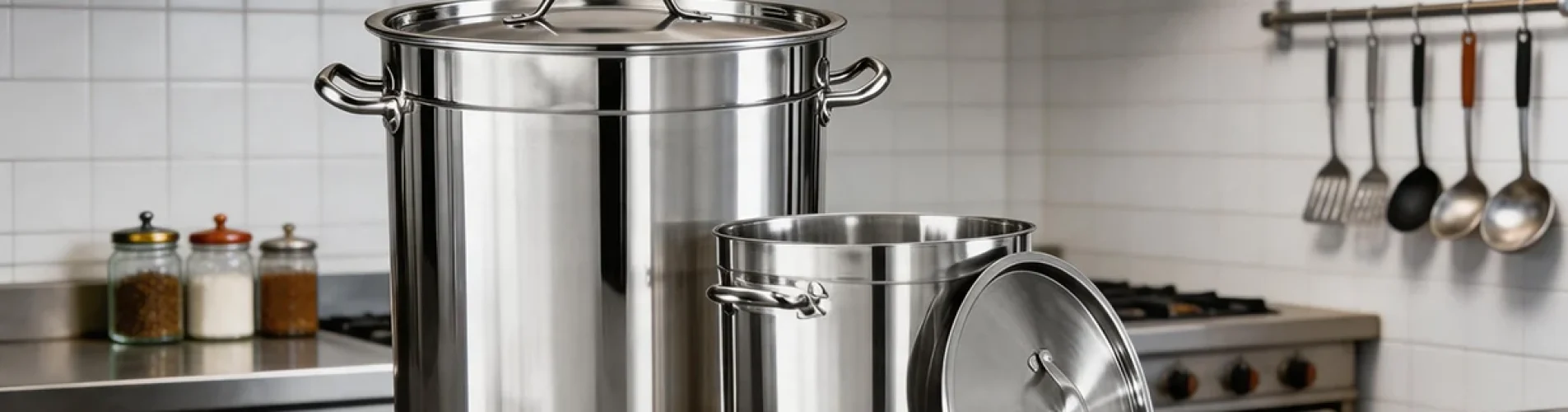
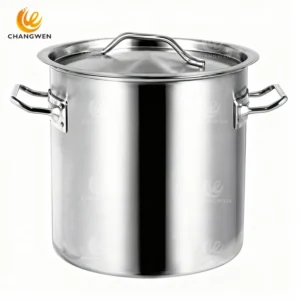
Changwen manufactures the full commercial stock pot size range from a single verified material specification. Every size in this range uses the same 304 stainless steel grade, the same encapsulated aluminum base construction, and the same riveted handle standard — meaning a kitchen that orders 8-quart and 40-quart pots from the same Changwen program is receiving the same material quality at both ends of the size range.
Complete Size Reference
| Capacity | Diameter × Height | Wall Gauge | Base Construction | Best Application |
|---|---|---|---|---|
| 6 qt (5.7L) | 22 × 17 cm | 1.0mm | Encapsulated base | Small batch, home-grade option |
| 8 qt (7.6L) | 24 × 19 cm | 1.0mm | Encapsulated base | Café, small restaurant |
| 12 qt (11.4L) | 28 × 22 cm | 1.0mm | Encapsulated base | Restaurant daily soup service |
| 16 qt (15.1L) | 30 × 24 cm | 1.0mm | Encapsulated base | Mid-volume restaurant |
| 20 qt (18.9L) | 32 × 26 cm | 1.2mm | Encapsulated base | Restaurant workhorse |
| 30 qt (28.4L) | 36 × 29 cm | 1.2mm | Encapsulated base | Hotel kitchen, catering |
| 40 qt (37.9L) | 38 × 32 cm | 1.2mm | Encapsulated base | High-volume restaurant, hotel |
| 60 qt (56.8L) | 44 × 36 cm | 1.5mm | Encapsulated base | Hotel, institutional kitchen |
| 80 qt (75.7L) | 48 × 40 cm | 1.5mm | Encapsulated base | Commissary, large catering |
| 120 qt (113.6L) | 56 × 46 cm | 1.5mm | Encapsulated base | Industrial, central kitchen |
Standard Material Specification Across All Sizes
Steel grade: 304 stainless steel (18% chromium minimum, 8% nickel minimum) — verified by Mill Test Certificate provided with every production batch.
Base construction: Encapsulated aluminum disc (2.0mm aluminum layer bonded between 1.0mm stainless layers at the base) — provides lateral heat distribution from the burner contact point, preventing hot spots that cause scorching in long-simmer applications.
Handle attachment: Stainless steel rivets through the pot wall, clinched on both sides — load-rated for full-capacity commercial use.
Surface finish: No. 4 brushed exterior (Ra 0.8–1.6 μm), interior polished to Ra 0.4–0.8 μm as standard. Mirror polish exterior available on request for hotel presentation programs.
Certification: NSF/ANSI 2 food equipment compliance. FDA food contact documentation. LFGB test report for European programs. ISO 9001 quality management.
Supply Solution #1 — Hotels and Hospitality Groups
A hotel kitchen’s relationship with its stock pots is different from a restaurant’s in one critical way: the hotel is running multiple kitchen formats under one procurement program. The main restaurant kitchen, the banquet kitchen, the room service prep area, the pool bar prep station — all may use stock pots of different sizes, but all need to operate from the same specification standard and all need to survive the hotel’s facilities management audit.
What Hotel Procurement Actually Needs
Batch consistency across properties: A hotel group purchasing 40-quart stock pots for twelve properties needs every unit in the program to perform identically. The executive chef who set up the flagship kitchen spec should not need to relearn heat behavior at each new property. This requires a manufacturer who maintains the same steel sourcing, the same base encapsulation, and the same handle attachment specification across every production run — documented with MTCs and pre-shipment inspection reports.
NSF and facilities compliance documentation: Hotel facilities management programs include periodic audits that require documentation for all food-contact equipment. NSF/ANSI 2 listing, FDA food contact compliance, and BSCI social compliance are typical documentation requirements. Changwen provides complete documentation packages with every hotel supply program — not as an option, as a standard.
Presentation standard for front-of-house applications: Hotel buffet service, live cooking stations, and table-side food preparation are visual experiences as much as culinary ones. Stock pots visible to guests need a mirror-polish finish or at minimum a flawless brushed finish free of handling marks. We offer mirror-polish exterior specification for hotel programs requiring a presentation-grade surface.
Asset tracking support: Large hotel groups track kitchen equipment as assets. This requires individual unit marking (engraved property codes), master carton labeling that routes to specific properties, and delivery documentation that integrates with the hotel’s asset management system. We coordinate these logistics requirements as part of hotel supply programs.
Hotel Program MOQ and Lead Times
Standard hotel stock pot programs operate at a 100-unit minimum across sizes. For a twelve-property program purchasing 5 sizes × 200 units each = 100 units total, the full program can be structured within a single production batch with coordinated delivery routing.
Production lead time: 30–45 days from deposit and specification confirmation. Ocean freight to most major markets: 15–35 days depending on destination.
Supply Solution #2 — Restaurant Chains and Multi-Location Operators
A restaurant chain’s stock pot problem is a consistency problem. A single-location restaurant operator can manage whatever equipment they have — they learn its behavior, they work with it, and they produce consistent food from it. A chain operator cannot allow each location to develop a different relationship with different equipment. The stock production protocol that works at location one must work at location twelve, or food quality becomes location-dependent rather than brand-consistent.
The Specification Lock That Chains Require
When a restaurant chain opens a new location, the kitchen equipment needs to match the flagship spec so precisely that kitchen staff trained at one location can function efficiently at another. This requires more than ordering the same nominal size from the same nominal specification. It requires locking:
Wall gauge to ±0.05mm tolerance: A 0.2mm difference in wall gauge between the stock pots at location one and location eight changes heat-up time by 8–12% and changes heat retention behavior. The executive chef notices. The training manager notices. The consistency protocol breaks.
Base construction to a fixed specification: A 2.0mm aluminum encapsulated base and a 1.5mm base behave differently on the same burner at the same gas pressure setting. Different base construction across locations means the stock protocol times documented in the kitchen training manual are wrong for some locations.
Handle geometry to a fixed form: Ergonomics matter across a staff that may move between locations. A handle that is 3mm shorter or a different bend radius changes the lifting mechanics — minor in isolation, meaningful across a training program.
Changwen maintains production specifications in documented files for each restaurant chain account. Re-orders for established chain clients are produced from the same tooling, the same steel sourcing, and the same quality specifications as the original order — with MTCs from each batch confirming steel grade consistency.
Chain Program Benefits at Scale
Restaurant chain programs above 5,000 units annually qualify for:
- Dedicated production planning — your order scheduled in advance rather than queued with general orders
- Blanket order arrangements — annual commitment with quarterly delivery releases, providing supply security without holding all inventory simultaneously
- Specification lock documentation — the chain’s stock pot specification stored in our production files with a revision history that records any changes and requires the chain’s written approval before implementation
Supply Solution #3 — E-Commerce Brands and Private Label Programs
E-commerce is where the stock pot wholesale market has grown fastest over the past five years — and where the supply chain requirements are most different from either hotel or restaurant procurement.
An e-commerce brand selling wholesale stock pots on Amazon, their own Shopify store, or through retail platforms is not buying cookware for its operational performance alone. It is buying a product that will be photographed, listed with specific certifications, reviewed by customers with specific expectations, and returned if the packaging experience does not match the visual promise.
This requires a different kind of manufacturer capability.
What E-Commerce Supply Actually Requires
Listing-ready certification documentation: An Amazon product listing for commercial kitchen cookware in the US market needs FDA food contact compliance and NSF documentation (where claimed). A listing on EU platforms needs LFGB test documentation. Changwen provides all certification documentation in formats compatible with platform upload requirements — not just as physical certificates, but as digital files with listing numbers, test report references, and compliance statements that satisfy platform verification systems.
Retail-quality individual packaging: A stock pot sold through e-commerce arrives in a customer’s home or commercial kitchen, opened in a box, and judged immediately on its packaging experience. Corrugated individual color boxes with foam inserts, branded with the seller’s logo, with care instruction inserts and branding collateral — this is e-commerce packaging standard. It is not the same as bulk shipping packaging. Changwen designs and produces custom retail packaging for e-commerce programs from the 100-unit MOQ.
FBA-compatible master carton specification: Amazon FBA receiving requires cartons within specific dimensional, weight, and labeling requirements. We produce master cartons to FBA-compatible specifications by default for e-commerce programs — FNSKU labeling, ASIN references, correct barcode positioning, and dimensions within FBA intake parameters.
Photography-grade surface finish: Product photography for e-commerce listings requires a surface finish that photographs cleanly — no handling marks, consistent brushed finish across the full surface, clean rim edges and handle attachment. We produce photography-grade samples for new e-commerce programs before entering full production, allowing the brand to confirm visual quality against their listing photography requirements before bulk units are committed.
Private Label Program Structure
E-commerce brands building a private label stock pot line can apply their brand identity to every element:
- Laser-engraved logo on pot body or lid handle
- Custom color retail box (full CMYK, matte or gloss laminate, soft-touch available)
- Custom insert card (seasoning instructions, brand story, warranty registration)
- Custom handle design (requires tooling — 1,000-unit minimum for new handle mold)
- Custom size or profile (requires tooling — 1,000-unit minimum)
Standard ODM with branding (existing pot profile, custom logo and packaging): 100-unit minimum.
Material and Construction Standards Across All Programs
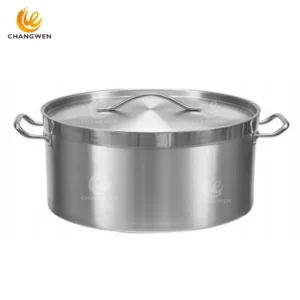
Every stock pot that leaves Changwen — whether destined for a hotel buffet in Dubai, a restaurant chain in Chicago, or an Amazon FBA warehouse in New Jersey — is produced to the same material and construction standard. The supply program structure changes. The product specification does not.
304 Stainless Steel Verification
Every production batch begins with a Mill Test Certificate from the steel mill confirming:
- Chromium: ≥18%
- Nickel: ≥8%
- Carbon: ≤0.08%
This MTC is provided to the buyer with every order as a standard shipping document. It is not an optional documentation item. It is the evidence that the material specification was met in the specific batch that produced the buyer’s specific order.
Encapsulated Base Engineering
The aluminum encapsulated base is the structural feature that most distinguishes commercial-grade from consumer-grade stainless steel stock pots. The aluminum layer (2.0mm standard, 2.5mm for the 60-quart and above range) is hydraulically bonded to the stainless base under controlled pressure, ensuring complete bonding across the full base area with no air voids.
An encapsulated base with voids produces uneven heat distribution — a hot spot directly above the void, cooler areas elsewhere. We verify complete bonding on production samples by thermal imaging test before each production run begins.
Handle Load Rating
Commercial stock pots are filled with liquid that weighs significantly. A 40-quart pot at 80% capacity holds approximately 30 liters of liquid — approximately 30 kg in water weight alone, plus the pot. Two stainless steel rivets through the pot wall at each handle attachment point, clinched to a controlled torque specification, distribute this load across four contact points per handle.
We load-test handle attachment on random samples from every production batch: full simulated load applied to each handle for 30 seconds. Zero flex, zero movement at rivet points is the pass criterion.
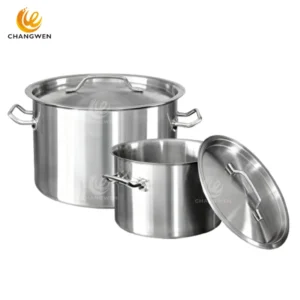
OEM and Custom Stock Pot Programs
Standard OEM (Existing Profile, Custom Branding)
For buyers who want their brand on a proven commercial stock pot without custom tooling investment: our standard commercial range with custom logo application and packaging.
- Minimum order: 100 units
- Logo application: laser engraving on pot body (most durable), screen print, or adhesive plate
- Packaging: full custom retail box design, FBA-ready master carton, custom insert materials
- Lead time: 30–40 days production + freight
Custom OEM (New Tooling)
For buyers who need a proprietary profile — a unique handle shape, a non-standard pot diameter, a signature lid design:
- Minimum order: 1,000 units (to amortize tooling investment)
- Tooling cost: handle mold $3,000–$8,000; lid mold $2,000–$5,000; pot profile tooling $4,000–$12,000
- Tooling ownership: belongs to the buyer, stored at Changwen’s facility with documented IP ownership
- Lead time: additional 8–14 weeks for tooling development before production begins
What OEM Documentation Includes
Every Changwen OEM program ships with the complete commercial documentation package:
- Mill Test Certificate (per batch)
- NSF/ANSI 2 listing documentation
- FDA food contact compliance letter
- LFGB test report (EU programs)
- ISO 9001 certificate
- BSCI social compliance certificate
- Pre-shipment inspection report (all orders)
Ordering, MOQ, and Lead Times
MOQ Reference
| Program Type | Minimum Order | Notes |
|---|---|---|
| Standard wholesale (no branding) | 100 units | Per size/SKU |
| ODM with logo + packaging | 100 units | Per size/SKU |
| Custom packaging only (existing pot) | 100 units | Per SKU |
| New handle mold (OEM) | 1,000 units | Tooling + production |
| New pot profile/lid mold (OEM) | 1,000 units | Tooling + production |
Lead Time by Program
| Program Type | Production | Total (inc. freight) |
|---|---|---|
| Standard wholesale | 25–35 days | 10–13 weeks |
| ODM with custom packaging | 30–45 days | 11–14 weeks |
| New tooling OEM | 70–100 days | 18–24 weeks |
Payment Terms
Standard terms: 30% deposit on order confirmation, 70% balance before shipment following pre-shipment inspection sign-off. Alibaba Trade Assurance available for first-time buyers through the platform.
Sample Program
Pre-production samples of any standard size are available with 7–10 day lead time. Custom-specification samples: 15–25 days. Sample orders are fulfilled at near-cost pricing and can be applied as credit against the subsequent bulk order minimum.
FAQ
What is the minimum order quantity for wholesale stock pots from Changwen?
Changwen’s minimum order quantity for wholesale stock pots is 100 units per SKU for standard configurations including those with OEM branding (custom logo and packaging). For programs requiring new tooling — custom handle shapes, non-standard pot profiles, or proprietary lid designs — the minimum order is 1,000 units to amortize the tooling development cost. The tooling paid for by the buyer belongs to the buyer and is stored at Changwen with documented ownership. Sample orders of 5–20 units are available prior to bulk commitment.
How does Changwen ensure specification consistency across repeat orders for restaurant chains?
For restaurant chain accounts, Changwen maintains a production specification file for each client account that documents: steel source (linked to MTC reference), wall gauge tolerance (±0.05mm), base construction specification (aluminum thickness and bonding parameters), handle geometry (CNC bend program reference), and surface finish standard (Ra specification). Repeat orders are produced against this locked specification file. Any change — even a supplier substitution within the same nominal grade — requires written approval from the chain account before implementation. MTCs are provided per batch confirming steel grade consistency, and pre-shipment inspection is commissioned on all production batches.
What certifications does Changwen provide with wholesale stock pot orders?
Every wholesale order includes a complete documentation package as standard: Mill Test Certificate confirming 304 stainless steel grade (per production batch), NSF/ANSI 2 food equipment compliance documentation, FDA food contact compliance letter, LFGB test report (for European market programs), ISO 9001 quality management system certificate, and BSCI social compliance certificate. Pre-shipment inspection reports are commissioned on all production batches. These documents are provided as standard deliverables — not optional additions — because commercial distribution programs in North American, European, and Australian markets require them.
Can Changwen produce wholesale stock pots in non-standard sizes for custom OEM programs?
Yes. Non-standard pot diameters, heights, or profiles require new pressing tooling or modified tooling, which is developed at the buyer’s cost and becomes the buyer’s intellectual property. Typical tooling cost for a new pot profile: $4,000–$12,000 depending on size and complexity. Minimum order for programs requiring new tooling is 1,000 units. For buyers who want product differentiation without tooling investment, our standard range in 10 sizes covers 6-quart through 120-quart — most commercial size requirements are met within this existing tooling range with custom branding and packaging applied from 100-unit MOQ.
What is the difference between Changwen’s hotel, restaurant chain, and e-commerce supply programs?
The stock pot specification is identical across all three programs — same 304 stainless steel, same encapsulated base, same riveted handle standard. The programs differ in what surrounds the product. Hotel programs include asset tracking support, mirror-polish presentation options, and documentation formatted for facilities audits. Restaurant chain programs include specification locking protocols, blanket order arrangements, and consistency documentation across multi-location rollouts. E-commerce programs include retail-quality individual packaging, FBA-compatible master cartons, photography-grade surface finish on samples, and listing-ready certification documentation. The right program depends on how the stock pot reaches its end user — not on what the pot itself needs to be.
Conclusion
Three buyers, three supply problems, one manufacturer.
The hotel procurement director needs consistent batch specification across fifteen properties and documentation that survives a facilities audit. The restaurant chain operations manager needs specification locked so tightly that the executive chef’s trained behavior works at location twelve as reliably as at location one. The e-commerce brand needs a product that photographs at a standard that sells, ships in packaging that generates five-star reviews, and comes with certifications that keep the listing live.
All three need the same underlying product: a properly specified wholesale stock pot in verified 304 stainless steel, encapsulated aluminum base, riveted handles, in the right size for their application, built to the standard that earns the word commercial.
Changwen has produced this product for 20+ years as a dedicated stainless steel stock pot manufacturer — supplying hotel groups, restaurant chains, catering companies, and e-commerce brands across North America, Europe, the Middle East, and Southeast Asia. Our MOQ of 100 units for standard programs is structured around the volume requirements of professional buyers — not the casual inquiry.
If your supply problem sounds like any of the three in this article, we would like to solve it with you.