Read time: 12 min
Introduction
Walk into any commercial kitchen and you’ll find the same problem repeated in different forms: a stock pot that’s the wrong size for the job. Too small, and you’re boiling pasta in batches when you should be doing it in one go. Too large, and you’ve got a 20 quart stock pot sitting three-quarters empty while heating unevenly and wasting energy.
Stock pot sizes for restaurants span an enormous range — from the 6 quart stock pot used for small-batch sauces to the 100 quart stainless steel pot used in institutional commissaries — and every size in between has a specific role in a well-equipped commercial kitchen.
This guide is the complete reference. Whether you need to know stock pot sizes in litres, a food pan sizes chart for your steam table, the difference between a sauce pot and a stock pot, or which size handles a lobster boil versus a bone broth batch for 200 covers — every size, every conversion, and every use case is covered here.
No brands. No marketing. Just the definitive sizing reference for restaurant and commercial kitchen professionals.
Key Takeaways
- Stock pot sizes in quarts range from 4 qt (home/light use) to 200+ qt (industrial). The commercial kitchen standard runs from 8 quart to 60 quart, with 20 qt and 40 qt being the highest-volume workhorses.
- 1 US quart ≈ 0.946 litres — multiply quarts × 0.946 for exact litre equivalent. A 20 quart stock pot holds approximately 18.9 litres.
- Usable capacity is 75–80% of stated capacity — a 12 quart pan should be filled to 9–10 quarts max during cooking to prevent boilover, foam overflow, and unsafe handling.
- Food pan sizes (hotel pans, GN pans) follow a completely different sizing system from stock pots — full-size hotel pan is 12″ × 20″; stock pots are measured by volume only.
- Heavy duty stainless steel stock pots (304 grade) are the commercial standard — aluminum cooks faster but reacts with acidic ingredients; stainless is non-reactive, durable, and NSF-certifiable.
- Extra large cooking pots (40 qt+) require dedicated burners, reinforced handles, and two-person lifting protocols in commercial kitchen safety plans.
Stock Pot Sizes Chart: Quarts, Litres & Dimensions
The table below is the master reference for stock pot sizes in litres and quarts, with approximate diameter dimensions and recommended commercial use case for each size.
Key conversion: 1 US quart = 0.946 litres | 1 litre = 1.057 US quarts
Complete Stock Pot Size Chart
| Size (Quarts) | Size (Litres) | Approx. Diameter | Approx. Height | Best Commercial Use |
|---|---|---|---|---|
| 6 qt | 5.7 L | 9.5–10.5″ | 6.5–7.5″ | Small sauces, sides, light prep |
| 8 qt | 7.6 L | 10–11″ | 7–8″ | Soups, stocks, pasta (small batch) |
| 10 qt | 9.5 L | 11–12″ | 8–9″ | Mid-volume soups, grains, blanching |
| 11 qt | 10.4 L | 11–12″ | 8.5–9.5″ | Stocks, multi-portion braises |
| 12 qt | 11.4 L | 12–13″ | 9–10″ | Standard restaurant stock pot |
| 16 qt | 15.1 L | 13–14″ | 10–11″ | High-volume soups, catering |
| 18 qt | 17 L | 13.5–14.5″ | 10.5–12″ | Large batch stocks, braises |
| 20 qt | 18.9 L | 14–15″ | 11–13″ | Full-service restaurant workhorse |
| 24 qt | 22.7 L | 15–16″ | 12–14″ | Bulk broth, institutional kitchens |
| 25 qt | 23.7 L | 15–16″ | 12–14″ | Catering, large banquet prep |
| 40 qt | 37.9 L | 17–18″ | 15–17″ | High-volume catering, commissary |
| 60 qt | 56.8 L | 18–20″ | 17–20″ | Industrial food production |
| 80 qt | 75.7 L | 20–22″ | 19–22″ | Institutional, central kitchen |
| 100 qt | 94.6 L | 22–24″ | 20–24″ | Military, hospital, mass catering |
Note on dimensions: Diameter and height vary between manufacturers for the same quart capacity. Two 20 quart stock pots from different manufacturers can have significantly different proportions — a wider, shorter pot will cook differently (faster evaporation) than a taller, narrower one (slower evaporation, better for long simmers). Always check actual manufacturer dimensions before ordering.
Every Stock Pot Size Explained
6 Quart Stock Pot (5.7 Litres)
The six quart stock pot (also called a 6 quart le creuset stock pot style format in home kitchens) is the smallest viable stock pot for commercial use. In a restaurant setting, it’s primarily used for:
- Small-batch sauces and reductions
- Side dish prep for smaller station cooking
- Blanching small quantities of vegetables
- Holding heated stocks at a prep station
Not recommended for: High-volume soups, pasta boiling for service, or any batch cooking feeding more than 4–6 portions. If you need something in this range for sauce work, a sauce pot with a long handle (rather than two loop handles) is often more practical for stove maneuverability.
8 Quart Stock Pot (7.6 Litres)
The 8 quart cooking pot (also expressed as an 8 quart pot) is the most common entry-level commercial stock pot. It handles:
- Soups and stews for 8–12 portions
- Pasta boiling for moderate-volume service
- Blanching large batches of vegetables
- Small stocks and bone broths
- Sauces requiring a larger volume than a sauce pot provides
The 8 quart cooking pot is the minimum size most professional kitchens should keep on hand for daily service prep. It fits on standard commercial burners without requiring dedicated stock pot ranges.
10 Quart Pot (9.5 Litres)
The 10 quarts pot (or 10 quart pot stainless steel) bridges the gap between the 8 qt daily workhorse and the full commercial 12 qt. Uses:
- Mid-volume soup production (12–18 portions)
- Grain and starch cooking in bulk
- Station stock pots for sauce work during service
- Blanching and pasta in high-throughput setups
The 10 quart pot is a useful supplementary size but is often skipped in favor of the more standard 8 qt + 12 qt combination.
11 Quart Pot (10.4 Litres)
The 11 quart pot is a less common but practical size available from some manufacturers. Functionally equivalent to the 10 qt range. Used in kitchens that prefer slightly more headroom than an 8 qt provides but don’t need full 12 qt capacity for standard prep.
12 Quart Stock Pot (11.4 Litres)
The 12 quart pan (or 12 quarts pot) is one of the most important sizes in a full-service restaurant kitchen. It is the standard commercial stock pot used in:
- Daily soup production for 20–30+ portions
- Pasta boiling for moderate-to-high volume service
- Multi-batch stock and broth preparation
- Blanching, braising, and large-batch sauce work
The 12 quart pan fits on standard commercial burners without dedicated stock pot equipment. It’s the size most commonly recommended as a restaurant’s core stock pot — versatile enough for most tasks while remaining manageable to handle full.
Weight when full: A 12 qt pot filled with water weighs approximately 26 lbs (12 kg) plus pot weight. Ensure handles are riveted and rated for the full load.
16 Quart Pots (15.1 Litres)
16 quart pots step into high-volume territory. Common in restaurants doing 100+ covers per service with soup or stock on the menu daily. Uses:
- High-volume soup service (40–60 portions)
- Large stocks and bone broths
- Catering prep for events
- Bulk pasta cooking for high-throughput stations
The 16 quart pots are the largest size that most standard commercial burners can handle comfortably. Above 16 qt, many kitchens transition to dedicated stock pot burner ranges.
18 Quart Pot (17 Litres)
The 18 quart pot is a high-capacity workhorse used in high-volume restaurant kitchens, hotels, and catering operations. Ideal for:
- Large batch bone broths and stocks (multi-day simmers)
- Catering soup production for 50–80 portions
- Bulk blanching for banquet prep
- Large-volume pasta service
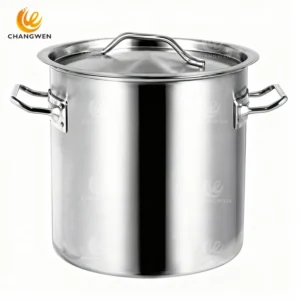
20 Quart Stock Pot (18.9 Litres)
The 20 quart stock pot (also written as 20 quarts pot or 20 quart pan) is the high-volume commercial standard — the size most professional kitchens operating at full service reach for when they need serious volume. This is the pot used for:
- Stocks and broths for 80–120 portions
- Full-service seafood boils
- Catering soup production
- Institutional batch cooking
- Large pasta stations
20 quart stock pots typically require a dedicated stock pot burner for even, efficient heating. At full capacity, a 20 quart stock pot filled with liquid weighs approximately 45–50 lbs (20–23 kg) — two-handle design and proper lifting technique are non-negotiable at this scale.
The 20 quart stock pots category is one of the most searched commercial sizes precisely because it represents the threshold between standard restaurant cookware and high-volume catering-grade equipment.
24 Quart Pot (22.7 Litres)
The 24 quarts pot is used in full-service catering kitchens, hotel central production, and high-volume commissary operations. At this capacity, the pot requires a dedicated floor-standing stock pot burner or integrated range in most setups.
25 Quart Pot (23.7 Litres)
The 25 quart pot is common in catering and institutional settings. Similar applications to 24 qt — bulk broth, large batch soup, seafood boils for large events.
40 Quart Pots (37.9 Litres)
40 quart pots are firmly in the extra large cooking pots category, used in:
- Commissary and central production kitchens
- Large catering operations (200+ portions)
- Hotel banquet and convention center kitchens
- School and hospital food service
At 40 qt, pots require dedicated burner infrastructure and two-person handling protocols. 40 quart pots are typically mounted on dedicated stock pot ranges rather than standard commercial burners.
100 Quart Stainless Steel Pot (94.6 Litres)
The 100 quart stainless steel pot is institutional-grade equipment — used in military kitchens, hospital central food production, large school district commissaries, and mass catering operations. At approximately 94.6 litres, these units:
- Require floor-standing dedicated burner systems
- Are handled with custom pot-lifting equipment or two-person teams
- Are typically produced in 304 stainless steel with reinforced handles and optional spigot fittings
- Have lead times of 30–60 days as semi-custom production items
Food Pan Sizes & Hotel Pan Sizes Reference
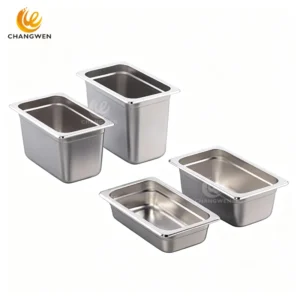
Food pan sizes (also called hotel pan sizes, steam table pan sizes, or GN pan sizes in international markets) follow a completely different sizing system from stock pots. Understanding both is essential for a complete commercial kitchen setup.
Food Pan Sizes Chart
Food pans are measured by fraction of the standard full-size pan, which measures approximately 20¾” × 12¾” (52.7 cm × 32.5 cm) in the US system.
| Pan Size | US Dimensions (approx.) | GN Equivalent | Typical Depth Options | Common Uses |
|---|---|---|---|---|
| Full size | 20¾” × 12¾” | GN 1/1 | 2″, 4″, 6″, 8″ | Entrees, roasted meats, large batches |
| Two-thirds | 13⅓” × 12¾” | GN 2/3 | 2″, 4″, 6″ | Proteins, casseroles, large sides |
| Half size | 12¾” × 10⅜” | GN 1/2 | 2″, 4″, 6″ | Side dishes, smaller entrees |
| Third size | 12¾” × 6⅞” | GN 1/3 | 2″, 4″, 6″ | Sides, condiments, toppings |
| Quarter size | 10⅜” × 6⅜” | GN 1/4 | 2″, 4″ | Garnishes, small sides, prep storage |
| Sixth size (1/6 pan) | 6⅞” × 6⅜” | GN 1/6 | 2″, 4″ | Toppings, dressings, small portions |
| Ninth size | 6⅞” × 4¼” | GN 1/9 | 2″ | Spices, small garnishes, specialty ingredients |
Full-Size Pan Dimensions: Key Facts
The full-size pan dimensions (GN 1/1) are the universal reference for commercial kitchen equipment compatibility:
- Exterior dimensions: 20¾” × 12¾” (52.7 cm × 32.4 cm) — standard across US foodservice
- Interior dimensions: Slightly smaller (varies by wall thickness and gauge)
- Depth options: 2″ (shallow), 4″ (medium), 6″ (deep), 8″ (extra deep)
- Fits: Standard steam tables, chafing dishes, bain marie inserts, refrigerated prep rails, hotel pan racks
The 1/6 Pan Size
The 1/6 pan size is one of the most useful but frequently underspecified pan sizes in commercial kitchens. At approximately 6⅞” × 6⅜”, six 1/6 pans fill one full-size slot. They’re ideal for:
- Condiment and topping stations (pizza, build-your-own concepts)
- Salad bar components
- Garnish organization at prep and service stations
- Sauce holding at line stations
Food Pan Depth Guide
Depth selection matters as much as the width/length dimension:
| Depth | Best Use |
|---|---|
| 2″ (shallow) | Solid foods, display, dry items |
| 4″ (standard) | Most soups, sides, entrees |
| 6″ (deep) | Liquids, high-volume storage, braised dishes |
| 8″ (extra deep) | Very high-volume liquid items, large batch storage |
Sauce Pot Sizes vs. Stock Pot Sizes
The sauce pot is often confused with the stock pot, but they serve different functions in a commercial kitchen. Understanding the distinction helps you buy the right cookware for each station.
Key Differences
| Feature | Stock Pot | Sauce Pot |
|---|---|---|
| Handle design | Two loop handles | One long handle + one helper handle |
| Shape | Tall and straight-sided | Shorter, wider relative to height |
| Primary use | Stocks, soups, bulk boiling | Sauces, gravies, reductions, sides |
| Control | Lifted by both hands | Tilted/poured with one hand |
| Typical sizes | 8 qt – 100 qt+ | 1 qt – 8 qt |
Sauce Pot Sizes for Commercial Kitchens
Standard sauce pot sizes for commercial use:
- 1 qt — single-portion sauce work, garnish preparation
- 1.5 qt — small sauce production, butter and cream work
- 2 qt — station sauce preparation, small reductions
- 3 qt — mid-volume sauces, side dish prep
- 4 qt — larger batch sauce work, sides for 20–30 portions
- 6–8 qt — high-volume sauce production (these sizes overlap with small stock pot range)
Pro tip: For stations that produce both soups and sauces, maintain a set of sauce pots (1.5–4 qt) alongside your stock pot lineup. The long handle of a sauce pot gives chefs far more control when finishing, tilting, or pouring than a loop-handled stock pot.
How to Choose the Right Stock Pot Size for Your Restaurant
Step 1 — Calculate by Portion Volume
Every soup pot size or stock pot large decision should start with the number of portions you need per batch and the volume per portion.
Portion volume reference:
- Bowl of soup (standard): 8–12 oz (240–355 ml) — approximately ⅓ to ½ cup per serving
- Large bowl of soup: 12–16 oz (355–475 ml)
- Stock/broth portion for cooking: 4–8 oz (120–240 ml) per dish
Formula:
Portions per batch × oz per portion ÷ 32 oz/quart = minimum quart capacity Add 20–25% for headspace and boilover prevention
Example: 60 portions of 12 oz soup = 720 oz ÷ 32 = 22.5 qt minimum. Add 25% headspace = need a 25 quart pot or larger.
Step 2 — Match Pot Size to Burner Capacity
Stock pot diameter must fit your burner:
- Standard commercial burner (18″–24″ spacing): handles up to 16–20 qt pots
- Dedicated stock pot range (floor-standing): handles 20–60 qt pots
- Industrial floor burner: handles 60 qt+ commercial pots
Oversizing your pot relative to your burner causes uneven heating, longer cook times, and energy waste.
Step 3 — Consider Your Kitchen’s Mix of Sizes
The most efficient commercial kitchens maintain a range of stock pot sizes, not just one size:
Recommended starter set for a full-service restaurant:
- 2–3 × 8 quart cooking pot — daily prep, sauces, blanching
- 2 × 12 quart pan — standard soup and stock production
- 1–2 × 20 quart stock pot — large batch soups, catering, seafood
- 1 × 40 quart pots (if doing catering or high volume) — bulk production
Step 4 — Weight and Handling Safety
Full pot weights (approximate):
| Pot Size | Water Weight | + Pot Weight | Total (approx.) |
|---|---|---|---|
| 8 qt | ~17 lbs (7.7 kg) | 3–5 lbs | ~20–22 lbs |
| 12 qt | ~25 lbs (11.4 kg) | 4–7 lbs | ~29–32 lbs |
| 20 qt | ~42 lbs (19 kg) | 7–12 lbs | ~49–54 lbs |
| 40 qt | ~84 lbs (38 kg) | 12–18 lbs | ~96–102 lbs |
At 20 qt and above, two-person handling protocols are recommended. At 40 qt and above, mechanical assistance (pot-tilting mechanisms, dedicated lifts) is standard in professional operations.
Materials: Stainless Steel vs. Aluminum
Heavy Duty Stainless Steel Stock Pot
Heavy duty stainless steel stock pots — 304 grade (18/8 or 18/10) — are the commercial kitchen standard for soup and stock production. Key advantages:
- Non-reactive — handles acidic ingredients (tomato, wine, citrus) without affecting flavor or corroding
- Durable — survives commercial dishwasher cycles, thermal shock, and daily use for 10+ years with proper care
- NSF-certifiable — required for commercial food contact in most jurisdictions
- Easy to clean — smooth, non-porous surface; stains respond to standard commercial cleaners
- No seasoning required — unlike cast iron or carbon steel
Heavy duty construction indicators:
- Base thickness: 2mm minimum; 2.5–3mm for heavy-duty commercial grade
- Handle attachment: riveted (not welded alone) — check rivet count and size
- Rim: rolled or reinforced — prevents warping under thermal cycling
- Bottom: flat and ground — prevents rocking on range grates
Large Aluminum Cooking Pot
Large aluminum cooking pots offer specific advantages for certain commercial applications:
- Faster heat-up — aluminum conducts heat faster than stainless steel
- Lighter weight — critical for 40 quart and larger sizes where weight is a safety concern
- Lower cost — aluminum pots are significantly less expensive than equivalent stainless
Limitations of aluminum:
- Reactive with acidic ingredients — bare aluminum pits and discolors when in contact with tomatoes, wine, citrus, or vinegar-based sauces
- Not suitable for acidic stocks or tomato-based soups unless hard-anodized
- Not NSF-approved for direct food contact in some jurisdictions (verify locally)
- Shorter service life under commercial dishwasher use than stainless steel
Best use for large aluminum cooking pots: Non-acidic bulk boiling — pasta water, shellfish boils, vegetable blanching — where speed of heating and weight management matter more than long-term durability.
Extra Large & Industrial Pots: 40 Qt to 100 Qt
Extra Large Wide Cooking Pots
Extra large wide cooking pots differ from standard tall-profile stock pots in their proportions:
- Wide base, shorter walls — increases surface area for faster evaporation and browning
- Better for reduction — larger surface evaporates liquid faster
- More difficult to manage volume — liquid reduces faster than in tall pots
Extra large wide pots are used for paella, large-batch braising, and seafood boils where surface area matters more than liquid depth.
Extra Large Soup Pot: 40–60 Qt Range
The extra large soup pot category (40–60 qt) is the equipment tier used in:
- Full-service catering operations (200–500 portions)
- Hotel central kitchens
- School district food production
- Hospital food service commissaries
- Military field kitchen operations
At this scale, extra large cooking pots typically require:
- Dedicated floor-standing stock pot ranges (60,000–100,000 BTU burners)
- Reinforced loop handles rated for full-capacity load
- Optional spigot / tap fitting at base for dispensing without lifting
- Two-person handling protocols or mechanical pot-tilting equipment
100 Quart Stainless Steel Pot: Specification Guide
For buyers sourcing 100 quart stainless steel pots for institutional applications:
Typical specifications:
- Capacity: 100 qt / 94.6 L
- Material: 304 stainless steel, 1.5–2mm wall thickness
- Base: Reinforced thick base, 2.5–3mm
- Handles: Dual heavy-duty loop handles, fully riveted, load-rated
- Optional: Spigot/tap at base for dispensing
- Optional: Lid with steam vent
- Certification: NSF-listed, food-grade
- Weight (empty): 20–35 lbs depending on gauge
- Weight (full): 200+ lbs — mechanical handling required
FAQ
What are the standard stock pot sizes for a restaurant?
Standard stock pot sizes for commercial restaurant use run from 8 quarts to 40 quarts, with the most common sizes being 8 qt (7.6 L), 12 qt (11.4 L), 20 qt (18.9 L), and 40 qt (37.9 L). Most full-service restaurants maintain a combination: 8 qt for daily prep and sauce work, 12 qt for standard soup and stock production, and 20 qt for high-volume service and catering. See the complete stock pot sizes chart above for the full range from 6 qt to 100 qt with litre equivalents and use-case guidance.
What is the difference between food pan sizes and stock pot sizes?
Food pan sizes (hotel pans, steam table pans, GN pans) and stock pot sizes are completely different measurement systems. Stock pots are measured by volume in quarts or litres. Food pans are measured by a fraction system based on the full-size pan footprint of approximately 20¾” × 12¾” — with standard sizes including full, half, third, quarter, 1/6 pan, and ninth. Food pans are used in steam tables, chafing dishes, cold rails, and food storage. Stock pots are used on stovetops and ranges. See the food pan sizes chart earlier in this guide for complete dimensions.
How many quarts is a large soup pot for a restaurant?
A large soup pot in a commercial kitchen typically means 20–40 quarts. The 20 quart stock pot (18.9 litres) is the standard high-volume workhorse for restaurant soup service — handling 80–120 portions per batch. For catering and commissary operations, 40 quart pots (37.9 litres) are common. The extra large soup pot category starts at 40 qt and extends to 100 qt+ for institutional use.
What is the difference between a stock pot and a sauce pot?
A stock pot has two loop handles, tall straight sides, and is designed for large-volume liquid cooking — stocks, soups, pasta boiling. A sauce pot has one long handle and typically one helper handle, is shorter and wider relative to its height, and is designed for sauces, reductions, and precise stove-top control. Sauce pot sizes run from 1 qt to 6–8 qt in commercial kitchens. Stock pots typically start at 6 qt and go up to 100 qt+. Both are distinct from a saucepan (which has a single long handle and is even smaller and more precise).
How do I convert stock pot sizes from quarts to litres?
Multiply quarts by 0.946 to get litres. Common conversions: 8 quart pot = 7.6 L; 12 quart pan = 11.4 L; 20 quart stock pot = 18.9 L; 40 quart pots = 37.9 L; 100 quart stainless steel pot = 94.6 L. Remember: usable cooking capacity is 75–80% of stated capacity — a 20 qt pot should be filled to a maximum of 15–16 quarts during cooking to prevent boilover and allow safe handling.
What size stock pot do I need to feed 50 people?
For soup or stock feeding 50 people at a standard 12 oz (355 ml) portion: 50 × 12 oz = 600 oz ÷ 32 oz/qt = approximately 18.75 quarts. Adding 25% headspace means you need at minimum a 25 quart pot or a 20 quart stock pot run in two batches. For a single-batch production feeding 50, the 20–25 qt range is the right specification.
What is a heavy duty stainless steel stock pot and why does it matter?
A heavy duty stainless steel stock pot in commercial kitchen terms means: 304-grade (18/8 or 18/10) stainless steel with a base thickness of 2mm minimum (2.5–3mm for true heavy-duty), fully riveted handles rated for the full load, a flat-ground bottom for range stability, and NSF certification for food contact. The distinction matters because light-gauge stainless pots warp under sustained commercial heat, develop hot spots, and fail at the handle attachments. In a commercial kitchen producing stock or soup daily, a correctly specified heavy duty stainless steel stock pot will outlast a light-gauge alternative by 5–10 years.
Conclusion
Stock pot sizes for restaurants cover a wider range than most buyers expect — and each size has a specific, well-defined role. Getting the sizing right from the start prevents the two most common commercial kitchen mistakes: buying too small (forcing multi-batch production where single-batch is possible) and buying too large (wasting energy on a pot that’s mostly empty for your typical production volume).
The framework from this guide:
- Use the stock pot sizes chart (quarts and litres) to match capacity to your portion volumes and cover count
- Maintain a range of sizes — 8 qt, 12 qt, and 20 qt cover the vast majority of full-service restaurant needs
- Understand food pan sizes separately — full-size pan dimensions, hotel pan sizes, and the 1/6 pan size system operate on a completely different measurement framework from stock pots
- Choose heavy duty stainless steel stock pots for daily commercial service — 304 grade, 2mm+ base, riveted handles, NSF-certified
- Scale up to 40 quart and 100 quart stainless steel pots with appropriate burner infrastructure and handling protocols
We manufacture and export commercial-grade stainless steel stock pots in all sizes — from 8 quart cooking pots to 100 quart institutional pots — alongside complete food pan sets, hotel pans, and sauce pots, with over 20 years of experience supplying restaurants, catering companies, and food equipment distributors worldwide. Request our full catalog and wholesale pricing below.