Read time: 14 min
Introduction
Here is the reality most catering equipment importers discover too late:
A gas bain marie food warmer cart is not just a cooking vessel on wheels. It is a gas appliance — and gas appliances crossing international borders carry a certification burden, a regulatory complexity, and a safety responsibility that standard kitchen smallwares do not.
Get it right and you have a high-margin, high-demand product for caterers, outdoor food operators, event companies, and mobile food businesses. The wholesale cost gap between factory-direct Chinese pricing and domestic distributor pricing runs 40–60% on commercial-grade units. That margin opportunity is real and accessible.
Get it wrong and you have an uncertified gas appliance at customs, a liability exposure in the hands of your customers, or a container of units that won’t connect to the gas regulators used in your target market.
This guide closes both gaps.
What follows is a complete, step-by-step import blueprint for gas bain marie food warmer carts from China — covering product specifications, gas certification requirements by market, factory verification, HTS codes and duties, freight logistics, and the pre-shipment checks that protect every significant order.
Whether you are importing for distribution, for a catering fleet, for a restaurant group, or to resell through an e-commerce channel — this guide gives you the exact process.
Key Takeaways
- A gas bain marie food warmer cart is a propane or natural gas powered mobile food holding unit — a water-bath heated GN pan system mounted on a wheeled stainless steel cart frame — primarily used by caterers, outdoor food operators, event companies, and buffet services.
- Gas certification is mandatory and market-specific. For North America: CSA certification (Canada/USA) for the gas train (burner, regulator, hose assembly). For Europe: CE marking under the Gas Appliances Regulation (EU 2016/426). For Australia: AGA/GAS certification. Uncertified gas appliances cannot be legally sold or commercially operated in most markets.
- 304 stainless steel is the required material for all food-contact surfaces (GN pans, water bath tub, work surfaces). 201 stainless for the cart frame is acceptable in dry environments; 304 throughout is the commercial premium specification.
- HTS code 8419.81 (machinery for cooking or heating food) is the primary US classification for gas bain marie units. Base MFN duty rate: 0%. However, Section 301 China-specific tariffs apply — verify the current rate at ustr.gov before placing any order.
- 30,000 BTU is the minimum burner output for a 4–6 pan commercial gas bain marie cart. Units below this threshold have inadequate temperature recovery for outdoor catering conditions.
- GN pan compatibility (Gastronorm standard) is a critical specification — confirm the water bath dimensions accept the exact GN fractions (1/1, 1/2, 1/3, 1/6) required by your target customers.
- Total first-order timeline: 10–16 weeks from supplier contact to warehouse delivery. Gas appliance certification lead times can add 4–12 weeks if the specific model is not already certified.
What Is a Gas Bain Marie Food Warmer Cart? Specs That Define Quality
Before approaching any supplier, you need to understand what you are specifying. A gas bain marie food warmer cart is an assembly of multiple components — each with its own quality specifications.
The Core Components
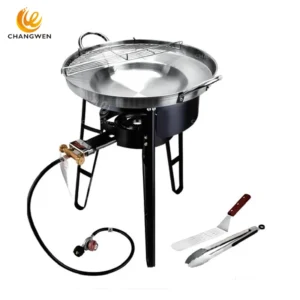
Water bath tub (bain marie vessel): A deep stainless steel vessel filled with water. The gas burner heats the water; the water transfers heat to the GN food pans sitting inside. The indirect water-bath heating method maintains food at safe holding temperatures (typically 63°C / 145°F minimum for hot holding in most food safety regulations) without scorching.
GN food pan inserts: Gastronorm-standard perforated or solid food containers that sit in the heated water bath. GN sizing follows the international standard: GN 1/1 (530 × 325mm), GN 1/2, GN 1/3, GN 1/6. The pan configuration (how many pans, what fractions) determines the unit’s serving versatility.
Gas burner assembly: The heat source. For a commercial 4–6 pan cart: a cast iron or stainless steel burner rated at 25,000–45,000 BTU, with a thermostatically controlled or manually adjustable gas valve, flame failure protection (automatic gas shutoff if flame extinguishes — a critical safety feature), and a CSA or CE certified gas hose and regulator assembly.
Cart frame: The wheeled structural frame. Commercial specification: 304 or 201 stainless steel tube or sheet construction, four swivel casters (minimum 4″ / 100mm diameter) with locking brakes on at least two wheels, an undershelf for GN pan storage, and structural cross-bracing rated for the loaded weight.
Control panel: Burner ignition (piezo spark or electronic), gas flow valve, thermostat (if equipped), and temperature indicator. On quality commercial units: labeled in the target market’s language, with clearly visible on/off indicators and an accessible emergency shutoff.
Lid system: Hinged or sliding lids for each GN pan section. Lids retain heat during transport and between service intervals — critical for outdoor catering where ambient air temperature reduces holding temperature rapidly.
Critical Dimensions to Specify
| Specification | Standard Range | What It Determines |
|---|---|---|
| Number of GN pans | 2, 3, 4, 6 | Serving capacity and menu variety |
| GN pan fraction | 1/1, 1/2, 1/3, 1/6 | Portion sizes and versatility |
| GN pan depth | 65mm, 100mm, 150mm | Volume per pan (deeper = more food) |
| Overall unit width | 600mm–1,800mm | Transport fit (van/truck doorways) |
| Overall unit height | 850mm–1,000mm | Service ergonomics |
| Water bath depth | 100mm–200mm | Heat retention capacity |
| Burner BTU | 20,000–50,000 BTU total | Heat-up speed and temperature recovery |
| Caster diameter | 75mm–125mm | Floor clearance and mobility on uneven surfaces |
| Weight (empty) | 30kg–90kg | Transport and handling considerations |
Gas vs Electric Bain Marie: Which Should You Import?
This is the first decision in the product specification process — and it determines your entire certification pathway.
Gas Bain Marie Food Warmer Cart
Operational advantages:
- No power outlet required — works anywhere with propane or natural gas supply
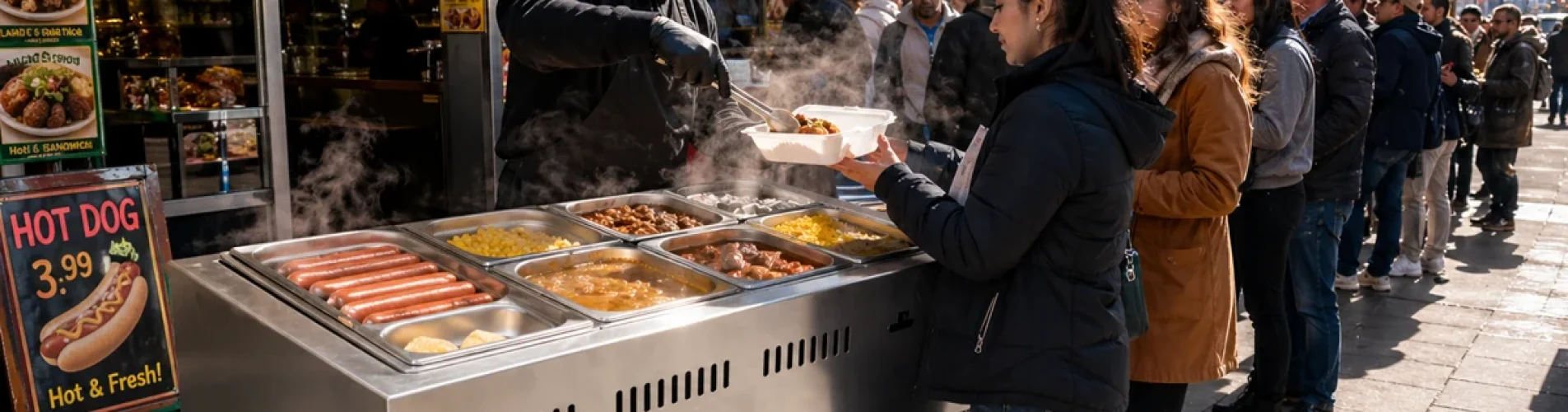
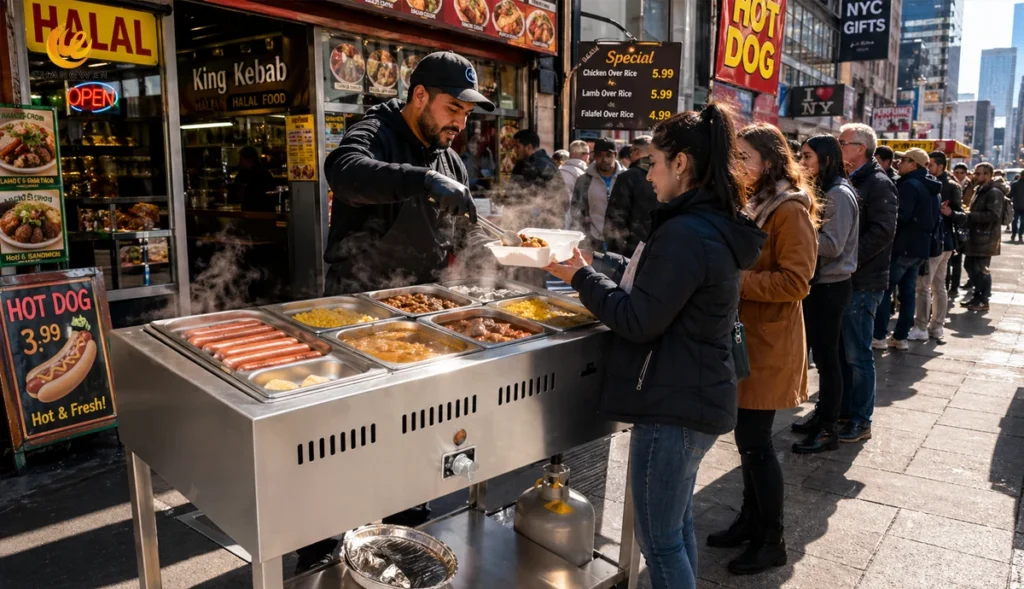
- Essential for outdoor catering, food trucks, events in venues without electrical infrastructure
- Faster initial heat-up from cold start on high-BTU gas versus electric resistance elements
- Lower operating cost in many markets where electricity is expensive relative to gas
Import and compliance complexity:
- Gas appliance certifications are mandatory and market-specific (CSA, CE, AGA)
- The gas train (regulator, hose, fittings) must be certified for the specific gas type in the target market (LPG/propane vs natural gas)
- Requires gas-specific import documentation and potentially additional customs scrutiny
- Some commercial venues and events prohibit open-flame equipment — limits deployment
Best market fit: Outdoor catering operators, food truck supply, mobile food businesses, outdoor event caterers, markets without reliable electrical infrastructure.
Electric Bain Marie Food Warmer Cart
Operational advantages:
- Simpler compliance path (electrical safety certification vs gas appliance certification)
- Precise thermostat control — holds exact temperatures more consistently than gas
- Suitable for indoor commercial kitchens and venues without open-flame restrictions
- Lower safety incident risk profile
Operational limitation: Requires electrical power outlet — not suitable for remote outdoor use.
Best market fit: Hotel buffet service, restaurant holding stations, indoor catering events, commissary kitchens.
The Market Decision
If your target customers are outdoor caterers, event companies, food truck operators, or catering companies serving venues without reliable power: gas is the correct specification.
If your target customers are hotel and restaurant groups, indoor buffet operators, or institutional food service: electric is typically preferred.
Many distributors import both configurations — gas for the outdoor/mobile segment, electric for the indoor segment — from the same factory source to maximize market coverage.
Step 1 — Build Your Complete Product Specification
Approaching any Chinese manufacturer without a complete specification sheet produces quotes for the wrong product. A complete spec sheet is the foundation of every successful import.
Required Specification Elements
Gas system specification:
- Fuel type: LPG/propane (most common for portable applications) vs natural gas (fixed installations)
- Target market: North America (CSA certification required), Europe (CE required), Australia (AGA required), or other
- Gas pressure: US/Canada standard LPG regulator output: 11″ WC (water column) / 2.74 kPa. EU standard varies by country. Always specify target market.
- BTU requirement: minimum 30,000 BTU total for 4-pan commercial cart; 40,000–50,000 BTU for 6-pan commercial configurations
- Ignition type: piezo spark (manual push-button) or electronic ignition
- Flame failure protection: required for any commercially operated unit in regulated markets
Food holding system specification:
- Number of GN pan sections: 2, 3, 4, or 6
- GN pan fractions: GN 1/2 (most versatile for mixed menu catering), GN 1/3, or combination
- GN pan depth: 65mm standard (2.5″), 100mm deep (4″), or 150mm extra-deep (6″)
- Pan material: 304 stainless steel — mandatory
- Lids: yes/no, hinged or lift-off, polycarbonate viewing panel option
Cart frame specification:
- Frame material: 304 SS throughout (premium) or 201 SS frame with 304 food-contact surfaces (commercial standard)
- Tube gauge: 1.2mm minimum for commercial service
- Caster specification: 4″ (100mm) swivel casters minimum; locking brakes on minimum 2 wheels; load rating must exceed fully loaded cart weight
- Undershelf: yes/no, open or enclosed
- Handle configuration: push handle height, material (stainless, rubber grip)
Temperature specification:
- Working temperature range: minimum 30°C–85°C (86°F–185°F) for hot holding
- Thermostat type: adjustable knob or digital display
Certification requirements:
- CSA (Canada and US commercial use)
- CE marking (EU)
- AGA (Australia)
- ETL (US alternative to CSA)
- NSF/ANSI 4 for food contact surfaces (US commercial kitchen licensing)
OEM/branding requirements:
- Logo: laser engraving, screen print, or adhesive plate
- Color: standard brushed stainless, or custom powder coat on frame
- Control panel labeling: language requirement (English, Spanish, French, etc.)
Step 2 — Find and Verify a Legitimate Chinese Manufacturer
Where China’s Gas Catering Equipment Manufacturing Is Located
Gas bain marie food warmer carts are manufactured primarily in Guangdong Province — specifically the commercial catering equipment clusters in Guangzhou (particularly Tianhe and Panyu districts) and Foshan. These areas concentrate the fabrication expertise, gas component supply chains, and export infrastructure for this product category.
Smaller clusters in Shandong and Zhejiang also produce commercial catering equipment but with less specialization in gas appliance systems.
How to Find Verified Manufacturers
Alibaba and Made-in-China: The primary B2B directories. Filter for “Gold Supplier + Verified Manufacturer” on Alibaba; “Audited Supplier” on Made-in-China. Use search terms like “gas bain marie cart manufacturer,” “commercial food warmer cart factory,” or “gas steam table cart OEM.”
Canton Fair (Guangzhou): The world’s largest trade fair, held twice annually. Catering equipment exhibitors are verified manufacturers. For buyers sourcing above $50,000 annually, attending Canton Fair is the most efficient verification path.
Direct factory inquiry: Search for Guangzhou and Foshan commercial kitchen equipment manufacturers with specific gas appliance experience.
The Factory Verification Framework
Step 1: Live video factory tour Request an unscripted live video call showing: sheet metal fabrication equipment, welding stations, gas assembly line (burner fitting, regulator connection), testing station (gas pressure testing, flame failure test), and finished product QC area. A genuine manufacturer shows this immediately. A trading company cannot — they have no production floor.
Step 2: Gas certification documentation Request the actual certification listing number for their CSA or CE certification. Verify:
- CSA: at csagroup.org
- CE: request the Declaration of Conformity document with notified body number
- ETL: at intertek.com/marks/etl
Certification must be for the specific model you are ordering, not just the company in general.
Step 3: Technical question test Ask: “What is the BTU output per burner on your 4-pan cart?” or “What flame failure protection does your gas valve use?” Real gas appliance manufacturers answer technically and immediately. Trading companies forward the question.
Step 4: Material documentation Request the Mill Test Certificate for the 304 stainless steel used in food-contact components (water bath tub and GN pans). Standard document from any manufacturer using traceable steel.
Step 5: Reference verification Request contact information for 2–3 current wholesale buyers in your target market. A manufacturer exporting CSA-certified carts to North America will have verifiable customer references.
Step 3 — Certifications That Are Non-Negotiable
Gas appliances are among the most tightly regulated products in international trade. This section covers what is required, what it means, and how to verify it.
CSA Certification (North America — Canada and USA)
What it covers: The CSA (Canadian Standards Association) certifies that a gas appliance meets applicable safety standards for gas handling, combustion, and consumer/operator safety. For a gas bain marie cart, CSA certification applies to: the burner assembly, gas regulator, hose assembly, fittings, and the integrated gas train.
Required for: Any gas appliance sold or operated commercially in Canada. Widely required (or demanded by insurers) in the United States for commercial food service operations.
How to verify: Request the CSA listing number. Verify at csagroup.org using the listing search. The listing must show the specific model, the standard it was tested to, and current active status. An expired, for a different product, or unverifiable listing is not genuine.
ETL certification (issued by Intertek) is an equivalent alternative to CSA for the US/Canada market, recognized by most commercial kitchen licensing authorities and insurers.
CE Marking (European Union and UK)
What it covers: CE marking under the Gas Appliances Regulation (EU) 2016/426 confirms the appliance meets EU safety requirements for gas combustion, construction, materials, and operation. Required for all gas appliances placed on the EU market.
Required for: Any gas appliance sold in EU member states and (post-Brexit) with UKCA marking for the UK.
How to verify: Request the Declaration of Conformity (DoC) document. The DoC must specify the relevant EU directive/regulation (EU 2016/426 for gas appliances), the notified body number (the third-party testing organization), and the specific standards to which the product was tested (EN 203-1 and EN 203-2 for commercial catering equipment).
AGA / Gas Certification (Australia)
Required for: Gas appliances sold or operated commercially in Australia. Administered through certified bodies under the Australian Gas Association or state energy safety authorities.
NSF/ANSI 4 — Food Equipment (USA)
Confirms that food-contact surfaces (water bath tub, GN pan inserts, any food-contact structure) meet NSF food safety standards. Required for commercial food service licensing in many US jurisdictions. Verify at nsf.org using the listing number.
What to Do If the Model Is Not Yet Certified
Many Chinese manufacturers have CE and CSA certification for their standard catalog models but not for custom configurations. If you require a custom specification (unusual BTU, non-standard pan configuration, custom frame dimensions), confirm:
- Whether the manufacturer can certify the custom variant (some can extend existing certifications to cover configuration variants)
- Certification lead time: CSA testing typically adds 8–16 weeks to the production timeline
- Certification cost: typically $3,000–$10,000+ for a new gas appliance CSA listing
Factor these timelines and costs into your first-order planning. Never place a bulk order for a gas appliance without confirmed certification coverage.
Step 4 — Request and Evaluate Samples
A gas bain marie food warmer cart sample evaluation requires testing both the equipment quality and the gas safety system. This is more involved than standard cookware sampling — and more important.
Sample Evaluation Protocol
Structural assessment:
- Steel grade verification: magnet test on the water bath tub and GN pans (304 is non-magnetic; any magnetic response on food-contact surfaces indicates non-304 grade)
- Weld quality on all structural joints, handle attachments, and frame connections
- Caster load test: fill the unit to capacity and test rolling, braking, and steering on both smooth and slightly uneven surfaces
- Undershelf load capacity: apply representative load to the undershelf
Gas system assessment (must be performed by a qualified gas technician for safety):
- Leak test: connect to gas supply, check all fittings and connections with leak detection solution
- Flame failure protection: confirm the safety valve shuts off gas within the specified time if the flame is extinguished (typically within 60 seconds for commercial units)
- Ignition test: multiple ignition cycles to confirm reliable lighting
- Thermostat calibration: use a calibrated thermometer to verify water temperature against thermostat setting at multiple points
- BTU verification: flow meter test to confirm gas consumption matches rated BTU output
- Regulator output pressure: confirm output pressure matches the target market specification
Temperature performance test:
- Cold start: time from ignition to target holding temperature (63°C/145°F minimum) — should reach holding temperature within 20–30 minutes for a commercial unit
- Loaded recovery: fill all GN pans with chilled food (5°C), start from cold water bath. Time to reach food safe holding temperature.
- Outdoor wind test: operate in moderate outdoor wind; wind baffle design should maintain consistent flame
Safety check:
- Confirm flame failure protection activates correctly
- Test emergency gas shutoff valve accessibility
- Verify gas hose routing does not contact hot surfaces
- Confirm regulator and hose length specification matches target market (US/Canada: minimum 5-foot hose is standard for safety in outdoor catering use)
Step 5 — MOQ, Pricing, and Payment Terms
MOQ for Gas Bain Marie Carts
Gas catering equipment has higher per-unit complexity than standard cookware, which is reflected in MOQ structures:
| Order Type | Typical MOQ |
|---|---|
| Standard catalog model (existing certification) | 5–20 units |
| Standard model with logo/branding | 10–30 units |
| Configuration modification (pan count, BTU) | 20–50 units |
| Custom frame dimensions | 50–100 units |
| New model requiring new certification | 200+ units (certification cost amortization) |
For most distributors testing a new product, starting with 10–20 units of a factory’s existing CSA or CE certified standard model is the correct first order approach — lower risk, shorter lead time, and no certification complexity.
Factory-Direct Pricing Context
Gas bain marie food warmer carts sourced factory-direct from verified Chinese manufacturers typically cost 40–60% less than equivalent units through domestic distributors. The actual price range varies significantly by configuration — number of pans, BTU output, cart construction quality, and certification status.
The key pricing principle: the cost gap between factory-direct and domestic distribution is widest for gas catering equipment because the product’s complexity and weight keep most buyers in the domestic distribution channel — which means the factory-direct option is less competitive and the margin opportunity is larger.
Payment Terms
Standard commercial terms: 30% deposit on order + 70% balance before shipment (after production, quality inspection passed, and shipping documents ready).
Alibaba Trade Assurance: Use for all first orders placed through Alibaba — provides payment protection if goods don’t match the order.
Never 100% upfront with a new supplier for gas appliance orders. Gas appliance compliance verification (certification check, pre-shipment inspection) happens after production and before the balance payment — this timing gives you quality leverage.
Step 6 — HTS Codes, Import Duties, and Landed Cost
HTS Classification for Gas Bain Marie Carts
The primary US HTS classification for gas bain marie food warmer carts:
HTS 8419.81 — Machinery, plant, or equipment for making hot drinks or for cooking or heating food
- This heading covers commercial gas food warmers, bain marie units, and related heating equipment
- Base MFN duty rate: 0% (favorable — commercial food equipment generally has low base duty rates)
Alternative classification for cart components: If the cart frame and the heating unit are imported separately, the cart frame may classify under a different heading (stainless steel furniture or equipment). Always confirm with a licensed customs broker before placing your first order.
Section 301 Tariffs (China-Specific)
Section 301 tariffs are additional duties applied specifically to Chinese-origin goods. The rate applicable to HTS 8419.81 commercial food equipment has ranged from 7.5% to 25% and is subject to change.
Critical action: Before placing any order, verify the current Section 301 rate for your specific HTS code at ustr.gov or through a licensed customs broker. Do not rely on rates from any guide (including this one) — these rates have changed multiple times and may change again.
Landed Cost Calculation Framework
| Cost Component | Notes |
|---|---|
| FOB factory price | Your negotiated unit price |
| Ocean freight (LCL or FCL) | Per unit based on CBM and route |
| Cargo insurance | Typically 0.3–0.5% of cargo value |
| Import duty (base MFN 0%) | Currently 0% base for HTS 8419.81 |
| Section 301 tariff | Verify current rate — budget 7.5–25% |
| Customs broker fee | $150–$350 per entry, amortized per unit |
| ISF filing fee | $25–$50 per unit (small orders) |
| Destination charges | Port fees, drayage, local delivery |
| Total landed cost | Typically 25–45% above FOB for China-origin gas equipment |
The CBM Challenge: Gas Bain Marie Carts Are Large
Gas bain marie carts are large, bulky items. A 6-pan commercial cart typically occupies 0.8–1.5 CBM per unit. Calculate total CBM carefully before freight quotes:
- 10 units × 1.2 CBM = 12 CBM — approaching the FCL/LCL break-even point
- 20 units × 1.2 CBM = 24 CBM — likely a partial 20-foot container
Nested or disassembled shipping (carts shipped with handles, shelves, and casters packed flat) can reduce CBM by 15–30% — always ask manufacturers about knocked-down (KD) packing options for large cart orders.
Step 7 — Freight, Documentation, and Lead Times
Freight Considerations for Gas Catering Equipment
Dangerous goods classification: Propane regulators and hoses are not classified as dangerous goods when shipped without the gas cylinder. Gas bain marie carts shipped without fuel (the factory ships the equipment; the customer supplies gas) are standard commercial cargo — no special dangerous goods packaging or documentation required.
However: confirm with your freight forwarder that no residual gas is in any component. Factories should purge all gas lines before shipping.
Packaging: Commercial gas catering equipment should ship in wooden crate or reinforced cardboard with foam inserts for structural protection. Gas lines, regulators, and control valves are fragile components — inadequate packaging creates damage claims.
Ocean vs air: Gas bain marie carts are too heavy and bulky for air freight economics in any volume. Ocean LCL or FCL is the only practical freight method.
Full Lead Time Timeline
| Phase | Duration |
|---|---|
| Supplier qualification and sample request | 5–15 days |
| Sample production and delivery | 10–20 days |
| Sample evaluation and approval | 5–10 days |
| Purchase order + deposit | 3–7 days |
| Production (standard certified model) | 25–40 days |
| Production (custom or new certification) | 60–120 days |
| Pre-shipment inspection | 3–7 days |
| Factory to port + export customs | 3–7 days |
| Ocean freight (to US West Coast) | 15–22 days |
| Ocean freight (to US East Coast) | 22–30 days |
| Ocean freight (to Europe) | 25–35 days |
| US customs clearance | 3–7 days |
| Inland delivery | 2–5 days |
| Total (standard model, first order) | 10–16 weeks |
Required Documents
Commercial Invoice: Full product description (“Gas-powered bain marie food warmer cart, 4-pan configuration, propane/LPG fuel type, 304 stainless steel construction”), unit price, total value, HTS code, country of origin.
Packing List: Carton dimensions, weights, contents.
Bill of Lading: From the shipping line.
Certificate of Origin: Required for tariff classification and Section 301 application.
Gas Certification Documentation: CSA listing certificate (with listing number), CE Declaration of Conformity, or applicable market certification. Keep copies for customs clearance and end-customer compliance files.
Mill Test Certificate: For 304 stainless steel food-contact components.
Country of Origin Marking: “Made in China” must be legibly marked on each unit per CBP requirements.
Step 8 — Pre-Shipment Inspection
For gas appliances, pre-shipment inspection is more critical than for any other kitchen equipment category. A non-conforming gas appliance in the hands of a customer creates liability exposure that no insurance policy fully resolves.
What the Inspection Must Cover
Gas safety verification:
- Flame failure protection: confirmed operational on sample units
- Leak test: all fittings and connections tested with leak detection solution under gas pressure
- Gas certification mark: physically stamped or permanently labeled on the unit (not a sticker)
- Regulator and hose specification: confirm matches target market (CSA certified assembly for North America; CE compliant assembly for EU)
Food contact surface verification:
- Magnet test on water bath tub and GN pans (304 = non-magnetic)
- NSF marking on food contact surfaces if specified
Structural inspection:
- Caster quality and load rating
- Weld quality on all frame joints
- Handle attachment load test
- Undershelf structural integrity
Quantity and packing:
- Count against purchase order
- Packaging integrity (wooden crate or reinforced carton protection)
- All accessories included (gas hose, regulator, GN pans, lids, drip tray)
Commission through: SGS, Bureau Veritas, Intertek, or QIMA. Cost: $300–600 per inspection day.
Common Mistakes That Cost Importers Money
Mistake 1: Importing uncertified gas appliances. Uncertified gas appliances cannot be legally sold or commercially operated in most regulated markets. Insurance typically does not cover incidents involving uncertified equipment. Before placing any order: confirm certification coverage for your specific target market and verify the listing number.
Mistake 2: Wrong gas type specification. LPG/propane and natural gas require different regulator output pressures and different orifice sizes at the burner. An LPG unit does not work on natural gas without conversion, and vice versa. Specify gas type explicitly in every purchase order.
Mistake 3: Wrong regulator pressure for target market. The US/Canada standard LPG regulator output is 11″ WC (water column). Some Chinese manufacturers supply units with regulators calibrated to different pressures. A mismatched regulator means the burner runs lean or rich — either inadequate heat output or dangerous over-pressure. Always specify the exact regulator output pressure required.
Mistake 4: Undersizing the BTU for outdoor use. A 20,000 BTU burner on a 4-pan cart may hold temperature adequately in a controlled indoor environment. At an outdoor event in cold, windy conditions, the same burner struggles to maintain food safe temperatures (63°C / 145°F minimum). Commercial outdoor gas bain marie carts need 30,000 BTU minimum; 40,000+ BTU for reliable performance in outdoor catering conditions.
Mistake 5: Ignoring CBM and shipping weight. Gas bain marie carts are heavy (30–80kg each) and bulky (0.8–1.5 CBM each). Failing to calculate freight costs accurately before pricing creates unpleasant landed-cost surprises. Always calculate CBM and weight from confirmed packing dimensions before finalizing pricing.
Mistake 6: Not requesting knocked-down (KD) packing. Many factories can ship gas bain marie carts in a knocked-down configuration — handles removed, shelves packed flat, casters packaged separately — reducing the per-unit CBM by 15–30%. On a 20-unit order, this can mean the difference between LCL and FCL freight and thousands of dollars in shipping cost.
Mistake 7: Treating gas certification as a one-time check. CSA and CE certifications have expiry dates and require ongoing factory compliance audits. Request the certification expiry date and confirm ongoing factory compliance status. A certification that expires while your inventory is in transit leaves your distribution program in compliance limbo.
FAQ
What HTS code applies to gas bain marie food warmer carts imported from China?
The primary US HTS code for gas bain marie food warmer carts is 8419.81 — machinery for making hot drinks or for cooking or heating food. This heading covers commercial gas food warming equipment and bain marie units. The base MFN duty rate is 0%. Section 301 China-specific tariffs apply in addition — verify the current rate at ustr.gov or through a licensed customs broker before placing any order, as these rates are subject to change.
Is CSA certification required for gas bain marie carts imported for commercial use in the United States?
CSA certification (or ETL, the Intertek equivalent) is not universally mandated by federal law for gas appliances in the US, but it is effectively required in commercial practice: most commercial kitchen fire codes require certification, most commercial kitchen insurers require certification, and most venue operators require documentation of certification before allowing gas equipment on premises. Any gas bain marie cart sold for commercial catering use in the US should carry CSA or ETL certification on the gas train (burner, regulator, hose assembly). Verify the certification listing number at csagroup.org before placing bulk orders.
What is the minimum BTU for a commercial gas bain marie food warmer cart?
For a 4-pan commercial configuration used in outdoor catering: 30,000 BTU minimum. For a 6-pan commercial configuration or for operations in cold or windy outdoor environments: 40,000–50,000 BTU total. BTU output determines how quickly the water bath reaches holding temperature and how effectively it recovers after the lids are opened during service. Undersized BTU output is the most common functional complaint about imported gas bain marie carts in outdoor commercial use.
What is the difference between a gas bain marie and an electric bain marie?
A gas bain marie uses a propane or natural gas burner to heat the water bath — suitable for outdoor use, mobile catering, and any application without reliable electrical power. An electric bain marie uses a resistance heating element or immersion heater — provides more precise thermostat control, simpler compliance pathway, and is required for venues with open-flame restrictions. Gas units require CSA/CE gas appliance certification; electric units require electrical safety certification (UL, CE, ETL). For outdoor and mobile catering: gas. For indoor buffet and fixed installations: electric.
What GN pan sizes are standard for commercial gas bain marie carts?
The Gastronorm (GN) standard is the international specification for commercial food containers. The most common configurations for gas bain marie food warmer carts: GN 1/2 pans (265 × 325mm) are the most versatile for mixed catering — a 4-pan cart with GN 1/2 pans handles most catering menu configurations. GN 1/3 pans allow more individual food items in the same footprint. GN 1/1 pans (530 × 325mm) are full-size but typically only fit one per water bath section. Pan depth options: 65mm (standard), 100mm (deep), 150mm (extra deep) — specify the depth based on the volume of food per item required. Always confirm that your water bath tub dimensions accept the exact GN fractions your customers need.
How many units can fit in a 20-foot container for ocean freight?
A standard 20-foot container has approximately 25–28 CBM of usable volume. A commercial 4-pan gas bain marie cart in standard packaging typically occupies 1.0–1.5 CBM per unit. In knocked-down (KD) packing (handles, shelves, and casters packed flat), volume reduces to 0.7–1.0 CBM per unit. Approximate container loads: 17–25 units in standard packing; 25–35 units in KD packing. Always confirm packing dimensions and CBM with the factory before finalizing freight quotes and container booking.
Conclusion
Importing gas bain marie food warmer carts from China is one of the highest-value opportunities in commercial catering equipment distribution — significant cost savings versus domestic pricing, growing demand from outdoor caterers and mobile food operators, and an accessible factory-direct relationship with verified Chinese manufacturers.
But gas appliance importing is not the same as importing stock pots or chafing dishes. The gas certification requirement is real, market-specific, and non-negotiable. The BTU specification matters for performance in your actual deployment conditions. The CBM and weight implications affect freight economics more than most smallwares categories.
The complete framework:
- Specify completely: Gas type, BTU, GN configuration, certification market, cart specification
- Verify the manufacturer: Live factory video, gas certification listing number verification, material documentation
- Confirm certification coverage: CSA, CE, or AGA — listing number verified in the official database, not just a certificate image
- Sample and test properly: Gas safety functional testing by a qualified technician; BTU performance test; outdoor conditions test
- Calculate landed cost fully: FOB + freight + Section 301 tariff + certification documentation + broker fees
- Commission pre-shipment inspection: Gas leak test, flame failure test, certification mark verification — before balance payment
- Manage documentation: Gas certification documents travel with the shipment for commercial compliance
Changwen manufacture and export commercial-grade gas and electric bain marie food warmer carts — 2-pan through 8-pan configurations, LPG and natural gas, with CSA and CE certification options, in 304 stainless steel with full documentation. Factory-direct wholesale pricing from 50 units. OEM and private label available.