Short answer: A hotel should buy buffet equipment as a coordinated service system, not as a collection of attractive countertop items. Start with the menu, peak guest flow, service duration, refill route and available utilities. Then specify chafing dishes for appropriate hot dishes, dedicated warmers for foods that need a different serving format, and beverage dispensers matched to drink type and temperature control. Confirm pan fit, cleaning access, spare parts and measurable acceptance criteria before ordering.
Estimated reading time: 14 minutes.
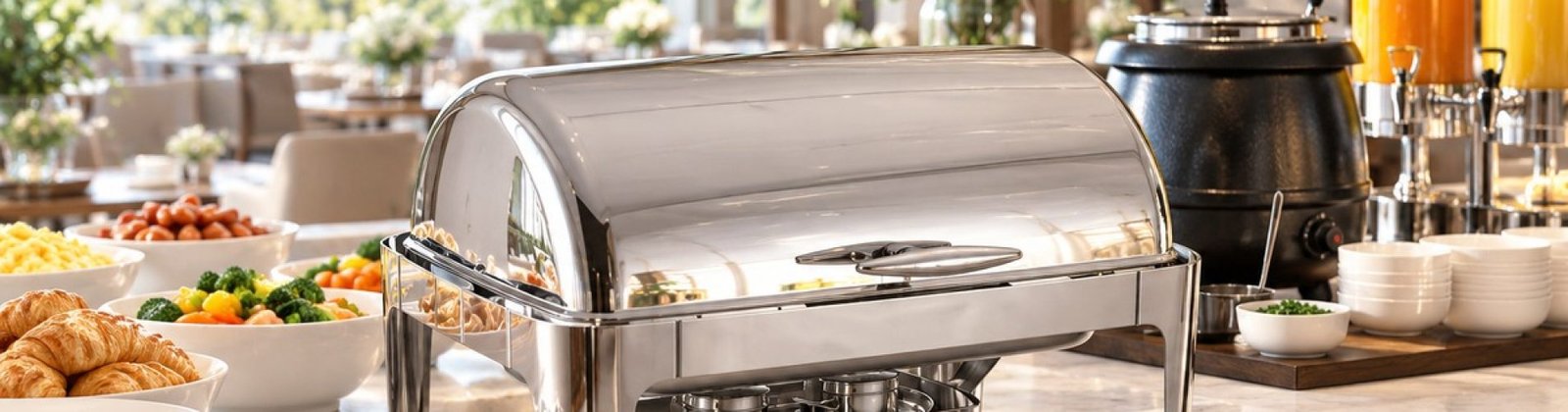
This guide is for hotel food-and-beverage managers, procurement teams and distributors sourcing breakfast or banquet equipment. A polished roll-top chafer is used in the photographs as a visual reference, but its appearance does not prove steel grade, pan capacity, heating performance or regulatory suitability. Those properties must be established by the actual model specification and a sample test.
What should a hotel decide before choosing buffet equipment?
A hotel should define the service it must run before deciding how many chafers or dispensers to purchase. Record the number of guests expected in the busiest interval, the number of dishes presented at once, the length of service, the refill method and whether the same equipment moves between breakfast and events. A 90-minute breakfast with fast pan exchanges needs a different setup from a four-hour banquet with staggered courses, even if the guest total is identical.
Map each menu item to its serving temperature, container and access pattern. Scrambled eggs need a shallow, frequently replaced hot pan; soup needs a vessel and ladle that guests can use without spilling; juice needs a tap and cleaning plan. Buying every item as a full-size rectangular chafer increases visual uniformity but may make staff refill awkwardly and waste counter space.
The equipment plan should also state who operates the buffet. A self-service breakfast gives guests repeated access to lids, taps and utensils, so opening force, drip control and clear labeling matter. A staff-served banquet places more emphasis on rapid pan changes behind the line and repeatable presentation. This operational distinction is the article’s focus; Changwen’s existing commercial chafing dish guide covers the single product category in more detail.
How do chafing dishes, food warmers and beverage dispensers differ?
A chafing dish is a serving assembly that generally holds prepared food in a removable food pan above a heat source or warm water pan. A dedicated food warmer may use a different vessel and controlled heating arrangement for soup, porridge or sauce. A beverage dispenser controls drink access through a tank and tap; it may be passively chilled, actively refrigerated or neither. A hotel buyer should compare these roles rather than assuming that every item described as a “warmer” performs the same function.
| Equipment | Best procurement question | Common hotel use | Critical sample check |
|---|---|---|---|
| Rectangular or round chafer | Does the lid, pan and heat source support the dish and refill pattern? | Eggs, cooked vegetables, rice or banquet mains | Pan fit, lid travel, temperature at the food, safe pan exchange |
| Dedicated soup or sauce warmer | Does the vessel allow clean ladling and controlled holding? | Soup, porridge and sauces | Lid opening, ladle parking, heat recovery and cleaning access |
| Beverage dispenser | Can the unit hold and dispense this drink safely throughout service? | Juice, water or other approved beverages | Actual cooling method, tap seal, cup clearance and disassembly |
Do not use a chafer or soup warmer to cook raw food or to rescue a dish that has been held improperly. Holding equipment must be evaluated for its actual duty, while cooking, reheating and cooling require their own validated procedures. For an example of a regulatory framework, the U.S. FDA Food Code 2022, section 3-501.16 describes hot and cold holding requirements for time/temperature control for safety foods; a hotel must apply the rules adopted in its own jurisdiction and verify food temperature with appropriate instruments.
How should a hotel estimate the number of buffet stations?
Count simultaneous menu positions first, not total dishes prepared in the kitchen. If five hot dishes must be visible at the same time, the line needs five suitable positions or a deliberate shared-pan layout. Next determine which positions can use a smaller pan, which require a round vessel and which need an independent warmer. Reserve space for serving utensils and a safe area for exchanging pans; a chafer that physically fits on the counter may still leave no room to work.
Use a refill calculation rather than a fixed “guests per chafer” promise. For each dish, estimate the portion served during the busiest 30-minute interval, the usable portion yield of the selected pan and the planned replacement interval. Divide peak demand by usable portions per pan, then check whether staff can prepare and exchange enough filled pans. Pan yield depends on the food, portion size, fill level and pan depth; nominal litres are not a reliable portion count.
For illustration, a hotel might expect 120 breakfast guests over two hours, with 55 arriving in the busiest half-hour. If 40 of those guests are expected to take one hot item and the tested serving pan yields 20 portions at the hotel’s agreed fill level, two pan loads are required during that interval. That does not necessarily mean two chafers: one display position plus a ready replacement pan may be sufficient if the exchange can be completed without interrupting service. The numbers are a planning example, not a universal equipment capacity.
Plan spare food pans before buying duplicate display units. A second pan can let the kitchen refill off-line while the chafer remains in place, whereas a second chafer consumes more counter space and cleaning time. Conversely, a permanently popular item may need two guest access points to avoid queues. The correct choice depends on the bottleneck: production, pan exchange or guest access.
Which chafing dish shape and lid should the hotel select?
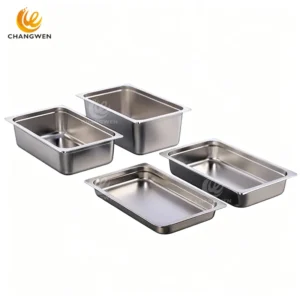
Rectangular chafers often suit modular hotel pans and straight buffet lines; round units can suit soups or a focal dish when their vessel and serving method fit the menu. Shape alone does not establish volume or compatibility. Obtain the exact food-pan drawing, rim dimensions, depth, water-pan relationship and lid clearance for every model. The hotel’s existing inserts should be tested in a sample unit before a bulk order.
A roll-top lid can keep the cover attached while guests serve themselves, reducing the need for a separate lid parking area. Its hinge or sliding path needs clearance behind and above the unit, and its handle must be reachable without forcing a guest over hot food. A lift-off lid may be simpler to remove for deep cleaning, but staff need a sanitary place to put it during service. A glass lid improves visibility but introduces a different cleaning and breakage consideration. Choose by service sequence, not appearance alone.
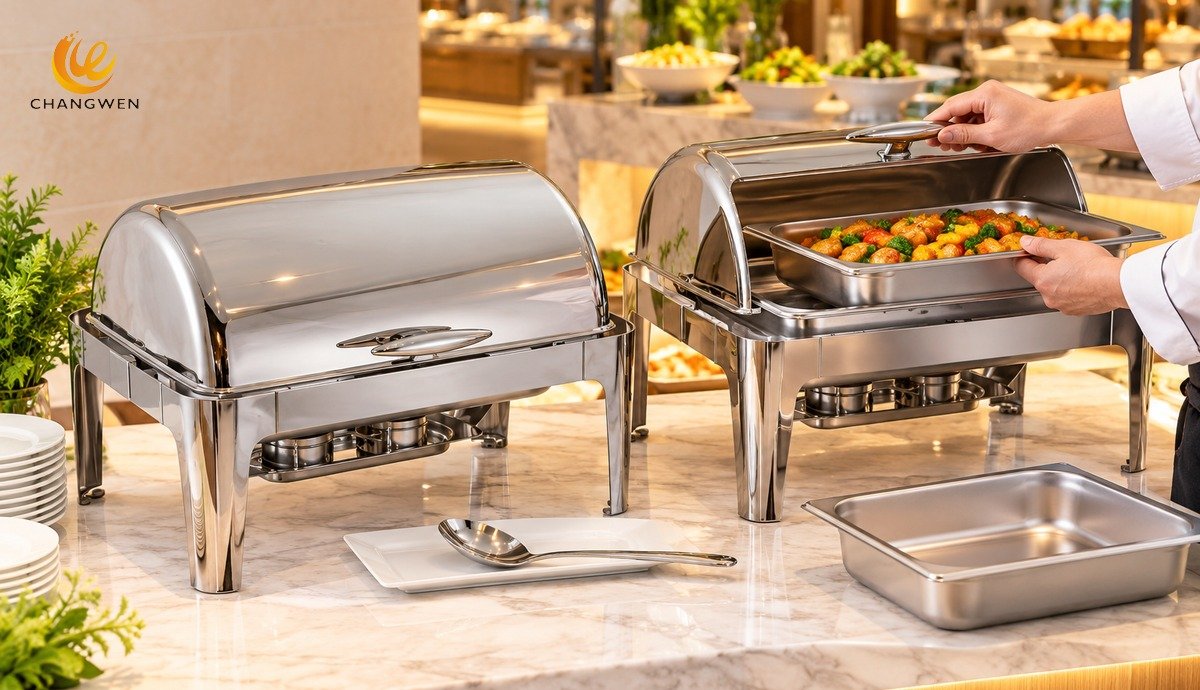
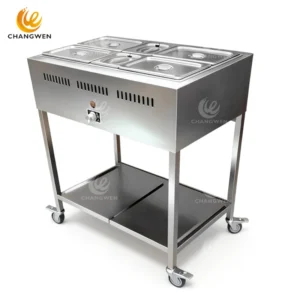
The supplied product image shows a rectangular polished roll-top unit with a raised frame and a lower tray area. It does not identify a precise model, steel grade, pan depth or fuel type. Buyers should request those details before using the image as the basis of a purchase order. Changwen’s buffet equipment range shows several chafer formats for comparison.
How should the heat source be specified?
Fuel, electric and induction arrangements impose different site requirements. Fuel may support a mobile event layout but requires approved fuel handling, ventilation and fire precautions. Electric heating avoids open fuel at the station but requires suitable outlets, cable routing and electrical capacity. Induction can provide a different control approach only when the vessel and base are compatible with the specified system. Do not assume that a stainless appearance proves induction compatibility.
Ask the supplier for the complete heating configuration, not just the chafer shell. The order should state whether burners, electric elements, controls, water pans, food pans and lids are included. Request a power rating and electrical documentation for powered models and confirm local installation requirements with the hotel’s facilities team. For fuel-fired setups, verify the hotel and local authority permit the chosen operating method in the intended location.
Compare heat performance under the hotel’s actual serving conditions. A sample check should record starting food temperature, pan fill level, ambient conditions, lid-opening frequency and food temperature at agreed intervals. The result tests the assembly and service method together; a thermostat display or flame alone does not prove that the food remains within the required holding range.
When is a dedicated food warmer better than a chafer?
A dedicated soup warmer can be preferable when a deep liquid dish is served by ladle. Its vessel shape and lid opening may reduce drips and make it easier to keep a ladle accessible. A shallow rectangular chafer may be excellent for plated hot food but awkward for soup, especially if guests must reach far into the pan. Selecting by food behavior reduces spills and helps maintain an orderly station.
The buyer should compare usable capacity, heat-control method, cleaning access and refill process. A large nominal vessel is not necessarily better if staff cannot lift it safely when full or if the last portion is difficult to serve. Ask for the removable insert’s dimensions and material, the lid’s opening angle, the placement of controls and the replacement-part list. Changwen’s catalog includes an electric soup warmer within the buffet category, but specifications for the chosen SKU must be confirmed separately.
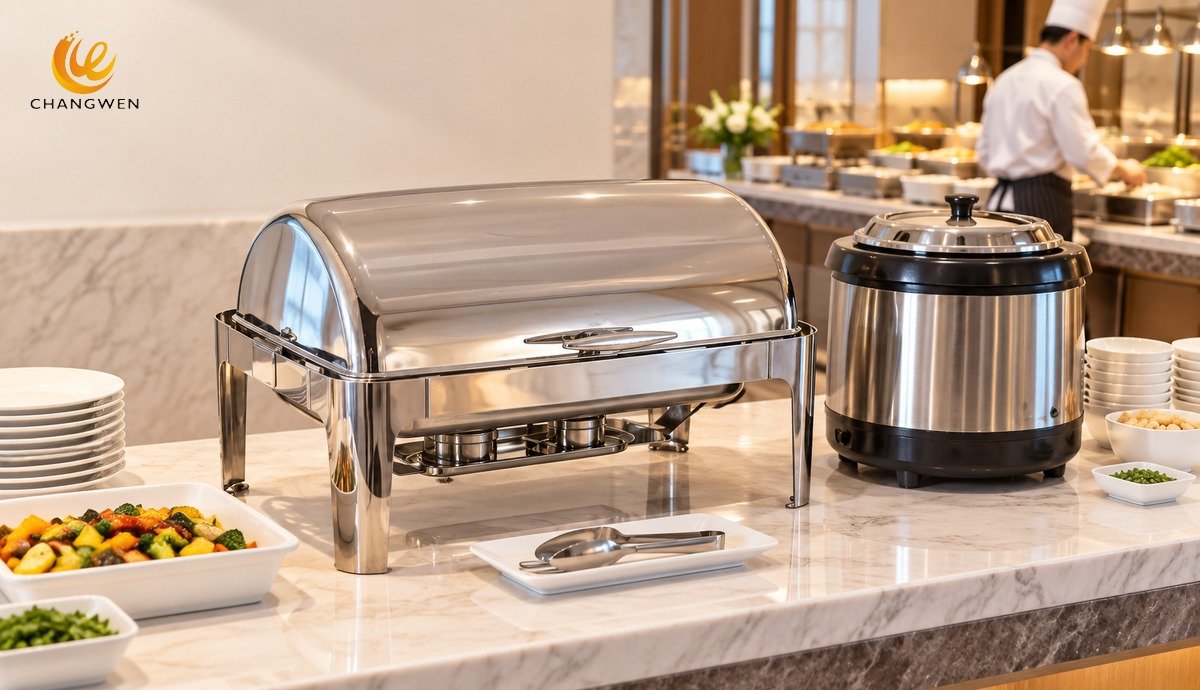
A food warmer also needs a clear handoff from the kitchen. Hot food should arrive under the hotel’s approved procedure, be placed into a clean vessel and be checked during service. If the station must hold a dish for a long interval, plan replacement frequency and quality checks; adding more heat is not a substitute for replenishment and temperature monitoring.
How should beverage dispensers be selected?
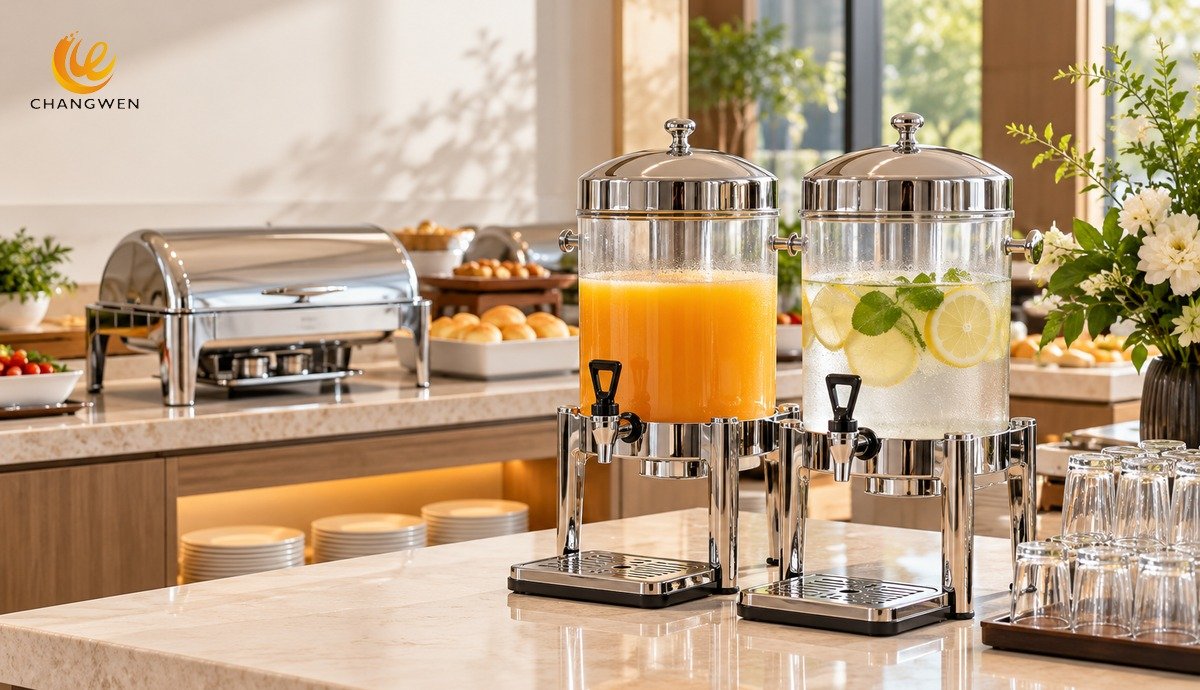
Start with the drink, not tank size. Water, shelf-stable drinks, fresh juice and dairy-containing beverages have different handling needs. A transparent dispenser with an ice core is not the same as an actively refrigerated unit. The purchase specification should say whether the drink itself is refrigerated, passively cooled, pre-chilled and replaced on a schedule, or served under another approved procedure. The hotel’s food-safety plan determines which approach is acceptable.
Choose capacity from peak draw and refill logistics. A larger tank may reduce refills but can increase carry weight, counter footprint and time spent with product in the dispenser. Two smaller tanks can offer beverage choice and let staff exchange a cleaned unit quickly; one large tank may simplify parts and cleaning. Compare the actual usable fill level, not only the volume printed in a catalog.
Inspect the tap as a guest-facing component. Cup clearance should accommodate the glasses the hotel actually uses; flow should be controllable without splashing; the drip tray should be removable and large enough for realistic guest use. A dispenser that looks elegant but drips onto the floor increases cleanup and slip risk. The unit should be stable during repeated one-handed dispensing.
Cleaning design matters as much as appearance. Staff should be able to remove the lid, tank, tap seals and drip tray according to the manufacturer’s instructions without inaccessible crevices. Ask whether replacement gaskets and taps are available and whether the container material is compatible with the beverages and cleaning chemicals the hotel uses. Changwen’s commercial juice dispenser guide expands on dispenser-specific options; this article focuses on how the beverage station works with the rest of the buffet.
How should buffet equipment be arranged on the hotel floor?
Guest flow and staff replenishment should not fight for the same narrow space. Position popular hot dishes so people can approach and move on without blocking the next station. Keep plates and utensils where guests need them, and reserve a staff-side path for exchanging food pans. A visually symmetrical line can fail operationally if one end becomes a queue while the other remains empty.
Separate beverage service from the busiest hot-food point when possible. Guests filling glasses need more dwell time and may spill, while staff carrying hot pans need a clear route. Check the counter depth for fully opened lids, the height for safe guest reach, and the floor’s suitability for carts and cleanup. A sample unit placed in the actual room can reveal conflicts that a catalog rendering hides.
Plan the buffet as a set of zones: plates, cold food, hot food, beverages and waste return, adapted to the hotel’s room. The sequence should reflect the menu and available circulation rather than a universal diagram. For hotels using GN inserts between prep and service, the GN pan sizes and depths guide explains why nominal rim size and depth must be verified as a fit system.
What construction and maintenance details should procurement compare?
Hotel equipment is handled, cleaned, moved and stored repeatedly. Buyers should inspect frame stability, lid alignment, weld or fastener finish, exposed edges, pan support and access to the heating components. A shiny surface is not a proxy for steel grade or durability. Request material identification and a documented finish specification for parts where those properties matter.
Consider daily cleaning time in the purchase decision. A unit with many decorative joints may take longer to wipe and disassemble than a simpler design. Ask which pieces can enter the hotel’s dishwasher, which require hand cleaning and how the lid mechanism is maintained. Cleaning instructions should be tested by the staff who will actually perform the work, not only by the buyer reviewing a showroom sample.
Spare parts can determine the service life of a buffet program. List the replaceable components for each model: food pans, lids, hinges or rollers, fuel trays, electric elements, taps, seals and drip trays as applicable. Ask for part codes and replenishment conditions. Standardizing a few compatible models can reduce training and spare inventory, but only after confirming genuine interchangeability.
How can a hotel compare supplier quotes fairly?
Send one equipment schedule to each supplier. State the quantity by model, pan size and depth, lid type, heating method, included accessories, material and finish, electrical market, packaging, required documents and destination. Ask suppliers to identify deviations line by line. A lower chafer price may exclude the food pan or heating element included in another quote.
Separate equipment cost from operating cost. Fuel consumption, electricity, cleaning labor, breakage, replacement taps and storage space affect the budget after purchase. Compare a common service scenario rather than assuming that the lowest unit price creates the lowest total cost. The comparison should be transparent enough that a different manager can reproduce the decision later.
For branded hotel groups or distributors, specify what must remain consistent across properties or orders: dimensions, logo application, finish, carton labels, spare-part codes and appearance standards. Private labeling is useful only when the same configuration can be repeated. Changwen states that it offers wholesale, customization and OEM/ODM support for commercial kitchen and buffet supplies; exact options, minimums and lead times require a project quotation.
What should be tested before approving a bulk order?
Build a sample trial around the hotel’s real service cycle. Assemble the chafer, fit the specified insert, open and close the lid repeatedly, transfer a filled pan with safe handling, clean the parts and store the unit. For warmers, check the actual vessel, temperature behavior and control access. For dispensers, fill with a permitted test liquid, dispense through the intended glasses, inspect leakage and disassemble for cleaning.
Record measurable pass criteria before testing. Examples include pan and lid fit, stable frame on the chosen counter, acceptable opening clearance, no tap leakage under agreed test conditions, complete accessory count and absence of sharp edges. Heating and cooling tests should use the applicable food-safety procedure and instruments, not an unverified marketing claim. A signed sample and written results form the reference for later inspection.
Inspect packaging and shipment readiness as part of approval. Polished surfaces can be scratched by poor protection; glass or clear components may break; small taps or fuel accessories can be omitted. Verify the carton contents, protective materials, handling labels and the condition of a trial-packed unit. The receiving checklist should mirror the approved bill of materials.
What is a practical first order for a hotel buffet?
A practical first order starts with the positions the menu definitely requires and the spare inserts needed for refill, then adds seasonal or event-specific equipment after a live trial. For a breakfast room, the buyer might specify a few modular hot positions, one dedicated soup or porridge warmer and a beverage station with two drink choices. The exact count cannot be inferred from hotel room count alone; it follows peak arrival, dish uptake, service interval and staffing.
Before expanding to multiple properties, pilot the system in one representative dining room. Observe where guests queue, how often staff replace pans, whether dispensers drip and how long the cleanup takes. Use those observations to revise equipment quantities and the purchase specification. A pilot measures the real operating bottleneck more reliably than a generic “one unit per number of guests” rule.
Frequently asked questions
Can a chafing dish replace a cooking or reheating appliance?
No. A chafing dish is selected for holding and serving prepared food under an approved operating procedure. Cooking and reheating need equipment and controls appropriate to those tasks. The hotel should verify the food’s temperature and follow the rules applicable to its location.
Is an ice-core juice dispenser equivalent to a refrigerated dispenser?
No. An ice core or ice chamber can provide passive cooling, while an actively refrigerated dispenser uses a powered cooling system. Neither label alone proves that a particular beverage will remain at a required temperature throughout service. Test the drink and refill schedule under actual conditions.
Should every hot dish use the same GN pan depth?
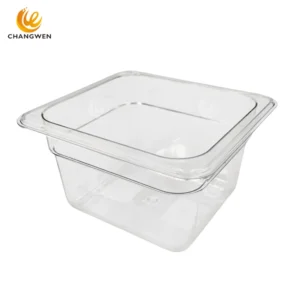
No. Pan depth changes capacity, food access, weight and lid clearance. The best depth depends on the dish and refill interval. A consistent rim footprint can still support different depths, but the hotel must test each combination with its chafer, support frame and lid.
Is a roll-top chafer always better for self-service?
No. A roll-top lid can be convenient because it stays attached, but it needs opening clearance and a mechanism that staff can clean and maintain. A lift-off or hinged design may suit another layout. Compare guest access, staff replenishment, maintenance and storage before standardizing.
How can Changwen help with a hotel buffet project?
Changwen supplies commercial kitchen and buffet products and describes wholesale, private-label, OEM and ODM services. A useful inquiry should include the hotel’s service model, menu, expected peak covers, existing GN pans, counter dimensions, permitted heat source, beverage types, target market and quantities. Add the preferred finish, logo and packaging if the purchase is for a hotel group or distributor. That brief lets the team discuss a coordinated equipment schedule rather than quoting isolated catalog items.
Review the buffet equipment catalog, then contact Changwen for a model-by-model quotation and sample plan. Ask for included components, drawings, cleaning instructions, spare parts and acceptance criteria. The goal is a buffet that guests can use comfortably and staff can replenish, clean and repeat across every service.