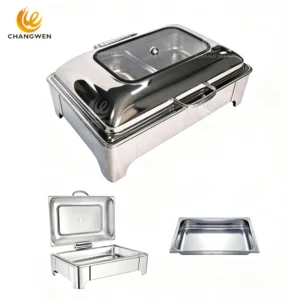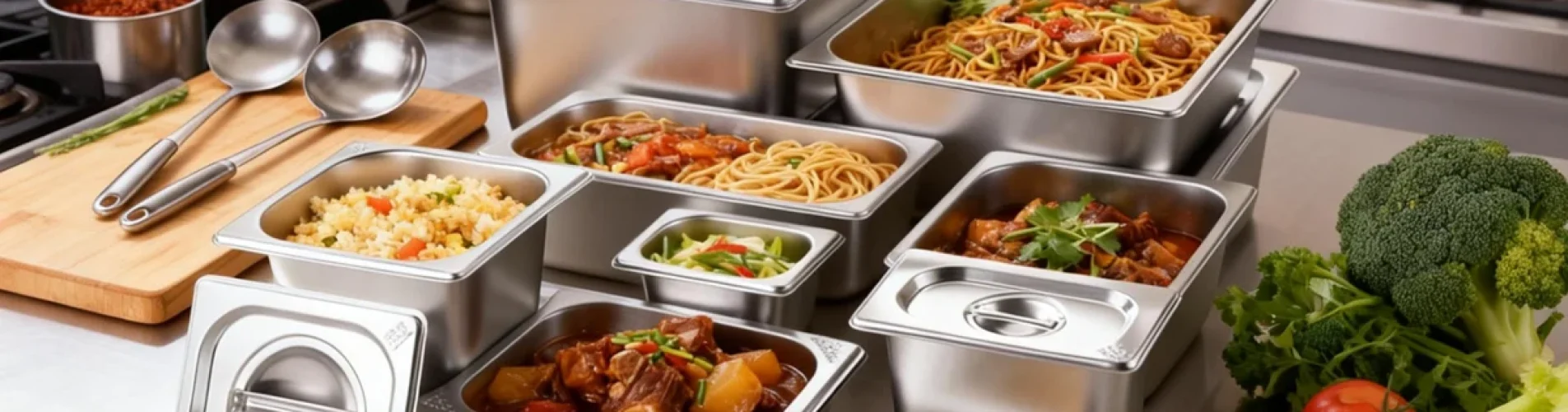
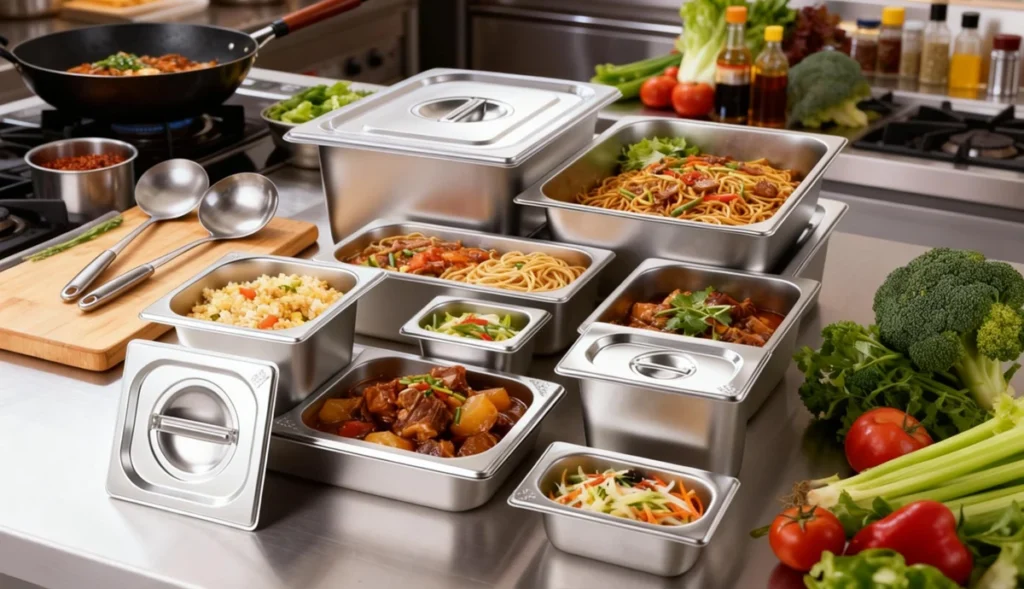
The Gastronorm Pan (GN Pan) is one of the most essential components in modern commercial kitchens. From restaurants, hotels, catering services, buffet lines, and central kitchens to bakeries and food processing facilities, GN pans have become a global standard for food preparation, storage, cooking, transport, and presentation.
This guide explains everything you need to know about GN pans—including sizes, materials, applications, and how to choose the right model—whether you are a chef, equipment buyer, distributor, or importer looking for OEM/wholesale solutions.
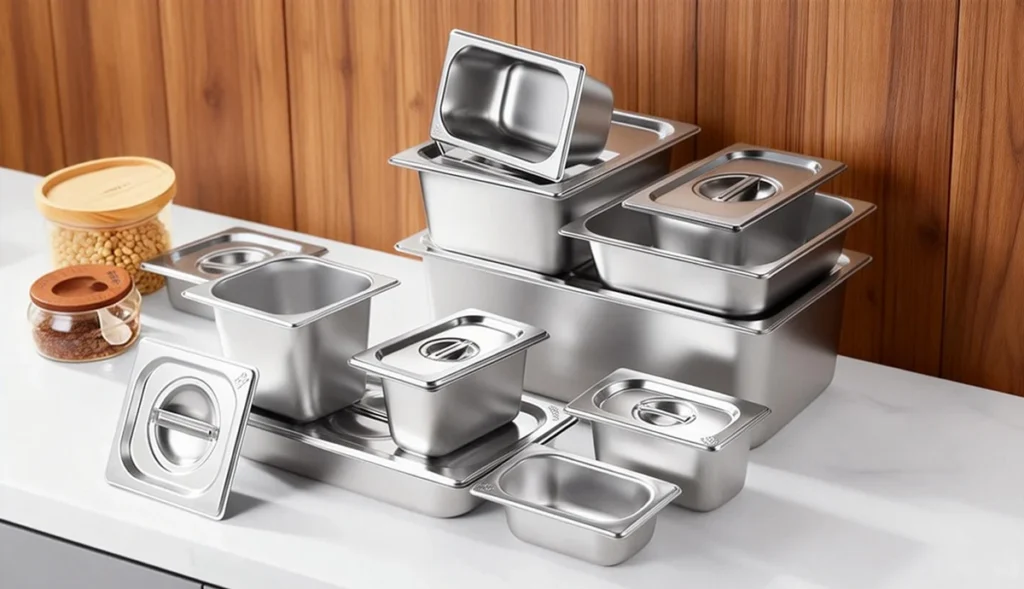
What Is a GN Pan?
A GN Pan (Gastronorm Pan) is a standardized food container used in professional kitchens.
The system is based on the European EN 631 standard, ensuring that pans, lids, racks, ovens, steamers, chillers, and buffet equipment are all fully compatible with each other.
The key idea of the GN system:
➡️ Modularity and compatibility across all brands and all kitchen equipment.
This makes GN pans the most practical, efficient, and universal solution for commercial food service.
Gastronorm Sizes
The GN system is based on the GN 1/1 (530 × 325 mm) size, with all other pans being fractions or multiples of it. The size of a 1/1 full-size GN pan is 530×325mm. A 1/2 size GN pan measures 325×265mm, which is half the size of a 1/1 pan, hence called a 1/2 pan. Similarly, the smallest 1/9 size food pan measures 176×108mm.
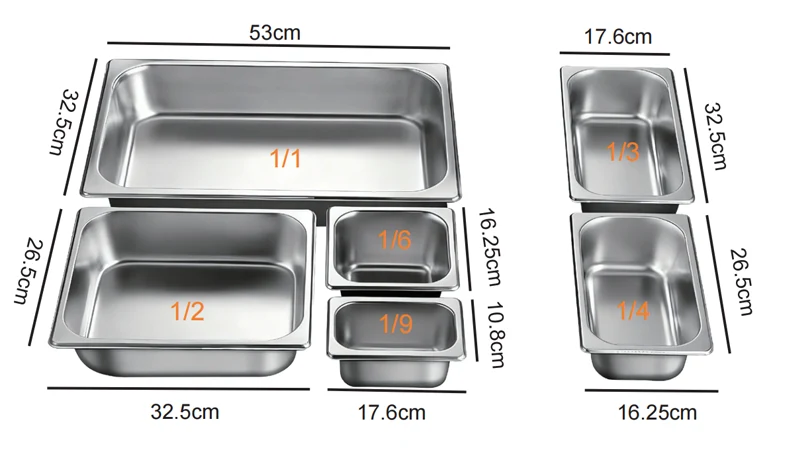
GN Pan Size Chart:
| GN Size | Description | Dimensions (mm) | Depth (cm) | Typical Use |
| GN 1/1 | Full GN | 530 × 325 | 2 / 4 / 6.5 / 10 / 15 / 20 (optional) | Main trays, steamers, ovens, buffet |
| GN 1/2 | Double GN | 325 × 265 | 2 / 4 / 6.5 / 10 / 15 / 20 (optional) | Prep, storage, display |
| GN 1/3 | One-third GN | 325 × 176 | 2 / 4 / 6.5 / 10 / 15 / 20 (optional) | Sauce, ingredients, salad bars |
| GN 1/4 | Quarter GN | 265 × 162 | 2 / 4 / 6.5 / 10 / 15 / 20 (optional) | Toppings, small batch foods |
| GN 1/6 | Sixth GN | 176 × 162 | 6.5 / 10 / 15 / 20 (optional) | Condiments, side dishes |
| GN 1/9 | Ninth GN | 108 × 176 | 6.5 / 10 / 15 / 20 (optional) | Small ingredients, sauces |
| GN 2/1 | Double GN | 650 × 530 | 6.5 / 10 / 15 / 20 (optional, less common) | Large ovens, roasting, catering |
| GN 2/3 | Two-third GN | 355 × 325 | 6.5 / 10 / 15 / 20 (optional, less common) | Medium portion cooking |
| GN 2/4 | Two-Quarter GN | 530 × 162 | 6.5 / 10 / 15 / 20 (optional, less common) | Narrow trays, specialized use |
To see the different sizes and capacities of the GN pan more clearly, you can also refer to the images below:
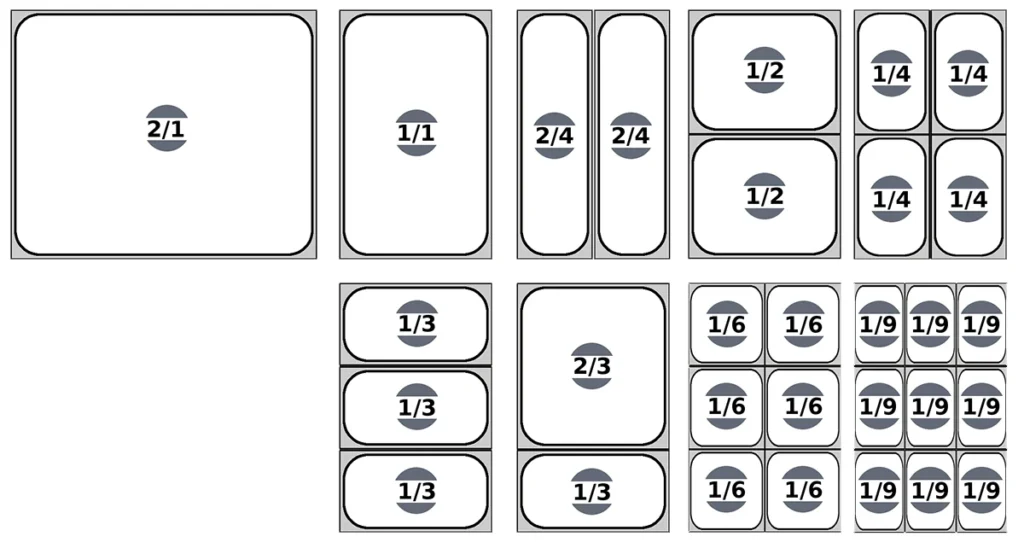
Depth Options:
20mm, 40mm, 10 mm, 20 mm, 40 mm, 65 mm, 100 mm, 150 mm, 200 mm (varies by manufacturer)
Different depths allow GN pans to be used for cooking, steaming, cold storage, transport, or buffet presentation.
Materials Used for GN Pans
Stainless Steel GN Pans
Most common in hot kitchens.
Advantages:
High durability
Excellent heat resistance
Suitable for ovens, steamers, bain-marie, chafing dishes
Easy to clean, hygienic
Long service life
Ideal for: cooking, steaming, roasting, buffet heating, commercial kitchens
Polycarbonate (PC) GN Pans
Clear, transparent plastic pans.
Advantages:
High visibility
Suitable for refrigerators and prep tables
Shatter-resistant
Lightweight
Not suitable for: ovens or high-temperature steamers
Polypropylene (PP) GN Pans
Economic plastic solution.
Advantages:
Cost-effective
Good for storage and transport
Lightweight, flexible
Suitable for: cold storage, dry ingredients
Compared to stainless steel food pans, plastic, acrylic, and melamine food pans have their own unique features. They can be transparent or come in various colors. Transparent food pans and lids make it easy to see the contents inside, while different colored pans allow for convenient food classification, helping you store different ingredients in separate areas.
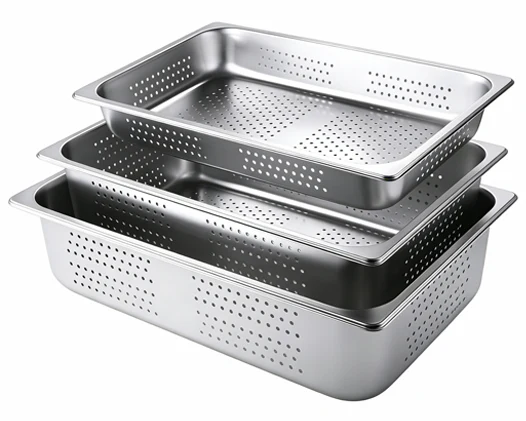
Perforated food pans allow drainage
Regular food pans are usually watertight and sealed. However, in some cases, we need to separate food from water or cooking oil, and that’s where perforated pans come in. The sides and bottom of a perforated pan are made with evenly distributed small holes using punching or laser techniques, allowing food to drain excess water or oil.
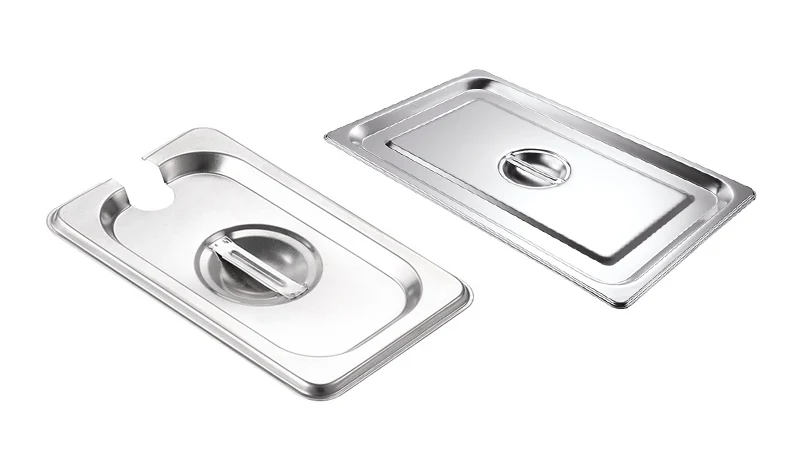
Open-top lids allow a spoon to stay inside the pan for easy use
Regular food pan lids are fully closed to provide a tighter seal. But if you want to keep a spoon inside the pan for easy access to the food, an open-top lid is more suitable. The small notch on the lid allows the spoon handle to stick out, making it more convenient and hygienic.
Key Applications of GN Pans
GN pans are used across the entire food workflow:
• Food Preparation
Prep tables, ingredient organization, pre-cooked food, dough, marination.
• Cooking & Heating
Compatible with ovens, steamers, combi ovens, bain-marie and chafing dishes.
• Cold Storage & Freezing
Used in refrigerators, display counters, and walk-in coolers.
• Food Display & Buffet
Buffet lines, hotel catering, salad bars, dessert stations.
• Food Transport
Used with insulated carriers, catering boxes, and hot-holding cabinets.
• Storage & Organization
Easily stackable, saves space, improves kitchen workflow.
How to Choose the Right GN Pan
Choose the size based on your equipment
Check compatibility with:
Oven / steamer / combi oven
Refrigerator or prep table
Buffet counter
Food warmers or chafing dishes
Choose the right depth
Use shallow pans for display or heating; deep pans for storage, stews, or bulk ingredients.
Select the material according to use
| Use Scenario | Best Material |
| Cooking / heating / steaming | Stainless Steel |
| Display & cold storage | Polycarbonate (PC) |
| Low-cost storage | Polypropylene (PP) |
Decide if you need accessories
Lids (solid, notched, perforated)
Perforated pans (for steaming, draining)
Dividers or combined sets
Consider durability, cleaning, and hygiene
Stainless steel remains the preferred choice for professional kitchens requiring long-term reliability.
OEM / ODM & Wholesale Solutions (For Distributors & Importers)
For buyers seeking factory-direct supply, GN pans are suitable for:
Importers
Restaurant equipment distributors
Catering suppliers
Supermarket chains
Kitchen equipment brands
OEM / Private label manufacturers
Custom Options Available:
Material selection (SS201 / SS304 / PC / PP)
Depth customization
Perforated or solid design
Custom logo engraving or printing
Packaging customization
Color-coded handles
Private label branding
With standardized GN dimensions, OEM production is highly efficient and stable in quality.
Care, Cleaning & Maintenance Tips
To extend the life of GN pans:
For Stainless Steel GN Pans
Avoid abrasive cleaning tools
Dry promptly after washing
Do not use harsh chemicals like bleach
Remove water stains with stainless steel cleaner
For PC/PP GN Pans
Follow recommended temperature range
Avoid microwaves or direct contact with heating elements
Do not use strong alkaline detergents
Proper maintenance ensures long-lasting performance and hygiene in professional kitchens.
Conclusion
GN Pans are the backbone of modern commercial kitchens due to their standardized sizing, modularity, and wide compatibility with global kitchen equipment. Whether used for cooking, refrigeration, display, or transport, GN pans provide unmatched efficiency, hygiene, and organization.
For distributors, importers, and brand owners, partnering with a reliable manufacturer that offers OEM/ODM customization and factory-direct pricing ensures consistent quality and competitive advantage.