Read time: 12 min
Introduction
Most people buy an ice bucket the same way they buy a dish rack — they grab whatever looks fine and costs a reasonable amount, then wonder six months later why the exterior is rusting, the ice melts in two hours, or the tongs went missing after the second party.
A stainless steel ice bucket is deceptively simple. But there are real differences between a double-wall vacuum-insulated 304 stainless unit that keeps ice solid for 8+ hours at a rooftop party versus a single-wall 201 stainless bucket that sweats through your tablecloth and loses half its ice before the first guest arrives.
This guide covers every decision point — steel grade, insulation type, sizing for your actual use case, must-have features, the stand vs no-stand question, and what commercial bars and event venues spec differently from home buyers. No brand-promotion, no filler — just the complete buying framework for anyone choosing a metal ice bucket for the first time or upgrading from something that never quite worked.
By the end, you will know exactly what to specify, why each feature matters, and where most buyers waste money choosing the wrong configuration for their actual needs.
Key Takeaways
- 18/8 (304) stainless steel is the commercial and consumer standard for any ice bucket that will see regular use. 201-grade steel looks identical but rusts at weld points and is not food-safe long term.
- Double-wall vacuum insulation is the single most important feature for ice retention. A good vacuum-insulated stainless steel ice bucket keeps ice frozen for 6–12 hours versus 1–3 hours for a single-wall unit.
- Lid + strainer combination matters more than most buyers realize. The strainer separates melt water from solid ice — your ice stays frozen longer because it is not sitting in its own melt water.
- For a large ice bucket for party use (outdoor events, weddings, large gatherings), the stainless steel ice bucket with stand format frees up table space and serves at standing height — essential for self-serve drink stations.
- Size selection depends entirely on your use case: 1–3L for cocktail bar and table use; 4–6L for chilling 1–2 bottles; 10–20L for large party self-serve; 20L+ (beverage tub format) for outdoor events and weddings.
- Tongs are not optional. An ice bucket with tong included means no bare-hand contact with ice — a food safety and hygiene standard for any commercial or event setting.
Types of Stainless Steel Ice Buckets
Understanding the different formats first prevents buying the wrong category entirely. A personal bar bucket and a large party beverage tub are both “stainless steel ice buckets” — but they serve completely different purposes.
Classic Bar Ice Bucket (1L–4L)
The traditional cylindrical or tapered form. Designed for table-top or bar-cart use. Holds ice for cocktail service, or chills a single bottle of wine or champagne at the table.
Typical features: Lid, tong, strainer, handle, double-wall insulation. Often sold as a complete set.
Best for: Home bar carts, cocktail parties, restaurant table service, hotel bar setups, gifting.
Capacity sweet spot: 3L — large enough to hold a full bottle plus ice and serve 6–8 cocktails without refilling; small enough to sit comfortably on a bar tray.
Champagne Bucket / Wine Chiller (4L–8L)
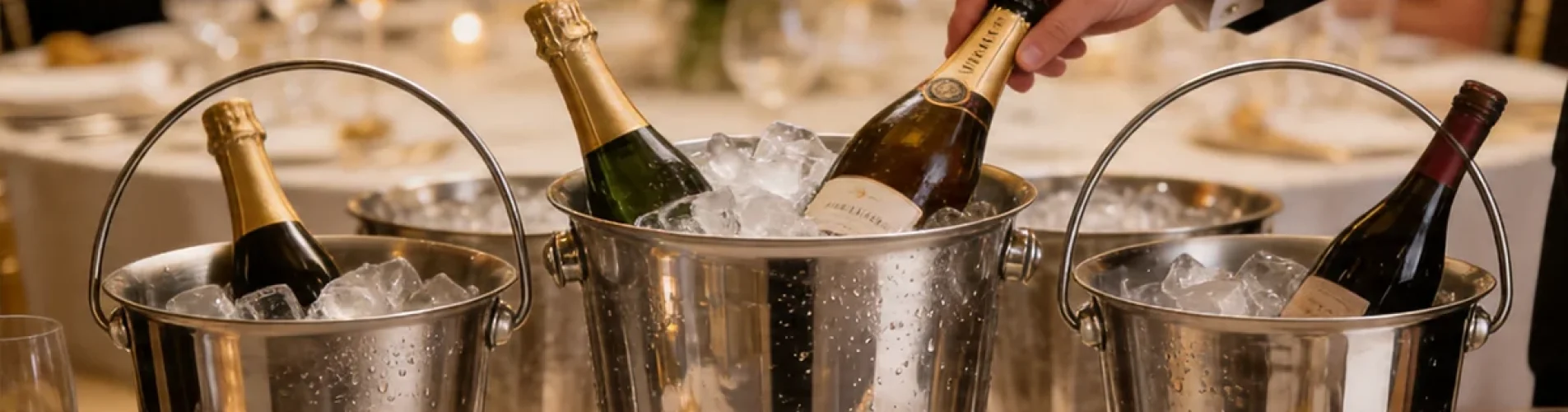
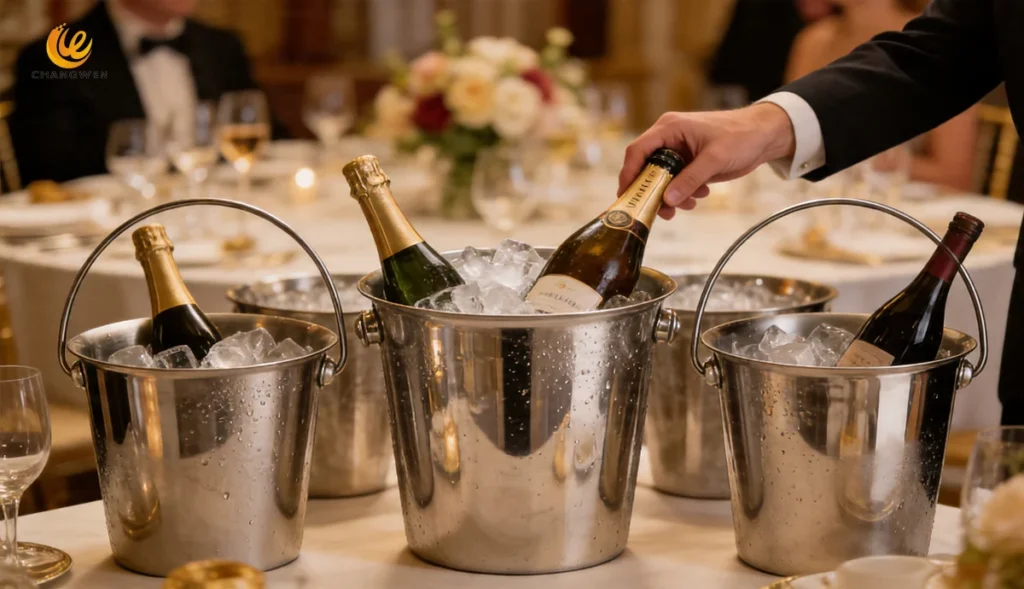
Taller and wider than a classic bar bucket. Designed specifically to hold a wine or champagne bottle upright, fully submerged in ice. The tapered profile that widens at the rim is the classic champagne bucket silhouette.
Typical features: Handles on both sides (for carrying with ice and a bottle), optional lid, no strainer (wine buckets are usually open-top). Often comes with a matching stand.
Best for: Restaurant wine service, bar and hospitality settings, formal dining, weddings and events, home dining room.
Key spec to verify: Internal diameter at base — must be at least 10–11cm to hold a standard 750ml bottle upright without tipping.
Large Party Ice Bucket (8L–20L)
A large-format bucket designed for self-serve drink service at gatherings. Holds multiple cans, small bottles, or a large volume of ice for scooping. Often comes with a lid and scoop rather than tongs.
Typical features: Lid (often with scoop slot), sturdy side handles, double-wall insulation optional, may include stand.
Best for: Backyard parties, pool parties, tailgating, holiday gatherings, small events where guests serve themselves.
Important: At this size, insulation makes a dramatic difference. A non-insulated 15L bucket full of ice at an outdoor summer party loses ice rapidly. A double-wall insulated unit keeps ice solid 3–4x longer.
Beverage Tub (12L–50L+)
Large metal drink buckets, often galvanized or stainless steel, typically oval or round. Can hold full-size wine and champagne bottles, multiple six-packs, or a very large volume of ice. Usually used with stands and often seen at weddings, outdoor events, and catering setups.
Typical features: Heavy-gauge construction, two rope or metal handles, optional lid, designed to pair with a floor-standing or tabletop stand.
Best for: Weddings, outdoor festivals, corporate events, catering, pool parties with 20+ guests.
Note: At this scale, the stainless steel ice bucket with stand format is almost always the right choice — a 20L tub of ice plus beverages can weigh 25–35 kg and should never be placed directly on a table.
Steel Grade Matters: 18/8 vs 18/10 vs 201
This is the specification most buyers never look at — and the one that most determines whether your bucket lasts two years or ten.
18/8 Stainless Steel (304 Grade) — The Standard
18/8 means 18% chromium and 8% nickel. This is the same grade used in professional kitchen equipment, commercial cookware, and food-grade containers globally. Also referred to as 304 stainless steel.
Why the numbers matter: Chromium forms the passive oxide layer that makes stainless steel self-repairing — scratch it and the surface re-seals. Nickel adds corrosion resistance, luster stability, and resistance to acidic environments (important when ice contacts citrus garnishes or acidic beverages).
Practical result: 18/8 / 304 grade stainless resists rust at all contact points — welds, rim edges, handle attachments — under regular use, regular cleaning, and outdoor exposure to humidity. It will not impart a metallic taste to ice or beverages.
18/10 Stainless Steel — The Premium Tier
18/10 means 18% chromium and 10% nickel. Marginally better corrosion resistance than 18/8. Used in premium cutlery and high-end barware. At the ice bucket application level, the performance difference versus 18/8 is minimal for most users. Where it matters is in hospitality settings with very aggressive cleaning chemicals or prolonged salt-ice exposure.
Practical result: Excellent. The premium specification for hotels, luxury bars, and high-end residential applications.
201 Stainless Steel — Know What You’re Buying
201 grade substitutes manganese for some of the nickel content in 304. The result: lower nickel (1–3%), lower chromium, significantly lower corrosion resistance — and a significantly lower price.
201 steel looks identical to 304 when new. The problem shows at 12–24 months of regular use: rust spots at weld joints, discoloration at rim edges, and surface pitting in humid environments or where the bucket has sat with standing water inside.
For a personal ice bucket used occasionally indoors and stored dry: 201 is functional. For a metal ice bucket used regularly at outdoor events, stored in humid environments, or used commercially: 201 is a false economy.
How to verify: Ask the supplier to specify the grade in writing. Request a material test certificate for wholesale purchases. The magnet test (201 is more magnetic than 304) provides a rough field check but is not definitive.
Practical Buying Rule
For any stainless steel ice bucket above $30 retail or any unit intended for commercial or frequent-party use: require 18/8 / 304 stainless steel minimum. The spec should appear in the product listing, not just on a sticker.
Single Wall vs Double Wall vs Vacuum Insulated
This is the feature with the largest performance gap of any specification on this list.
Single-Wall Stainless
One layer of stainless steel. No insulation. The exterior of the bucket reaches close to the temperature of the ice inside — it feels cold to the touch. Condensation forms on the outside, creating a wet ring on your table or bar cart.
Ice retention: 1–2.5 hours in a room-temperature environment. Approximately 45–75 minutes in outdoor summer conditions.
Best for: Budget applications, occasional indoor use in cool environments, commercial setups where ice is replenished continuously (hotel buffet ice service where a dedicated ice station is nearby).
Not suitable for: Outdoor parties, extended events, any situation where you cannot replenish ice frequently.
Double-Wall Stainless (Air Gap Insulation)
Two layers of stainless steel with an air gap between them. The outer wall does not conduct the cold of the inner wall directly. Dramatically reduces condensation on the exterior. Noticeably better ice retention than single-wall.
Ice retention: 3–6 hours in room-temperature conditions.
Best for: Most home bar and party use. A good double-wall insulated ice bucket handles a standard 3–5 hour party with ice to spare.
The condensation test: A quality double-wall bucket should stay dry on the exterior. If you see condensation forming on the outside of a claimed double-wall bucket, the air gap seal quality is poor.
Vacuum-Insulated (Double-Wall Vacuum)
The highest-performing insulation technology. The air between the two stainless walls is evacuated (removed), creating a near-vacuum. Vacuum is an extremely efficient insulator — the same technology used in high-performance water bottles and professional beverage containers.
Ice retention: 6–12 hours in room-temperature conditions. Some vacuum-insulated units retain ice for 12–18 hours in controlled conditions.
Exterior: Completely dry. No condensation whatsoever, even in hot outdoor conditions.
Best for: Outdoor summer events, full-day parties, any application where you need ice to last without intervention.
Price premium: A vacuum-insulated stainless steel ice bucket typically costs 25–50% more than an equivalent double-wall air-gap model. For serious entertaining, the premium is justified.
Quick Comparison
| Type | Ice Duration | Condensation | Best Application |
|---|---|---|---|
| Single wall | 1–2.5 hrs | Heavy | Budget/buffet use |
| Double wall (air gap) | 3–6 hrs | Minimal | Home bar, parties |
| Vacuum insulated | 6–12+ hrs | None | Outdoor events, premium use |
Size Guide: From 1L Personal to 12+ Gallon Party Tub
Matching capacity to your actual use case is the second most common buying mistake (after not checking steel grade).
Personal / Cocktail Bar: 1L–3L
The range for personal table-top use, cocktail bar service, and single-bottle chilling. A 3L stainless ice bucket holds:
- Enough ice for 6–8 cocktail servings
- One standard 750ml wine or champagne bottle with ice surrounding it
- 3–4 standard 12oz cans plus ice
Best capacity for most home bar situations: 3L. It is the most-sold size for a reason — genuinely versatile without being cumbersome.
Couple / Small Gathering: 4L–8L
The range for chilling 2+ bottles simultaneously or serving ice to a group of 4–8 people.
- 4L: Two bottles plus ice, or ice service for 6–8 people
- 6L–8L: Full-size champagne service for small events, or self-serve ice station for up to 10 guests
Large Gatherings: 8L–20L
The large ice bucket for party range. Self-serve format. At this size, a lid with scoop slot matters more than tongs. Stand compatibility becomes important.
- 10L: Party self-serve for 10–20 guests, holds 8–12 cans with ice
- 15L–20L: Large gatherings of 20–40 guests
The key insight: A 15L bucket filled with ice and drinks at the start of a 4-hour outdoor party loses approximately 40–60% of its ice by the end without insulation. The same 15L large insulated ice bucket for party use retains 60–80% of its ice over the same period. At this size, insulation is not optional.
Event / Commercial Scale: 20L–200L+
The beverage tub territory. A 7-gallon (26L) stainless tub with stand holds:
- 25+ canned beverages with ice
- 10–19 wine or champagne bottles
- Sufficient ice for a 50-guest outdoor event
At this scale, purchase units rated for the weight (20L of ice + beverages = 25+ kg) and confirm stand weight capacity.
Size Selection Quick Reference
| Capacity | Quart Equivalent | Use Case |
|---|---|---|
| 1L–2L | 1–2 qt | Personal/bar cart |
| 3L | 3.2 qt | Home bar, table service, gift |
| 4L–6L | 4–6.5 qt | 1–2 bottle chilling |
| 8L–12L | 8.5–12.5 qt | Small party, 8–15 guests |
| 15L–20L | 16–21 qt | Medium party, 15–30 guests |
| 25L+ (tub) | 26 qt+ | Large event, wedding, commercial |
Essential Features Checklist
When evaluating any stainless steel ice bucket, run through this list before purchasing.
Lid
A tight-fitting lid does three things: slows ice melt by blocking ambient heat, keeps dust and insects out of the ice in outdoor settings, and reduces spills when transporting a loaded bucket.
What good looks like: Silicone or rubber seal on the underside of the lid rim creates an airtight closure. The lid sits flat without rocking.
What to avoid: Lids that rest loosely on the rim without sealing, glass lids on any unit used outdoors (breakage risk), and lids that do not hook or lock to the bucket (they get separated and lost).
Strainer / Drain Plate
A removable perforated plate or drain screen sits inside the bucket above the base. As ice melts, water drains through the strainer to the bottom while solid ice remains elevated and dry above the water line.
Why this matters: Ice sitting in melt water melts significantly faster due to thermal conduction with the cold water. A strainer dramatically extends usable ice life. In a 3L bucket, a quality strainer can add 30–60 minutes of effective ice service.
What good looks like: Removable for cleaning, perforations large enough to drain freely but fine enough to catch small ice fragments.
Tong (Ice Tong / Ice Tongs)
An ice bucket with tong included is not just convenient — it is a hygiene standard. Bare-hand ice handling introduces bacteria and contaminants into the ice, affects food safety, and simply looks unprofessional at any hosted event.
What good looks like: Stainless steel construction (not chrome-plated zinc, which chips), spring-loaded mechanism, serrated or rounded grip tips (serrated grips ice better; rounded are gentler on ice cubes), long enough to reach the bottom of the bucket comfortably.
The hook feature: Many better units include tongs that hook onto the lid rim or bucket handle when not in use. This prevents the tongs from being set down somewhere and lost between uses.
Handles
Critical for any bucket over 4L. At 10L+, you need two handles.
Single handle (bail/swing handle): Sufficient for 1L–5L buckets. Should swing freely and lock upright for carrying.
Dual side handles: Required for 6L+ buckets. Should be firmly riveted or welded, not folded metal pressed through a slot. Test by applying the equivalent of a full-load downward force before trusting any new unit.
Material: Stainless, leather-wrapped stainless, or wood-grip handles all perform well. Avoid lacquered handles that can chip and flake into the ice.
Scoop
Included with larger format buckets (8L+) for ice scooping at self-serve stations. Should be stainless steel with a long enough handle to reach the bucket base without your hand entering the bucket.
Ice Bucket with Stand: When You Actually Need One
The stainless steel ice bucket with stand is often overlooked as an optional accessory. In many applications it is not optional — it is the correct configuration.
When a Stand Is Essential
Large outdoor events: A party ice bucket with stand raises the bucket to serving height (approximately 70–90cm from the floor), creating a self-serve drink station that guests can access comfortably without bending. This is standard setup for weddings, outdoor receptions, and large parties.
Table space conservation: At catered events, every inch of table surface is used. A floor-standing bucket with stand eliminates the table footprint entirely.
Beverage tub weight management: A 20L tub filled with ice and drinks weighs 25–35 kg. This should not be placed on a standard folding event table. A properly rated stand distributes the weight to the floor.
Professional appearance: The champagne bucket stainless steel with floor stand is the classic fine-dining and hospitality presentation. It communicates that service has been thought through.
Stand Specifications to Verify
Weight capacity: Must exceed the filled bucket weight. For a 15L bucket: minimum 20kg stand rating. For a 25L+ beverage tub: minimum 40kg stand rating.
Base stability: A wide tripod or four-leg base significantly outperforms a narrow single-post stand under real event conditions. Wine bottle removal from a stand-mounted bucket creates lateral forces — a narrow-base stand tips.
Height: Standard serving height is 70–90cm from the floor to the bucket rim. Confirm the stand positions the rim at a comfortable serving height for a standing adult.
Material: Wrought iron stands are durable but heavy for transport. Stainless steel stands match the bucket aesthetically and are lighter. Chromed iron stands are fine for indoor use but corrode in outdoor/humid conditions.
Portability: For caterers and event companies: confirm the stand folds flat or breaks into manageable sections for transport and storage.
Best Uses by Application
Home Bar
What to buy: 3L double-wall insulated ice bucket with lid, tong, and strainer. Mirror or brushed finish. Leather or stainless handle.
What matters most: Aesthetics matter here as much as performance. The bucket will be visible as a permanent fixture on your bar cart. Double-wall insulation is sufficient for a 3–4 hour hosting session. Vacuum insulation is a worthwhile upgrade if your home bar sees regular use.
Restaurant Table Service
What to buy: 5L–7L stainless steel champagne bucket with two handles and optional stand.
What matters most: 18/8 or 18/10 stainless, commercial-grade cleaning tolerance, uniform appearance across multiple units. NSF food contact compliance preferred for licensed food service.
Cocktail Bar (Commercial)
What to buy: 3L–5L bar buckets with tight-fitting lid, strainer, and hooked tong. Multiple units.
What matters most: Durability for daily use, stackability for storage, ease of cleaning in commercial dishwashers. Single-wall is acceptable if ice is replenished frequently from a central ice machine.
Backyard / Pool Party (20–40 Guests)
What to buy: 15L–20L large insulated ice bucket for party with lid, scoop, stand. Double-wall or vacuum insulated.
What matters most: Ice retention over 4–6 hours without restocking. Stand to free table space. Lid to prevent contamination and slow ice melt.
Wedding / Large Event (50+ Guests)
What to buy: 25L–50L large metal ice bucket beverage tub with stand, scoop, and heavy-gauge stainless construction.
What matters most: Weight capacity of stand, ease of transport (folding stand), fill capacity per unit. Multiple stations for events above 80 guests.
Hotel Minibar / In-Room Service
What to buy: 1.5L–2L single-wall or double-wall personal ice bucket with lid and tong.
What matters most: Compact size, attractive presentation, easy cleaning, consistent appearance across rooms.
What to Look for in a Metal Drink Bucket for Commercial Use
Commercial buyers — bars, restaurants, hotels, caterers, event companies — have different priorities from home buyers.
NSF Certification
For food service licensed premises, the ice bucket and its components should ideally be NSF-certified or NSF-compliant in material. NSF confirmation means food-safe materials throughout, including the strainer, lid seal, and tong.
Batch Consistency
When ordering 20 identical stainless steel champagne buckets for a restaurant’s table service program, every unit must match. Finish consistency (all mirror or all brushed), weld quality consistency, and dimensional accuracy all matter. Work with a manufacturer rather than a retailer for batch orders.
Commercial Cleaning Tolerance
Commercial kitchens clean equipment daily with industrial detergents and commercial dishwashers. Cheap stainless steel and inferior surface finishes degrade under this treatment. Require 18/8 grade minimum and confirm commercial-dishwasher safe rating.
Stack Efficiency for Storage
Events companies and caterers store large quantities of ice buckets. Confirm that units nest or stack efficiently. Even 20% reduction in per-unit storage footprint matters significantly when you are storing 50–100 units.
Weight-to-Capacity Ratio
Heavy commercial-gauge buckets hold up better but add transport weight. For caterers moving equipment between venues, the weight of 20 empty buckets matters. Balance gauge against practicality for your specific operation.
Care, Cleaning and Maintenance
A quality stainless steel ice bucket with proper care will last 10–20 years. Here is the practical maintenance protocol.
Daily / After Each Use
Empty all ice and melt water immediately after use. Ice left sitting in a bucket accelerates surface degradation in lower-grade units and can cause internal staining even in 304-grade steel over time.
Rinse with warm water. For vacuum-insulated units, do not submerge — water can enter the gap between walls if the seal is compromised.
Dry thoroughly before storage. Standing water is the enemy of all stainless steel surfaces, including 304 grade.
Regular Cleaning
Hand wash with mild dish soap and a soft cloth or sponge. Do not use steel wool, abrasive scrubbing pads, or harsh scouring compounds — they will scratch the surface and create microscopic grooves where bacteria can accumulate and staining can begin.
For the interior: a dilute white vinegar solution (1 part vinegar: 3 parts water) removes water spots and mineral deposits effectively without damaging the steel. Rinse thoroughly after.
Dishwasher Use
Many stainless steel ice buckets are labeled dishwasher-safe. The caveat: dishwasher detergents are aggressive, and the high temperatures and harsh chemicals shorten the life of surface finishes, lid seals, and handle components over time.
Recommendation: Hand wash for longevity. Reserve dishwasher cleaning for commercial settings where hand washing is not practical.
Restoring Mirror Polish
If a mirror-finish bucket has developed surface scratches, a stainless steel polishing compound (available at hardware stores) can restore most surface-level marks. Apply with a soft cloth in the direction of any existing grain.
Storage
Store with the lid off or loosely placed (not sealed) to allow air circulation and prevent moisture buildup inside. Store upright, not inverted — inverted storage traps any residual moisture at the base.
FAQ
What is the best size stainless steel ice bucket for home bar use?
For most home bars, a 3L (3.2 quart) stainless steel ice bucket is the right size. It holds enough ice for a 3–4 hour hosting session without constant refilling, fits comfortably on a bar cart or serving tray, and can chill a full wine or champagne bottle if needed. If your home bar sees heavy regular use or you frequently host groups above 8 people, consider a 5L–6L unit.
How long does a stainless steel ice bucket keep ice frozen?
Ice retention depends almost entirely on insulation type. A single-wall stainless ice bucket keeps ice for approximately 1–2.5 hours. A double-wall (air gap) insulated bucket extends this to 3–6 hours. A vacuum-insulated insulated ice bucket keeps ice frozen for 6–12+ hours. Other factors that affect ice retention: ambient temperature, whether the lid is on, how often the bucket is opened, and whether the ice is wet or dry at the time of filling.
What is the difference between a stainless steel ice bucket and a stainless steel champagne bucket?
Both are metal ice buckets made from stainless steel. The distinction is in form factor and primary use. A standard ice bucket is typically cylindrical or slightly tapered, with a focus on holding ice for serving. A stainless steel champagne bucket (also called wine chiller) is taller and wider to hold a bottle upright, typically without a lid, and often comes with side handles for tableside carrying and a matching stand. In practice, the two forms overlap — a good-quality champagne bucket also serves as a large ice bucket.
Do I need a stand for my ice bucket?
Not always — but for specific use cases, yes. If you are setting up a self-serve drink station at an outdoor party or event where multiple guests will access the bucket repeatedly, a party ice bucket with stand at serving height (70–90cm) is dramatically more functional than a bucket on a table or ground level. If the bucket will sit on a bar cart or table and be managed by a host or server, a stand is optional. For beverage tubs over 20L, a stand is recommended both for safety (weight management) and practical service.
What does “18/8” mean on a stainless steel ice bucket?
18/8 refers to the steel composition: 18% chromium and 8% nickel. This is the standard food-grade specification also called 304 stainless steel. The chromium content creates the self-repairing passive oxide layer that prevents rust, while the nickel provides luster and acid resistance. 18/8 / 304 is the commercial kitchen standard and is what you should look for in any ice bucket stainless product. Some products use 18/10 (10% nickel — marginally better) or lower-grade 201 (look-alike but significantly lower corrosion resistance). Always verify the grade before purchasing.
What accessories should come with a stainless steel ice bucket?
A complete ice cube steel bucket set should include: a tight-fitting lid (with silicone or rubber seal), a strainer/drain plate, stainless steel tongs (the ice bucket with tong combination), and ideally a scoop for larger buckets. Some premium sets also include a leather or stainless handle with locking mechanism. The accessories that matter most in practice: lid (insulation and hygiene), strainer (ice longevity), and tong (food hygiene). Any bucket sold without tongs for commercial or event use should have tongs sourced and dedicated to it.
Where can I find a metal ice bucket near me?
For a metal ice bucket near me, check kitchen supply stores, restaurant equipment suppliers, department stores with barware sections, and home goods retailers. For commercial quantities or wholesale pricing on large metal ice buckets for events or hospitality use, factory-direct sourcing from a manufacturer is significantly more cost-effective than retail. Our factory produces commercial-grade stainless steel ice buckets and beverage tubs in full customization — size, finish, logo, packaging — with wholesale pricing from 500 units.
Conclusion
Buying a stainless steel ice bucket is a five-minute decision that most people get partially wrong. They focus on the finish (mirror vs brushed), buy based on appearance, and discover the performance limitations the first time they need it to actually work — at a party, an event, a dinner table.
The framework that makes the decision straightforward:
Steel grade first. 18/8 (304) minimum for any bucket that will see regular use or commercial service. Non-negotiable.
Match insulation to duration. If your event runs 2 hours indoors, double-wall is fine. If it runs 5+ hours outdoors in summer, vacuum insulation is worth every penny of the price premium.
Size for the actual headcount. Use the size reference table in this guide. Too small means constant refilling. Too large means excess weight, storage problems, and ice you’ll throw away.
Lid + strainer + tong. All three. Every time. The strainer alone adds meaningful time to your usable ice life. The tong is a hygiene standard. The lid is insulation.
Stand if you need self-serve. For any event where guests will serve themselves, a stainless steel ice bucket with stand at serving height is the correct format.
We manufacture and supply commercial-grade stainless steel ice buckets — 1.5L to 50L, single and double-wall vacuum insulation, mirror and brushed finishes, with lid, tong, strainer, and stand options. Full OEM and private label available from 500 units. Factory-direct wholesale pricing for bars, restaurants, hotels, event companies, and distributors.