Read time: 12 min
Introduction
The word “commercial” on a piece of cookware is doing a lot of work.
It appears on products that genuinely deserve it — thick-walled 304 stainless saucepans with encapsulated bases, riveted handles, and NSF food safety certification that survive daily restaurant service for a decade. It also appears on products that do not — thin-walled pans with pressed-on handles and no material documentation, priced to clear a warehouse and replaced in 18 months.
Most buyers cannot tell the difference until the cookware is in service. And by then, the saucepan that felt like a bargain has become the reason a sauce scorched, a handle failed, or a health code inspection produced an unwelcome note about corroded food-contact surfaces.
This guide is about the difference. Specifically, what makes a commercial stainless steel saucepan genuinely commercial — in material specification, base construction, handle engineering, certification status, and manufacturing process. And it is about how Changwen, as a stainless steel saucepan manufacturer with 20+ years of commercial kitchen supply experience, builds these products to a standard that earns the word.
By the end of this article, you will be able to specify a commercial saucepan correctly, evaluate supplier claims with documented criteria, and understand the full picture of what a reliable commercial cookware program requires — from individual saucepans to complete commercial cookware sets.
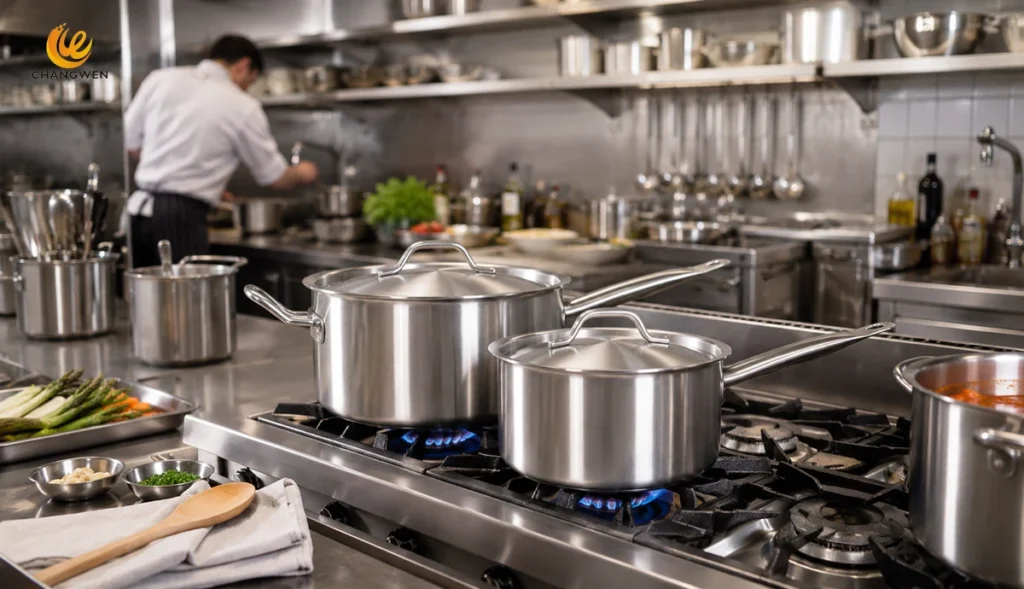
Commercial vs. Consumer Saucepans: The Gap Nobody Talks About Clearly
A consumer saucepan and a commercial saucepan occupy the same basic category — a pot with a single long handle, used for sauces, soups, heating liquids, and small-batch cooking. The physical form is nearly identical. The performance gap under real commercial kitchen conditions is enormous.
The Operating Environment Difference
A consumer saucepan is designed around home cooking patterns: moderate heat (most home stoves produce 7,000–12,000 BTU), infrequent use (perhaps 5–10 times per week), gentle cleaning (hand wash or dishwasher with standard detergents), and careful handling (stored carefully, not stacked without protection).
A commercial saucepan operates under entirely different conditions. Commercial range burners produce 25,000–35,000 BTU. A saucepan may be used 30–80 times per day across a full restaurant service. It is washed in a commercial dishwasher running at 82°C (180°F) with highly alkaline detergents, or scrubbed aggressively by kitchen staff. It is stacked, moved, and handled by multiple people under pressure.
Under home conditions, a consumer saucepan with 0.6mm walls, a stamped base, and welded handle attachment performs adequately for years. Under commercial conditions, that same pan shows base warping within weeks, handle loosening within months, and a compromised food-contact surface within a year.
Four Specifications That Define the Commercial Standard
Wall gauge: Consumer saucepans commonly use 0.5–0.8mm stainless steel walls. Commercial saucepans require a minimum of 1.0mm, with 1.2mm standard for high-frequency commercial use. The additional thickness resists thermal deformation and provides better heat retention through the pan walls during long simmer applications.
Base construction: A stamped flat base distributes heat only at the burner contact point, creating hot spots. An encapsulated base (aluminum disc bonded under the stainless steel base layer) spreads heat laterally before it reaches the food. Tri-ply full-clad extends this aluminum layer up the walls. For a saucepan producing 50 portions of hollandaise, béchamel, or pastry cream in a service, the difference between even heat distribution and hot spots is the difference between a consistent product and a scorched one.
Handle attachment: Consumer pans frequently use welded handles — a weld joint that connects the handle bracket to the pan wall. This is adequate for low-frequency home use. Commercial pans require riveted handles — stainless steel rivets that pass through the pan wall and are clinched on both sides, distributing load across multiple contact points. A riveted handle on a 3-quart saucepan full of boiling stock weighs approximately 3.5–4 kg — the handle attachment needs to be rated for this load through thousands of lift cycles.
Steel grade: The difference between 304 stainless (18% chromium, 8% nickel) and 201 stainless (lower nickel, lower chromium) is invisible in photographs and product listings but significant in corrosion resistance over commercial kitchen timescales. 304 maintains the passive chromium oxide layer that prevents rust under acidic food contact and commercial cleaning. 201 grade shows pitting and rust at weld points and handle attachments within 12–24 months of daily commercial use. Only a Mill Test Certificate confirming ≥18% chromium and ≥8% nickel verifies the grade with certainty.
Material Architecture: How 304 Stainless Steel Earns Its Place
304 stainless steel’s dominance in commercial kitchen cookware is not historical inertia. It is earned through specific material properties that no lower-cost alternative fully replicates.
Non-Reactivity Across the pH Range
A commercial saucepan is used for preparations spanning a wide pH range: acidic tomato-based sauces (pH 4.0–4.5), wine reductions (pH 3.0–3.5), hollandaise (mildly acidic), béchamel (near neutral), and everything in between. The passive chromium oxide layer on 304 stainless steel is chemically stable across this entire range — it neither imparts metallic flavors to acidic preparations nor degrades under alkali cleaning products.
Aluminum is reactive with highly acidic ingredients and leaches ions under extended contact. Bare cast iron imparts detectable iron flavor to acidic sauces. 304 stainless steel does neither, which is why it is the material of choice for sauce production in professional kitchens worldwide.
Temperature Stability and No Upper Limit
304 stainless steel has no functional upper temperature limit within the range of any commercial kitchen application. It performs safely and consistently from stovetop to oven at 260°C (500°F) to commercial salamander temperatures. It does not release harmful substances, does not change its food-contact properties, and does not deform under normal cooking conditions.
This temperature stability makes stainless steel pans the appropriate vessel for any preparation that transitions between cooking methods — a sauce started on the stovetop and finished in the oven, a saucepan carried from prep to service without temperature recovery time.
Corrosion Resistance Under Commercial Cleaning
Commercial kitchen cleaning is more aggressive than most consumers encounter. Alkaline commercial dishwasher detergents, sanitizing solutions, and the physical abrasion of commercial scrubbing would degrade most coated surfaces quickly. 304 stainless steel handles all of these without surface degradation — the passive oxide layer continuously regenerates when mechanically disrupted, maintaining the food-safe surface integrity throughout the pan’s service life.
The Heavy Bottom Problem: Why Base Construction Defines Performance
Heavy bottom pots and pans — saucepans, frying pans, stock pots — are a marketing category that can mean several different things, and only some of those things actually deliver the performance the term implies.
What “Heavy Bottom” Should Mean
A genuinely heavy bottom saucepan has a base with significantly more mass than the pan walls — achieved through either a thick encapsulated aluminum disc bonded to the stainless base, a full-clad (tri-ply or five-ply) construction where aluminum layers run through the base, or a combination of thicker-gauge base stainless and an aluminum insert.
The function of this additional mass is thermal: it stores heat and distributes it laterally, turning the concentrated heat source of a gas burner ring into a broadly even heat distribution across the base. The larger the base area and the higher the heat input, the more important this function becomes. For a large saucepan producing a custard or hollandaise on a 30,000 BTU commercial burner, even heat distribution is not a preference — it is the engineering requirement that prevents scorching and product failure.
What “Heavy Bottom” Sometimes Means Instead
In low-cost products, “heavy bottom” can describe simply a thicker-gauge stainless steel base without an aluminum layer — which increases thermal mass somewhat but does not provide the lateral heat spreading that an aluminum insert achieves. Stainless steel’s thermal conductivity (approximately 16 W/m·K) is too low to spread heat laterally across a wide base from a concentrated burner contact point. Only an aluminum insert (205 W/m·K thermal conductivity) provides genuine even heat distribution.
When evaluating any commercial saucepan labeled “heavy bottom,” ask specifically: is the base construction encapsulated aluminum (aluminum bonded between stainless layers), tri-ply full-clad, or simply thicker single-ply stainless? The first two are genuine heavy bottom constructions. The third is heavier but not a true heavy bottom in performance terms.
Base Thickness Specifications at Changwen
Our commercial saucepans use a minimum 2.0mm encapsulated aluminum base layer in the standard commercial configuration, with tri-ply full-clad construction available for applications requiring lateral heat distribution up the walls (custard production, temperature-sensitive sauce work). Base total thickness for the commercial series: 3.5mm minimum (1.0mm stainless + 2.0mm aluminum + 0.5mm stainless base layers).
NSF Commercial Cookware: What Certification Actually Requires
NSF commercial cookware certification is widely claimed and frequently misunderstood. Understanding what NSF/ANSI 2 actually requires — and how to verify it — is essential for any buyer distributing into US commercial food service channels.
What NSF/ANSI 2 Requires for Saucepans
NSF International’s Standard 2 (Food Equipment) requires that food-contact surfaces meet specific criteria:
- Material: 304 stainless steel or equivalent corrosion-resistant material (AISI 300 series minimum for metal food-contact surfaces)
- Surface smoothness: Food-contact surfaces must be smooth, non-porous, non-absorbent, and free of pits, crevices, or projections where food particles can lodge and bacteria can grow
- Weld quality: All welds in food zones must be smooth and accessible for cleaning — no rough weld beads, no weld voids, no recessed areas
- Accessibility for cleaning: All surfaces that contact food must be accessible for cleaning and inspection
- No exposed threads in food zones: Any threaded fasteners in food-contact areas must be sealed or otherwise protected
- Clearance from floor: For floor-standing equipment, minimum 6″ clearance is required — not directly applicable to saucepans but relevant for saucepan storage rack specifications
How to Verify NSF Certification
The only verification that matters is a listing number checked in the NSF online database at nsf.org. The search is free, takes two minutes, and confirms whether a specific manufacturer’s specific product model holds an active NSF/ANSI 2 listing.
A certificate image — even a high-quality, accurately formatted one — can be expired, for a different product model, or fabricated. The database listing cannot be falsified. Any commercial cookware buyer distributing into US food service channels should verify NSF listing numbers for every product line before building distribution commitments.
Changwen provides NSF/ANSI 2 listing documentation with listing number as standard with all commercial grade saucepan orders, verifiable through the NSF database.
The Full Commercial Cookware Set: Saucepans in Context
A commercial saucepan does not operate in isolation. It is part of a complete commercial cookware set that defines a kitchen’s production capability — and a cookware program built around consistent material specification, handle ergonomics, lid compatibility, and sizing logic is more valuable than a collection of individually specified pieces.
What a Complete Commercial Cookware Set Requires
Consistent material grade throughout: A kitchen where saucepans are 304 stainless and frying pans are 201 stainless introduces unpredictable corrosion timelines and inconsistent heat performance. A complete set from a single stainless steel cookware manufacturer with consistent 304 grade throughout eliminates this variability.
Standardized sizing and lid compatibility: Commercial kitchens benefit from lids that fit multiple pan sizes within the same line (a lid from a 2-quart saucepan fitting a 2.5-quart saucepan in the same series, for example). This reduces lost lid problems and allows more efficient storage. A manufacturer producing a coordinated set with intentional sizing logic provides this; a collection of individually sourced pieces typically does not.
Consistent handle specification: When multiple staff members use multiple pieces from the same set, consistent handle design reduces training complexity and ergonomic variation. All Changwen commercial series pieces use the same riveted handle system with consistent grip geometry across saucepans, frying pans, and auxiliary pots.
Complete sizing coverage: A commercial saucepan program should cover at minimum: 1.5 qt (sauce finishing, small preparations), 2 qt (standard sauce production), 3 qt (medium batch sauces and soups), 4 qt (large batch sauces, pastry cream, stock reductions). Stock pots and sauce pots complete the upper volume range.
Commercial Stainless Steel Frying Pan: The Saucepan’s Daily Partner
In commercial kitchen production, the saucepan and the commercial stainless steel frying pan are used together across almost every service — proteins seared in the frying pan, sauces finished in the saucepan, the two vessels transitioning between burners in continuous production. Sourcing both from the same manufacturer with the same material specification and ergonomic standard provides operational consistency that a mixed-source kitchen cannot achieve.
What Distinguishes a Commercial Stainless Steel Frying Pan
The commercial stainless steel frying pan shares the material specification of commercial saucepans (304 grade, 1.0mm minimum wall) but differs in geometry and base requirements:
Sloped sides vs. straight walls: A frying pan’s sloped sides allow tossing, sliding food out of the pan, and easy spatula access. The slope angle affects the functional cooking surface area relative to the nominal pan size. Commercial pans typically have a gentler slope (approximately 20°) than consumer non-stick pans (often 30–35°), providing more flat bottom surface for searing.
Base diameter relative to burner size: For a commercial frying pan to sear proteins evenly, the base diameter must be compatible with the burner ring it sits on. A 12-inch frying pan on a 10-inch burner ring has a hot center and cooler edges. A 10-inch frying pan on a 10-inch burner ring achieves even surface temperature.
Warp resistance under high searing heat: Commercial searing applications run the frying pan at near-maximum burner output for extended periods. A pan that warps under this heat moves on the burner, loses stable contact, and creates uneven cooking. Our commercial frying pan series uses 1.0mm walls with a 2.5mm encapsulated base — sufficient thermal mass to resist warping under sustained commercial searing temperatures.
How Changwen Manufactures Commercial Saucepans: 20+ Years of Production Detail
Changwen is a specialized commercial stainless steel saucepan manufacturer located in Jiangmen, Guangdong — China’s primary stainless steel commercial cookware manufacturing cluster. With more than 20 years of production experience supplying commercial-grade cookware to international markets, our manufacturing process is built around the specifications that commercial kitchens actually require.
Steel Sourcing and Verification
Every production batch begins with 304 stainless steel coil from verified domestic steel mills. We receive and verify a Mill Test Certificate for each coil, confirming chromium content ≥18% and nickel content ≥8% before the steel enters production. This is not an optional documentation step — it is the first quality gate in our process, and it is the document that allows us to guarantee 304 grade to every wholesale buyer.
We do not use 201-grade steel in any food-contact component of our commercial saucepan range. This is a product policy, not a cost consideration — and we document it with the MTC on every order.
Pressing and Forming
Saucepan bodies are deep-drawn from verified 304 stainless coil on hydraulic forming presses. Deep drawing is a precision process — the steel must be drawn to the correct depth and diameter without cracking, thinning at the walls, or creating stress concentrations that become failure points under repeated thermal cycling. Our forming tooling is maintained to dimensional tolerances of ±0.3mm on finished pan diameter and depth.
Encapsulated base discs (the aluminum layer sandwiched between the base stainless layers) are applied under controlled hydraulic pressure to ensure full bonding across the complete base area. A base with voids or partial bonding creates uneven heat spots — effectively the same problem as no encapsulated base in the affected areas.
Handle Fabrication and Attachment
Handles are formed from 304 stainless steel rod using CNC bending to a fixed geometry that is consistent across every unit in a production run. The handle bracket is positioned and welded to the pan body, then stainless steel rivets are installed through the bracket and pan wall. Rivets are clinched to a specified torque that provides firm attachment without deforming the pan wall.
Each finished handle attachment is subject to a load test: the pan is filled with water to capacity, then lifted by the handle only and held for 30 seconds. Zero flex in the handle attachment, zero movement at the rivet points, is the pass criterion. Any unit that fails this test is pulled from the production batch before packaging.
Surface Finishing
Pan exteriors are finished to No. 4 brushed standard (Ra 0.8–1.6 μm) as the commercial default — consistent, professional appearance, easy to clean, resistant to showing fingerprints and light abrasion. Mirror polish exterior is available as an alternative specification for hotel and fine dining supply programs where presentation standard is a commercial priority.
Pan interior food-contact surfaces are polished to Ra 0.4–0.8 μm — smooth enough for easy cleaning and food release, with enough surface texture to avoid the optical distortion of a full mirror interior.
Quality Inspection
Every finished commercial saucepan passes through a seven-point inspection before packaging: wall gauge measurement, base flatness check, handle load test, weld integrity inspection, surface finish verification, dimensional check against specification, and weight verification. Units that fail any check are removed from the batch — not downgraded or reworked for a lower tier, removed.
OEM and ODM Programs for Commercial Cookware Brands
Changwen provides full OEM and ODM manufacturing services for cookware brands, restaurant equipment distributors, hotel supply programs, and private-label retail programs.
What OEM Service Includes
Under an OEM (Original Equipment Manufacturing) arrangement, the buyer owns the product specification. We manufacture to your brief: material grade, wall gauge, base construction, handle design, sizing, surface finish, and certification requirements. Tooling for custom handle shapes or non-standard sizes is developed at the buyer’s cost and remains the buyer’s intellectual property. All OEM tooling is stored at our facility on behalf of the buyer with documented ownership.
OEM minimum order: 1000 units per SKU for standard configuration with custom branding. Custom tooling programs: 10000 units minimum.
What ODM Service Includes
Under an ODM (Original Design Manufacturing) arrangement, the buyer selects from our existing catalog designs and applies their brand identity — logo engraving, custom packaging, set composition. No tooling investment required. Full catalog with specifications available on request.
ODM minimum order: 1000 units per SKU. Sample lead time: 7–10 days. Production lead time: 35–45 days from deposit.
Standard Documentation With Every Order
- Mill Test Certificate confirming 304 stainless steel grade
- NSF/ANSI 2 compliance documentation with listing number
- ISO 9001 quality management system certificate
- FDA food contact compliance letter
- LFGB test report (for European market programs)
- Pre-shipment inspection report (commissioned on orders of 100+ units)
Sourcing and Wholesale Buying Guide
How to Evaluate a Commercial Stainless Steel Saucepan Manufacturer
For wholesale buyers evaluating commercial cookware manufacturers, these criteria separate verified commercial-grade producers from suppliers who claim the specification without delivering it:
Mill Test Certificate availability: Request the MTC for the steel grade before placing any order. A manufacturer using documented 304 stainless steel has this document from their steel supplier. A delay in producing it or a refusal to provide it indicates either non-304 material or a trading company without direct factory access.
NSF listing verification: Request the NSF listing number and verify it at nsf.org. Active listing, correct product type, correct manufacturer name. This three-minute check eliminates fabricated or expired certifications.
Live factory verification: Request an unscripted live video call during production hours showing the forming presses, welding stations, surface finishing lines, and QC inspection area. Trading companies — which add 15–30% to pricing without adding quality control — cannot show production equipment they do not own.
Physical sample evaluation: Before any bulk commitment, evaluate physical samples with: magnet test on the pan body (304 is non-magnetic — any magnetic attraction to the food-contact surface indicates non-304 grade), calipers measurement of wall gauge at three points, handle load test with full simulated load, base flatness check with a precision straightedge.
Pre-shipment inspection: Commission a third-party inspection (SGS, Bureau Veritas, Intertek, or QIMA) for any order above $20,000. Cost: $280–500 for a standard inspection day. This is the final quality gate before goods leave the factory.
Wholesale MOQ Reference
| Program Type | Minimum Order |
|---|---|
| ODM with branding (logo + packaging) | 1000 units per SKU |
| Full commercial cookware set ODM | 1000 sets |
| OEM with custom dimensions | 10000 units |
| OEM with new tooling (handle, profile) | 10000 units + tooling |
FAQ
What is the minimum wall gauge for a commercial stainless steel saucepan?
A commercial stainless steel saucepan requires a minimum wall gauge of 1.0mm in 304 stainless steel for standard restaurant use. For high-frequency institutional use (hotel kitchens, catering commissaries, hospital food service), 1.2mm is the recommended specification. Consumer-grade saucepans typically use 0.5–0.8mm walls — adequate for home use but prone to thermal deformation and structural failure under commercial kitchen conditions. Always request the wall gauge specification in writing and verify it with calipers on physical samples before placing bulk orders.
What does “heavy bottom” mean in commercial saucepans, and does it actually matter?
In a genuine heavy bottom pot or saucepan, the base contains an aluminum layer bonded between stainless steel layers (encapsulated base) or running through the full height of the pan (tri-ply or five-ply). Aluminum conducts heat approximately 13 times faster than stainless steel, so the aluminum layer spreads heat laterally from the burner contact point before it reaches the food — eliminating hot spots and preventing scorching. This matters significantly for sauce production, where concentrated heat at the base of a pan running thick preparations is the primary cause of product failure. A pan labeled “heavy bottom” without an aluminum layer is heavier but does not provide this heat distribution function.
How do I verify NSF certification for commercial cookware before placing a wholesale order?
Request the NSF listing number from the manufacturer (not a certificate image — the number itself). Go to nsf.org and search the certification database using the listing number. Confirm the listing is currently active, covers the product type you are purchasing (not just the company in general), and matches the manufacturer’s name. NSF conducts ongoing unannounced factory audits as a condition of maintaining certification — an active listing represents current compliance, not just a historical approval. This verification takes under three minutes and is the only reliable way to confirm active NSF certification.
What is the difference between OEM and ODM commercial cookware manufacturing?
OEM (Original Equipment Manufacturing) means the buyer owns the product design and specification — the manufacturer builds to the buyer’s requirements. Custom tooling paid by the buyer belongs to the buyer. No other customer can order the identical product. ODM (Original Design Manufacturing) means the buyer selects from the manufacturer’s existing catalog and applies their brand. The manufacturer owns the design and tooling. ODM reaches market faster and requires no tooling investment; OEM provides product exclusivity and design ownership. Changwen provides both models. For buyers entering the market, ODM with custom branding is typically the right starting point; OEM is appropriate once sales volume justifies tooling investment.
Why should commercial cookware be sourced from a factory rather than a trading company?
A factory manufactures the product and can verify material grade (via Mill Test Certificate), control production quality, accept third-party inspection, and provide accurate technical specifications. A trading company resells from one or more factories, adds 15–30% margin, and has no ability to control or verify the production it sells. When quality issues arise, a trading company cannot inspect production or require rework — they can only communicate with the factory after the fact. Working directly with a verified manufacturer eliminates the trading company margin and provides the production access that enables quality verification.
Conclusion
The word “commercial” on a saucepan should mean something specific. It should mean 304 stainless steel confirmed by Mill Test Certificate. It should mean 1.0mm minimum walls and a genuine encapsulated aluminum base. It should mean riveted handles rated for full commercial load. It should mean NSF food equipment certification with a verifiable listing number.
It does not always mean these things. The difference is visible only when the cookware is in service — and by then, the cost of discovering the gap is already built into the operational budget.
Changwen has spent 20+ years building commercial grade stainless steel cookware to the specification that commercial kitchens actually require — not the specification that passes visual inspection and fails service inspection. Our saucepans, commercial stainless steel frying pans, and complete commercial cookware sets are documented to the material, construction, and certification standards that wholesale buyers, equipment distributors, and commercial kitchen operators need to run a compliant, efficient operation.
The documentation — the MTC, the NSF listing, the pre-shipment inspection report — is not a sales tool. It is the evidence of a manufacturing process that earns the word commercial.
If you are sourcing best stainless steel cookware for commercial distribution or professional kitchen supply, we would be glad to provide product specifications, Mill Test Certificates, and sample units for your evaluation.