A commercial griddle is one of the most versatile cooking surfaces in professional kitchens. From burgers and pancakes to vegetables and seafood, a flat top griddle allows chefs to cook large volumes of food quickly and consistently. Whether you run a busy restaurant, operate a food truck, or manage a hotel kitchen, choosing the right griddle can significantly impact your cooking efficiency and food quality. This guide covers everything you need to know about commercial griddles—from material selection and heat sources to cleaning methods and manufacturer selection. If you’re considering a stainless steel griddle for your operation or exploring OEM solutions for your brand, this comprehensive resource will help you make an informed decision.
Key Takeaways:
Material matters: Stainless steel griddles outperform cast iron in commercial settings due to easier cleaning, rust resistance, and lower maintenance
Size selection: Choose from compact 12″ stove top models to large 36″ commercial units based on your volume needs
Heat source: Gas griddles offer faster heat control; electric models work where gas isn’t available
Cleaning is simple: Daily scraping while warm and weekly deep cleaning keeps stainless steel griddles performing optimally
OEM available: Wholesale and private label options help dealers and brands build their product lines
What Is a Griddle?
A griddle is a flat, smooth cooking surface used to prepare food at consistent temperatures across a large area. Unlike a grill with raised ridges or a frying pan with high sides, a griddle features a completely flat top that allows for easy flipping, sliding, and moving of ingredients.
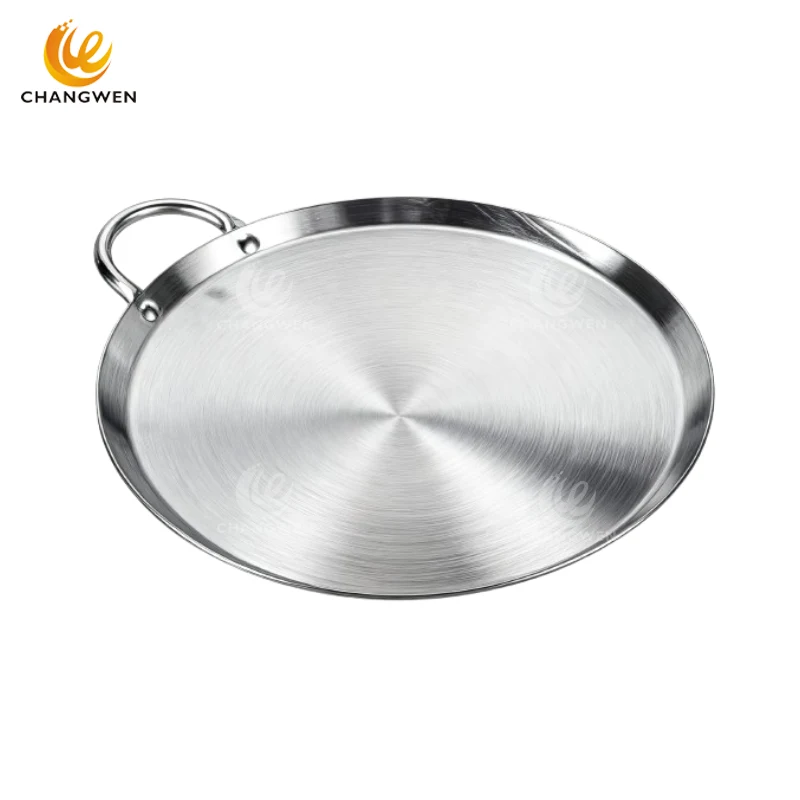
Key differences:
Griddle vs Grill: A grill has grooved surfaces that create char marks, while a griddle has a smooth, flat surface ideal for delicate items like eggs and pancakes
Griddle vs Frying Pan: A frying pan has raised edges and smaller cooking area, limiting batch cooking capacity
The flat top griddle design offers several advantages: even heat distribution, larger cooking capacity, easier cleanup, and the ability to cook multiple food types simultaneously without flavor transfer.
In commercial settings, griddles are essential for high-volume cooking where speed and consistency matter most.
Types of Commercial Griddles
By Heat Source
Gas Griddle
A gas griddle connects directly to natural gas or propane lines, offering instant heat control and lower operating costs in areas with affordable gas rates. Gas models heat up quickly and allow chefs to adjust temperatures rapidly during service.
Ideal for: Restaurants with existing gas infrastructure, food trucks with propane systems, operations requiring precise flame control.
Electric Griddle
An electric griddle plugs into standard electrical outlets and provides consistent, even heating without open flames. Stainless steel griddle electric models are popular in settings where gas isn’t available or ventilation is limited.
Ideal for: Hotel breakfast buffets, office cafeterias, catering operations, locations without gas access.
By Material
Stainless Steel Griddle
Stainless steel griddles are the industry standard for commercial kitchens due to their durability, hygiene, and professional appearance. A stainless steel griddle pan or full-size flat top resists corrosion and maintains food safety standards.
Cast Iron Griddle
Cast iron retains heat exceptionally well but requires seasoning and more maintenance. When comparing stainless steel griddle vs cast iron, stainless steel wins for commercial applications due to ease of cleaning and regulatory compliance.
Why Stainless Steel Griddles Are Preferred in Commercial Kitchens
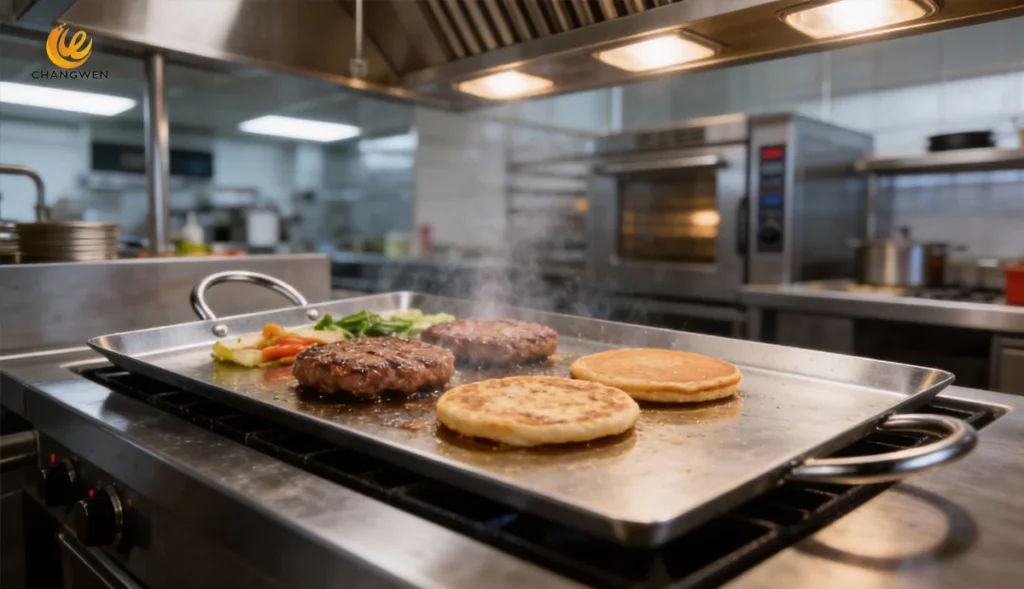
A stainless steel griddle is widely used in restaurants and food trucks due to its durability, hygiene, and ease of maintenance. Here’s why professional kitchens choose stainless steel:
Even Heat Distribution: High-grade stainless steel plates, especially when paired with proper burner design, distribute heat uniformly across the entire cooking surface, eliminating hot spots that can burn food.
Easy Cleaning: Stainless steel griddle cleaning is straightforward—simply scrape off food debris while hot, then wipe with a damp cloth or specialized griddle cleaner. No seasoning required.
Rust Resistance: Unlike cast iron, stainless steel naturally resists corrosion, even in humid kitchen environments or coastal areas.
Food Safety: Non-porous stainless steel surfaces don’t harbor bacteria and meet health department standards in most jurisdictions.
Long Service Life: A quality stainless steel griddle can last 10-15 years with proper care, making it a sound investment for commercial operations.
Professional Appearance: The polished finish of a stainless steel griddle grill maintains its attractive look over time, important for open kitchens and food trucks where customers can see cooking surfaces.
Key Features to Look for When Buying a Commercial Griddle
When selecting a commercial flat top griddle, pay attention to these critical specifications:
Plate Thickness: Commercial-grade griddles typically feature 3/4″ to 1″ thick cooking plates. Thicker plates retain heat better and recover temperature faster when cold food is added.
Heat Distribution: Look for models with multiple burners or heating elements positioned to eliminate cold zones. Even heating is essential for consistent cooking results.
Surface Finish: A smooth, polished surface prevents food from sticking and simplifies cleaning. Mirror-polished stainless steel griddles offer the best performance.
Grease Management: Integrated grease troughs and removable drip trays make cleanup faster and reduce fire hazards.
Temperature Controls: Individual zone controls allow you to cook different foods at different temperatures simultaneously—eggs at 300°F while searing steaks at 450°F.
Size Options: Griddles range from compact 12″ stainless steel griddle for stove top models to commercial stainless steel griddle 36″ units for high-volume operations.
Compatibility: Ensure your chosen griddle matches your kitchen’s power supply (gas pressure, electrical voltage, and amperage).
Safety Features: Flame failure devices for gas models, automatic shut-off for electric units, and cool-touch handles improve workplace safety.
Applications of Commercial Griddles
Commercial griddles serve virtually every segment of the foodservice industry:
Restaurants: From diners cooking breakfast all day to steakhouses searing proteins, a flat top griddle handles diverse menu items. Cook burgers, eggs, bacon, grilled cheese, quesadillas, and stir-fried vegetables on the same surface.
Hotels: Breakfast buffets rely on large griddles to prepare pancakes, French toast, eggs, and breakfast meats for dozens of guests simultaneously.
Fast Food Chains: Speed and consistency are critical. Griddles allow cooks to prepare multiple burgers, chicken breasts, or breakfast sandwiches at once with uniform results.
Food Trucks: Mobile operations need reliable equipment in tight spaces. A compact stainless steel griddle for stove top or a dedicated flat top maximizes limited cooking area while serving high volumes.
Central Kitchens: Large commissaries preparing meals for multiple locations use oversized griddles to batch-cook proteins, vegetables, and other components.
Real cooking scenarios:
- Morning rush: 50+ eggs, 30 pancakes, 20 orders of bacon
- Lunch service: Burgers, tortillas, grilled vegetables, pressed sandwiches
- Dinner prep: Searing steaks, cooking shrimp, caramelizing onions
- Specialty items: Hibachi-style fried rice, smash burgers, breakfast burritos
The versatility of a commercial griddle makes it one of the highest-ROI pieces of kitchen equipment.
Commercial Griddle vs Frying Pan
Understanding the differences helps you optimize your kitchen setup:
Cooking Capacity: A 36″ commercial griddle offers approximately 900 square inches of cooking space—equivalent to 10-12 standard frying pans. This allows one cook to manage multiple orders simultaneously.
Heat Control: Griddles maintain consistent temperatures across zones, while frying pans can develop hot spots. A stainless steel griddle grill provides superior temperature stability for batch cooking.
Efficiency: Griddles reduce cooking time by allowing parallel preparation. Cook 20 burgers in the same time it takes to cook 2 in a pan.
Labor Savings: One griddle operator can match the output of multiple cooks using frying pans, reducing labor costs during peak hours.
Versatility: While frying pans excel at sauces and liquid-based dishes, griddles handle everything from delicate fish to thick steaks with ease.
Cleanup: One large flat surface is faster to clean than multiple pans, especially with proper stainless steel griddle cleaning techniques.
For commercial operations focused on speed and volume, griddles are the clear choice over traditional frying pans.
Stainless Steel Griddle Cleaning: Best Practices
Proper maintenance extends griddle life and ensures food safety:
Daily Cleaning (After Each Service):
- While the griddle is still warm (not hot), scrape off food debris with a griddle scraper or spatula
- Pour a small amount of water on the surface to loosen stuck-on residue
- Scrub with a griddle brick or pad designed for stainless steel
- Wipe clean with a damp cloth
- Apply a thin layer of cooking oil to prevent oxidation
Weekly Deep Cleaning:
- Allow the griddle to cool completely
- Apply a commercial stainless steel griddle cleaner or a paste of baking soda and water
- Let sit for 10-15 minutes
- Scrub thoroughly with a non-abrasive pad
- Rinse with clean water and dry completely
- Polish with a microfiber cloth
What to Avoid:
- Never use steel wool on polished stainless steel surfaces
- Avoid chlorine-based cleaners that can pit stainless steel
- Don’t let grease build up in troughs and drip pans
- Never pour cold water on an extremely hot griddle surface (thermal shock can warp the plate)
Pro Tips:
- Clean while warm for easier debris removal
- Use a griddle screen for stubborn carbon buildup
- Keep grease management systems empty to prevent fires
- Season the surface lightly after cleaning to maintain non-stick properties
Regular stainless steel griddle cleaning takes just 10-15 minutes but prevents costly repairs and maintains food quality.
Stainless Steel Griddle vs Cast Iron: Which Is Better for Commercial Use?
This is one of the most common questions when selecting a commercial griddle. Here’s how they compare:
Stainless Steel Griddle Advantages:
- No seasoning required—ready to use immediately
- Rust-proof even in humid or coastal environments
- Meets health department standards without special maintenance
- Easy to clean with standard commercial cleaners
- Maintains polished appearance for years
- Lighter weight for countertop and mobile applications
Cast Iron Griddle Advantages:
- Superior heat retention for searing
- Develops natural non-stick surface when properly seasoned
- Lower initial cost
- Traditional cooking performance preferred by some chefs
The Verdict for Commercial Kitchens: While cast iron has its merits, stainless steel griddle models are the practical choice for most commercial operations. The elimination of seasoning requirements, resistance to corrosion, and simplified cleaning procedures make stainless steel the industry standard. When comparing stainless steel griddle vs cast iron, consider your staff training, maintenance capabilities, and health inspection requirements.
OEM & Wholesale Commercial Griddle Solutions
As a professional griddle manufacturer, we understand that restaurant equipment dealers, kitchen supply companies, and foodservice brands need reliable manufacturing partners.
OEM / Private Label Services: We can produce griddles under your brand name with custom logos, packaging, and specifications. Build your product line without the overhead of manufacturing facilities.
Custom Size & Thickness: Standard sizes don’t fit every application. We manufacture custom dimensions from compact 12″ models to extra-large 60″ units, with plate thickness options from 1/2″ to 1-1/4″.
Bulk Production: Our facility produces 2,000+ griddles monthly, ensuring consistent availability for wholesalers and distributors serving multiple markets.
Stable Quality Control: Every stainless steel griddle undergoes multi-point inspection including material verification, heat distribution testing, and surface finish evaluation before shipping.
Export Experience: We’ve shipped commercial griddles to 40+ countries with full documentation, proper packaging, and compliance with international safety standards (CE, ETL, NSF where applicable).
Material Options: Choose from 304 or 316 grade stainless steel depending on your market requirements and price point. We also offer combination models with stainless steel bodies and chrome-plated cooking surfaces.
Flexible MOQ: Whether you need a container load or a smaller trial order, we work with businesses at different growth stages.
How to Choose a Reliable Griddle Manufacturer
When sourcing commercial griddles for your business, evaluate potential manufacturers on these criteria:
Factory Experience: Look for manufacturers with 10+ years in commercial kitchen equipment. Established factories understand the nuances of foodservice requirements better than newcomers.
Export Markets: A manufacturer serving diverse international markets demonstrates adaptability and quality standards. Ask which countries they export to and request customer references.
Material Standards: Verify that stainless steel meets food-grade specifications (304 or 316 grade). Request material certificates and third-party testing reports.
Customization Ability: Can they modify dimensions, burner configurations, or control placements? Flexibility indicates manufacturing expertise and customer focus.
Production Capacity: Ensure they can meet your volume needs during peak seasons. Ask about lead times, minimum order quantities, and scaling capabilities.
Quality Control Process: Request details about inspection procedures, testing protocols, and defect rates. Better manufacturers provide transparent quality data.
After-Sales Support: Technical documentation, installation guidance, warranty terms, and spare parts availability separate professional manufacturers from trading companies.
Certifications: Look for ISO 9001 (quality management), and product-specific certifications like NSF, ETL, or CE depending on your target market.
Sample Policy: Reputable manufacturers offer sample griddles at reasonable costs, allowing you to test quality before placing large orders.
Frequently Asked Questions
What’s the difference between a griddle and a grill?
A griddle has a completely flat, smooth cooking surface, while a grill has raised ridges or grates. Griddles are ideal for foods like eggs, pancakes, and burgers where you want even contact with the cooking surface. Grills create char marks and allow fat to drip away, making them better for steaks and vegetables where you want those distinctive grill lines.
Can I use a stainless steel griddle on a regular stove top?
Yes, a stainless steel griddle for stove top is designed to sit across multiple burners on residential or commercial ranges. These compact models typically range from 12″ to 20″ and work well for smaller operations or as supplemental cooking surfaces. Ensure your stove burners can support the weight and that the griddle sits level.
How do I clean burnt-on food from my stainless steel griddle?
For stainless steel griddle cleaning of stubborn residue, heat the griddle to medium temperature, add a small amount of water to create steam, then scrape with a griddle scraper. For carbon buildup, use a griddle brick or specialized stainless steel cleaner while the surface is warm. Never use steel wool or abrasive metal scrapers that can scratch the polished surface.
Is a 36-inch griddle big enough for a full-service restaurant?
A stainless steel griddle 36″ model provides approximately 900 square inches of cooking space, which is sufficient for most restaurants serving 100-150 customers during peak hours. For higher volume operations or breakfast-focused concepts, consider a 48″ or 60″ model. Food trucks and smaller cafes often do well with 24″ to 30″ units.
Do electric griddles perform as well as gas models?
Modern stainless steel griddle electric models offer excellent performance with more even heat distribution than some gas units. Electric griddles heat up slightly slower but maintain temperature consistency better. The choice often depends on available utilities, operating costs in your area, and kitchen ventilation requirements rather than performance differences.
How often should I deep clean my commercial griddle?
Perform daily cleaning after each service by scraping and wiping the surface. Schedule weekly deep cleaning with commercial stainless steel griddle cleaner to remove carbon buildup and restore the polished finish. Monthly maintenance should include checking gas connections or electrical components and inspecting grease management systems.
What temperature should I use for different foods on my griddle?
Eggs and delicate fish: 300-325°F; Pancakes and French toast: 350-375°F; Burgers and chicken: 375-400°F; Steaks and searing: 400-450°F. A commercial flat top griddle with multiple zone controls allows you to cook different items at their optimal temperatures simultaneously.
Can stainless steel griddles rust?
High-quality food-grade stainless steel (304 or 316 grade) is highly resistant to rust and corrosion. However, prolonged exposure to salt, chlorine cleaners, or acidic foods without proper cleaning can eventually cause pitting. Regular stainless steel griddle cleaning and light oiling after each use prevents oxidation.
What’s the typical lifespan of a commercial stainless steel griddle?
With proper maintenance, a quality commercial griddle should last 10-15 years in a busy restaurant environment. Key factors affecting longevity include plate thickness, frequency of use, cleaning practices, and whether the unit is stationary or mobile (food trucks experience more wear from transportation).
How do I prevent food from sticking to my stainless steel griddle?
Preheat the griddle to proper cooking temperature before adding food. Apply a thin layer of high-smoke-point oil (not butter or olive oil). Avoid moving food too soon—most items naturally release when properly seared. A well-maintained, polished stainless steel griddle grill develops natural non-stick properties over time with regular oiling after cleaning.
Conclusion
A commercial griddle is an essential investment for any foodservice operation focused on efficiency, consistency, and high-volume cooking. Whether you choose a gas griddle for rapid heat control or a stainless steel griddle electric model for convenience, selecting quality equipment from a reliable manufacturer ensures years of dependable service.
Stainless steel griddles offer the best combination of durability, hygiene, and ease of maintenance for commercial kitchens. From compact stainless steel griddle for stove top models in small cafes to large stainless steel griddle 36″ units in busy restaurants, the right griddle can transform your cooking capacity.
When comparing stainless steel griddle vs cast iron or evaluating different manufacturers, prioritize heat distribution, build quality, and after-sales support. A well-chosen commercial flat top griddle will handle everything from morning pancakes to evening burgers with consistent, professional results.
Looking for a reliable commercial griddle manufacturer?
We offer premium stainless steel griddles for restaurants, food trucks, and commercial kitchens. OEM and wholesale orders are welcome. Contact us today for a product catalog and quotation.