Read time: 13 min
Introduction
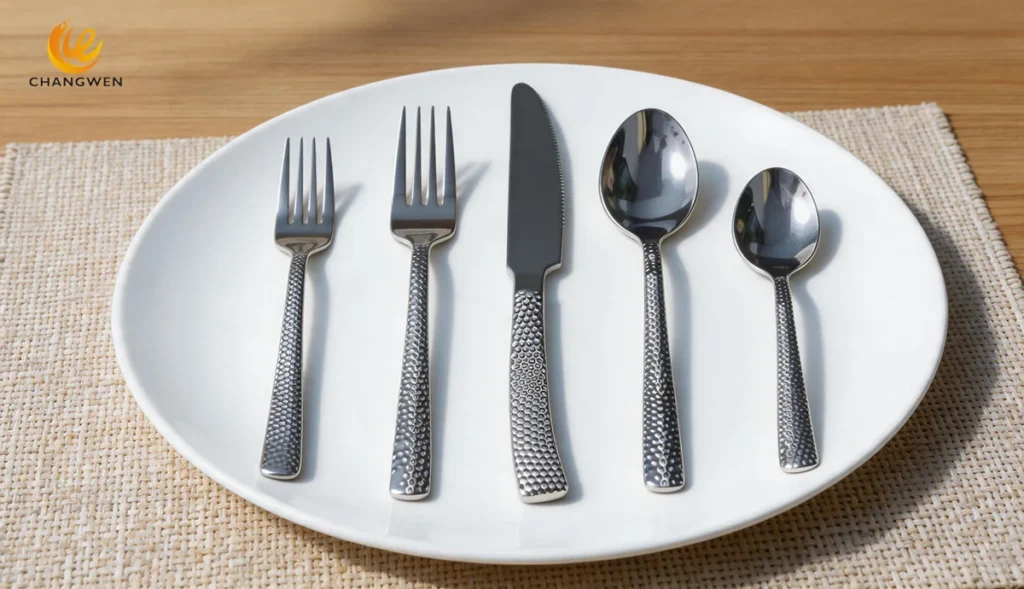
There is a small number stamped on the back of every piece of quality stainless steel cutlery — usually at the base of the handle, sometimes on the neck.
Most buyers never look at it.
They choose by appearance, by weight in the hand, by whether the set looks right for the table. And then they wonder, twelve months later, why some pieces have developed dull patches, why the surface is pitting near the tines, or why the forks no longer match the luster of the spoons after a year of dishwasher cycles.
The number — 18/10, 18/8, or 18/0 — was telling them exactly what would happen. They just did not know how to read it.
This guide teaches you to read it. And in doing so, it gives you a complete framework for evaluating any stainless steel cutlery set — from the steel grade and what the nickel percentage actually does to your cutlery’s longevity, to surface finish selection, weight and balance, set sizing for home and commercial use, care protocols, and how to source directly from a stainless steel cutlery manufacturer for wholesale programs.
Whether you are furnishing a family dining table, procuring for a hotel or restaurant, or building a wholesale kitchen tableware catalog — the complete buying guide for 2026 starts here.
Decoding the Numbers: 18/10 vs 18/8 vs 18/0 — What They Mean and Why They Matter
The stamped designation on the back of a cutlery piece is the most compressed quality specification in all of tableware. Two numbers, a slash between them, and you know exactly what you are buying — if you understand what the numbers mean.
Chromium: The First Number (Always 18)
The first number in any stainless steel cutlery designation refers to the percentage of chromium in the alloy. In quality cutlery, this is almost universally 18%. Chromium is the element that makes stainless steel “stainless” — it forms an invisible, self-repairing passive oxide layer on the steel surface that resists rust, corrosion, and surface degradation.
When the passive layer is scratched, chromium reacts with atmospheric oxygen to immediately regenerate it. This is why stainless steel does not rust in the way that ordinary carbon steel does — the passive layer heals itself as long as sufficient chromium is present.
Why 18% specifically? This concentration provides the minimum necessary chromium content to form a stable, reliable passive layer under the range of conditions cutlery encounters: contact with acidic foods (citrus, vinegar, tomato), alkaline dishwasher detergents, and exposure to moisture and humidity in storage.
Nickel: The Second Number (Where the Grades Diverge)
The second number is where the meaningful quality differences appear. This is the nickel percentage — and nickel does several things that chromium alone cannot:
Luster and appearance: Nickel produces the warm, bright, silvery-white reflective quality that distinguishes premium cutlery from plainer alternatives. Higher nickel content means a brighter, more stable surface appearance that resists dulling over years of use.
Additional corrosion resistance: Nickel stabilizes the austenitic crystal structure of the steel, making it significantly more resistant to pitting (microscopic surface corrosion) and crevice corrosion in the presence of chlorides — the primary corrosive compound in dishwasher salt and many detergents.
Resistance to acid attack: Food acids — the acidity of tomatoes, citrus, vinegar, wine — attack stainless steel surfaces over time at the microscopic level. Higher nickel content substantially reduces this attack rate, preserving the food-contact surface integrity of spoons, forks, and the cutting edges of knives.
18/10: The Premium Standard
18/10 stainless steel contains 18% chromium and 10% nickel. This is the gold standard for fine dining cutlery, premium retail sets, hotel supply, and any application where longevity, appearance, and quality are the priority.
A properly manufactured 18/10 cutlery set will maintain its luster through daily dishwasher use for 20–40 years. It resists pitting from even aggressive commercial dishwasher detergents. The surface does not cloud or develop uneven patches under normal use conditions.
For buyers choosing a set intended to be passed to the next generation or to anchor a hotel’s tableware identity for a decade or more: 18/10 is the correct specification.
18/8: The Reliable Second
18/8 stainless steel contains 18% chromium and 8% nickel — 2% less nickel than 18/10. This alloy corresponds to the AISI 304 designation used in industrial specifications (discussed in the next section).
The practical difference between 18/8 and 18/10 in cutlery performance is real but modest under normal conditions. 18/8 provides excellent corrosion resistance and a bright appearance. Under extreme conditions — very aggressive detergents, prolonged exposure to high salt concentrations, or industrial dishwasher cycles running at the highest temperatures — 18/8 shows marginally faster surface degradation than 18/10.
For buyers sourcing for moderate-use environments (home kitchens with standard dishwashers, casual dining restaurants): 18/8 is a practical and cost-effective specification that delivers excellent long-term performance.
18/0: The Practical Alternative
18/0 stainless steel contains 18% chromium and zero nickel. The absence of nickel has two significant consequences:
The steel becomes ferrite rather than austenite in crystal structure, making it magnetic — it will adhere to magnetic knife racks and cutlery holders.
Without nickel’s corrosion-enhancing effect, 18/0 is notably more susceptible to surface pitting and dulling under dishwasher conditions, particularly with citrus or highly alkaline detergents.
Who should choose 18/0: Individuals with a nickel allergy (genuine cutlery nickel sensitivity is uncommon but documented), buyers who need magnetic cutlery for specific storage systems, and budget-priority programs where the cost difference matters.
Who should not choose 18/0 as a premium program: Hotels, restaurants, any buyer positioning cutlery as fine dining or premium quality. The visual dulling of 18/0 over commercial use timescales is noticeable and inconsistent with premium table presentation.
Grade Quick Reference
| Grade | Chromium | Nickel | Magnetic? | Corrosion Resistance | Best For |
|---|---|---|---|---|---|
| 18/10 | 18% | 10% | No | Excellent | Premium, hotel, fine dining, heirloom sets |
| 18/8 | 18% | 8% | No | Very good | Home daily use, casual dining, mainstream retail |
| 18/0 | 18% | 0% | Yes | Good | Nickel allergy, magnetic storage, budget programs |
18/10 vs 304 Stainless Steel: Are They the Same Thing?
This question appears in every wholesale sourcing conversation between buyers and stainless steel cutlery manufacturers — and the answer is both simpler and more nuanced than most people expect.
The Short Answer
Yes, 18/10 stainless steel and 304 stainless steel refer to the same fundamental alloy, described by two different nomenclature systems used in different contexts.
The Two Naming Systems
The consumer/cutlery designation (18/10): Expresses the composition as chromium percentage / nickel percentage. This is the designation used in retail cutlery, tableware, and cookware worldwide. It directly tells the buyer the composition of the steel.
The industrial/engineering designation (304 or AISI 304 / EN 1.4301): The American Iron and Steel Institute grade number for austenitic stainless steel containing approximately 18% chromium and 8–10.5% nickel with specific limits on carbon, manganese, silicon, phosphorus, and sulfur content.
The Nuance: Why 18/10 and 304 Are Not Perfectly Interchangeable
304 stainless steel has a nickel specification range of 8–10.5%. The 18/10 designation implies exactly 10% nickel.
In practice:
- Steel described as “304” in industrial sourcing may contain 8.0–10.5% nickel, depending on where in the specification range the production batch falls
- Steel described as “18/10” in cutlery sourcing implies the higher end of the nickel range
This means a product described as “304 stainless steel” by a manufacturer could be anywhere within the 8–10.5% nickel range. For cutlery buyers sourcing wholesale, this distinction matters: a Mill Test Certificate confirming ≥10% nickel verifies genuine 18/10 specification rather than the lower end of the 304 range.
For wholesale sourcing purposes: Request documentation that confirms both the 304/18/8 alloy classification AND the specific nickel content. This ensures you receive the specification you are paying for.
Surface Finish: Mirror, Satin, Brushed, and PVD — Choosing the Right Look
Steel grade determines longevity. Surface finish determines appearance — and appearance determines what the cutlery communicates about the table it is set on.
Mirror Polish (High Polish)
The classic fine dining finish. The steel is polished through successive grades of abrasive media until the surface is highly reflective — producing that immediately recognizable, brilliantly bright appearance associated with formal dining and premium tableware.
Properties: Maximum reflectivity, warm silver-white color in 18/10 grade. Shows water spots, fingerprints, and handling marks more readily than matte finishes. Requires buffing or careful drying to maintain appearance between uses.
Best for: Fine dining restaurants, upscale hotels, formal home dining, gift sets where visual impact at first impression matters.
Satin / Brushed Finish
Created by brushing the steel surface with an abrasive belt in a single direction, leaving a consistent low-sheen directional grain texture. Significantly more fingerprint-resistant than mirror polish. Small scratches from daily use are less visible against the brushed texture.
Properties: Understated elegance, contemporary aesthetic. Hides daily handling marks far better than mirror polish. Equally appropriate for both formal and casual settings.
Best for: Contemporary home dining, modern restaurant concepts, hotel buffet and casual dining settings, any program where maintenance of appearance with minimal polishing effort is a priority.
Matte / Sandblasted Finish
Flat, non-reflective surface with a soft appearance. More casual than brushed. Becoming increasingly popular in contemporary restaurant design where the contrast of a matte surface against other table elements creates a deliberate aesthetic.
Best for: Contemporary casual dining, gastropub settings, modern hotel F&B concepts seeking visual differentiation.
PVD Color Finishes (Gold, Black, Rose Gold, Copper)
Physical Vapor Deposition applies a thin, extremely hard metallic color layer over the base stainless steel through a vacuum deposition process. The result is genuinely durable color that resists abrasion better than painted or electroplated finishes.
Properties: Strong visual impact. Available in gold, black, rose gold, champagne, bronze. Dishwasher tolerance varies by PVD process quality — premium PVD is dishwasher safe; lower-quality coatings should be hand-washed.
Best for: Hotel branding programs where cutlery color is part of the visual identity, premium retail gift sets, specialty restaurant concepts where cutlery is part of the design statement.
What to verify when specifying PVD: PVD thickness (typically 1–3 microns for cutlery), substrate material (must be 18/10 or 18/8 underneath for structural integrity), and dishwasher compatibility rating from the manufacturer.
Weight and Balance: The Specification Nobody Talks About That Changes Everything
The weight and balance of a cutlery piece is how the experience of eating communicates quality before the first bite. It is also one of the most underspecified dimensions in most buying guides.
Why Weight Matters
Cutlery weight is determined by: the thickness of the material (gauge), the overall dimensions of the piece, and whether the handle contains any internal weighting. In stainless steel cutlery, heavier pieces generally indicate thicker material and more substantial construction.
Heavier cutlery (typically 100–150g for a dinner fork): Signals formality and quality. Feels substantial and considered in the hand. Associated with fine dining and luxury hotel settings. The sensory experience of placing a heavy fork on a plate sounds different — more solid, more deliberate.
Lighter cutlery (typically 50–85g for a dinner fork): More agile. Associated with everyday use, modern minimalist design, and casual dining. Not necessarily lower quality — many contemporary premium sets deliberately choose lighter gauges for aesthetic reasons.
For hotel and restaurant procurement: the correct weight for your concept is the weight that matches your dining room’s visual and experiential identity. A Michelin-starred restaurant and a boutique café make different appropriate choices.
The Balance Point: Where the Center of Gravity Lives
Balance is more nuanced than total weight, and arguably more important for the actual dining experience.
A well-balanced fork holds its center of gravity at approximately the point where the handle meets the neck — the natural pivot point when the fork rests across the index finger. At this point, the tines and the handle end balance each other. The fork neither tips forward (heavy tines) nor backward (heavy handle), and rests naturally with minimal muscular effort to hold.
A simple field test: Rest a fork across your index finger with the finger at the handle/neck junction. A well-balanced fork remains level or tips only very slightly forward (toward the tines). A fork that drops heavily on either end has an imbalanced weight distribution.
In wholesale procurement, balance cannot be evaluated from a specification sheet or photograph — it requires physical samples. This is one of the primary reasons sample evaluation before bulk order commitment is non-negotiable in cutlery sourcing.
Handle Design and Ergonomics
The handle cross-section — round, oval, rectangular, or faceted — changes how the piece rests in the hand.
Round handles: Traditional, comfortable for extended use, rotate naturally in the grip.
Oval/flat handles: Contemporary, minimize rotation in the grip, create a more deliberate directional feel.
Faceted/architectural handles: Design-forward, visually striking, provide positive grip orientation.
Hollow versus solid handles: Some premium cutlery uses hollow stainless handles that can be weighted internally for balance control. Hollow handles are also lighter when unweighted — used in contemporary lightweight designs. Solid handles are heavier and simpler to manufacture.
How to Count a Cutlery Set: Pieces, Place Settings, and What You Actually Need
The arithmetic of cutlery sets is genuinely confusing because manufacturers count differently — sometimes per piece, sometimes per place setting, sometimes including serving pieces and sometimes not.
The Place Setting: The Building Block
A “place setting” is the collection of pieces one person uses at the table for a complete meal. Standard configurations:
4-piece place setting: Dinner knife, dinner fork, dessert spoon, teaspoon. The minimum for everyday dining.
5-piece place setting: Adds a soup spoon to the 4-piece. Standard for sets described as 5-piece per person.
7-piece place setting: Adds dessert fork and dessert knife for formal multi-course dining. Common in premium retail and hotel programs.
The Math Behind Set Sizes
| Set Size (pieces) | Place Settings (at 4-piece) | Place Settings (at 5-piece) | Best For |
|---|---|---|---|
| 16-piece | 4 | — | Couple or small household, daily use |
| 20-piece | 5 | 4 | Small family, daily use |
| 24-piece | 6 | — | 6-person daily use baseline |
| 30-piece | — | 6 | 6-person 5-piece standard |
| 40-piece | 10 | 8 | Entertaining, 8-person dining |
| 48-piece | 12 | — | 12-person formal |
| 56-piece | — | — | 8-person 7-piece formal |
| 84-piece | 21 | — | 12-person formal + serving pieces |
What the Count Includes (and What it Might Not)
Always verify what a set count includes:
Usually included: Dinner knives, dinner forks, dessert spoons, teaspoons (and soup spoons if 5-piece format).
Sometimes included: Dessert forks, dessert knives, fish eaters, steak knives.
Sometimes sold separately: Serving spoons, salad servers, sugar tongs, butter knives, carving sets.
A “24-piece set for 6” describes 6 × 4-piece place settings. A “42-piece set for 6” typically means 6 × 7-piece place settings with serving pieces added. These are very different products at potentially similar headline piece counts — always count the pieces per person, not just the total.
Cutlery Set Sizing by Use Case
Home Kitchen: Daily Use for a Family of Four
Starting recommendation: 20-piece (5-person, 4-piece setting) for a household of four. Provides one spare setting for unexpected guests and daily rotation without constant dishwasher dependency.
Better recommendation: 40-piece (10-person, 4-piece) — buys the household enough to entertain comfortably without washing between courses, handle two dishwasher loads without running out, and absorb the inevitable disappearance of teaspoons without crisis.
Steel grade for home use: 18/8 at minimum; 18/10 if the set is intended to last the decade and serve as a heirloom purchase.
Home Kitchen: Entertaining Focus
For households that regularly host dinners of 8–12:
Recommended: 48-piece (12-person, 4-piece) in 18/10, with steak knife sets and serving pieces bought separately as needs arise.
Wedding Gift
A complete 8-person set in 18/10 stainless steel, presented in a proper storage case, is one of the most practically useful and durable wedding gifts possible. A quality 18/10 cutlery set will likely outlast most other gifts received at any wedding.
What to look for in a wedding gift set: Presentation box or canteen (protects pieces, makes gifting appropriate), 18/10 steel throughout, a design that reads as timeless rather than on-trend.
Cutlery for Hotels and Commercial Dining: A Different Calculation
Commercial procurement of stainless steel cutlery for hotels and restaurants follows a fundamentally different arithmetic from home buying.
The 2.5–3× Rule for Commercial Procurement
In commercial dining, cutlery is in continuous circulation between tables, washing, drying, polishing, setting, and use. To ensure clean cutlery is always available without gaps in service, standard industry practice is to purchase 2.5–3 times the number of pieces per seat.
Example: A 100-seat restaurant with 5-piece place settings needs:
- 100 seats × 5 pieces = 500 pieces minimum
- At 2.5× buffer: 1,250 pieces total
- At 3× buffer: 1,500 pieces total
This buffer accounts for: pieces in use at tables, pieces being bussed and cleared, pieces in the washing cycle, pieces being dried and polished, pieces in the setting preparation, and pieces that inevitably disappear, get damaged, or are temporarily unavailable.
Steel Grade for Commercial Dining
For any hotel or restaurant program: 18/10 stainless steel only. The corrosion resistance of 18/10 under daily commercial dishwasher cycling — particularly the combination of high temperatures, alkaline detergents, and salt — is meaningfully superior to 18/8 and dramatically superior to 18/0.
Over a 5–10 year program life, the cost difference between 18/10 and 18/8 is insignificant relative to the replacement frequency difference when 18/8 is exposed to aggressive commercial cleaning daily.
Commercial Finish Selection
Mirror polish: Traditional fine dining, formal hotel restaurant service, white tablecloth settings.
Satin/brushed: Contemporary hotel F&B, casual dining concepts, buffet and brasserie settings.
PVD color: Boutique hotel branding programs, specialty restaurant design concepts.
For commercial programs, the finish also interacts with the polishing labor investment. Mirror-finish cutlery requires regular polishing to maintain appearance. Satin finishes require significantly less polishing effort for an equivalent appearance standard — a practical operational consideration in high-volume commercial settings.
Specialty Pieces: What to Add and When
Steak Knives
Essential for any program serving whole steaks or thick-cut meats. A dedicated steak knife (serrated or non-serrated) cuts cleanly through the meat fibers rather than tearing — the difference between a steak that eats well and one that frustrates the diner.
Serrated vs. non-serrated steak knife: Serrated knives require less maintenance sharpening but cannot be resharpened by most methods. Non-serrated (straight blade) steak knives can be maintained to a sharper edge but require periodic professional sharpening.
Fish Eaters (Fish Fork and Fish Knife)
The fish knife has a specific shape designed to gently separate fish flesh from bone without tearing — a rounded blade tip, wider at the tip than at the heel. Used in formal multi-course dining where a fish course precedes the meat course.
For commercial programs: Include in sets designed for formal fine dining service only. Casual and contemporary dining formats do not typically use fish eaters.
Dessert Fork and Knife
A smaller-scale fork and knife for dessert courses. Included in 7-piece place settings and higher. Essential for formal dining programs.
Soup Spoon (Round Bowl) vs. Dessert Spoon (Oval Bowl)
These serve different functions despite similar size. A round-bowl soup spoon is designed for liquid soup — the round bowl allows a comfortable sipping motion. An oval-bowl dessert spoon is for semi-solid desserts, cereals, and other non-liquid applications.
Many sets include only one of these shapes — confirm which is included if both functions are needed.
Serving Pieces
Large spoons, serving forks, salad servers, sauce ladles, and sugar tongs complete a table service program. These are typically sold separately from place setting counts and are essential for any full-service dining concept.
Care, Cleaning, and Storage
A well-chosen 18/10 cutlery set will maintain its appearance for decades with straightforward care. The main threats to cutlery appearance — pitting, spotting, cloudiness, rust — are almost entirely preventable.
Dishwasher Use: Safe for 18/10 With Proper Protocol
18/10 and 18/8 stainless steel cutlery is dishwasher safe under normal conditions. The precautions that matter:
Remove food promptly: Acidic food residues (lemon, tomato, vinegar, mustard, salt) are the primary corrosion risk for stainless cutlery. Rinsing before loading or running the dishwasher promptly after use prevents acid contact time from accumulating.
Avoid overcrowding: Cutlery pieces that contact each other in the dishwasher basket develop micro-scratches that dull the surface over time. Separate pieces in the basket.
Avoid harsh or citrus-based detergents: Citric acid in some dishwasher detergents attacks the passive layer of stainless steel. Use pH-neutral or mild alkaline detergents without citric acid for premium cutlery.
Remove and dry immediately: Allowing wet cutlery to sit in a closed, humid dishwasher environment promotes water spot formation (mineral deposits from hard water). Remove immediately after the cycle, dry with a soft cloth.
The Water Spot Problem
Water spots on stainless steel cutlery are mineral deposits (primarily calcium carbonate from hard water) left as the water evaporates. They are cosmetic only — they do not damage the steel — but they are unsightly on mirror-finish pieces.
Prevention: Rinse aid in the dishwasher reduces surface tension, causing water to sheet off rather than bead. Immediate drying after the dishwasher cycle prevents deposit formation.
Removal: A mild solution of white vinegar and water (1:3 ratio), applied with a soft cloth and rinsed thoroughly, dissolves calcium deposits without damaging the steel. Rinse completely — do not allow vinegar to remain on the surface.
Storage
Cutlery drawer insert: A divided insert keeps pieces separated and prevents contact scratching. The simplest and most practical storage for daily-use cutlery.
Wooden canteen: Traditional storage solution for premium sets not in daily use. Provides individual slot protection for each piece. Visually appropriate for gift sets and heirloom pieces.
Cutlery rolls: Fabric or leather rolls for individual piece storage. Particularly useful for specialty pieces, traveling with personal cutlery, or specialty knife storage.
What to avoid: Loose storage in a kitchen drawer without dividers. Cutlery pieces contacting each other develop micro-scratches that accumulate into visible surface dulling over months.
Sourcing 18/10 Stainless Steel Cutlery from a Manufacturer
For hotel procurement groups, restaurant chains, tableware distributors, and private-label kitchenware brands sourcing at wholesale volume, factory-direct supply from a verified stainless steel cutlery manufacturer delivers significant cost advantage over domestic distributor pricing.
Where Stainless Steel Cutlery Is Manufactured
Jieyang, Guangdong, China is the world’s primary stainless steel tableware and flatware manufacturing cluster — producing the majority of China’s stainless steel cutlery exports globally. The cluster’s deep supply chain integration (stainless steel sheet, handle materials, polishing equipment, packaging) enables cost-competitive production of fully certified 18/10 cutlery for export.
South Korea (particularly Yangpyeong region) historically produced high-quality stainless cutlery for the premium market. Still an active supply source for buyers positioning at the upper market tier.
India (Shekhawati region, Rajasthan) is an emerging stainless cutlery production center with growing export capability.
What to Specify for Wholesale Cutlery Programs
A complete specification for any 18/10 stainless steel cutlery wholesale program:
- Steel grade: “18/10 stainless steel — Mill Test Certificate required confirming ≥18% chromium and ≥10% nickel”
- Surface finish: Mirror polish / satin / brushed / PVD (specify color and coating thickness for PVD)
- Weight specification: Grams per piece for each piece type (verified against samples)
- Set composition: Exact pieces included per place setting and number of place settings
- Serving piece inclusion: Yes/no and specific pieces
- Packaging: Individual piece protection, presentation box, canteen box, or bulk packing
- Certifications: Food contact compliance (FDA for US, LFGB for EU), NSF (for commercial kitchen distribution)
Changwen as Stainless Steel Cutlery Manufacturer
Changwen Cookware & Kitchenware Co., Ltd. produces 18/10 stainless steel cutlery sets alongside its broader commercial kitchen equipment and cookware range, supplying hotel groups, restaurant chains, and wholesale tableware distributors with verified-grade cutlery in mirror, satin, and PVD finish configurations. OEM programs include custom handle design, proprietary set composition, and branded packaging.
Standard MOQ: 1,000 units for standard OEM programs with branding. 10,000 units for programs requiring new tooling (custom handle molds, proprietary profile designs).
Documentation provided: Mill Test Certificate (per production batch confirming 18/10 grade), food contact compliance documentation (FDA/LFGB), ISO 9001 quality management certificate.
FAQ
What does 18/10 mean on stainless steel cutlery?
18/10 designates the alloy composition of the stainless steel: 18% chromium and 10% nickel. The chromium content forms the protective passive oxide layer that prevents rusting and corrosion. The nickel content provides the warm, brilliant luster and significantly enhanced resistance to pitting, acid attack, and surface degradation from dishwasher detergents. 18/10 is the premium designation for high-quality cutlery — higher nickel means better corrosion resistance, superior appearance retention, and longer service life compared to 18/8 (8% nickel) or 18/0 (no nickel).
Is 18/10 the same as 304 stainless steel?
Yes, substantially. 18/10 and 304 (AISI 304 / EN 1.4301) refer to the same fundamental austenitic stainless steel alloy. The difference is the naming system: 18/10 is the consumer/tableware designation expressing composition directly; 304 is the industrial grade number. The nuance is that 304 specification allows nickel content of 8–10.5%, while 18/10 implies the higher end of this range (≥10% nickel). When sourcing wholesale, request a Mill Test Certificate confirming ≥10% nickel to verify genuine 18/10 rather than the lower end of the 304 range.
How much cutlery do I need for a family of four?
For daily use without constant washing: a 20-piece set (5 complete 4-piece place settings) is the practical minimum. For comfortable daily use plus occasional guests: a 40-piece set (10 × 4-piece settings) is the better long-term investment. The extra settings allow the household to entertain 6–8 people without supplementing from mismatched spares, absorb the reality that teaspoons disappear, and run two dishwasher cycles between full settings without running short.
What is the difference between 18/10 and 18/0 cutlery?
Both contain 18% chromium. The difference is the nickel content: 18/10 has 10% nickel; 18/0 has zero. Nickel is responsible for the bright luster of quality cutlery and significantly enhances corrosion resistance — particularly against pitting from dishwasher detergents and acid attack from food residues. 18/0 steel is ferrite-structured (magnetic) and will adhere to magnetic storage systems — a practical advantage for some users. 18/0 is an appropriate choice for nickel-sensitive individuals (genuine cutlery nickel allergy is uncommon but documented) or magnetic storage requirements. For durability, appearance, and long-term performance: 18/10 is meaningfully superior.
How many pieces of cutlery does a hotel need per seat?
The commercial industry standard is 2.5–3× the number of pieces per seat. For a 100-seat hotel restaurant with 5-piece place settings: 100 seats × 5 pieces × 2.5–3 = 1,250–1,500 total pieces. This buffer ensures clean cutlery is always available in service despite the continuous cycle of use, clearing, washing, drying, polishing, and re-setting that a commercial dining operation runs through.
Can 18/10 stainless cutlery go in the dishwasher?
Yes. 18/10 stainless steel is designed to withstand regular dishwasher use. Three practices protect the cutlery: rinse food (especially acidic or salty residues) before loading; avoid citrus-based or highly alkaline detergents that attack the steel surface; remove and dry immediately when the cycle finishes rather than leaving pieces in the humid post-cycle environment. Following these simple protocols allows 18/10 cutlery to be dishwashed daily for decades without meaningful surface degradation.
Conclusion
The numbers on the back of a fork are not a bureaucratic code. They are a performance specification — and understanding them is the single most valuable thing any buyer can know before purchasing a stainless steel cutlery set.
18/10: Premium, brilliant, durable. The right choice for heirloom sets, hotel supply programs, fine dining, and any context where the cutlery needs to perform consistently for ten years or more.
18/8 (304): Excellent, practical, slightly lower nickel. The right choice for everyday home dining, casual commercial programs, and any context where performance is the priority and the marginal appearance difference from 18/10 is acceptable.
18/0: Hypoallergenic, magnetic, economical. The right choice when nickel sensitivity is a factor or magnetic storage is required — with appropriate expectations about long-term appearance retention.
The rest of the buying framework follows from this foundation: surface finish that matches the table setting’s aesthetic intent, weight and balance evaluated in the hand not on a specification sheet, set size calculated for actual use patterns not theoretical ideals, and for commercial programs, procurement multiples that ensure service never stalls.
Changwen manufactures 18/10 stainless steel cutlery sets — place settings, hospitality programs, and private-label retail collections — for wholesale buyers and OEM brands worldwide. Standard MOQ: 1,000 units. Full documentation package included as standard.