Read time: 14 min
Introduction
In 2024, China exported $1.66 billion worth of knives — accounting for 51.5% of all global knife exports, the highest share of any country in the world. Total knife, scissors, and blade production reached 2.9 billion units, up 8% year-over-year.
Those are not abstract numbers. They represent the most concentrated, most capable, and most competitively priced knife manufacturing infrastructure on earth — and for any importer, distributor, restaurant equipment buyer, or private-label brand sourcing kitchen knives at volume, understanding how to navigate China’s knife wholesale market in 2026 is directly worth money.
But “China knife wholesale” is not one place or one market. It is three distinct clusters with different product specializations, three types of sourcing channels (physical markets, online B2B platforms, factory-direct programs), and a wide range of manufacturer quality tiers from commodity production to premium OEM that rival European and Japanese makers on both specification and finish.
This guide maps all of it: the manufacturing clusters, the China wholesale market online platforms, the China wholesale market Guangzhou trade infrastructure, how to find and verify a legitimate kitchen knife manufacturer, what steel grades are available at each price tier, and what the MOQ, pricing, and certification landscape looks like for the 2026 buying season.
Whether you are sourcing kitchen knives for restaurant supply, building a private-label knife brand, or expanding a retail kitchen equipment catalog — this is the complete sourcing guide.
Key Takeaways
- Yangjiang, Guangdong is the world’s dominant knife manufacturing cluster — producing approximately 70% of China’s knife output and 85% of its knife exports. More than 1,400 knife enterprises operate here, covering kitchen, EDC, outdoor, hunting, and tactical categories.
- Longquan, Zhejiang specializes in traditional hand-forged blades and collector swords — not the right source for commercial kitchen knife programs.
- China wholesale market online sourcing — through Alibaba, Made-in-China, Global Sources, and domestic platform 1688 — is the primary access point for international buyers who cannot visit China physically.
- China wholesale market Guangzhou provides access to the Canton Fair (the world’s largest trade fair, held twice annually) and the region’s commercial distribution infrastructure — valuable for buyers who want to evaluate physical samples before committing to factory relationships.
- Steel grade transparency is the most important single factor when evaluating any China knife wholesale program. Specific grade designation (3Cr13, 5Cr15MoV, AUS-8, VG-10, etc.) must be confirmed in writing with mill certificates — not just “stainless steel.”
- MOQ for kitchen knife wholesale programs starts at 500–1,000 units per SKU for standard catalog products with OEM branding. Custom handle molds or proprietary profiles require 10,000 units. Changwen’s standard knife program MOQ: 1,000 units per SKU.
- Certifications vary by market: FDA food contact compliance for the US, LFGB for EU/Germany, ISO 9001 for quality management. These are verifiable through official databases — not just certificate images.
Why China Dominates Global Knife Manufacturing
Understanding why China leads global knife production — not just that it does — gives buyers the context to source more effectively.
The Vertical Integration Advantage
China’s knife manufacturing dominance is structural. Unlike markets where blade-making, handle production, and steel sourcing are geographically separated, China’s primary knife clusters are vertically integrated industrial ecosystems. In Yangjiang:
- Raw stainless steel coil is sourced from domestic steel mills within the supply chain
- Handle materials (G10, polymer, wood, stainless, pakkawood) are produced by local specialty suppliers
- Heat treatment facilities operate within the cluster
- Blade grinding and surface finishing equipment is built and serviced locally
- Export logistics and customs brokers are embedded in the local business infrastructure
This vertical integration eliminates the supply chain coordination costs that add time and money in geographically dispersed manufacturing regions. A Yangjiang knife factory can go from raw steel coil to finished packaged knife in a production cycle that a more fragmented supply chain cannot match.
1,400+ Years of Accumulated Expertise
Yangjiang has been producing blades for over 1,400 years. The accumulated technical knowledge — in blade geometry, heat treatment protocols, edge grinding, and surface finishing — is embedded in the manufacturing workforce at a density that cannot be quickly replicated. This expertise is the less-visible but more durable competitive advantage underlying the cost and quality combination China offers.
Scale Effects at Production Volume
China’s knife factories operate at volumes that drive per-unit costs to levels impossible in lower-volume manufacturing contexts. A Yangjiang factory producing 2 million kitchen knives per year achieves tooling amortization, process optimization, and logistics efficiency that a 50,000-unit-per-year factory cannot approach. This scale advantage flows directly to buyers as competitive per-unit pricing.
The Three Major China Knife Manufacturing Clusters
Yangjiang, Guangdong — The Knife Capital of the World
Yangjiang is the destination for any buyer sourcing commercial-volume kitchen knives, EDC folders, outdoor knives, or tactical knives from China. The statistics underscore the point: Yangjiang accounts for approximately 70% of China’s knife production and 85% of its knife exports. The local knife and hardware industry exceeded 55 billion RMB in output value in 2024.
What Yangjiang produces:
- Kitchen knife sets (all steel grades from budget 3Cr13 to premium VG-10)
- Chef’s knives, paring knives, bread knives, cleaver sets
- EDC and folding knives (from value-tier G10 models to premium titanium framelocks)
- Outdoor, hunting, and tactical fixed blades
- Multi-tools and utility knives
Key infrastructure for buyers visiting Yangjiang:
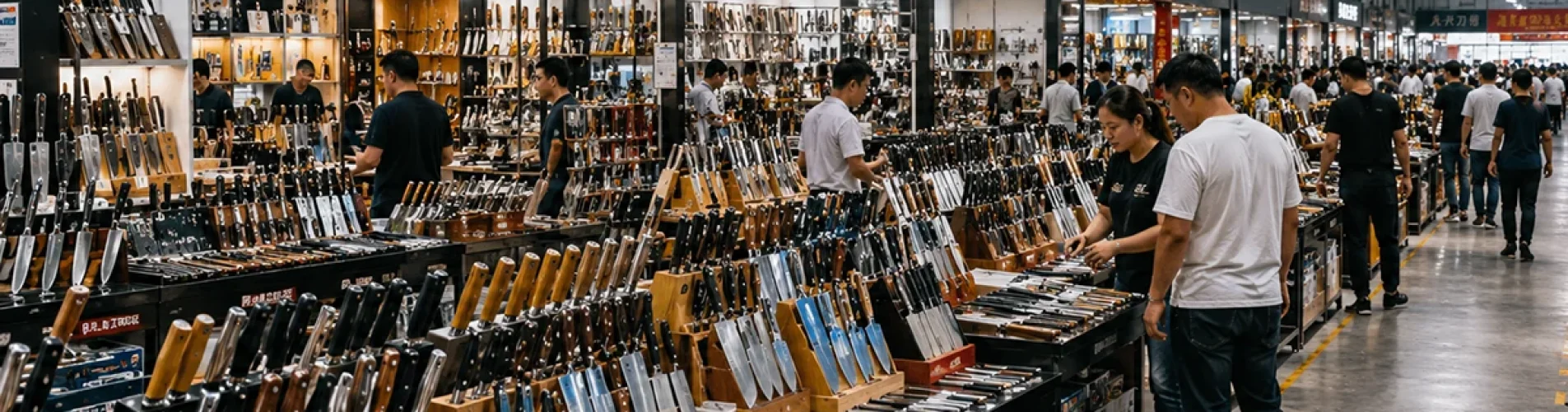
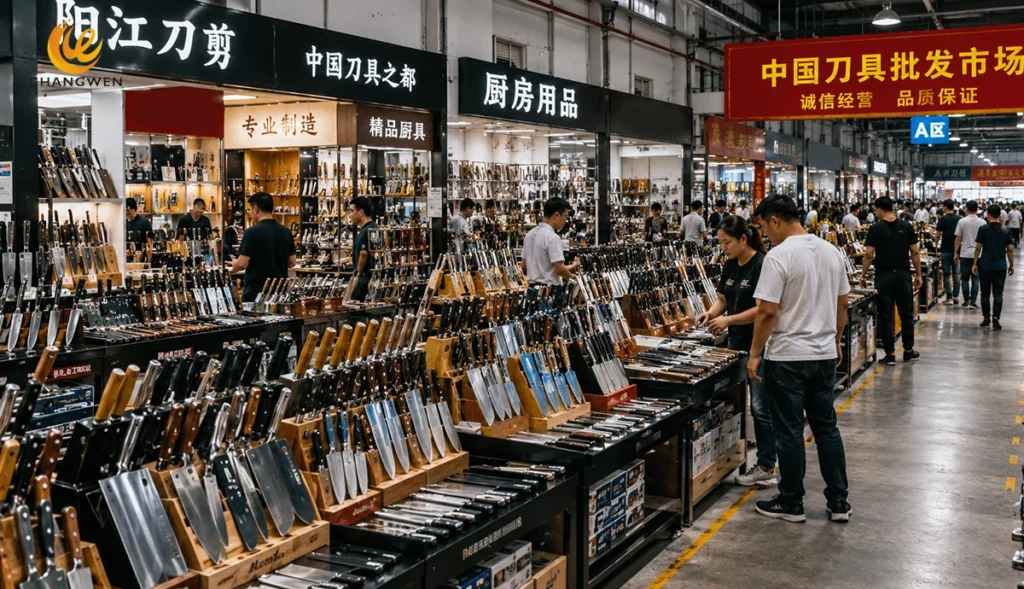
- Yangjiang International Hardware Knives & Scissors Trade City — the central wholesale market for knife products
- China (Yangjiang) International Hardware Knives & Scissors Fair — held annually each October
- National Knives, Scissors and Commodity Metal Tools Quality Supervision and Inspection Center — government testing facility
Physical access from Guangzhou: Yangjiang is approximately 2.5–3 hours by high-speed rail or road from Guangzhou. For buyers combining a Canton Fair visit with factory sourcing, Yangjiang is an efficient addition to the itinerary.
Longquan, Zhejiang — Traditional Blades and Collector Market
Longquan has a 2,600-year history of sword and blade making and is designated as a Chinese Intangible Cultural Heritage production region. The cluster specializes in hand-forged traditional Chinese swords, Japanese-style katana, anime and cosplay blades, and collector-grade ceremonial weapons.
Who should source here: Martial arts retailers, collector markets, anime and cosplay goods importers, museum procurement, and premium gift companies.
Who should not source here: Buyers looking for commercial kitchen knives, restaurant supply programs, or high-volume ODM/OEM production. Longquan’s craft-oriented workshops are not equipped for volume production at commercial kitchen supply scale.
Guangdong (Dongguan, Jiangmen) — Industrial and Specialty Blades
Beyond Yangjiang, the broader Guangdong region — particularly Dongguan and Jiangmen — has manufacturing capacity for industrial utility knives, hardware blades, and OEM knife programs for branded tool companies. Jiangmen specifically is China’s stainless steel commercial cookware hub and also produces basic kitchen knife and utensil programs as part of broader commercial kitchen equipment manufacturing.
China Wholesale Market Online: Platforms and Digital Sourcing Channels
The China wholesale market online landscape has evolved significantly since the early Alibaba era. Buyers in 2026 have access to multiple platforms with different supplier quality profiles, verification systems, and pricing structures.
Alibaba (alibaba.com)
The largest B2B platform for Chinese manufacturing globally. Alibaba hosts both genuine factories and trading companies — the distinction matters significantly for knife sourcing (discussed in the verification section below).
How to use Alibaba effectively for knife sourcing:
Use specific search terms rather than broad categories: “kitchen knife manufacturer OEM” produces more relevant results than “kitchen knife.” Filter for “Gold Supplier” + “Verified Manufacturer” badges — not just Gold Supplier alone. Request RFQs from 5–8 shortlisted suppliers simultaneously to establish a comparative baseline for pricing and specification.
Alibaba’s knife category landscape (2026): The platform hosts thousands of kitchen knife listings. Most fall into three tiers: commodity product (3Cr13, 5Cr15MoV steel, budget handles), mid-market (7Cr17MoV, AUS-8, polymer handles), and premium OEM (AUS-10, VG-10, stainless or G10 handles). Price alone does not separate these tiers reliably — steel grade documentation does.
Made-in-China (made-in-china.com)
The second-largest B2B platform with a strong manufacturer focus. “Audited Supplier” verification requires physical factory inspection, making it a useful cross-reference for suppliers found on Alibaba. Better for finding manufacturers in specific industrial categories than for broad consumer product browsing.
1688 (1688.com)
Alibaba’s domestic Chinese B2B platform — the platform that Chinese businesses use to buy from Chinese factories. Pricing on 1688 reflects domestic market rates: typically 10–30% below equivalent Alibaba export listings for the same factory and product.
The access challenge: 1688 is entirely in Mandarin and requires a China-registered account or a sourcing agent with access. For buyers with language capability or a China-based agent, 1688 is the most cost-efficient sourcing environment available.
Global Sources (globalsources.com)
Stronger verified manufacturer focus than Alibaba in some categories. Useful secondary platform for cross-referencing suppliers and finding manufacturers who have specifically invested in international market presence.
Direct Outreach via Google and Trade Directories
Searching Google with region-specific manufacturer queries — “kitchen knife manufacturer Yangjiang,” “OEM knife factory Guangdong” — surfaces factory websites not listed on major B2B platforms. These manufacturers may offer better pricing because they bear no platform fees. Verification requires more due diligence without platform-provided badges, but the trade-off can be worth it for established buyers.
China Wholesale Market Guangzhou: The Physical Trade Hub
Guangzhou functions as the commercial hub for China’s wholesale market ecosystem in southern China and specifically for Guangdong Province’s manufacturing output. For international knife buyers, Guangzhou is significant for two primary reasons: the Canton Fair and logistics connectivity to Yangjiang.
Canton Fair (China Import and Export Fair)
The Canton Fair is the world’s largest trade fair, held twice annually in Guangzhou — Phase 1 in April, Phase 2 in October. Every exhibitor is a production operation, not a trading company. The fair covers all product categories including knives and kitchen equipment.
Why Canton Fair matters for knife buyers:
- Physical product evaluation in one location — 50 supplier comparisons in 3 days versus 50 email exchanges over 3 months
- Verified manufacturer exhibitors — platform status is required for exhibition
- Relationship establishment — face-to-face supplier meetings establish the trust baseline for B2B programs
- Sample collection — most exhibitors bring production samples that buyers can handle and evaluate in person
Practical logistics: Canton Fair is held at the China Import and Export Fair Complex in Pazhou, Guangzhou — accessible from Guangzhou Baiyun International Airport in approximately 30–45 minutes. Yangjiang is 2.5–3 hours by car or high-speed rail, making a combined Canton Fair + Yangjiang factory visit trip efficient for serious buyers.
Registration: International buyer registration is free at the Canton Fair official website. Hall allocation by product category is published in advance. Knife and hardware products are typically in specific halls within the daily necessities category.
Guangzhou Commercial Distribution Infrastructure
Beyond Canton Fair, Guangzhou hosts a substantial commercial distribution and logistics infrastructure relevant to knife buyers:
Guangzhou Knife and Hardware Wholesale Markets: Several wholesale markets in Guangzhou’s Tianhe and Haizhu districts carry knife and cutlery products alongside broader hardware categories. These are more relevant for buyers needing small quantities or quick replenishment than for wholesale OEM program development.
Freight and Logistics: Guangzhou Port (including Nansha Port) and nearby Shenzhen are the primary export points for Guangdong Province manufacturing. Transit times from these ports: US West Coast 15–20 days, East Coast 22–28 days, Europe 25–35 days.
Yangjiang: The World’s Knife Capital — What to Know Before You Go
For any buyer planning a factory visit to source from Chinese kitchen knife manufacturers at volume, Yangjiang is the destination. Here is the practical guide.
How to Get to Yangjiang
From Guangzhou: High-speed rail from Guangzhou South Station to Yangjiang Station — approximately 1.5 hours. Taxi or ride-share from Yangjiang Station to the industrial zones: 20–30 minutes.
From Hong Kong: High-speed train from West Kowloon to Yangjiang — approximately 2 hours.
From Shenzhen: Road or rail connection through Guangzhou — total approximately 3 hours.
Where Knife Factories Are Located
The primary knife manufacturing concentration is in Yangjiang’s industrial zones:
- Yidong Industrial Zone (Jiangcheng District): The core of Yangjiang’s knife manufacturing cluster. Home to the highest concentration of knife factories and component suppliers.
- Yangdong District: Additional manufacturing zones with capacity across knife and hardware categories.
The Yangjiang International Hardware Knives & Scissors Trade City
This is the wholesale market to visit for product sampling and supplier identification. Approximately 1,000 vendors occupy the complex, covering finished knife products, knife components (handles, rivets, guards, sheaths), and materials. For buyers who want to evaluate many product types quickly and collect samples for comparison, the Trade City is a more efficient starting point than visiting individual factories.
The Annual Knife and Scissors Fair
Held each October, the China (Yangjiang) International Hardware Knives & Scissors Fair concentrates the region’s major manufacturers in one exhibition venue. For buyers who cannot visit during the rest of the year, the Fair provides structured access to the full range of Yangjiang’s manufacturing capability. Exhibitors include both major volume manufacturers and specialty OEM operations.
Knife Steel Grades Available in China: The Buyer’s Reference
Steel grade is the single most important specification in any China knife wholesale program. The table below maps the grades available from Chinese manufacturers to their performance characteristics and appropriate market positioning.
| Steel Grade | HRC Range | Key Properties | Appropriate Market Tier |
|---|---|---|---|
| 3Cr13 | 50–52 | Budget stainless, easy to sharpen, poor edge retention | Entry-level, promotional, giveaway |
| 5Cr15MoV | 54–56 | Improved corrosion resistance over 3Cr13, standard mid-budget | Mid-budget retail, food service basic |
| 7Cr17MoV | 56–58 | Commercial kitchen standard in China, decent edge retention | Commercial kitchen supply, mainstream retail |
| AUS-8 | 57–59 | Japanese-specification stainless, good balance of edge retention and toughness | Mid-market retail, branded programs |
| AUS-10 | 59–61 | Superior to AUS-8, closer to VG-10 in performance | Upper-mid retail, premium distribution |
| VG-10 | 60–62 | Premium Japanese stainless, excellent edge retention, corrosion resistant | Premium retail, chef’s grade programs |
| D2 | 60–62 | Semi-stainless tool steel, outstanding edge retention, requires more maintenance | EDC, hunting, outdoor categories |
| S35VN | 59–61 | American powder metallurgy steel, toughness + edge retention balance | Premium EDC, high-end retail programs |
| M390 / 20CV | 60–62 | High-end powder metallurgy, maximum edge retention | Premium collector, flagship products |
How to Verify Steel Grade in China Knife Sourcing
Mill Test Certificate (MTC): The steel mill’s documentation confirming the elemental composition of the steel batch. Any legitimate manufacturer using documented-grade steel has this on file. It is the only reliable documentation of grade — product markings and supplier claims are insufficient on their own.
XRF Testing: X-Ray Fluorescence elemental analysis on a physical blade sample. Measures actual composition non-destructively in approximately 30 seconds. Can be commissioned through SGS, Bureau Veritas, Intertek, or any accredited testing laboratory in China. Definitive verification of what is actually in the blade.
HRC Testing: Rockwell hardness test on a production sample confirms the heat treatment was executed correctly for the declared steel grade. A blade declared as VG-10 at HRC 60–62 that tests at HRC 55 has been inadequately heat-treated regardless of the steel specification.
OEM vs. ODM vs. Wholesale: Choosing Your Sourcing Model
Before approaching any kitchen knife manufacturer in China, defining your sourcing model determines the conversation, the pricing structure, and the right factory to approach.
Wholesale (Catalog Products)
Buying finished, catalogued products in bulk. No product development, no tooling investment, no design work. Fastest path to inventory with no customization.
When wholesale is right: Market testing, budget retail programs, fulfillment of short-term demand, product categories where commodity standard is acceptable.
Limitation: No product exclusivity. The same product is available to any buyer.
ODM (Original Design Manufacturing)
The factory provides existing designs that the buyer brands and sells. No tooling investment (factory owns the tooling), faster than full OEM, brand identity applied to a proven product base.
When ODM is right: New brand launches where speed to market is the priority, buyers who want brand differentiation without design development, programs where the factory’s existing design quality is sufficient for the target market.
Limitation: Other buyers can access the same base product. Design is not exclusive.
OEM (Original Equipment Manufacturing)
The buyer provides complete specifications; the factory manufactures to the buyer’s design. Full design ownership. Tooling paid by the buyer belongs to the buyer. No other buyer can replicate the product.
When OEM is right: Established brands with volume to amortize tooling investment, programs where product exclusivity is a competitive requirement, buyers with specific design requirements that factory catalog products do not meet.
Tooling investment: Handle molds ($2,000–$8,000), blade profile dies ($5,000–$15,000). At Changwen, custom tooling programs require a minimum of 10,000 units to amortize tooling cost.
The Hybrid That Most Successful Programs Use
Start with ODM — use the factory’s proven product construction and tooling with your branding and packaging. When volume justifies it, invest in one OEM element (custom handle mold, exclusive surface finish) that creates genuine product differentiation. This is faster than full OEM and more differentiated than pure catalog sourcing.
Kitchen Knife Manufacturer Selection: A Category-by-Category Guide
Not all kitchen knife manufacturers are equally capable across all product categories. Matching manufacturer selection to product category is the foundation of effective sourcing.
Commercial Restaurant and Hotel Supply Programs
What to prioritize: NSF/ANSI 2 food equipment compliance, FDA food contact documentation, 7Cr17MoV or AUS-8 steel minimum (not 3Cr13 or 5Cr15MoV for daily commercial use), Fibrox-style polymer handles (NSF-compliant, dishwasher-safe), full tang construction for chef’s and slicing knives.
Key specification to verify: Handle material and its compliance status. Commercial kitchen health codes in most US jurisdictions prohibit wood handles for licensed food service. Polymer handles (Fibrox-equivalent) are NSF-compliant and commercially appropriate.
MOQ range at commercial kitchen supply programs: 500–1,000 units per SKU for standard configurations. Changwen’s MOQ: 1,000 units for standard OEM with branding.
Retail Kitchen Knife Programs (Amazon, DTC, Retail Chains)
What to prioritize: Visual presentation, packaging quality, steel grade appropriate for the retail price point, consistent edge angle specification, LFGB or FDA documentation for listing compliance.
Steel grade guidance by retail price tier:
- Under $20 retail: 5Cr15MoV or 7Cr17MoV
- $20–$50 retail: AUS-8 or AUS-10
- $50–$100 retail: AUS-10 or VG-10
- Above $100 retail: VG-10, S35VN, or Damascus with VG-10 core
Packaging investment: Retail programs live or die on packaging quality. Budget adequately — a $1.50–$2.50 per unit retail color box is the minimum for a credible Amazon or retail chain program.
Private-Label Chef Knife Programs
What to prioritize: Handle design that differentiates from catalog products, consistent edge geometry, finish quality that photographs well, reliable batch-to-batch consistency.
The design investment that pays: A custom handle mold (at Changwen: requires 10,000-unit minimum for new tooling) creates a knife profile that no competitor can replicate from the same factory. Alternatively, ODM construction + exclusive surface finish (PVD black, hammered texture, custom etching) creates visual differentiation without full tooling investment.
Factory Verification: How to Separate Real Manufacturers from Middlemen
The most common and most expensive mistake in China knife wholesale sourcing is paying a trading company’s margin while believing you are buying factory-direct.
The Trading Company Problem
Trading companies source from one or more factories and resell to international buyers, adding 15–30% to the effective unit price. They have no production equipment, no process control, and no ability to intervene in production when quality issues arise. Their margin is a cost to the buyer with no corresponding value addition.
In knife sourcing specifically, a trading company cannot:
- Provide the Mill Test Certificate for the specific steel batch used in your order
- Accept factory-floor access for pre-shipment inspection
- Modify specifications mid-production
- Guarantee steel grade consistency on repeat orders
The Five-Step Factory Verification Protocol
Step 1: Live Video Factory Tour Request an unscripted live video call during production hours showing: steel sheet or billet handling, grinding and heat treatment equipment, handle attachment stations, edge finishing lines, quality control inspection area. A genuine knife manufacturer can show all of this. A trading company cannot show a production floor.
Step 2: Business Registration Review Request the business license (营业执照). Check that the registered business activity includes manufacturing. Trading companies register as trading entities, not manufacturing entities.
Step 3: Steel Grade Documentation Request the Mill Test Certificate for the steel used in production. A manufacturer using documented-grade steel has this on file as a standard document from their steel supplier. No MTC = no material traceability.
Step 4: Certification Verification Request certification documents with listing numbers. Verify:
- NSF/ANSI 2 listing at nsf.org
- ISO 9001 certificate issuing body (SGS, TÜV, Bureau Veritas — all recognized)
- LFGB test report laboratory accreditation
Step 5: Physical Sample and HRC Testing Request 3–5 production samples before bulk commitment. Test edge angle (compare to specification), handle attachment security (load test), HRC hardness (simple file test provides indication; professional Rockwell testing provides confirmation).
MOQ, Pricing, and Lead Times for 2026
MOQ Reference for China Knife Wholesale Programs
| Program Type | Typical MOQ | Notes |
|---|---|---|
| Catalog kitchen knife, no branding | 200–500 units | Standard wholesale entry |
| Catalog knife with logo + packaging | 500–1,000 units | Standard OEM minimum |
| Custom handle color or minor modification | 1,000–3,000 units | Uses existing tooling |
| New handle mold (proprietary design) | 10,000 units | Tooling paid by buyer |
| New blade profile (new grinding die) | 10,000 units | Tooling paid by buyer |
Changwen’s MOQ: 1,000 units per SKU for standard OEM programs; 10,000 units for new tooling development.
Pricing by Steel Grade (FOB Yangjiang, 2026 Reference)
| Steel Grade | Typical FOB Range (8″ Chef’s Knife) | Positioning |
|---|---|---|
| 3Cr13 | $2.00–$4.00 | Promotional, budget entry |
| 5Cr15MoV | $3.50–$6.00 | Mid-budget retail |
| 7Cr17MoV | $5.00–$9.00 | Commercial kitchen supply |
| AUS-8 | $8.00–$14.00 | Mid-market branded retail |
| AUS-10 / VG-10 | $12.00–$25.00 | Premium retail, chef’s grade |
These ranges assume no significant customization beyond standard OEM branding. Custom handle materials, Damascus cladding, or specialty surface treatments add $2.00–$15.00+ per unit depending on the complexity.
Lead Times (2026)
| Phase | Duration |
|---|---|
| Sample production | 7–15 days |
| Sample evaluation and approval | 5–10 days |
| Production (standard OEM order) | 30–45 days |
| New tooling development | Additional 4–6 weeks |
| Pre-shipment inspection | 2–5 days |
| Factory to port + export customs | 3–7 days |
| Ocean freight to US West Coast | 15–20 days |
| Ocean freight to US East Coast | 22–28 days |
| Ocean freight to Europe | 25–35 days |
Total first-order timeline (no new tooling): 10–14 weeks from initial supplier contact to warehouse delivery.
Certifications Required for Each Market
Certifications determine legal market access. Sourcing without confirming the required certifications for your target market creates compliance exposure at customs and in the retail channel.
United States
FDA food contact compliance: Required for any knife blade in contact with food. Confirms materials meet 21 CFR food contact regulations. Typically documented through a material compliance declaration.
NSF/ANSI 2: Required for commercial food service distribution in most US jurisdictions. Verifiable at nsf.org. Applies to the full knife, not just the blade.
CPSC (Consumer Product Safety Commission): Applicable for consumer retail knives. Ensure packaging meets US CPSC requirements including country of origin marking.
European Union and UK
LFGB (Germany / EU food safety): The German food contact safety standard, widely accepted as the EU benchmark for kitchen knives. More stringent than FDA in some areas. Test reports from accredited laboratories are required — not just compliance declarations.
CE marking: General EU safety marking. For kitchen knives, confirms compliance with EU safety directives. Required for retail distribution in EU member states.
UKCA marking: Post-Brexit UK equivalent of CE. Required for UK retail distribution.
Australia and New Zealand
FSANZ (Food Standards Australia New Zealand): Food contact material compliance for kitchen knives. Similar framework to FDA food contact requirements.
Global Quality Management
ISO 9001:2015: Quality management system certification. Required or expected by most professional buyers and commercial distributors. Verifiable through the issuing certification body.
BSCI (Business Social Compliance Initiative): Social compliance audit. Required by many European retailers and hotel supply chains.
How to Attend Canton Fair and Knife Trade Shows
Canton Fair Practical Guide
When: Phase 1 (April, weeks 1–2), Phase 2 (October, weeks 1–2). The specific hall allocation for knives and kitchen equipment changes slightly each year — check the official Canton Fair website for current exhibition maps.
Registration: International buyer registration is free at cantonfair.org.cn. Pre-register online to avoid queue times at the venue.
What to bring:
- Business cards (bring significantly more than you expect to use — 500 is not excessive for an active sourcing visit)
- A product specification sheet for what you are sourcing — this immediately signals to exhibitors that you are a serious buyer
- A notebook or tablet for sample evaluation notes
- Sample bags for collecting product samples
How to approach exhibitors: Open with a clear statement of what you are sourcing and your volume expectations. “We source 10,000 kitchen knife sets per year for restaurant supply distribution” gets a meaningfully different response than a general browsing approach.
After the fair: Follow up with shortlisted suppliers within 48 hours while the interaction is fresh. Request samples from the top 3–5 candidates.
Yangjiang Knife and Scissors Fair (October)
Held at the Yangjiang Convention and Exhibition Center in October, this fair concentrates the full range of Yangjiang’s knife manufacturing ecosystem in one venue. More specialized than Canton Fair (knives and hardware specifically), with a higher proportion of actual manufacturers relative to distributors.
For buyers making a dedicated knife sourcing trip, combining Canton Fair attendance with a Yangjiang factory visit and Knife Fair attendance in October is the most efficient physical sourcing program available.
FAQ
What is the largest China knife wholesale market?
The largest knife wholesale market in China is the Yangjiang International Hardware Knives & Scissors Trade City in Yangjiang, Guangdong — the center of the world’s most concentrated knife manufacturing cluster. Approximately 1,000 vendors occupy the complex, covering finished knife products, components, and materials. For broader product categories, the Yiwu International Trade City includes knife and cutlery sections alongside its vast general merchandise catalog. For Canton Fair access, the China Import and Export Fair Complex in Guangzhou concentrates verified manufacturers twice annually.
How do I find a legitimate kitchen knife manufacturer in China online?
Start with Alibaba, Made-in-China, or Global Sources — filtering for “Verified Manufacturer” status (not just supplier status). Request a live video factory tour, not just a recorded video or photograph. Ask for the Mill Test Certificate for the steel grade they claim to use. Verify any certification listing numbers in official databases (nsf.org for NSF, relevant ISO certification bodies for ISO 9001). Commission 5–10 units of physical samples and evaluate steel grade (magnet test for obvious substitutions, XRF for definitive verification), handle attachment, edge geometry, and finish quality before placing any bulk order.
What steel grade should I specify for commercial kitchen knife wholesale?
For commercial restaurant and hotel supply programs in the US and EU: 7Cr17MoV is the minimum acceptable specification — it provides adequate corrosion resistance and edge retention for daily food service use with appropriate maintenance. For premium commercial kitchen programs or branded restaurant supply lines: AUS-8 or AUS-10 for significantly better edge retention without requiring specialized maintenance. For retail programs: match steel grade to retail price point — 5Cr15MoV or 7Cr17MoV under $20 retail; AUS-8 to $50; AUS-10 or VG-10 above $50. Always require a Mill Test Certificate confirming the grade — verbal confirmation or product labeling is insufficient for wholesale programs.
What is the minimum order quantity for kitchen knives from China in 2026?
MOQ varies by program type. For standard catalog kitchen knives without customization: 200–500 units per SKU. For OEM programs with custom logo and packaging (the standard minimum for a branded program): 500–1,000 units per SKU. Changwen’s standard MOQ is 1,000 units per SKU for OEM programs using existing tooling. For programs requiring new tooling (custom handle molds, new blade profiles): 10,000 units minimum to amortize tooling development cost. Sample orders of 5–20 units are available before bulk commitment at near-cost pricing.
Is it better to attend Canton Fair or visit Yangjiang directly for knife sourcing?
Both serve different purposes. Canton Fair provides access to verified manufacturer exhibitors across all categories in one location — ideal for initial market scan, sample collection, and establishing supplier relationships across multiple categories simultaneously. Yangjiang provides factory-floor access, deeper product range evaluation, and the ability to see production quality in person — ideal for confirming shortlisted suppliers from online or trade fair sourcing. For serious buyers, the optimal approach combines both: Canton Fair for initial screening and Yangjiang for factory verification and sample evaluation. The two are approximately 2.5–3 hours apart by road or rail.
What certifications are most important for kitchen knife wholesale programs targeting the US?
For the US commercial food service market: NSF/ANSI 2 (food equipment compliance) is the most important — required by most commercial kitchen health codes and expected by distributors serving restaurant and hotel accounts. FDA food contact compliance is required for all food-contact materials. For US retail distribution through major retailers: CPSC compliance and country of origin marking. For organic or natural product retail channels: additional material disclosure documentation may be expected. Verify all certification listings in official databases before building distribution commitments — certificate images can be outdated, for different products, or fabricated.
Conclusion
China’s knife wholesale market in 2026 offers the best combination of specification range, production scale, OEM flexibility, and cost efficiency available anywhere in the world. The $1.66 billion in annual knife exports and 51.5% share of global knife trade did not happen by accident — it reflects genuine manufacturing depth and capability that benefits any buyer who navigates the market correctly.
The navigation keys:
Cluster first. Yangjiang for kitchen, EDC, outdoor, and tactical. Longquan for traditional and collector blades. Physical China wholesale market Guangzhou infrastructure for Canton Fair access and logistics.
Channel strategy. China wholesale market online through Alibaba, Made-in-China, and 1688 for initial sourcing and comparison. Direct factory relationships for program development and specification control.
Verification before commitment. Live factory tour, MTC documentation, certification verification in official databases, physical sample evaluation before any bulk order.
Steel grade specificity. The most important single specification in any knife program. Require alloy designation and Mill Test Certificate — not just “stainless steel.”
Model match to stage. Wholesale for testing. ODM for speed to market. OEM for product exclusivity when volume justifies the tooling investment.
Changwen manufactures commercial-grade kitchen knives as part of a complete commercial kitchen equipment program — chef’s knives, paring knives, bread knives, and complete knife sets in verified steel grades, with FDA and food contact compliance documentation, NSF-compliant handle materials, OEM branding from 1,000 units, and custom tooling programs from 2,000 units.