Read time: 12 min
Introduction
Pasta is one of the most ordered dishes in the world — and one of the most punishing tests of a cooking pot.
Boiling pasta correctly requires a large volume of rapidly boiling water, sustained at a rolling boil through multiple batch additions, in a pot that can be lifted, drained, and returned to service dozens of times per service. Do that in the wrong pot — thin walls that lose heat the moment cold pasta hits the water, a base that creates hot spots and uneven boiling, handles that loosen under repeated load — and what should be a simple operation becomes a daily source of slow service, inconsistent texture, and equipment replacement cost.
The right pasta cooker pot solves all of this. But “pasta pot” covers an enormous range — from 8-quart home cooking sets to 20-quart commercial restaurant pots with perforated insert systems, and from stovetop stock pots adapted for pasta to purpose-built pasta cooker systems with integrated basket wells.
This buying guide covers every decision point: material, size, insert system, heat compatibility, commercial versus home use, and how to evaluate quality before committing to a purchase. It also introduces Changwen, a professional pasta cooker pot manufacturer based in China with 20+ years of production experience supplying commercial-grade cookware to restaurants, hotels, and wholesale distributors worldwide.
Whether you are equipping a home kitchen, a professional restaurant line, or building a wholesale cookware catalog — this is the complete guide to choosing the right pots for cooking pasta at your specific volume.
What Is a Pasta Cooker Pot? Types Explained
The term “pasta cooker pot” describes a range of products from dedicated commercial pasta cooking systems to standard stock pots used for pasta. Understanding the category helps you match the right product to your specific use case.
Standard Stock Pot Used for Pasta
The most basic configuration: a tall, straight-sided pot used for boiling pasta without any specialized pasta insert. A stock pot adapted for pasta cooking works for low-frequency home use and for kitchens where pasta is not the primary production focus.
Limitation: Without an insert basket, draining requires either carrying a full heavy pot to the sink (ergonomic and safety risk) or ladling pasta out with a slotted spoon (slow and messy). The pasta water — which professional cooks value as a sauce ingredient — is either discarded or must be reserved separately before draining.
Pasta Cooker Pot with Perforated Insert
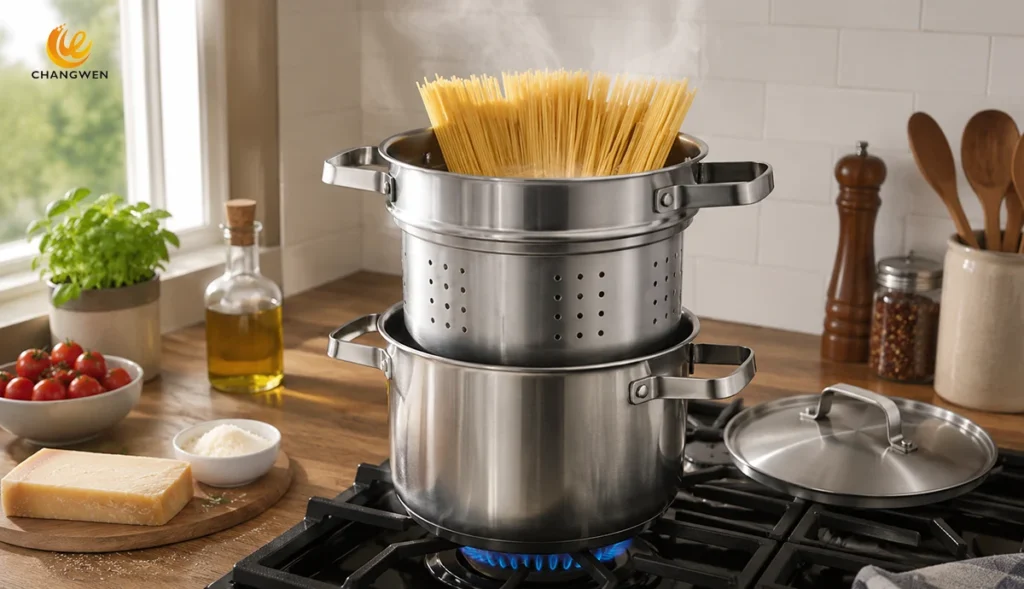
A stock pot or dedicated pasta cooking vessel sold with a perforated stainless steel insert basket that sits inside the pot. Pasta is cooked in the basket, which is then lifted straight out of the boiling water, draining back into the pot. The water remains in the pot, hot and starchy, ready for the next batch or for use in sauce.
This is the practical standard for any kitchen where pasta is prepared regularly. Commercial pasta pots typically range in size from 8 to 20 quarts and are designed for use with perforated inserts. Pasta baskets and inserts may include hooks for latching onto the pot rim. This configuration is the most versatile pasta cooker pot format for both home and commercial kitchen use.
Multi-Basket Pasta Cooker Set
A larger pasta pot configuration accommodating multiple independent insert baskets — typically quarter-size or third-size perforated inserts that divide the pot into sections. Each basket can hold a different pasta type or a different batch, cooked simultaneously in the same pot of boiling water.
Best for: High-volume restaurant pasta stations where multiple pasta types are prepared simultaneously and portions need to be pulled from the water in a controlled sequence rather than all at once.
Dedicated Commercial Pasta Cooker Equipment
Floor-standing or countertop commercial equipment — separate from stovetop cookware — with built-in heating elements, thermostat control, and integrated basket wells. These systems operate independently from the stovetop range and can be positioned specifically for pasta station work.
Best for: Very high-volume pasta operations (Italian restaurant flagship kitchens, hotel pasta stations, large institutional catering) where pasta production is a primary kitchen focus and freeing up stovetop space is operationally important.
This buying guide focuses primarily on pasta cooker pots in the stovetop pot format — the most accessible and most widely used configuration for both commercial and home cooking.
Pots for Cooking Pasta: Material Comparison
For the demanding environment of a professional kitchen, stainless steel is often the most reliable option. It’s incredibly durable, heats up evenly, and generally plays well with all types of stovetops, from gas to induction. But not all materials perform equally across all pasta cooking applications. Here is the complete comparison.
304 Stainless Steel: The Professional Standard
Construction: 18% chromium, 8% nickel alloy (18/8). Non-reactive. Magnetic only if the base includes a 430 stainless or composite layer for induction compatibility.
Performance for pasta: Stainless steel with an encapsulated aluminum base maintains rolling boil temperature effectively through cold pasta additions because the aluminum layer distributes heat rapidly from the burner. Single-ply stainless (without aluminum core) has lower thermal conductivity and creates hot spots — acceptable for home use, limiting at commercial volume.
Why it is the right choice for serious pasta cooking:
- Non-reactive with slightly acidic pasta water (salted water, or water from starchy pasta, can have pH around 5.5–6.5)
- Survives commercial dishwasher cleaning without surface degradation
- Service life of 8–15 years in daily professional use
- The starchy pasta water that collects in the pot is free of any metal contamination — it can be used directly in sauces
Limitation: Single-ply stainless steel alone has low thermal conductivity (16 W/m·K versus aluminum’s 205 W/m·K). For pasta pots specifically, this means the base must include an aluminum layer or the pot will struggle to maintain rolling boil under heavy load.
Aluminum (Standard and Hard-Anodized)
Performance: Aluminum heats significantly faster than stainless and maintains boil temperature well under load. Pure aluminum pots are lightweight and economical.
Limitation for pasta: Standard aluminum is reactive with acidic ingredients and leaches metal ions under extended contact. For pasta water — where the pot is in contact with water and pasta starch for 8–15 minutes per batch — this reactivity is minimal but present over time. Hard-anodized aluminum dramatically reduces reactivity, making it an acceptable alternative to stainless for pasta cooking.
Commercial kitchen consideration: Bare aluminum does not meet NSF food contact standards for commercial kitchen licensing in most US jurisdictions. Hard-anodized aluminum may satisfy compliance requirements depending on the specific certification scope.
Tri-Ply (Stainless Steel / Aluminum / Stainless Steel)
Performance: The full tri-ply construction — stainless exterior, aluminum core, stainless interior — combines the non-reactivity and durability of stainless steel with the thermal performance of aluminum throughout the pot body, not just the base.
Best for: Pasta cooking applications where consistency across the full pot volume matters — the aluminum core maintains even temperature from base to sides, preventing the temperature gradient that can cause pasta near the walls to cook differently from pasta in the center.
Cost: Higher than single-ply stainless with encapsulated base. For pasta operations at commercial scale where the pot is in continuous use, the performance and durability justify the investment.
Cast Iron
Not suitable as a dedicated pasta cooker pot. Cast iron’s thermal mass makes it excellent for heat retention but impractically slow for pasta cooking where rapid heat-up and recovery from cold pasta additions are operationally important. The weight at pasta pot volumes (a 12-quart cast iron pot weighs 15+ lbs empty) creates ergonomic hazards in daily commercial use.
Material Quick Reference
| Material | Heat-Up Speed | Pasta Water Safety | Commercial Cleaning | Service Life |
|---|---|---|---|---|
| 304 SS (encapsulated base) | Good | Excellent — non-reactive | Dishwasher safe | 10–15 years |
| Tri-ply SS | Very good | Excellent — non-reactive | Dishwasher safe | 10–15+ years |
| Hard-anodized aluminum | Excellent | Good — low reactivity | Hand wash recommended | 5–8 years |
| Standard aluminum | Excellent | Poor — reactive | Hand wash only | 3–5 years |
| Cast iron | Very slow | Acceptable | Seasoning required | Decades |
Size Guide: Matching Pot Capacity to Your Volume
Size is the most consequential decision for pasta cooking performance. An undersized pot compromises pasta quality — crowded pasta in insufficient water loses boil temperature, sticks together, cooks unevenly, and absorbs excess starch into a gummy texture.
The Water Volume Rule for Pasta
The professional standard: 4–5 quarts (approximately 4–5 liters) of water per pound (450g) of dry pasta.
This ratio ensures pasta moves freely in the water, the boil recovers quickly after pasta is added, and starch dilutes sufficiently to prevent gummy texture.
Home and Light Commercial Use
| Pot Size | Water Capacity (at 4/5 ratio) | Pasta Capacity (dry) | Best For |
|---|---|---|---|
| 6 qt (5.7L) | ~5 qt usable | Up to 1.2 lbs | 2–4 portions |
| 8 qt (7.6L) | ~6.5 qt usable | Up to 1.5 lbs | 3–5 portions |
| 10 qt (9.5L) | ~8 qt usable | Up to 2 lbs | 4–6 portions |
| 12 qt (11.4L) | ~10 qt usable | Up to 2.5 lbs | 5–8 portions, small catering |
For most home cooks producing pasta for 2–6 people, an 8-quart pasta cooker pot with insert is the optimal size — large enough for a complete meal batch, manageable for lifting when full.
Commercial and Restaurant Use
| Pot Size | Water Capacity | Pasta Capacity | Portions (4 oz dry each) | Best For |
|---|---|---|---|---|
| 12 qt | ~10 qt usable | ~2.5 lbs | ~10 portions | Small restaurant, café |
| 16 qt | ~13 qt usable | ~3 lbs | ~12 portions | Mid-volume restaurant |
| 20 qt | ~16 qt usable | ~4 lbs | ~16 portions | High-volume restaurant workhorse |
For a restaurant serving 60 pasta dishes per service (at 4 oz dry per portion): 60 × 4 oz = 15 lbs total pasta needed. With a 20-quart pot cooking ~4 lbs per batch, approximately 4 batch cycles are needed — or two 20-quart pots running simultaneously reduces batch cycling significantly.
The commercial pasta station setup: Most Italian-focused restaurant lines use 2–3 × 20-quart pasta pots running simultaneously with a multi-basket insert system. This allows continuous pasta production throughout service without waiting for temperature recovery between batches.
The Pasta Insert Basket: Why It Changes Everything
The perforated insert basket transforms a standard stock pot into a dedicated pasta cooker pot — and it is the feature most worth paying attention to when evaluating any pasta cooking vessel.
What the Insert Basket Does
The insert basket is a perforated stainless steel or mesh basket that sits inside the pot, holding the pasta while it cooks. When the pasta is done, the entire basket is lifted straight out of the boiling water, which drains back through the perforations into the pot below.
This one feature eliminates three operational problems:
No need to move the pot for draining. A 20-quart pot full of boiling water weighs approximately 20 kg (44 lbs). Carrying this to the sink to drain through a colander is a significant safety hazard — one of the most common causes of commercial kitchen burns. The insert basket eliminates this movement entirely.
The pasta water is preserved. Starchy pasta water — the hot, cloudy water that pasta has been cooking in — is one of the most valuable tools in pasta cooking. A tablespoon of pasta water added to a sauté pan with pasta and sauce emulsifies the sauce, creates body, and helps the sauce coat the pasta. This is why restaurant pasta consistently tastes different from pasta cooked at home: the professional kitchen always has starchy pasta water available because the insert basket keeps it in the pot. When you drain pasta over the sink, this water is lost.
Multiple batches, one pot of water. With an insert basket, pasta water is used through an entire service without being discarded between batches. The water becomes progressively more starchy with each batch, which improves its sauce-enhancing function. A restaurant running 40 pasta orders does not drain and refill its pasta water 40 times — the water runs continuously through service.
Insert Basket Specifications to Evaluate
Perforation size: Larger perforations (6–8mm) drain faster — better for thick pasta shapes (penne, rigatoni, fusilli). Smaller perforations (3–4mm) prevent small pasta shapes (orzo, small shells, couscous) from falling through. For restaurants with varied pasta menus, interchangeable inserts with different perforation sizes provide complete flexibility.
Handle design: The insert handle must be long enough to keep the user’s hand away from steam when lifting — a minimum of 15–20cm of handle clearance above the pot rim is the practical standard. Heat-resistant handle coating (silicone sleeve or PVC-grip) prevents burns from steam conduction through metal handles.
Fit precision: The insert should sit securely within the pot without wobbling and be close enough in diameter to the pot interior that pasta cannot escape around the sides — while still leaving clearance for water circulation around the basket. Poorly fitted inserts allow pasta to escape below the basket and require separate straining.
Heat Source Compatibility: Gas, Electric, Induction
A pasta cooker pot must be compatible with the heat source in your kitchen. Here is what each heat source requires.
Gas Burner
Gas is the commercial kitchen standard for pasta cooking because high BTU output (25,000–35,000 BTU on commercial ranges) drives rapid return to boil after cold pasta addition. Any pasta pot works on gas — material and base construction determine how quickly the boil recovers, but all materials work on gas burners. For large pasta pots (16–20 quarts), match the burner ring diameter to the pot base diameter to ensure even heat across the full base area.
Electric Coil and Glass-Top Electric
Electric cooktops require a flat, stable pot base for maximum surface contact with the heating element. A pot with a convex or slightly warped base — even warped from a single heat-shock event — loses contact with the electric element and heats unevenly. Stainless steel pots with heavy-gauge encapsulated bases resist warping and maintain flat contact with electric cooktops through years of use.
Induction
Induction cooktops require a magnetic base layer. Standard 304 stainless steel is austenitic (non-magnetic) and does not work on induction. For induction-compatible pots for cooking pasta, specify either:
- A pasta pot with a 430 stainless steel magnetic exterior base layer bonded to the encapsulated aluminum base
- A tri-ply construction with a magnetic exterior layer
A simple field test: if a magnet adheres firmly to the pot base, it is induction-compatible. If the magnet slides off, the pot will not work on induction cooktops.
Commercial Pasta Cooker Pot vs. Home Pasta Pot: Key Differences
While you can boil pasta in just about any large pot, a dedicated pasta pot offers several advantages in a professional kitchen. The differences between a commercial pasta cooker pot and a home pasta pot reflect the operating environment gap discussed throughout this guide.
| Specification | Home Pasta Pot | Commercial Pasta Cooker Pot |
|---|---|---|
| Wall gauge | 0.5–0.8mm | 1.0–1.5mm minimum |
| Base construction | Thin encapsulated or single-ply | Heavy encapsulated or tri-ply |
| Handle attachment | Welded or riveted (light) | Riveted, load-rated for commercial use |
| Insert basket | Often included, light gauge | Heavy-gauge perforated stainless, precision-fit |
| NSF certification | Rarely | Standard requirement for commercial kitchen |
| Service life | 3–8 years with careful use | 10–15+ years in daily commercial use |
| Dishwasher tolerance | Variable | Commercial dishwasher safe |
| Price range | Moderate | Higher upfront, lower total cost of ownership |
The key principle: a home pasta pot used in a restaurant kitchen will fail — in warped base, loosened handles, degraded insert basket — within months of commercial frequency use. The correct investment is a commercial-grade pasta cooker pot from the beginning.
What to Look for When Buying a Pasta Cooker Pot
Material Grade Documentation
For any stainless steel pasta cooker pot purchased for commercial use, require documentation of the steel grade — specifically a Mill Test Certificate confirming ≥18% chromium and ≥8% nickel (304 grade). Product listings that state “stainless steel” without specifying grade may be 201-grade steel, which looks identical but corrodes under daily commercial cleaning within 12–24 months.
Base Construction Type
Ask specifically: encapsulated base (aluminum disc bonded to base), tri-ply, or single-ply? For pasta cooking specifically, the base construction determines boil recovery time — the most operationally important performance factor at commercial volume.
Insert Basket Quality
The insert basket is used more frequently than the pot itself — lifted in and out of boiling water tens of times per service. Evaluate:
- Gauge of the perforated sheet (thicker = more rigid, less flex during lifting)
- Handle length and grip material
- Perforation size versus your typical pasta shapes
- Fit precision within the pot
NSF Certification
For commercial kitchen distribution: NSF/ANSI 2 food equipment compliance. Verify the listing number at nsf.org — not the certificate image alone.
Handle Load Rating
For commercial pasta pots (12-quart and above), handles must be rated for the full pot load: a 20-quart pot full of boiling water weighs approximately 20 kg. Riveted handles (steel rivets through the pot wall) are the commercial standard. Welded-only handles on large pasta pots are a long-term reliability risk under daily commercial use.
Pasta Cooker Pot Maintenance and Care
A well-maintained pasta cooker pot in commercial use requires a straightforward but consistent care protocol.
Daily Care
After each service, clean the pot and insert basket while still warm — food residue releases more easily from warm stainless than from a cold surface. For stainless steel pasta pots without coatings, commercial dishwasher use is fully acceptable and efficient.
To remove the mineral scale that builds up from repeated pasta water boiling (calcium and magnesium deposits from hard water), fill the pot with a solution of one part white vinegar to three parts water, bring to a simmer for 10 minutes, and rinse thoroughly. This is safe for 304 stainless steel and removes scale buildup without abrasive methods that can scratch the interior surface.
Preventing and Addressing Sticking
Pasta does not stick to a properly used stainless steel pasta cooker pot — it sticks to a pot where the water was not at a full rolling boil when the pasta was added. Always bring water to a full boil before adding pasta, stir immediately after adding pasta, and stir again 30–60 seconds after (when starch is released and sticking risk is highest). Adding oil to pasta water — a common misconception — does not prevent sticking and coats the pasta surface in a way that prevents sauce from adhering.
Insert Basket Care
The insert basket endures the most mechanical stress of any component in the pasta cooker pot set — repeated immersion in boiling water, repeated lifting under pasta load, repeated stacking and storage. For longevity:
- After washing, dry completely before storage to prevent water spot buildup on the perforated surface
- Store nested within the pot rather than inverted on top, which can deform the rim over time
- Inspect handle attachment rivets or welds monthly in commercial use — early signs of loosening are catchable before handle failure
Changwen: Pasta Cooker Pot Manufacturer for Wholesale Programs
Changwen Cookware & Kitchenware Co., Ltd. is a professional pasta cooker pot manufacturer and stainless steel cookware manufacturer based in Jiangmen, Guangdong, China — the primary stainless steel commercial cookware manufacturing cluster globally. With over 20 years of production experience, Changwen supplies commercial-grade pasta cooker pots, stock pots, and cookware sets to restaurant equipment distributors, hotel supply programs, and private-label cookware brands across 80+ countries.
Changwen Pasta Cooker Pot Specifications
Every pasta cooker pot in the Changwen commercial range is built to the following verified specifications:
- Steel grade: 304 stainless steel (18% chromium minimum, 8% nickel minimum) — verified by Mill Test Certificate per production batch
- Wall gauge: 1.0mm standard commercial; 1.2mm available for heavy-duty specification programs
- Base construction: Encapsulated aluminum base (2.0mm aluminum layer) for even heat distribution and boil recovery performance
- Handle attachment: Stainless steel rivets through the pot wall — load-rated for full commercial use
- Insert basket: Heavy-gauge perforated 304 stainless steel, precision-fit to pot interior, with heat-resistant long handle
- NSF/ANSI 2: Food equipment compliance documentation provided with every commercial wholesale order
Available Configurations
| Size | Inserts Included | Configuration |
|---|---|---|
| 8 qt | 1 × full-size insert | Single basket |
| 12 qt | 1 × full-size insert | Single basket |
| 16 qt | 1 full or 2 × half inserts | Single or dual basket |
| 20 qt | 2 × half or 4 × quarter inserts | Multi-basket commercial |
OEM and Wholesale Programs
- Standard wholesale MOQ: 1,000 units per SKU
- Custom configuration (new tooling): 10,000 units
- OEM branding: Custom logo (laser engraving), custom packaging, custom insert materials — available from 1,000-unit MOQ
- Documentation included: Mill Test Certificate, NSF/ANSI 2 compliance, FDA food contact letter, LFGB test report (EU programs), ISO 9001 certificate
- Sample program: 5–20 unit samples available within 7–10 days
FAQ
What size pasta cooker pot do I need for a restaurant?
For most full-service restaurant pasta programs, 20-quart pasta cooker pots are the commercial standard. A single 20-quart pot cooks approximately 4 lbs of dry pasta per batch — enough for 15–16 portions at 4 oz dry pasta each. For a restaurant serving 60 pasta covers per service, two 20-quart pots running simultaneously allows continuous production without throughput constraints. For a smaller café or bistro serving under 20 pasta portions per service, a 12-quart pasta cooker pot handles the volume.
What is the best material for a pasta cooker pot?
304 stainless steel with an encapsulated aluminum base is the best material for any pasta cooker pot used in commercial or frequent home cooking. It is non-reactive with pasta water, survives commercial dishwasher cleaning, has a service life of 10–15 years in daily use, and with an encapsulated aluminum base provides the heat distribution performance needed to maintain rolling boil through cold pasta additions. Verify grade with a Mill Test Certificate when sourcing wholesale.
What is the purpose of the insert basket in a pasta cooker pot?
The perforated insert basket allows pasta to be cooked, lifted, and drained in one motion — without moving the pot and without discarding the pasta water. Lifting the basket out of the pot drains the water back through the perforations into the pot below. This preserves the starchy pasta water (a critical sauce ingredient), eliminates the safety risk of carrying a heavy pot of boiling water to a drain, and allows continuous multiple batches through the same water during a restaurant service.
Is a pasta cooker pot the same as a stock pot?
A pasta cooker pot and a stock pot share the same basic tall, straight-sided cylindrical form. The distinction is functional: a pasta cooker pot is specifically paired with a perforated insert basket and is sized and constructed for the specific requirements of pasta cooking — enough volume for free pasta movement, base construction for rapid boil recovery, and handle engineering for frequent heavy-load lifting. A stock pot without an insert basket can be used for pasta but requires separate draining and discards the pasta water. Many pasta cooker pots in the 8–20 quart range are sold as stock pot and pasta cooker combinations.
What is the difference between commercial and home pasta cooker pots?
Commercial pasta cooker pots are built to survive daily high-frequency use: 1.0mm+ wall gauge (versus 0.5–0.8mm in consumer products), heavy-gauge encapsulated aluminum base for rapid boil recovery, riveted handle attachment rated for full-load commercial use, and NSF food equipment certification. A home pasta pot used in a restaurant kitchen typically shows warping, handle loosening, and insert basket deformation within months of commercial frequency use. The upfront cost difference is real but the 10–15 year service life of a commercial pasta cooker pot versus 3–5 years for a home pasta pot makes the commercial specification the lower total cost of ownership for any professional kitchen.
Can a pasta cooker pot be used on induction?
Yes — if it is specified for induction compatibility. Standard 304 stainless steel is non-magnetic and does not work on induction cooktops. Induction-compatible pasta cooker pots require a magnetic base layer: either a 430 stainless steel exterior base layer or a composite magnetic base bonded to the aluminum encapsulation. Apply a magnet to the pot base — firm adhesion confirms induction compatibility. When ordering wholesale, specify induction compatibility explicitly, as it is a configuration option not automatically included on all models.
What should I look for when buying a pasta cooker pot wholesale?
When sourcing pasta cooker pots wholesale, require: (1) Mill Test Certificate confirming 304 stainless steel grade (≥18% chromium, ≥8% nickel) per production batch; (2) NSF/ANSI 2 food equipment compliance with verifiable listing number at nsf.org; (3) wall gauge specification in writing — minimum 1.0mm for commercial use; (4) handle attachment type — riveted for commercial load requirements; (5) insert basket gauge and perforation size specifications; (6) pre-shipment inspection report confirming compliance before goods are shipped. These six requirements distinguish a verified commercial-grade pasta cooker pot from a product listing that claims specifications without documenting them.
Conclusion
The difference between a pasta cooker pot that works correctly for years and one that becomes a daily friction point in your kitchen — warping under heat, handles that flex under load, an insert basket that fits imprecisely — almost always traces back to decisions made at the buying stage.
Material grade. Base construction. Handle attachment. Insert basket quality. NSF documentation. These are the specifications that matter, verified before purchase rather than discovered after delivery.
The buying framework from this guide:
- 304 stainless steel with encapsulated aluminum base — the commercial standard for all serious pots for cooking pasta
- Size to volume — 4–5 quarts of water per pound of pasta, scaled to your service output
- Insert basket — the feature that preserves pasta water, eliminates heavy pot movement, and enables continuous batch cooking
- Commercial versus home spec — based on frequency, not kitchen size
- Documentation — MTC, NSF listing, handle load rating — confirmed before committing to any wholesale program