Read time: 11 min
Introduction
Walk into any kitchen store and the shelves tell a very clear story.
Non-stick pans in every size. Colorful coatings. Promises of effortless cleanup. Beautiful photography of eggs sliding out of pans as if gravity itself has been politely asked to step aside. Add to cart. Ship to door. Cook one good omelette.
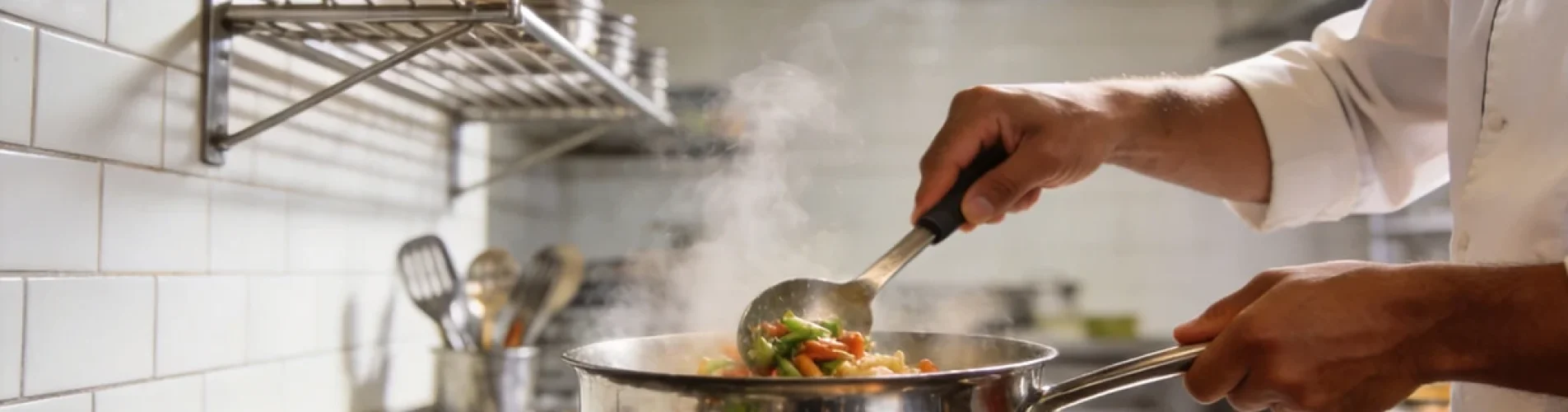
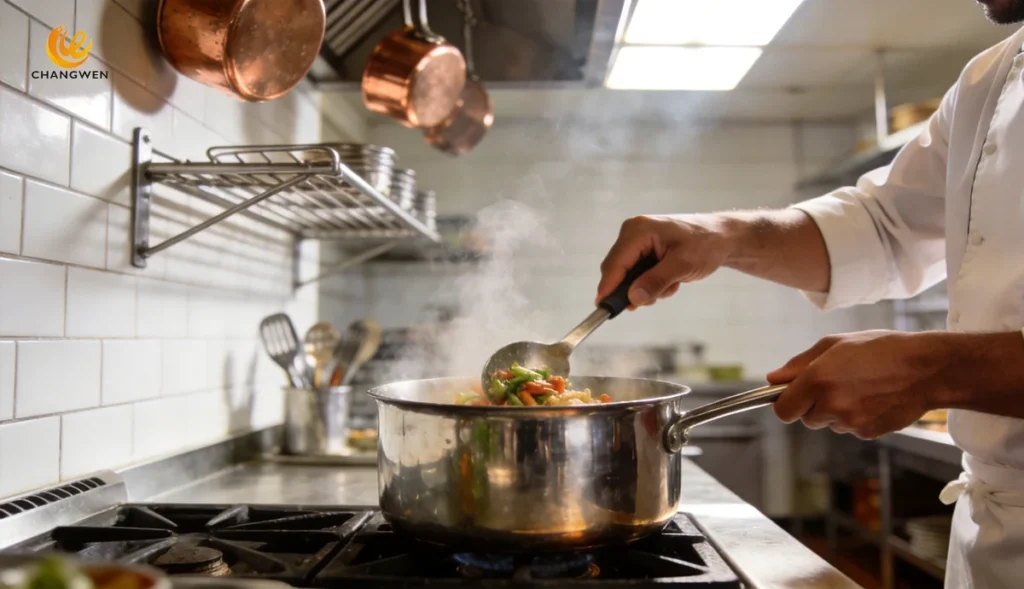
Now walk into the back of any serious restaurant kitchen — a taqueria, a steakhouse, a hotel breakfast line, a Michelin-starred service kitchen — and look at the cookware.
You will not find those pans.
What you will find is stainless steel. Carbon steel. Cast iron. Heavy, uncoated, demanding pans that require technique rather than coating to release food. Pans that have been used 200 times this week and will be used 200 times next week and, if maintained correctly, will still be in service in five years.
The gap between the cookware consumers love and the cookware restaurants use is not a matter of taste or tradition. It is a gap in operating environment, performance requirements, and the cold economics of what happens to a non-stick coating when a professional kitchen gets hold of it.
This article explains exactly why that gap exists — and what it reveals about what actually matters in a cooking surface.
Key Takeaways
- Non-stick cookware is designed for a home kitchen environment: moderate temperatures, infrequent use, gentle cleaning, and patient handling. Commercial kitchens operate at every extreme of all four variables. The coating that makes non-stick convenient at home is precisely what makes it impractical in a restaurant.
- The Maillard reaction — the high-heat chemical reaction between proteins and sugars that creates the sear, the crust, the caramelization that defines restaurant food — requires direct, high-heat metal contact. Non-stick coatings insulate food from the pan surface, slowing the reaction and limiting the flavor development that professional cooking depends on.
- A non-stick pan used in a commercial kitchen has a functional lifespan of 1–3 months before coating degradation compromises performance. The same pan in a home kitchen lasts 1–3 years. At restaurant usage frequency, replacing non-stick pans would cost a kitchen $2,000–$8,000 per year per station — before accounting for the safety implications of damaged PTFE coating.
- 304 stainless steel is the dominant commercial kitchen material because it combines non-reactivity (safe for acidic ingredients), heat stability (no coating to degrade at high temperatures), cleaning tolerance (survives commercial dishwashers and abrasive scrubbing), and a lifespan measured in decades rather than months.
- The technique gap is real: cooking on stainless steel requires knowing how to prevent sticking (proper preheating, the Leidenfrost effect, adequate fat at the right moment) — skills that non-stick pans mask at home but that professional kitchens develop as a baseline competency.
- As a stainless steel cookware manufacturer with decades of commercial kitchen supply experience, we can confirm: not one restaurant in our customer base has ever requested a non-stick pan as their primary cooking vessel. The reasons they give are the same reasons in this article.
The Cookware Gap: What You Buy vs. What Professional Kitchens Use
The most popular cookware categories in consumer retail are, in order: non-stick (ceramic or PTFE-coated), enameled cast iron, and stainless steel sets marketed primarily on appearance. Non-stick dominates. It is the default purchase for millions of home cooks who reasonably prioritize ease of use and cleanup.
The most common cookware in commercial kitchens worldwide is stainless steel, followed by aluminum and carbon steel. Non-stick pans exist in commercial kitchens but occupy a highly specialized role — the delicate fish section, the egg station — not the primary cooking position.
This is not a coincidence or a professional preference for complexity over convenience. It reflects a fundamental incompatibility between what makes non-stick cookware appealing to consumers and what a commercial kitchen requires of its tools every day.
To understand why, you need to understand the operating environment difference — which is more extreme than most home cooks realize.
A home cook uses a non-stick pan perhaps 5–10 times per week. It is used at medium heat most of the time. It is hand-washed gently. It is never stacked without protection. Under these conditions, a quality non-stick pan can last 1–3 years before the coating degrades noticeably.
A commercial kitchen uses a pan 50–200 times per week. It runs at high heat routinely. It is washed in a commercial dishwasher with aggressive detergents or scrubbed with metal pads by a dishwasher in a hurry. It is stacked in a shelf with other pans, sometimes roughly. Under these conditions, the same non-stick pan degrades in weeks, not years.
The commercial kitchen did not reject non-stick cookware because of snobbery. It rejected non-stick cookware because the environment destroyed it.
Why Non-Stick Pans Rarely Survive a Commercial Kitchen
Non-stick coatings — whether traditional PTFE (polytetrafluoroethylene) or newer ceramic-based alternatives — work by providing a surface with very low surface energy, meaning food molecules do not adhere to it readily. This is genuine engineering. The chemistry is real. The convenience it provides is real.
The problem is that the chemistry is fragile at the scale of commercial kitchen use.
Temperature Sensitivity
PTFE coatings begin to degrade at sustained temperatures above 260°C (500°F). In a commercial kitchen, a sauté pan going into a 300°C (570°F) oven is a normal event. A pan placed on a high-BTU commercial burner and forgotten briefly while the chef handles another station reaches surface temperatures well above this threshold routinely.
At these temperatures, the PTFE polymer begins to break down, releasing degradation products. The coating loses adhesion to the substrate beneath it. Surface pitting begins. The non-stick property degrades unevenly — some areas release food easily while others do not, which is operationally worse than a pan that sticks uniformly (because uniform sticking can be managed with technique; unpredictable sticking cannot).
Modern ceramic coatings tolerate higher temperatures but have their own failure mode: microcracking under thermal shock. A ceramic-coated pan that goes from a hot burner into cold water (a common event in a busy kitchen service) develops microscopic fractures in the coating that accumulate over repeated cycles, progressively degrading the non-stick surface.
Physical Wear
In a commercial kitchen, stainless steel spatulas, metal tongs, and wire whisks contact the cooking surface hundreds of times per day. Non-stick coatings are soft by necessity — the same molecular properties that make them non-stick make them susceptible to scratching and abrasion. Even with the most careful professional handling, the mechanical wear of a commercial kitchen service compresses years of consumer kitchen wear into weeks.
Cleaning Aggressiveness
Commercial kitchens clean at a scale and speed that home kitchens do not. A non-stick pan that gets scrubbed with a Scotch-Brite pad by a dishwasher who is cleaning 200 pans in two hours loses its coating faster than any temperature or physical wear could account for. Commercial dishwashers run at temperatures above 82°C (180°F) with alkaline detergents that attack coating adhesion. Neither is a problem for bare stainless steel or carbon steel. Both are accelerated degradation mechanisms for any coated surface.
The Maillard Reaction: Why Stainless Steel Builds Flavor That Non-Stick Cannot
There is a practical reason — beyond durability — why professional kitchens prefer uncoated metal surfaces. It is about flavor, and it is about a specific chemical reaction that defines how restaurant food tastes.
What the Maillard Reaction Is
The Maillard reaction is a chemical process that occurs when proteins and reducing sugars in food are exposed to high heat — typically above 140–165°C (280–330°F) — and react to form hundreds of new flavor and aroma compounds simultaneously. This reaction is responsible for the brown crust on a seared steak, the caramelized surface of a roast chicken, the golden underside of a sautéed piece of fish, the deep brown fond at the bottom of a pan that forms the base of every pan sauce.
Without the Maillard reaction, food is cooked but not developed. Proteins are denatured (safe to eat) but not transformed (developed in flavor). It is the difference between food that is done and food that is good.
Why Non-Stick Limits This Reaction
The Maillard reaction requires direct, intense, sustained heat transfer from the pan surface to the food surface. The non-stick coating — even the thinnest ceramic or PTFE layer — acts as a thermal insulator between the metal substrate (which heats rapidly to high temperatures) and the food surface.
This insulation effect slows the rate of heat transfer to the food, requiring either longer cooking times or higher pan temperatures to achieve the same surface browning. At home, this is a manageable compromise — cook a little longer, accept a slightly less developed sear. In a restaurant kitchen producing 80 orders of the same protein in a service, the accumulated effect of slower Maillard development means less flavorful food served more slowly with greater inconsistency.
The fond — the browned bits that stick to the bottom of a stainless steel or carbon steel pan — is not a cleaning problem. It is a flavor resource. Every pan sauce, every quick jus, every butter-based finishing sauce in a restaurant begins with that fond being deglazed with wine, stock, or acid. A non-stick pan produces almost no fond because nothing sticks to it. The chef who reaches for a non-stick pan has traded the flavor development mechanism for cooking convenience.
This is a trade professional kitchens rarely accept.
Heat: The Real Reason Restaurants and Consumers Live in Different Worlds
The most fundamental difference between a home kitchen and a professional kitchen is not the equipment, the technique, or the ingredients. It is the heat.
A standard home gas stove produces 7,000–12,000 BTU per burner. A commercial restaurant range produces 25,000–35,000 BTU per burner, and some specialty wok ranges produce 150,000 BTU or more. The difference is not a matter of degree — it is an entirely different cooking environment.
At commercial BTU levels, a pan heats to cooking temperature in 60–90 seconds. Food added to the pan is immediately exposed to high surface heat. Temperature recovery after adding cold food is fast. The entire cooking process happens at higher temperatures for shorter durations.
This heat environment is specifically hostile to non-stick coatings in two ways:
First, the high surface temperatures reached on commercial burners exceed safe operating ranges for most non-stick materials within the first 90 seconds of preheating. Second, the speed of cooking at commercial heat means that temperature fluctuations — from adding cold food, from flambéing, from pan transfer — happen faster and more dramatically than home cooking, accelerating the thermal shock degradation that damages ceramic coatings.
Stainless steel, carbon steel, and cast iron have no operating temperature ceiling within the range of any commercial cooking application. They heat up, they cook at whatever temperature is required, they survive cleaning, and they do it again. For a material that needs to do this 200 times per week, the absence of a temperature limit is not a minor advantage. It is the entire basis for commercial kitchen selection.
The Lifespan Math: What Non-Stick Costs a Restaurant vs. a Home Cook
This section does the math that most people skip — and the math is decisive.
Home Kitchen Economics
A quality consumer non-stick pan costs $40–$120. Used 5–10 times per week with careful handling, it lasts 1–3 years before the coating degrades to the point of replacement. Annual cost: $15–$120 per pan. For most home cooks, this is acceptable.
Commercial Kitchen Economics
The same pan in a commercial kitchen, used 50–200 times per week, typically lasts 1–4 months before coating failure forces replacement. At a replacement cost of $40–$120:
- 3 replacements per year × $80 average cost = $240/year per pan
- A typical restaurant line has 8–12 sauté pans in rotation
- Total non-stick pan replacement cost: $1,920–$2,880 per year
And this assumes the pans are being managed carefully. In a busy commercial kitchen where dishwashers are moving fast and line cooks are focused on output, pan damage happens faster.
A comparable stainless steel cookware setup for the same 8–12 pan line:
- Commercial 304 stainless sauté pans: $30–$80 per unit
- Service life in daily commercial use: 8–15 years with normal maintenance
- Annual cost amortized: $25–$75 per pan
- Total annual cost for the line: $200–$900
Over a 10-year period, a restaurant that equipped its line with quality stainless steel spends roughly 15–25% of what it would spend replacing non-stick pans at commercial degradation rates. The math is not even close.
This economic reality is one reason commercial kitchens adopted stainless steel as the standard decades ago and have never meaningfully revisited the decision.
What Restaurants Actually Use — and Why Each Material Earns Its Place
Commercial kitchens are not monolithic. They use different materials for different purposes, and understanding why each material is chosen reveals the performance logic that home cooks rarely have access to.
Stainless Steel: The Foundation
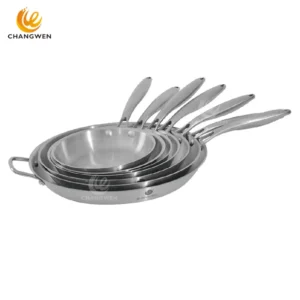
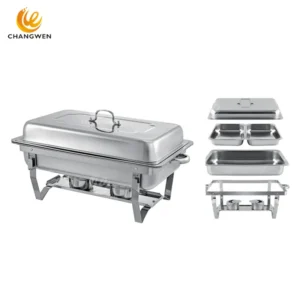
304 stainless steel (18/8 — 18% chromium, 8% nickel) is the dominant commercial kitchen material for saucepans, sauté pans, stock pots, food pans, and most cookware that needs to be versatile, durable, and non-reactive. As any stainless steel cookware manufacturer with commercial kitchen experience will confirm, stainless steel is chosen for its combination of non-reactivity (safe for acidic ingredients), heat stability, cleaning tolerance, and longevity.
The perceived weakness of stainless steel — food sticking to an uncoated surface — is a technique problem, not a material problem. A properly heated stainless steel pan with adequate fat behaves nearly non-stick for most applications. This is the Leidenfrost effect in practice: heating the pan until the surface is hot enough that water droplets bead and dance rather than sitting still. At this temperature, food added to the pan forms a natural protein skin that releases from the surface rather than bonding to it.
Carbon Steel: The Chef’s Everyday Workhorse
Carbon steel — the same material used for cast iron but significantly thinner — is the dominant material for frying pans, sauté pans, and crêpe pans in professional kitchens. Lighter than cast iron, with faster heat response and the same ability to develop a natural seasoned non-stick surface with use, carbon steel is what most professional cooks reach for when they need a pan that combines high-heat performance with usable weight.
Aluminum: Speed and Cost Efficiency
Uncoated aluminum is lighter than stainless and conducts heat more rapidly — approximately 13× faster than stainless steel. In high-volume kitchens where heat-up speed and temperature recovery matter more than chemical resistance, aluminum pans are common for specific applications. The limitation is reactivity with acidic ingredients (tomatoes, wine, citrus), which rules aluminum out of sauce and stock production but leaves it appropriate for many protein and vegetable applications.
Cast Iron: Retention Over Response
Cast iron is slow to heat but holds heat exceptionally well once at temperature. Its place in the commercial kitchen is specific: the grill press, the fajita plate, the skillet for service presentations where retained heat is part of the dish. It is not the primary cooking tool — it is a specialist with a specific job.
Non-Stick: The Specialist’s Last Resort
Non-stick pans are not absent from professional kitchens. They are present in a limited, specialized role: the egg station, the crêpe section, the delicate fish preparation area where the cost of sticking is high and the heat required is lower. They are treated as consumables — tools with a defined lifespan — rather than assets. A professional kitchen that uses non-stick pans for their specialized purpose has made a rational tool selection. One that relies on them as primary cooking vessels has not thought through the implications.
The Stainless Steel Case: Why It Is the Default Choice for Serious Cooking
The question a home cook might ask at this point is: if stainless steel is so good for professional kitchens, why doesn’t every home cook use it?
The honest answer is: many home cooks should be using it more than they do.
Why Home Cooks Underestimate Stainless Steel
The consumer marketing around stainless steel cookware emphasizes aesthetics — the gleam, the professional appearance, the brand positioning as “serious cooking.” What it rarely emphasizes clearly enough is the technique required to use it well.
A home cook who buys a stainless steel pan and immediately adds cold food to a room-temperature pan will experience sticking. They will conclude that stainless steel is difficult and reach for the non-stick pan. The conclusion is not wrong — they experienced sticking. But the cause was technique, not material.
Stainless steel requires three things that non-stick conceals: proper preheating (2–3 minutes over medium heat before adding anything), adequate fat added to the hot pan before food, and patience to let proteins release naturally rather than forcing them. These are learnable skills that every professional cook masters in the first weeks of kitchen training. Non-stick pans mean home cooks never have to learn them.
What Stainless Steel Offers That Cannot Be Replicated
Non-reactivity with all ingredients at all temperatures. Decades of service life under commercial-intensity cleaning. The ability to go from stovetop to 260°C (500°F) oven without limitation. The development of fond and the pan sauce tradition that depends on it. Compatibility with metal utensils, commercial dishwashers, and the most aggressive cleaning protocols. All of this is specific to uncoated metal surfaces.
As a stainless steel cookware manufacturer supplying commercial kitchens worldwide, we have seen these properties proven across millions of service cycles in thousands of restaurants. The materials that survive commercial kitchen environments are the materials that deserve respect in any kitchen.
What Home Cooks Can Learn From the Restaurant Kitchen
This article is not an argument that non-stick pans are bad or that home cooks should throw out everything they own. Non-stick has genuine applications — eggs at low temperature, delicate fish, crêpes — and the convenience it provides is real. The argument is about proportion: non-stick should be a specialist tool in the kitchen, not the primary one.
What the restaurant kitchen teaches the home cook:
Heat is flavor. Every technique professional kitchens use — from the screaming hot sear on a steak to the rapid high-heat stir-fry — is about applying the right heat at the right moment to build the Maillard reaction compounds that make food taste like restaurant food. Non-stick pans slow this process. Stainless or carbon steel pans enable it.
Technique is reusable; coating is not. The skills developed cooking on an uncoated pan — proper preheating, reading the heat by visual and auditory cues, managing protein release without force — apply to every pan in every kitchen. The convenience of a non-stick coating applies only while the coating is intact.
Durability has real value. A well-made stainless steel pan purchased today and maintained correctly will outlast every non-stick pan in any kitchen by a factor of 5–10. The upfront cost is higher. The total 10-year cost is dramatically lower, and the performance stays consistent rather than degrading.
The pan is not the hard part. Professional kitchens use technically demanding, uncoated cookware and consistently produce better food than most home kitchens. The cookware did not make the food better — the skills did. But the cookware does not limit the skills either.
FAQ
Why do restaurants not use non-stick pans as their primary cookware?
Restaurants primarily avoid non-stick pans because the commercial kitchen environment destroys non-stick coatings rapidly — through high heat exposure, abrasive cleaning, physical impact, and use frequency that far exceeds consumer kitchen conditions. A non-stick pan that lasts 1–3 years with careful home use typically degrades to replacement condition within 1–4 months of commercial kitchen use. Beyond durability, non-stick coatings limit the high-heat Maillard reactions that build flavor in professional cooking, and produce almost no fond — the browned residue that forms the basis of pan sauces, one of the primary flavor tools in restaurant kitchens.
What cookware do professional restaurants actually use?
The primary cookware in most professional restaurant kitchens is 304 stainless steel (for saucepans, stock pots, and general cooking) and carbon steel (for frying pans and sauté work). High-end kitchens may use lined copper for precise temperature control. Cast iron appears in specific applications — grill presses, service skillets — where heat retention is specifically valuable. Non-stick pans are present in limited specialist roles (egg stations, crêpe sections, delicate fish preparation) but are treated as consumables with a defined lifespan rather than primary kitchen assets.
Can home cooks use stainless steel cookware effectively without food sticking?
Yes — with two techniques. First, always preheat the empty stainless steel pan over medium heat for 2–3 minutes before adding any fat or food. The pan is ready when a few drops of water added to the surface bead up and glide freely rather than immediately evaporating (this is the Leidenfrost effect in practice). Second, add your cooking fat to the hot pan, heat until it shimmers, and then add food. Protein-rich foods (meat, fish, eggs) will initially stick to the surface but will release naturally as a crust forms — resist the urge to move them. These two adjustments make stainless steel cookware largely non-stick for most applications without relying on a coating.
How long does stainless steel cookware last in a commercial kitchen?
Quality 304 stainless steel cookware in daily commercial kitchen use typically lasts 8–15 years with normal maintenance. This compares to 1–4 months for non-stick coated pans in the same environment. The longevity difference is the primary economic driver behind the commercial kitchen’s preference for stainless steel: the higher upfront cost is more than offset by the dramatically reduced replacement frequency over any meaningful time period.
Why is 304 stainless steel the standard material for commercial cookware?
304 stainless steel (containing 18% chromium and 8% nickel) is the commercial kitchen standard because it combines four properties that commercial use demands: non-reactivity with all food ingredients including acidic sauces, wines, and citrus; temperature stability with no performance limit within the range of any cooking application; resistance to corrosion under daily commercial cleaning with aggressive detergents and commercial dishwashers; and a service lifespan measured in decades under heavy commercial use. As a stainless steel cookware manufacturer, we supply 304 grade exclusively for food-contact surfaces because the evidence from commercial kitchen performance is unambiguous — no other material combines these properties at commercial scale.
Conclusion
The cookware your kitchen loves — the non-stick pan with the smooth coating and the effortless cleanup — would be gone within months in a professional restaurant kitchen. Not because restaurants are traditionalists or equipment snobs. Because the commercial kitchen environment tests cookware at extremes that reveal exactly what is resilient and what is fragile.
Non-stick coatings are fragile at commercial intensity. Uncoated metal is not.
Stainless steel, carbon steel, and cast iron earn their place in professional kitchens not through marketing but through performance across thousands of services and millions of heat cycles. They build flavor through mechanisms that coated surfaces cannot replicate. They survive cleaning protocols that destroy coatings. They remain consistent from year one to year ten. They cost less per year of use than replaceable coated pans — often dramatically less.
For home cooks: the lesson from the professional kitchen is not that you should abandon non-stick entirely. It is that non-stick should serve a specific, limited purpose — the eggs, the crêpes, the delicate fish — while uncoated metal does the work that builds flavor and rewards technique.
And for anyone who sources commercial cookware at scale — restaurant operators, equipment distributors, hotel procurement teams — the choice was settled decades ago. Changwen as a stainless steel cookware manufacturer with 20+ years of experience supplying professional kitchens worldwide, we have never had a commercial customer regret choosing stainless steel as their foundation. We have had many tell us they regret trying anything else first.