Read time: 13 min
Introduction
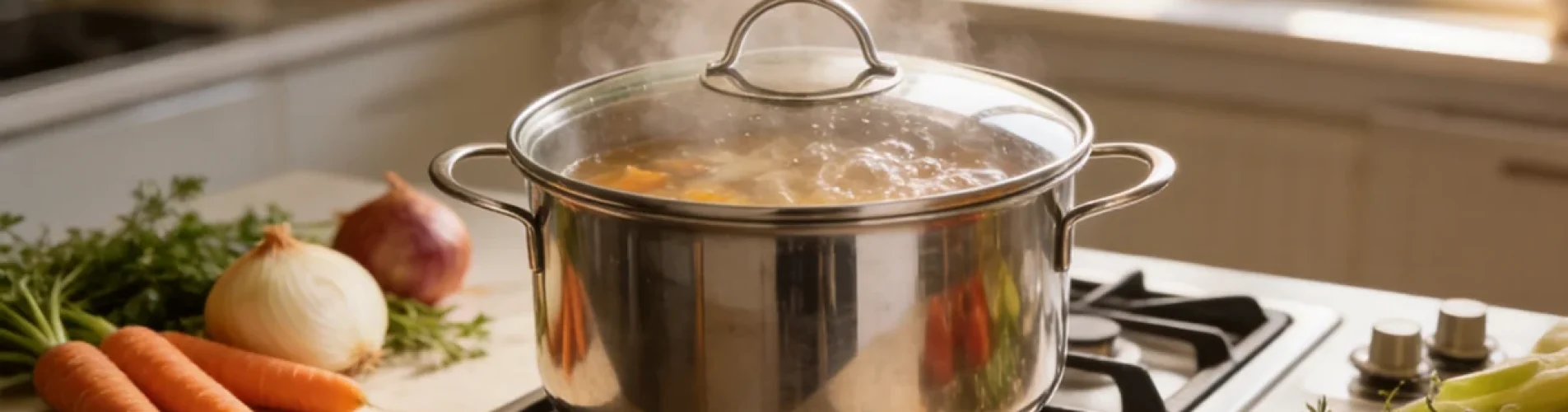
Walk into the back-of-house of any American restaurant — a neighborhood Italian place, a downtown steakhouse, a New England seafood shack, a Tex-Mex taqueria — and you will find the same piece of equipment running through every service, every day.
The stock pot.
It is not the most glamorous piece of kitchen equipment. It does not appear on menu descriptions. Diners never see it. But the stock pot is responsible for more of what makes a restaurant’s food taste distinctly, unmistakably better than home cooking than almost any other single piece of equipment in the kitchen.
The house chicken stock that goes into every sauce, every risotto, every braising liquid. The 40-quart pot of lobster water that boils 25 whole lobsters an hour for Friday night service. The commercial chili that 200 covers will order over the weekend. The pasta water for 300 portions of pappardelle on a Saturday night. The demi-glace reduction that takes three days to make and costs $4 per plate in labor — made in a stock pot.
This guide covers all of it: the top 10 uses of the stock pot in American commercial kitchens, the equipment decisions (stock pot vs crock pot, stock pot vs Dutch oven), how to choose the best stock pot for your operation, practical stock pot recipes for dinner service, and how to source from a stock pot manufacturer in China for wholesale buying programs.
Key Takeaways
- A commercial stock pot is the most versatile piece of cookware in any American restaurant kitchen — used for at least 10 distinct cooking functions across every cuisine category.
- Stock and broth production is the single most commercially important use: house-made stocks are the flavor foundation of soups, sauces, braises, and risottos — differentiating restaurant cooking from home cooking more than any other single preparation.
- For stock pot recipes for dinner service: the stock pot handles everything from stock pot recipes chicken (chicken stock, chicken noodle soup, chicken and dumplings) to pasta boiling, chili, seafood boils, and large-batch sauces.
- Stock pot vs crock pot: Stock pots are the commercial choice — stovetop, faster, controllable heat, larger capacity. Crock pots are slow cookers designed for home use; they lack the volume and heat output for most commercial applications.
- Stock pot vs Dutch oven: Dutch ovens are for oven-to-stovetop braising, smaller batches, and high-heat searing before liquid cooking. Stock pots are for large-volume liquid cooking. Most commercial kitchens need both.
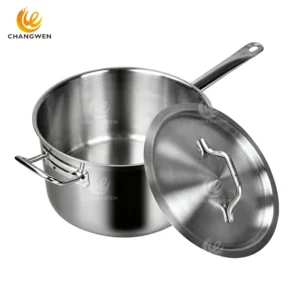
- The best stock pot for a commercial kitchen is 304 stainless steel, 16–20 quart for standard service, 40–60 quart for high-volume or catering use, with an encapsulated aluminum base for even heat distribution.
- Stock pot manufacturers in China — primarily in Guangdong Province (Jiangmen, Chaozhou) — supply commercial-grade 304 stainless steel stock pots at factory-direct pricing 35–55% below domestic distributor costs.
Use #1 — Making Stocks and Broths: The Foundation of the Menu
Every classically trained cook knows the phrase: the stock is the soul of the kitchen. This is not poetry. It is a literal description of how professional restaurant food tastes the way it does.
What the Stock Pot Does That Nothing Else Does
A stock pot’s tall, cylindrical form maximizes liquid volume while minimizing evaporation surface area. This is engineering matched to function: a long stock simmer (chicken stock: 4–6 hours; veal stock: 8–12 hours; beef stock: 12+ hours) needs to maintain consistent liquid level without drying out. The tall walls achieve this. A wide, shallow pan would lose half the liquid before the bones have given up their collagen.
The Primary Stock Types in American Restaurant Kitchens
White chicken stock (fond blanc de volaille): The most versatile and commonly produced stock in American restaurants. Made from raw chicken bones, mirepoix, and a bouquet garni. Simmered 4–6 hours. Light color, neutral flavor — goes into everything from cream sauces to consommé to risotto liquid.
Brown chicken stock: Bones and mirepoix roasted before adding water. Richer color and more complex, slightly caramelized flavor. Used where deeper flavor is appropriate.
Veal stock: The premium foundation stock of French-derived cooking. Long simmer (8–12 hours) extracts maximum gelatin from veal bones. Reduces to veal jus, further reduces to demi-glace — the base of classic French brown sauces.
Brown beef stock: Rich, deeply colored stock from roasted beef bones. Backbone of beef consommé, French onion soup base, and beef braises.
Fish stock (fumet): Short simmer (30–45 minutes maximum) from fish bones and aromatic vegetables. Base for cream-based fish sauces, bouillabaisse, and cioppino.
Vegetable stock: All-vegetable simmer for plant-based menu items and vegetarian cooking. Increasingly important as American menus expand plant-forward options.
The Stock Pot Size for Stock Production
For restaurant stock production, the minimum practical size is 20 quarts (for small restaurants producing stock every 2–3 days). Most full-service restaurants use 40-quart stock pots for stock production, making enough for 3–5 days of service with a single batch.
Use #2 — Soup Service: The Daily Restaurant Workhorse
Soup service in American restaurants runs the spectrum from the cup-of-soup-with-sandwich model to the signature bowl-program of a serious soup kitchen concept. In every case, the stock pot is the production vessel.
Daily Soup Production Math
A mid-size full-service restaurant serving 150 covers at lunch with 30% ordering soup needs approximately:
- 150 × 0.30 = 45 portions of soup at lunch
- At 8 oz (240ml) per bowl: 45 × 240ml = 10.8 liters per service
- Plus holding losses (evaporation, spills): plan for 14–15 liters total production
A 20-quart (18.9L) stock pot handles this comfortably with volume to spare.
For a restaurant with high soup participation (40–50% of covers, or a dedicated soup-and-sandwich concept): 40-quart production with multiple varieties runs simultaneously.
Easy Stock Pot Recipes for Soup Service
The core soup program for most American restaurants:
- French onion soup: Caramelize onions in batches, deglaze with wine and beef stock, finish with crouton and gruyère gratinée. Batch-produced in a stock pot, held in hotel pans.
- Clam chowder (New England style): Rendered salt pork, sweated mirepoix, potatoes, clam juice, heavy cream. Classic American restaurant staple — the stock pot handles the batch production for service.
- Tomato basil soup: Sweated aromatics, San Marzano tomatoes, chicken stock, cream finish. One of the most ordered soups on American menus; stock pot production in 20–40 quart batches.
- Chicken tortilla soup: Chicken stock base with roasted tomatoes, chiles, shredded chicken, topped with crispy tortilla strips. High-margin, high-demand item across American casual dining.
Use #3 — Pasta and Grain Boiling at Commercial Volume
The pasta water rule in professional kitchens: the pot must be large enough that the pasta moves freely while boiling. Crowded pasta water drops temperature too quickly, starch concentrates too heavily, and pasta clumps. The stock pot solves all three problems.
The Volume Math for Commercial Pasta Service
Standard ratio: 4 quarts (3.8 liters) of water per pound of dry pasta. A restaurant serving 60 orders of pasta per service at 4 oz dry pasta per portion needs:
- 60 × 4 oz = 15 lbs pasta per service
- 15 lbs × 4 qts/lb = 60 quarts of water boiling simultaneously
In practice, this is handled with 2–3 large stock pots (20-quart each) running continuously, with pasta cooked in controlled batches throughout service.
The Pasta Water Asset
Restaurant pasta water — heavily starchy from continuous pasta cooking — is a culinary asset, not waste. A tablespoon of pasta water tossed into a sauté pan with pasta and sauce emulsifies the sauce, creates body, and helps coat the pasta. This technique is why restaurant pasta tastes different from pasta made at home. It happens because of the stock pot running all service.
Grain Cooking at Scale
The stock pot handles bulk grain cooking for service: rice pilaf for 200 portions, polenta for a family-style dinner, risotto rice parboiled for quick finishing, farro or barley for grain bowl programs. The volume capacity of the commercial stock pot is the enabling factor for all of it.
Use #4 — Sauce Reduction and Glaze Production
The most time-intensive work the stock pot does — and the work that most directly creates the flavor differential between restaurant food and home food.
What Reduction Is and Why It Matters
Reduction is the concentration of flavor through evaporation. When a gallon of chicken stock reduces by 50%, the same flavor molecules that were in a gallon are now in a quart — the result tastes four times more intensely chicken-flavored. Continue reducing to a syrup consistency and you have glace de volaille — chicken glaze — a tiny spoonful of which can transform a sauce entirely.
The stock pot enables this because its volume accommodates the starting quantity needed to yield practical finished amounts after reduction.
The Reduction Hierarchy in American Restaurant Kitchens
Jus (pan drippings + stock): Simple reduction of roasting pan drippings with stock. The natural sauce for roasted meats. Made in the stock pot after the roast is finished.
Veal jus / demi-glace: 50–75% reduction of veal stock. The base of most classical French-inspired American restaurant sauces. Time-intensive (1–2 days of continuous reduction), but a quart of demi-glace serves 50–100 portions when used as a sauce component. The stock pot is the only vessel large enough to start the process at meaningful commercial scale.
Fruit and wine reductions: Port wine reductions, balsamic reductions, red wine reductions for red meat dishes. The stock pot handles the volume needed to reduce efficiently.
Use #5 — Seafood Boiling (Lobster, Crab, Crawfish, Shrimp)
No other cooking vessel handles whole shellfish at commercial scale. The stock pot is the only option — size, thermal mass, and depth are all required.
Live Lobster Service
A stock pot’s thermal requirement for live lobster: bring a 20-quart pot to a rolling boil, add two 1.5-lb lobsters, return to boil within 3–4 minutes. This requires a stock pot large enough to hold the lobsters covered with water, with enough thermal mass to recover quickly from the cold addition.
In a high-volume seafood restaurant serving 50 lobsters per Friday night, multiple 20–40 quart stock pots run simultaneously on high-BTU commercial burners throughout the service period.
Crawfish and Crab Boils
Cajun and coastal American restaurants run commercial crawfish boils (30–60 lbs per batch) and crab boils (blue crab, Dungeness, king crab legs) in 40–80 quart stock pots with seasoned boiling liquid. The flavor of the boiling liquid — cayenne, crab boil spice mix, lemons, garlic — infuses the shellfish during the boil. The stock pot’s volume accommodates the full batch in one production cycle.
Shrimp Blanching for Cold Applications
Shrimp cocktail and cold shrimp salads require perfectly cooked, perfectly cooled shrimp. Commercial production: blanch 10–15 lbs of shrimp per batch in 20-quart stock pots of seasoned boiling water (5–7 minutes), shock immediately in ice water, peel. The stock pot handles the volume required for service prep.
Use #6 — Blanching and Parboiling Vegetables at Scale
Commercial kitchens do not blanch one portion of vegetables. They blanch service worth — 20, 30, 50 portions — in a single stock pot, shock in ice water, and hold for service finishing.
The Commercial Blanching Protocol
Purpose of blanching: Partially or fully cook vegetables, set color and texture, reduce enzyme activity that causes deterioration. Blanched vegetables hold refrigerated for 2–3 days, ready for rapid service finishing in sauté pans.
The sequence: Full boiling water in a 20-quart stock pot → add vegetables (haricots verts, broccoli florets, asparagus spears, English peas) → boil 90 seconds to 3 minutes depending on vegetable → transfer immediately to ice water bath → drain, towel dry, refrigerate.
Scale: A restaurant doing 100+ covers needs 10–15 lbs of blanched vegetables in prep. This requires the stock pot’s volume — smaller pans cannot maintain boiling temperature when this mass of cold vegetables is added, and the result is waterlogged, overcooked vegetables.
Use #7 — Braising and Slow-Cooking Large Cuts
The stock pot is used for braising large quantities of tough cuts that need extended moist heat to become tender and service-ready.
Stovetop Braising in the Stock Pot
Classic braise sequence in a commercial stock pot:
- Season and sear large cuts (short ribs, lamb shanks, pork shoulder, beef chuck) in batches
- Remove meat, sauté aromatics (mirepoix, garlic, tomato paste) in the same pot
- Deglaze with wine, add stock, return meat
- Cover and simmer at a controlled 185–195°F (85–90°C) for 2–4 hours
The stock pot’s straight, tall sides and flat bottom make it suitable for both the initial searing step (when using high heat with fat) and the long, low simmer. For portions requiring oven finishing, the braising liquid can be transferred to hotel pans — but the stock pot handles the initial production phase.
Carnitas, Birria, and American BBQ Braises
American restaurant menus increasingly feature braise-based proteins: carnitas (pork shoulder slow-cooked in its own fat and stock), birria (beef and chile braise), pulled pork, brisket in liquid. All produced in stock pots at commercial scale, finished by shredding or pulling, held in service pans.
Use #8 — Chili, Stew, and Large-Batch Comfort Foods
Chili is perhaps the quintessential American stock pot recipe for dinner service. A serious chili operation builds batches of 20–40 quarts — meaning the stock pot is the only viable production vessel.
Commercial Chili Production
Texas-style chili con carne for 200 portions:
- 40 lbs ground beef or chuck
- 2 gallons beef stock
- Dried chile rehydration and purée
- Aromatics, spices, tomatoes
Total volume before reduction: approximately 25–30 gallons. Produced in multiple 40-quart stock pots, reduced to service consistency, held in hotel pans.
New England chili with beans: White bean chili with chicken is increasingly common on American casual menus. Same stock pot production model, different flavor profile.
American Stew Program
Beef stew, chicken and dumplings, Brunswick stew, seafood chowder-stew — all American restaurant comfort food staples, all batch-produced in stock pots and held through service. The stock pot’s volume makes economic production possible.
Use #9 — Deep Frying at Volume
Less commonly discussed, but widely practiced in commercial kitchens without dedicated deep fryers or for specific applications: deep frying in a large stock pot with oil and a thermometer.
When Stock Pot Frying Makes Sense
Turkey frying (Thanksgiving service and outdoor events): A 40-quart stock pot with 5–6 gallons of peanut oil handles a whole 12–15 lb turkey in approximately 45 minutes. Many restaurant pop-up events and catering operations use commercial stock pots for turkey frying.
Batch doughnut or fritter production: Restaurant pastry programs that produce doughnuts, beignets, or savory fritters in batches use large stock pots for frying quantity without a dedicated commercial fryer.
Seafood boil-fry hybrids: Some Cajun/Southern American restaurant concepts fry shrimp, oysters, and catfish in heavy stock pots — the thermal mass maintains oil temperature through multiple batch additions.
Use #10 — Batch Cooking and Meal Prep for Service
Every restaurant’s prep list includes stock pot production: the back-of-house work done before service that enables the kitchen to execute a full service at speed.
The Prep Pot as a Service Enabler
The stock pot is not always producing a final dish — it is frequently in use for:
- Potato boiling: 20+ lbs of potatoes boiled, mashed or held whole for service finishing
- Egg cooking at scale: Hotels and brunch restaurants hard-boil 50–200 eggs simultaneously in stock pots
- Corn on the cob for events: 100-ear corn production for Fourth of July events, summer catering, barbecue service
- Whole chicken poaching: Poaching 10–15 whole chickens simultaneously for chicken salad, enchilada filling, and chopped chicken applications
- Bulk tomato blanching: Blanching 30 lbs of tomatoes for peeling before producing fresh tomato sauce
All of this prep work happens in stock pots. The vessel that enables consistent, high-volume prep is as important as the vessel used during service.
Stock Pot vs Crock Pot: Which Does What in a Commercial Kitchen?
This comparison comes up frequently — and the answer is largely decided by the commercial kitchen context.
Stock Pot vs Crock Pot: The Key Differences
| Feature | Stock Pot (Stovetop) | Crock Pot (Slow Cooker) |
|---|---|---|
| Heat source | Gas or induction stovetop | Internal electric element |
| Temperature control | Fully variable, immediate | Fixed low/high settings |
| Heat-up time | Fast (boiling in 15–25 min) | Slow (2–3 hours to reach temp) |
| Capacity | 8–200 quarts | Typically 4–10 quarts |
| Batch searing | Yes (stovetop, high heat) | No |
| Commercial use | Universal | Very limited |
| NSF compliance | Standard for commercial models | Rarely NSF-listed for commercial |
In a commercial kitchen: The stock pot wins on every dimension for volume production. Crock pots appear in limited commercial applications — keeping small-batch dips warm at a buffet, supplementing prep for very small operations. They are not commercial production tools.
The only exception: Some restaurant concepts (small diners, ghost kitchen operations with minimal equipment) use large residential slow cookers for specific batch preparations (BBQ pulled pork held overnight). This is the exception, not the rule.
Stock Pot vs Dutch Oven: When to Use Each
Unlike the stock pot vs crock pot comparison (which is largely one-sided in commercial kitchens), the stock pot vs Dutch oven comparison involves two genuinely important, genuinely different tools.
Stock Pot vs Dutch Oven: The Practical Difference
| Feature | Stock Pot | Dutch Oven |
|---|---|---|
| Shape | Tall, straight-sided | Short, wide-mouthed, heavier walls |
| Best use | Large-volume liquid cooking | Oven braising, searing + liquid cooking |
| Heat distribution | Good (encapsulated base) | Excellent (thick walls conduct throughout) |
| Oven compatibility | Limited (depends on handle material) | Designed for oven use |
| Volume range | 8–200 quarts | 4–13 quarts |
| Weight at size | Heavier (full liquid) | Heavier per quart (thicker walls) |
Use a stock pot when: Large volume liquid cooking — stocks, soups, pasta water, blanching, seafood boiling, bulk braises.
Use a Dutch oven when: Smaller-batch, oven-finished braises; recipes requiring a hard sear before liquid addition; tableside or display cooking where aesthetics matter; preparations where oven-top heat conduction through the walls matters (risotto, braised short ribs in small batches).
Most commercial kitchens need both. A stock pot cannot replace a Dutch oven for oven-finished braises, and a Dutch oven cannot replace a stock pot for 40-quart pasta water or full-day stock production.
How to Choose the Best Stock Pot for Your Restaurant
Material: 304 Stainless Steel — The Only Commercial Specification
304 stainless steel (18/8) is the commercial food service standard for stock pots. Non-reactive (will not impart flavor to acidic stocks), corrosion-resistant, dishwasher-safe, NSF-compliant. For commercial kitchens: this is the required specification.
Aluminum stock pots cost less but are reactive with acidic ingredients (wine-based stocks, tomato stocks, citrus), degrade faster under commercial cleaning, and do not meet NSF food equipment standards in most commercial kitchen licensing contexts.
Construction: Encapsulated Base vs. Single-Ply
Single-ply stainless steel creates hot spots directly above the burner ring — the classic problem with standard restaurant stock pots. Encapsulated aluminum base (aluminum disc bonded into the base under the stainless) spreads heat laterally from the burner contact point before it reaches the liquid. The result: no hot spots, no scorching, even temperature across the base.
For stock production especially — where long, gentle simmers are essential and scorching ruins the entire batch — an encapsulated aluminum base is worth the additional cost.
Size Selection Guide
| Restaurant Type | Primary Stock Pot Sizes |
|---|---|
| Small café / bistro (50 covers) | 12 qt + 20 qt |
| Full-service restaurant (100–150 covers) | 20 qt (×2) + 40 qt |
| High-volume restaurant (200+ covers) | 40 qt (×2) + 60 qt |
| Catering operation | 40 qt (×3) + 60–80 qt |
| Hotel / institutional | 60 qt + 80 qt + 100+ qt |
Handle Specification
For commercial use: riveted handles only. Welded handles fail under the repeated heavy-load lifting of a 20-quart pot full of stock. Stainless steel rivets through the pot wall provide multiple load-bearing contact points that distribute force across the joint.
Stock Pot Recipes for Restaurant Service
Easy Stock Pot Recipes: The Commercial Kitchen Staple List
Classic chicken stock (40-quart production)
- 20 lbs chicken backs and necks
- 4 lbs mirepoix (2:1:1 onion:carrot:celery)
- 1 bouquet garni (bay leaves, thyme, parsley stems, peppercorns)
- Cold water to cover (approximately 10 gallons)
- Simmer 4–6 hours, skim continuously
- Strain, cool rapidly, refrigerate. Yield: approximately 8–10 gallons
Stock pot recipes chicken: Chicken tortilla soup for 50 portions
- 3 gallons chicken stock
- 5 lbs shredded poached chicken
- Roasted tomatoes, chiles, corn
- Finish with fresh cilantro, lime, crispy tortilla strips per bowl
- Stock pot production time: 90 minutes start to service-ready
Restaurant-Scale Chili (feeds 100 portions)
- 25 lbs ground beef chuck (80/20)
- 1 gallon beef stock
- 2 lbs dried chile blend (ancho, pasilla, mulato), rehydrated and puréed
- Aromatics, spices, kidney beans
- 40-quart stock pot production
- Hold in hotel pans through service
Sourcing from a Stock Pot Manufacturer in China
For wholesale buyers — restaurant equipment distributors, hotel procurement groups, catering equipment operators — sourcing directly from a stock pot manufacturer in China delivers the highest cost efficiency for commercial-grade product.
China’s Commercial Stock Pot Manufacturing Landscape
Jiangmen, Guangdong: China’s primary stainless steel cookware manufacturing hub. More than 300 factories producing commercial stock pots, sauce pots, and cooking vessels for export. Deep supply chain integration — steel coil, handle castings, rivets, and packaging all sourced within the local cluster.
Chaozhou (Caitang Town), Guangdong: “The Stainless Steel Capital of China.” Specializes in premium-finish cookware. Primary source for encapsulated-base and tri-ply commercial stock pots.
What to Specify from a Stock Pot Manufacturer
- Material: 304 stainless steel — require Mill Test Certificate confirming 18%+ chromium, 8%+ nickel
- Wall gauge: 1.0mm minimum for commercial use; 1.2mm for heavy commercial
- Base construction: encapsulated aluminum base (specify thickness: 2.0mm+ aluminum core)
- Handle attachment: riveted, not welded
- NSF compliance: required for US commercial kitchen use
- Certification: ISO 9001 quality management; NSF listing number verifiable at nsf.org
Wholesale MOQ Reference
| Configuration | Typical MOQ |
|---|---|
| Standard 304 SS stock pot (20 qt) | 50–200 units |
| Standard with custom logo/packaging | 100–500 units |
| Custom size or configuration | 200–500 units |
| OEM private label program | 500–2,000 units |
Factory Verification Essentials
- Live video call factory tour (shows stamping equipment, welding stations, polishing line)
- Mill Test Certificate for 304 stainless steel
- NSF listing number verified at nsf.org
- Physical samples evaluated before bulk order
Factory-direct pricing from verified Chinese manufacturers is typically 35–55% below domestic distributor pricing for equivalent commercial-grade stock pots.
FAQ
What are the most important uses of a stock pot in a restaurant kitchen?
The three most commercially important uses in American restaurants are: (1) stock and broth production — the flavor foundation of the entire menu; (2) soup service — daily large-batch soup production for service; and (3) pasta and grain boiling — the volume cooking that enables Italian-style and pasta-heavy menus at commercial scale. Beyond these three, stock pots handle sauce reduction, seafood boiling, blanching, braising, chili and stew production, and batch prep that enables every service.
Stock pot vs crock pot: which is better for a restaurant kitchen?
For commercial restaurant use, a stock pot on a stovetop is the correct choice. Crock pots (slow cookers) are designed for home use — they lack the volume (most max at 10 quarts vs 40–80 quarts for commercial stock pots), lack the heat output for rapid boiling and blanching, cannot sear before braising, and are not NSF-certified for commercial food service in most jurisdictions. The stock pot is the commercial production tool; the crock pot has limited supplemental applications in very small operations.
Stock pot vs Dutch oven: what is the practical difference for cooking?
A stock pot is designed for large-volume liquid cooking — stocks, soups, pasta water, blanching, and seafood boiling. A Dutch oven is designed for oven-to-stovetop cooking — it has heavier, thicker walls that distribute heat from all directions (essential for oven braising), a wide mouth that allows evaporation control, and is typically smaller (4–13 quarts). Most commercial kitchens use both: stock pots for volume liquid production, Dutch ovens for smaller-batch, oven-finished braises and display presentations.
What size stock pot is best for a restaurant?
For a standard full-service restaurant (100–150 covers): a 20-quart stock pot for daily soup service and reheating, plus a 40-quart for stock production and large-batch cooking, is the practical combination. For catering operations: 40-quart and 60-quart minimum. For institutional kitchens: 60-quart through 100-quart. For a small café or bistro under 75 covers: 12-quart and 20-quart handles most needs. The general rule: always size up from your estimate — a stock pot running at 80% capacity is more controllable and safer than one at 100%.
What is the best stock pot material for commercial kitchen use?
304 stainless steel with an encapsulated aluminum base is the commercial standard. 304 grade (18/8 — 18% chromium, 8% nickel) is non-reactive with acidic stocks, corrosion-resistant, NSF food contact compliant, and dishwasher safe. The encapsulated aluminum base solves single-ply stainless steel’s primary weakness (hot spots at the burner ring) while maintaining the food-safe stainless interior surface. Verify material grade with a Mill Test Certificate when sourcing wholesale.
Where are stock pot manufacturers located in China?
The primary commercial stock pot manufacturing clusters are in Guangdong Province — specifically Jiangmen (Xinhui District) and Chaozhou (Caitang Town), which together represent the largest concentration of stainless steel cookware manufacturing in the world. Jiangmen is known for standard commercial production at competitive pricing; Chaozhou for premium-finish and encapsulated-base products. Zhejiang Province (Yongkang) produces aluminum and hardware-focused cookware. For wholesale sourcing of commercial 304 stainless steel stock pots, Guangdong is the primary target region.
Conclusion
The stock pot is not one tool with one job. It is the commercial kitchen’s most versatile vessel — doing ten distinct jobs across every shift, in every cuisine category, in every format of American restaurant from the neighborhood diner to the fine dining kitchen.
The ten uses in this guide — stock production, soup service, pasta boiling, sauce reduction, seafood boiling, blanching, braising, chili and stew, frying, and batch prep — represent the full scope of what a properly specified commercial stock pot delivers. Remove it from any American restaurant kitchen and a chain of failures begins: the stocks stop, the sauces falter, the pasta service stalls, the soup runs out.
The best stock pot for commercial use is 304 stainless steel, encapsulated aluminum base, riveted handles, 1.0mm minimum wall gauge, NSF-compliant, in the right size for your service volume.
For wholesale sourcing: Chinese stock pot manufacturers in Guangdong Province supply commercial-grade product at factory-direct pricing that consistently delivers 35–55% savings versus domestic distributor pricing. Verify with Mill Test Certificates and NSF listing numbers. Sample before bulk. Commission pre-shipment inspection.
Changwen manufacture and supply commercial 304 stainless steel stock pots — 8 quart through 200 quart, single-ply and encapsulated-base, riveted handles, NSF-compliant materials, with full material certification — factory-direct to restaurants, hotel chains, catering operations, and equipment distributors worldwide.