Read time: 15 min
Introduction
The math is straightforward.
China kitchenware — stainless steel cookware, commercial food pans, kitchen utensils, chafing dishes, stock pots, prep tables, and the full range of commercial kitchen smallwares — sourced factory-direct from verified Chinese manufacturers typically costs 35–55% less than buying the same specification through a domestic distributor.
On a $50,000 annual kitchen equipment spend, that gap represents $17,500–$27,500 in saved cost. Per year. On a distribution business doing $500,000 in kitchen equipment sales, the margin implications are measured in hundreds of thousands of dollars.
That number is why every serious restaurant equipment distributor, hotel group purchasing director, and commercial kitchen operator who has done the work to source china kitchen equipment directly never goes back to paying domestic distributor prices for equivalent product.
But here is what the math does not show:
The sourcing process requires doing the right things in the right order. Every expensive sourcing mistake follows the same pattern — someone skipped a step. They contacted suppliers before specifying what they needed. They ordered bulk before evaluating samples. They accepted a “304 stainless” claim without documentation. They did not commission a pre-shipment inspection. They chose the cheapest quote without understanding why it was cheapest.
This guide is built to prevent every one of those mistakes.
What follows is the complete, step-by-step sourcing framework for kitchen smallwares from China — written for restaurant equipment distributors, hotel procurement teams, catering operators, commercial kitchen owners, and wholesale buyers sourcing smallwares equipment at any scale.
Key Takeaways
- China accounts for approximately 75% of global kitchenware exports. The manufacturing clusters in Guangdong and Zhejiang represent the deepest concentration of verified china kitchenware manufacturers anywhere in the world.
- Factory vs. trading company is the single most important distinction in China sourcing. Trading companies add 15–30% to factory pricing without adding production value or quality control.
- 304 stainless steel is the commercial standard for food-contact commercial kitchen smallwares. 201-grade steel looks identical and costs less — but corrodes under commercial conditions and fails food safety standards. Always require a Mill Test Certificate.
- NSF/ANSI certification (US), LFGB (EU/Germany), CE (EU), and FDA food contact compliance are the certifications that matter for china kitchen equipment sold into regulated markets. Verify listing numbers — not just certificate images.
- The complete sourcing process — from supplier identification to warehouse delivery — takes 10–16 weeks for a first order. Starting too late for seasonal demand is the most common planning mistake.
- Pre-shipment inspection by a third-party firm (SGS, Bureau Veritas, Intertek, QIMA) for any order above $5,000 is not optional. It is the highest-ROI quality assurance step in the entire process.
- MOQ for smallwares equipment from Chinese manufacturers: 50–200 units per SKU for stainless steel cookware; 100–500 units for utensils; 50–200 units for food pans. Custom OEM: 200–1,000 units depending on complexity.
Why Source China Kitchenware? The Economics Made Clear
Before the process, the rationale deserves a precise statement — because understanding the economics drives the discipline the process requires.
The Cost Gap Is Structural, Not Coincidental
China’s dominance in china kitchenware manufacturing is not about cheap labor alone. It is a consequence of 40+ years of accumulated manufacturing infrastructure, supply chain integration, and specialized regional expertise that cannot be quickly replicated elsewhere.
In Jiangmen, Guangdong — China’s primary commercial stainless steel cookware cluster — a mid-size factory producing commercial stock pots and food pans has its raw steel coil supplier, handle foundry, lid stamper, rivet supplier, and packaging manufacturer all within a 20-kilometer radius. That vertical supply chain integration is the cost advantage, and it compounds at scale.
The result: a 20-quart 304 stainless steel commercial stock pot that retails domestically in the US for $45–$65 through a distributor costs $12–$22 factory-direct FOB China at commercial wholesale quantities. The specification is identical. The origin marking is identical. The margin gap is 40–60%.
The Market Growth Context
The global kitchenware market was valued at over $73 billion in 2025 and is projected to reach $123 billion by 2033, growing at approximately 6.8% annually. Commercial kitchen smallwares represent a particularly stable segment — driven by hotel openings, restaurant expansion, catering industry growth, and institutional food service investment that continues regardless of consumer spending cycles.
For distributors and importers, this combination — structural cost advantage, stable demand growth, and a product category that repeats reliably — makes china kitchen equipment one of the most accessible wholesale import categories.
Understanding What You’re Sourcing: Commercial Kitchen Smallwares Defined
Commercial kitchen smallwares (also called smallwares equipment) are all non-mechanical, hand-held, or hand-operated tools and supplies used in commercial food preparation, cooking, storage, and service. The term distinguishes these items from large mechanical equipment — ranges, refrigerators, dishwashers, combi ovens.
The Complete Smallwares Equipment Category Map
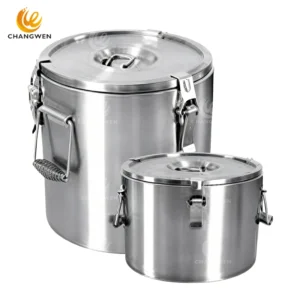
Cookware: Stock pots, sauce pots, saucepans, sauté pans, frying pans, woks, steamers, pressure cookers, baking sheets, roasting pans, sheet pans (full, half, quarter size)
Kitchen Utensils and Hand Tools: Ladles (all sizes), slotted spoons, serving spoons, tongs (6″, 9″, 12″, 16″), spatulas (slotted, offset, rubber/silicone), whisks (French and ball), peelers, graters, zesters, thermometers, can openers, ice cream scoops (portion dishers), measuring cups and spoons
Food Storage and Prep Containers: Stainless steel mixing bowls, polycarbonate food containers, hotel pans / GN food pans (full, half, 1/3, 1/6 sizes), squeeze bottles, sauce dispensers
Cutting Tools and Boards: Chef’s knives, paring knives, bread knives, cleavers, boning knives, color-coded cutting boards (NSF-compliant), mandoline slicers, bench scrapers
Bakeware: Sheet pans (full, half, quarter size), baking molds (silicone and aluminum), wire cooling racks
Serving and Front-of-House: Serving trays, tray stands, chafing dishes and fuel holders, beverage dispensers, juice dispensers, GN pans for buffet/steam table service
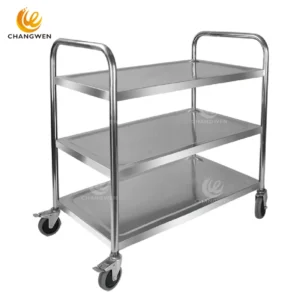
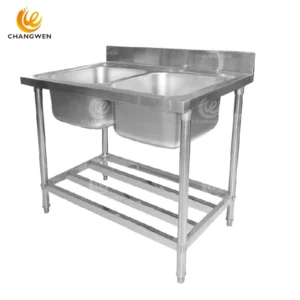
Commercial Kitchen Equipment (larger smallwares): Stainless steel prep tables, worktables with undershelves, stainless steel sinks, shelving units, equipment stands
Why the Category Definition Matters for Sourcing
Different smallwares equipment categories come from different Chinese manufacturing clusters, require different certifications, and have different MOQ structures. A sourcing strategy that treats all kitchenware as a single category will consistently land you in the wrong factories.
China’s Manufacturing Map: Which Region Makes What
This is the most underutilized sourcing intelligence available to international buyers. China’s china kitchenware manufacturing is not geographically uniform — it is organized into highly specialized regional clusters where supply chains, expertise, and production capacity concentrate around specific product categories.
Guangdong Province — The Commercial Kitchen Hub
Jiangmen (Xinhui District, Sanjiang Town): China’s primary cluster for commercial kitchen smallwares in stainless steel — stock pots, food pans, GN containers, saucepans, and commercial cookware sets. More than 300 dedicated kitchenware factories operate within the Jiangmen cluster. The concentration of expertise and supply chain integration makes Jiangmen the most cost-competitive source for stainless steel commercial cookware globally.
Chaozhou (Caitang Town) — “The Stainless Steel Capital”: Over 300 stainless steel fabrication and kitchenware factories. Specialization in saucepans, frying pans, composite-base cookware, and premium finish products. Strong export infrastructure to European and North American markets. Caitang manufacturers are the primary source for branded OEM cookware programs sold through major retailers.
Yangjiang — “The Knife Capital”: Dominant in kitchen knives, scissors, and cutting tools. Decades of specialized blade manufacturing expertise. More than 1,400 enterprises and 100,000 workers in the knives and scissors industry. If you are sourcing cutting tools, Yangjiang is where the global supply is made.
Guangzhou (Panyu, Tianhe Districts): Commercial catering equipment — gas and electric ranges, fryers, bain maries, food warmers, commercial woks, and larger china kitchen equipment. Guangzhou’s proximity to major export ports (Guangzhou Port, Huangpu) makes it a logistics hub for heavy commercial equipment.
Foshan: Commercial kitchen furniture — stainless steel prep tables, worktables, undershelves, sinks, and storage equipment. Also a significant hub for cookware components.
Zhejiang Province — Precision and Gadgets
Yongkang: “The Hardware Capital of China.” Pressure cookers, aluminum and stainless steel cookware, thermos flasks, and kitchen hardware accessories. Yongkang manufacturers have strong R&D capability and are often preferred for products requiring mechanical precision.
Ningbo and Cixi: Non-stick cookware, aluminum cookware, OEM production for Western brands. Strong compliance infrastructure for EU and US regulatory requirements. Preferred by buyers with stringent certification requirements.
Yiwu: The world’s largest small commodities market. Best for broad-category sampling and low-MOQ variety orders of kitchen gadgets, utensils, and accessories. Higher per-unit cost than direct factories but unmatched variety and low minimum orders.
Shandong Province
Zibo: China’s dominant glassware manufacturing center. Glass food storage containers, baking dishes, drinkware, and glass cookware. Borosilicate glass kitchen products primarily originate here.
Other Shandong clusters: Commercial kitchen equipment manufacturing — particularly larger-scale food service equipment suitable for institutional and hotel procurement.
Jiangsu Province
Wuxi and Changzhou: Stainless steel fabrication and commercial kitchen equipment. Wuxi has a strong industrial stainless steel manufacturing heritage that extends into commercial kitchen products.
Hebei Province
Shijiazhuang area: Cast iron cookware manufacturing. If you are sourcing cast iron pots, pans, or grills, Hebei is the primary production source alongside some Guangdong foundries.
The Practical Implication
Map your commercial kitchen smallwares sourcing list to the right manufacturing cluster before approaching any supplier. A Jiangmen stainless steel cookware factory is not the best source for kitchen knives (Yangjiang) or non-stick pans (Ningbo/Cixi). Targeting the right cluster immediately gives you access to deeper expertise, more competitive pricing, and better supply chain stability.
Where to Find Suppliers: Every Sourcing Channel Compared
Alibaba (alibaba.com)
The world’s largest B2B sourcing platform. Millions of product listings, supplier profiles, and verified status indicators. The primary digital sourcing channel for first-time China buyers.
Use it for: Initial supplier discovery, broad category research, quick quote comparison, finding suppliers for standard catalog products.
Limitations: Includes both factories and trading companies — often indistinguishable until you dig deeper. Product images and specifications may not reflect actual production capability.
Platform signals to use: “Gold Supplier” + “Verified Manufacturer” combined status (not just Gold Supplier alone). Trade Assurance enrollment for payment protection on first orders.
Made-in-China (made-in-china.com)
The second-largest B2B platform for Chinese manufacturing. Stronger manufacturer focus than Alibaba in some categories, with “Audited Supplier” certification that requires physical factory inspection.
Use it for: Finding manufacturers in specific product categories, particularly for china kitchen equipment and industrial-grade products.
Canton Fair (Guangzhou, twice annually)
The China Import and Export Fair — the world’s largest trade fair held every April and October in Guangzhou. Every exhibitor is a production operation, not a trading company. Products are physically present for evaluation. Relationships are built in person.
The irreplaceable advantage: You can evaluate 50 suppliers in 3 days at the fair versus 50 email exchanges over 3 months online. Physical product comparison is impossible to replicate digitally.
Best for: Buyers planning programs above $30,000 annually, buyers evaluating multiple product categories simultaneously, and first-time buyers who want the highest-confidence supplier verification path.
1688 (1688.com)
Alibaba’s domestic Chinese B2B platform — primarily used by Chinese businesses buying from Chinese factories. Prices on 1688 are domestic market prices: often 10–30% lower than Alibaba export prices for the same product and factory.
How to access: Requires a China-registered account or a sourcing agent with access. The interface is entirely in Mandarin. For buyers with language access or a sourcing agent, 1688 is the most competitive pricing environment available.
Global Sources (globalsources.com)
Strong for verified manufacturer listings with a particular focus on electronics and household goods. Useful secondary platform for cross-referencing suppliers found on Alibaba.
Direct Factory Outreach
Searching Google with region-specific queries — “commercial stock pot manufacturer Jiangmen,” “stainless steel food pan factory Chaozhou” — produces direct factory websites that are not listed on B2B platforms. These factories may offer better pricing because they bear no platform fees and have fewer Western-facing sourcing inquiries competing for their capacity.
Best for: Experienced buyers who know the product category and can evaluate a factory directly without platform verification support.
Sourcing Agents
China-based sourcing agents (individuals or agencies) provide factory access, language support, price negotiation, quality inspection coordination, and logistics management. The right sourcing agent can replace weeks of self-directed research with days of qualified factory access.
When a sourcing agent makes sense: First-time buyers with no existing China contacts, buyers sourcing across multiple product categories simultaneously, buyers who cannot travel to China for Canton Fair or factory visits, and programs with total sourcing value under $50,000 where the agent fee (typically 5–10% of order value) is justified by the risk reduction.
Factory vs Trading Company: The Most Important Distinction in China Sourcing
This single distinction determines more about your sourcing outcome than any other variable. Trading companies and factories present identically in online listings, quote with identical confidence, and use identical language about their capabilities. The difference becomes visible when quality issues arise — and then it is very visible.
What a Trading Company Is
A trading company purchases goods from one or more factories and resells them to international buyers. They do not manufacture. They have no production equipment. They cannot control production quality because they do not run production.
Why trading companies exist: They consolidate products from multiple factories, provide English-language sales interfaces, handle export documentation, and serve buyers who cannot access factories directly. They add genuine value in some contexts — particularly for buyers needing very small quantities from multiple categories.
The problem: Trading companies add 15–30% to factory pricing without adding manufacturing value. When quality issues arise, they have no ability to intervene in production — only to pressure the factory after the fact. Their margin requirement means you will never receive factory-direct pricing.
How to Identify a Factory vs Trading Company
Method 1: Live Video Call Factory Tour Request an unscripted live video call showing the production floor. A genuine china kitchenware manufacturer can show you: stamping and pressing equipment, welding stations, polishing and finishing lines, assembly areas, and quality control stations. Request this tour during active production hours — not during a lunch break or weekend.
Trading companies cannot show a production floor because they do not have one. A pre-recorded video or a photo presentation is not acceptable — it could be any factory’s footage.
Method 2: Business Registration Document Review Request the business license (营业执照). This document specifies the registered business activity. Manufacturing companies register under manufacturing activities. Trading companies register under trading activities. Ask for a scanned copy and check the registered scope.
Method 3: Technical Question Test Ask highly specific production questions:
- “What is the wall gauge of your 20-quart stock pot, and what stamping press do you use for the base forming?”
- “What is the weld method for your handle attachments — MIG or TIG — and what filler wire specification?”
- “What is your base composite construction for your tri-ply pans?”
A factory engineer answers these immediately and accurately. A trading company sales representative says “I will check with our factory and get back to you” — which confirms they are not the manufacturer.
Method 4: Mill Test Certificate Request Ask for the Mill Test Certificate for the 304 stainless steel they use. Any manufacturer using documented 304 stainless has this document from their steel supplier. A trader who sources from multiple factories will either not have it or will need to request it — a delay that reveals their position in the supply chain.
Method 5: Platform Verification Status On Alibaba: “Gold Supplier” alone is insufficient — trading companies can hold Gold Supplier status. Look for “Verified Manufacturer” badge (requires physical factory audit). On Made-in-China: “Audited Supplier” badge. On Global Sources: “Verified Manufacturer” status.
The 7-Step Supplier Verification Framework
Once you have identified candidate suppliers, apply this framework before investing time in serious negotiation.
Step 1: Platform Pre-Screening
Shortlist 5–8 candidate suppliers using platform verification status, product range match, and response quality to your initial inquiry. Eliminate any that cannot answer specific product questions directly.
Step 2: Live Video Factory Tour
Conduct a video call tour of the production floor as described above. Eliminate any supplier who cannot provide this.
Step 3: Business Registration Verification
Request the business license. Confirm the registered business activity includes manufacturing.
Step 4: Material Documentation Request
For stainless steel products: request the Mill Test Certificate for the steel used in production. For NSF-claimed products: request the listing number. For CE-claimed products: request the Declaration of Conformity.
Step 5: Export Reference Check
Ask for 2–3 references from current wholesale buyers in your target market. Legitimate manufacturers exporting to North America or Europe will have verifiable customer relationships. Contact the references directly.
Step 6: Technical Depth Assessment
Request detailed production specifications for a representative product: wall gauge, welding method, handle attachment method and rivet material, surface finish process, base construction. The depth and accuracy of the response tells you more than any certificate.
Step 7: Sample Order
Before any bulk commitment, order 3–5 physical sample units. The sample evaluation process is covered in its own section below. No supplier passes the framework without satisfactory sample evaluation.
Certifications by Market: What to Require and How to Check
Certifications are the difference between china kitchen equipment you can legally sell in regulated commercial markets and product that creates liability exposure.
NSF International (United States and Canada)
What it covers: NSF/ANSI 2 (Food Equipment) and NSF/ANSI 51 (Food Equipment Materials) cover the food safety and sanitation requirements for commercial kitchen equipment and food-contact materials.
Required for: Commercial kitchen licensing in most US jurisdictions. Widely required for hotel, restaurant, and institutional food service procurement.
How to verify: Request the NSF listing number. Verify at nsf.org using the database search. The listing shows the specific products certified, the applicable standard, and current active status. A certificate image without a verifiable listing number is not genuine certification.
FDA Food Contact Compliance (United States)
What it covers: Confirms that materials in contact with food comply with FDA food contact regulations (21 CFR).
Required for: Any product with food-contact surfaces sold in the US market.
How to verify: Request the FDA compliance letter or material compliance declaration from the supplier.
LFGB (Germany / European Union)
What it covers: The German Food, Commodities and Feed Code (Lebensmittel- und Futtermittelgesetzbuch). LFGB testing confirms food contact material safety — resistance to migration of harmful substances under cooking conditions.
Required / expected for: EU market, particularly Germany, Netherlands, and Scandinavian markets. LFGB is considered one of the most stringent food contact standards globally and is accepted as proof of compliance across most EU markets.
How to verify: Request the LFGB test report number from the testing laboratory (typically SGS, Intertek, or TÜV). Verify the test scope covers the specific materials and temperatures relevant to your product.
CE Marking (European Union)
Required for: Electrical kitchen equipment (food warmers, electric grills, electric appliances). Not required for non-electrical cookware. CE marking confirms compliance with relevant EU directives.
ISO 9001 (Quality Management System)
What it confirms: The manufacturer has documented quality management processes — incoming material inspection, production controls, non-conformance procedures, and continuous improvement systems.
How to verify: Request the ISO 9001 certificate and the issuing certification body (SGS, TÜV, Bureau Veritas, Intertek are globally recognized). Verify the scope of certification covers the product categories you are sourcing.
BSCI (Business Social Compliance Initiative)
What it confirms: Social compliance audit — labor standards, workplace safety, and ethical manufacturing practices. Required by many European retail chains and hotel groups for supplier approval.
Certification Verification Rule
Never accept certificate images as proof. Certificate images can be outdated, for different products, or fabricated. The only verification that matters is the listing number checked in the certification body’s public database.
Specifications That Matter: What to Put in Your Brief
A vague brief produces a vague product. A complete specification sheet is the most important document in the entire sourcing process — it determines whether your quote is for what you want or for what the factory finds easiest to sell.
For Every Product, Specify:
Material:
- Steel grade: “304 stainless steel, 18/8 minimum — Mill Test Certificate required”
- For non-stick: “PTFE coating, PFOA-free certification required” or “ceramic coating, PFOA/PFOS-free”
- For plastic: “BPA-free food-grade polycarbonate” or “Tritan (EASTMAN specification)” — specify brand if critical
Dimensions:
- Exact dimensions in millimeters
- Capacity in both liters and quarts
- For GN pans: the GN fraction (1/1, 1/2, 1/3, 1/6) and depth (65mm, 100mm, 150mm, 200mm)
Wall gauge or thickness:
- Specific millimeter measurement (e.g., “minimum 1.0mm walls, minimum 2.0mm base”)
Construction:
- Handle attachment: “riveted” or “welded” — specify
- Base construction: “single-ply,” “aluminum-clad base (encapsulated),” or “tri-ply full-clad”
- Handle material: “stainless steel casting” or “silicone grip stainless”
Surface finish:
- “No. 4 brushed exterior, satin interior” (standard commercial specification)
- “Mirror polish exterior” (premium presentation)
- “Matte finish” (specific applications)
Certification requirements:
- List every certification required for your target market
Quantity per SKU and total order quantity
Packaging:
- Individual carton, nested packing, custom branding requirements
Why This Level of Detail Matters
A supplier receiving “20-quart commercial stock pot, 304 stainless” will quote their default product — which may be 0.8mm walls, a welded handle, and a flat single-ply base. A supplier receiving your complete specification — “20-quart, 304 stainless, 1.0mm walls, 2.5mm encapsulated aluminum base, riveted handle, NSF-compliant” — quotes exactly what you need and cannot substitute a lower specification without your explicit approval.
Samples: The Non-Negotiable Quality Gate
Photographs do not reveal material weight. Videos do not show weld quality. Product listings do not tell you whether a 304 claim is accurate.
Physical samples do.
The Sample Evaluation Protocol for Stainless Steel Smallwares
Steel grade check (magnet test): Apply a kitchen magnet to the claimed-304 surface. 304 stainless steel is austenitic — non-magnetic. A magnet should not adhere. Magnetic response on a claimed-304 food-contact surface indicates 201 grade or lower. This is a quick, reliable field test. Note: handles, feet, and some frame components may be 430 (magnetic) — this is expected and acceptable.
Wall gauge measurement: Use digital calipers to measure wall thickness at multiple points across the product. Confirm against your specified minimum. This is objective and non-arguable.
Weld quality inspection: Examine every weld joint under good lighting: handle attachments, rim reinforcements, lid knob mounts, base seams. Clean, full-penetration welds with no voids, gaps, or sharp edges. Rough welds or visible gaps are production quality failures.
Handle load test: Fill the pot or pan with water to 80% capacity. Lift and hold by one handle only for 30 seconds. Zero flex, zero movement, zero noise from the attachment point. Repeat for the other handle. A handle that flexes under load will fail in commercial service.
Surface finish assessment: Mirror finish: uniform reflection with no tool marks, inconsistent areas, or polishing gaps. Brushed finish: consistent directional grain across the entire surface.
Fit and dimensional accuracy: For GN pans: verify exact dimensions against Gastronorm standard. For lids: should seat fully with consistent contact around the circumference. No rocking.
Sample lead time: 7–15 days for standard configurations. Evaluate samples from your top 2–3 candidate suppliers side by side before making your selection.
Incoterms, Freight, and Landed Cost for China Kitchen Equipment
The Three Incoterms That Matter
FOB — Free On Board (Recommended Starting Point) The seller delivers goods to the named origin port, loaded on the vessel. Freight, insurance, and risk transfer to you from that point.
You handle: international freight, cargo insurance, import customs, import duties, inland delivery.
Why FOB is usually right: You control freight costs by choosing your own freight forwarder. Full visibility into each cost component. The standard term for experienced importers.
EXW — Ex Works Seller’s responsibility ends at the factory gate. You arrange everything from there — domestic Chinese transport to port, export customs, ocean freight, import customs, final delivery.
Best for: Buyers with experienced China-side logistics agents. Not recommended for first-time importers.
DDP — Delivered Duty Paid Seller handles everything including import duties and delivery to your door. Simple for you — but typically 15–25% more expensive than FOB because the seller adds margin to every logistics component.
When DDP makes sense: Small first test orders under $3,000 where simplicity justifies the cost premium.
Freight Methods for China Kitchenware
Ocean LCL (Less than Container Load): Your cargo shares container space. Best for orders under 10–12 CBM. Transit time: China to US West Coast 15–20 days; East Coast 22–28 days; Europe 25–35 days; Australia 18–25 days.
Ocean FCL (Full Container Load): Your cargo fills the container. More cost-effective above 10–15 CBM. A 20-foot container holds approximately 25–28 CBM of commercial kitchenware.
Air freight: Fast (3–7 days) but expensive — typically 4–8× the per-kg cost of ocean. Practical only for urgent low-weight restocking or sample shipments.
Landed Cost Formula
Landed cost is the only number that tells you whether your sourcing program is actually profitable. Include every component:
| Component | Notes |
|---|---|
| FOB unit price | Negotiated factory price |
| Ocean freight (per unit) | Based on CBM and route |
| Cargo insurance | ~0.3–0.5% of cargo value |
| Import duty (by HTS code) | Varies by product category |
| Section 301 tariff (China-specific, US) | Verify current rate at ustr.gov |
| Customs broker fee (amortized) | $150–$350 per entry |
| ISF filing fee (US importers) | Required 24 hours pre-vessel departure |
| Destination charges | Port fees, drayage, local delivery |
| Inland freight to warehouse | From port to your facility |
For most china kitchen equipment categories, all costs beyond the FOB price add 25–50% to your unit cost. Calculate this fully before comparing factory-direct pricing to domestic supply options.
Pre-Shipment Inspection: Your Last Line of Defense
Every experienced commercial kitchen equipment importer who has had a quality problem says the same thing afterward: “I wish I had done an inspection.”
For any order above $5,000 — regardless of your relationship with the supplier — commission a pre-shipment inspection. The cost ($280–500 per inspection day from SGS, Bureau Veritas, Intertek, or QIMA) is among the highest-ROI investments available in the sourcing process.
What the Inspector Checks
- Quantity verification: Does the packed quantity match the purchase order?
- Steel grade: Magnet test on food-contact surfaces. XRF elemental analysis if specified.
- Gauge measurement: Calipers measurement on random sample units against your spec.
- Weld quality: Visual and mechanical inspection on sample units.
- Surface finish consistency: Uniform assessment across the production lot.
- Handle load test: On-site load test on sample units.
- NSF/certification marking: Physically stamped on each unit — not a sticker.
- Packaging: Carton quality, foam protection, country of origin marking, correct labeling.
- Dimensional accuracy: Spot measurements against your specification.
The Leverage Point
The value of a pre-shipment inspection is not primarily in the report. It is in the leverage the process creates. A non-conformance found before shipment — wrong gauge, 201 steel instead of 304, handle attachment quality failures — gives you the ability to require factory rework before the goods leave China. After the container is sealed and on the ocean, your leverage is essentially zero and your remediation costs are very high.
Building a Long-Term Sourcing Relationship
Your first order is an investment in a supplier relationship. The operational infrastructure you build on the first order — communication protocols, specification documents, QC standards, inspection requirements — compounds in value with every subsequent order.
What Good Supplier Management Looks Like
Dedicated vendor file for each approved supplier:
- Contact names and verified contact channels
- Bank account details confirmed by phone (protect against wire fraud)
- Specification sheets for every approved SKU
- Sample photos for QC reference
- Copies of all certifications with expiry dates tracked
- Pre-shipment inspection reports (historical)
- Performance record: lead time accuracy, quality defect rate, communication responsiveness
Annual review trigger points:
- Certification expiry — renew or verify renewal before expiry
- Specification review — confirm no material substitutions have been introduced
- Pricing review — benchmark current factory pricing annually
Volume growth pathway: As your order volume grows, negotiate: improved unit pricing, priority production scheduling, dedicated account manager, reduced lead times, expanded OEM/customization capability.
The factories that become the most valuable long-term supply partners are the ones where the relationship is structured rather than transactional. Communication frequency, joint quality reviews, and advance production planning deliver better outcomes than arm’s-length price-only negotiations.
FAQ
What is the difference between china kitchenware and commercial kitchen smallwares?
“China kitchenware” refers to kitchenware manufactured in China — the origin of the product. Commercial kitchen smallwares refers to the specification category: non-mechanical, food-grade, commercially durable kitchen tools and equipment designed for professional food service environments (restaurants, hotels, catering). Most commercial kitchen smallwares sourced internationally come from China. The two terms overlap in practice but address different dimensions: one is origin, one is specification category.
How do I know if a Chinese kitchen supplier is a factory or a trading company?
The most reliable methods: (1) Request a live, unscripted video call showing the production floor — genuine manufacturers can show this immediately; (2) Request the business registration document — Chinese business licenses specify registered activity type; (3) Ask specific technical production questions — factories answer immediately, trading companies defer; (4) Request the Mill Test Certificate for stainless steel — genuine manufacturers have this from their steel supplier; (5) Apply a magnet to claimed-304 products (304 is non-magnetic) — instant field verification. Trading companies add 15–30% to factory pricing, so identification saves significant cost.
What certifications should I require for commercial kitchen smallwares from China?
For the US market: NSF/ANSI 2 or NSF/ANSI 51 (food equipment/materials) and FDA food contact compliance. For the EU: LFGB (food contact material safety) and CE for electrical items. For Australia: FSANZ food contact compliance. For global programs: ISO 9001 (quality management system) and BSCI (social compliance). For any certification claimed: verify the listing number in the certification body’s official database — never accept certificate images alone.
What is a realistic MOQ when sourcing kitchen smallwares from China?
For standard catalog configurations: 50–200 units per SKU for stainless steel cookware; 100–500 units for kitchen utensils; 50–200 units for GN food pans. For custom OEM (your logo, custom packaging, non-standard dimensions): 200–1,000 units depending on customization complexity. Most established manufacturers will negotiate first-order MOQ concessions for buyers demonstrating genuine long-term sourcing intent — always ask explicitly for a lower introductory MOQ.
How long does it take to receive a first order of kitchen smallwares from China?
Total timeline from initial supplier contact to warehouse delivery: typically 10–16 weeks for a first order. This includes: 2–3 weeks for sample evaluation, 1 week for order placement and deposit, 4–6 weeks for production, 1 week for pre-shipment inspection, 1 week factory to port, 2–4 weeks ocean transit (depending on destination), 1 week customs clearance, and several days inland delivery. Plan your first order at least 4 months before your required inventory date.
What is the landed cost formula for sourcing kitchen equipment from China?
Landed cost = FOB factory price + ocean freight + cargo insurance + import duty (by HTS code, base rate) + Section 301 tariff (China-specific, verify current rate at ustr.gov) + customs broker fee + ISF filing fee (US importers) + destination charges (port, drayage) + inland freight. For most china kitchen equipment categories, all costs beyond FOB typically add 25–50% to your unit cost depending on product weight, route, and current tariff rates. Always calculate full landed cost before comparing to domestic supply pricing.
Conclusion
Sourcing kitchen smallwares from China is one of the highest-return procurement decisions available to commercial kitchen operators, restaurant equipment distributors, and hotel procurement programs. The 35–55% cost advantage over domestic distributor pricing on equivalent specifications is real, documented, and accessible through a disciplined sourcing process.
The buyers who build successful, durable sourcing programs do it the same way every time:
Map the right manufacturing cluster to each product category before approaching any supplier.
Distinguish factories from trading companies using live video verification, business registration review, and technical question testing.
Specify completely before sending any inquiry — material grade, wall gauge, dimensions, certification requirements, packaging.
Sample before ordering bulk — physical evaluation of steel grade, weld quality, handle stability, and surface finish.
Verify certifications by listing number in the official database — never by certificate image.
Calculate full landed cost — FOB price is the beginning, not the end, of your cost analysis.
Commission pre-shipment inspection on every significant order — the highest-ROI quality assurance step in the process.
Build the relationship — the second order is faster, cheaper, and more reliable than the first.
Changwen manufacture and supply commercial kitchen smallwares — 304 stainless steel cookware, GN food pans, mixing bowls, kitchen utensils, chafing dishes, stock pots, and complete smallwares equipment packages — factory-direct to distributors, restaurant groups, hotel chains, and importers worldwide. 20+ years of export experience. ISO 9001 certified. LFGB and FDA compliant.