Read time: 13 min
Introduction
Here is the uncomfortable truth about sourcing stainless steel prep tables from China:
The difference between a table that lasts 15 years in a high-volume commercial kitchen and one that shows rust at the welds inside 18 months looks identical in photographs. Same brushed finish. Same leg profile. Same undershelf configuration. Same claimed specifications.
The difference is in three things you cannot see from a photo: the steel grade, the gauge, and the weld quality. And most first-time overseas buyers do not know how to verify any of them.
This guide is built to change that.
What follows is the complete sourcing playbook for anyone who needs to procure stainless steel work tables, stainless steel food prep tables, or custom stainless steel tables from Chinese manufacturers — whether you are setting up a single commercial kitchen, equipping a hotel chain, running a restaurant supply distribution business, or building a private-label equipment brand.
By the end, you will know exactly what specifications to require, how to find and verify legitimate manufacturers, what NSF certification actually means and how to check it, and how to avoid the sourcing mistakes that turn a cost-saving opportunity into an expensive problem.
Key Takeaways
- 304 stainless steel is the commercial standard for food-contact surfaces on stainless steel food prep tables. 430 stainless steel is acceptable for undershelves and legs in dry environments but not for food preparation surfaces in wet or acid-exposed conditions.
- 16-gauge is the heavy duty stainless steel table specification for high-impact work (butchering, tenderizing, heavy equipment placement). 18-gauge is the workhorse for most commercial kitchen applications. 20-gauge is light-duty and not appropriate for daily commercial use.
- NSF/ANSI 2 certification is required for commercial kitchen equipment in most US jurisdictions and is the internationally recognized benchmark for food equipment safety. Verify the NSF listing number at nsf.org — do not accept certificate images alone.
- China’s stainless steel kitchen work table manufacturing is concentrated primarily in Guangdong (Foshan, Guangzhou), Shandong, and Zhejiang provinces.
- Factory vs. trading company is the most critical distinction in sourcing. A legitimate stainless steel table manufacturer will show you their production floor, provide Mill Test Certificates for steel grade, and welcome third-party inspection.
- Custom stainless steel tables (non-standard dimensions, integrated sinks, drawer configurations, casters) are available from most established manufacturers from 20–50 unit MOQs — far lower than most buyers expect.
What Makes a Great Stainless Steel Prep Table: Specs That Matter
Before approaching any manufacturer, you need to know what you are specifying. A vague inquiry produces a vague product. Here is the complete specification framework for a stainless steel preparation table.
Tabletop
The work surface is the most critical component. Specify:
Steel grade: 304 for food-contact surfaces. Non-negotiable for commercial kitchens.
Gauge (thickness): 16-gauge for heavy duty applications; 18-gauge for standard commercial use.
Surface finish: No. 4 brushed (the standard commercial finish — hides scratches, easy to clean) vs. mirror polish (higher maintenance). Specify which.
Edge treatment: Turned-down edges (folded under) add rigidity. A raised backsplash (standard height: 4 inches) prevents food and liquid from falling behind the table when placed against a wall. Specify whether backsplash is required.
Weld treatment: All welds should be ground smooth and polished flush. No exposed weld beads, no voids, no sharp edges anywhere on the work surface.
Legs and Frame
Leg material: 1-5/8″ diameter stainless steel legs are the commercial standard. Specify stainless (preferred for wet environments) or galvanized steel (acceptable for dry environments, lower cost).
Adjustable feet: Bullet-style adjustable feet provide 1″–2″ of height adjustment, allowing the table to be leveled on uneven floors. Essential for commercial kitchen compliance. Specify plastic bullet feet (most common) or metal bullet feet (more durable under heavy use).
Leg cross-brace: On longer tables (60″+ / 150cm+), a horizontal cross-brace between leg pairs significantly increases rigidity and prevents racking. Specify for any table above 60″.
Casters (optional): If mobility is required, specify locking casters (4″ or 5″ swivel casters with brake locks on at least two legs). Mobile configuration adds cost and slightly reduces stability under heavy loads.
Undershelf
Configuration options:
- Open undershelf (flat stainless or galvanized steel shelf, most common): Storage for dry goods, small equipment
- Wire undershelf: Allows air circulation, easier cleaning
- Enclosed cabinet base: Full cabinet with doors, maximum hygiene and storage protection
Undershelf material: Stainless steel undershelves are preferable for wet environments. Galvanized undershelves are an acceptable cost reduction for dry applications.
Clearance height: NSF/ANSI 2 requires the undershelf to be at least 6″ (15cm) from the floor to allow cleaning under and around the table. Adjustable undershelf configurations that lock at 6″+ comply with this requirement.
Standard Dimensions
Commercial kitchen work tables follow standard industry dimensions:
| Depth | Length Range | Standard Height |
|---|---|---|
| 18″ (46cm) | 24″–96″ | 34″–36″ |
| 24″ (61cm) | 24″–96″ | 34″–36″ |
| 30″ (76cm) | 24″–96″ | 34″–36″ |
| 36″ (91cm) | 36″–120″ | 34″–36″ |
Standard working height is 34″–35″ (86–89cm) for most commercial kitchen applications. Custom heights (typically 28″–38″) can be specified for ergonomic optimization.
304 vs 430 Stainless Steel: The Grade Decision That Defines Quality
This is the most important technical decision in the entire sourcing process — and the one most frequently obscured by suppliers who want to reduce material cost without reducing apparent quality.
304 Stainless Steel (18/8)
Composition: 18% chromium, 8–10.5% nickel, max 0.08% carbon.
Properties: Austenitic structure. Non-magnetic. Excellent corrosion resistance. Resistant to oxidation and most acids. Self-healing passive oxide layer that repairs microscopic surface damage automatically.
Why it matters for prep tables: Commercial kitchens expose surfaces to water, acidic foods (citrus, tomatoes, vinegars), cleaning chemicals, and high humidity — often simultaneously. 304 grade handles all of these without degradation.
NSF requirement: NSF/ANSI Standard 2 mandates 304 or equivalent corrosion-resistant stainless steel for all food-contact surfaces. This is a regulatory requirement for US commercial kitchen compliance, not a preference.
The magnet test: 304 is non-magnetic (austenitic). A magnet will not stick to a genuine 304 tabletop. This provides a quick field verification.
430 Stainless Steel
Composition: 17–19.5% chromium, 0–0.75% nickel, max 0.12% carbon.
Properties: Ferritic structure. Magnetic. Moderate corrosion resistance. Less expensive than 304 due to minimal nickel content.
Where it is appropriate: Undershelves, table legs, and structural components in dry environments where direct food contact does not occur. Many commercial tables use 430 for the undershelf as a cost-saving measure while maintaining 304 for the food-contact surface — this is a legitimate and accepted specification.
Where it fails: Food preparation surfaces in wet environments, any surface exposed to acidic food contact, or any application where the surface is cleaned frequently with commercial cleaning agents. Under these conditions, 430 shows pitting, staining, and eventual rust at weld points and surface irregularities within 12–24 months.
How to Verify Steel Grade When Sourcing
Verbal assurances are insufficient. Require:
Mill Test Certificate (MTC): The document issued by the steel mill confirming the chemical composition of the specific batch used. Any manufacturer using documented 304 steel has this document. Request it as a standard deliverable.
XRF Testing (X-Ray Fluorescence): The only reliable method to verify steel grade on a finished product. An XRF analyzer measures elemental composition non-destructively in approximately 30 seconds. Third-party inspection firms (SGS, Intertek, Bureau Veritas) offer XRF verification as part of pre-shipment inspection services.
Magnet test: Quick field check — a magnet should not stick to 304 tabletop. Note: 430 undershelves and legs will attract a magnet; this is expected and acceptable.
Gauge Guide: 16 vs 18 vs 20-Gauge for Commercial Use
Gauge refers to steel thickness. In the US gauge system, lower numbers mean thicker steel:
| Gauge | Thickness (inches) | Thickness (mm) | Typical Application |
|---|---|---|---|
| 14 | 0.075″ | 1.9mm | Industrial / extra heavy duty |
| 16 | 0.060″ | 1.5mm | Heavy duty commercial |
| 18 | 0.048″ | 1.2mm | Standard commercial kitchen |
| 20 | 0.036″ | 0.9mm | Light duty / home use |
16-Gauge: Heavy Duty Stainless Steel Table
The specification for demanding commercial applications:
- Butchering and meat processing stations
- Tables that will hold heavy equipment (commercial mixers, slicers, pasta machines)
- High-impact food preparation (tenderizing, heavy chopping)
- High-volume operations where the table surface takes continuous mechanical stress
A heavy duty stainless steel table at 16-gauge deflects less, dents less, and tolerates more surface abuse than an 18-gauge equivalent. The weight capacity difference is significant: a 16-gauge 30″ × 72″ table typically has a top capacity of 600–640 lbs, compared to 430–540 lbs for 18-gauge equivalents.
18-Gauge: Standard Commercial Kitchen Workhorse
The correct specification for most commercial kitchen applications:
- Standard food preparation and plating stations
- Dishwashing and pot-washing areas
- Cold prep stations
- Bakery preparation
- General-purpose kitchen worktables
18-gauge provides the right balance of durability, weight, and cost for daily commercial kitchen use. It handles hundreds of pounds of distributed load and tolerates years of commercial cleaning cycles without structural degradation.
20-Gauge and Below: Light Duty Only
20-gauge and thinner stainless steel is appropriate for home kitchens and very light commercial use — not for daily commercial food preparation. Surfaces at this thickness dent more easily, bow under heavy equipment, and show wear faster in high-frequency use environments.
Types of Stainless Steel Prep Tables You Can Source
Understanding the full range of available configurations prevents the mistake of sourcing one type for an application that requires another.
Standard Work Table (Open Base with Undershelf)
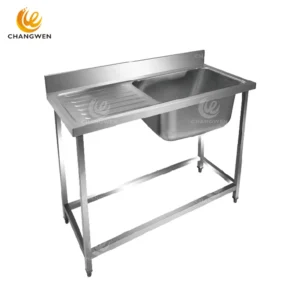
The most common commercial configuration. Flat stainless steel top, four legs, one adjustable undershelf. Available with or without backsplash.
Best for: General food preparation in restaurants, hotels, catering kitchens, cafeterias, bakeries.
Stainless Steel Work Table with Undershelf (Fixed or Adjustable)
The stainless steel work table with undershelf is the standard kitchen specification. Undershelf configuration options:
- Fixed undershelf at standard 6″ clearance
- Adjustable undershelf (locking brackets allow repositioning)
- Double undershelf (two storage tiers below the work surface)
- Wire undershelf (improved air circulation, easier cleaning)
Wall-Mounted Preparation Table
Fixed to a wall bracket rather than floor-standing. Saves floor space in tight kitchen layouts. Folds away when not in use in some configurations.
Best for: Small commercial kitchens, food truck installations, back-of-house areas where floor space is premium.
Cabinet Base Prep Table (Enclosed)
The undershelf area is replaced by a full cabinet enclosure with stainless steel doors and shelves. Maximum storage and hygiene — enclosed storage prevents cross-contamination from floor-level debris.
Best for: Prep stations requiring hygienic ingredient storage nearby, pastry stations, laboratory-adjacent applications.
Mobile Prep Table (with Casters)
Standard table configuration with 4″ or 5″ locking casters replacing fixed feet. Can be repositioned for different prep configurations, cleaning, or event setups.
Best for: Catering operations, food trucks, kitchens with variable layouts, any application where table mobility is operationally valuable.
Custom Stainless Steel Tables
Non-standard dimensions, integrated features, or multi-function configurations. Common custom options include:
- Integrated sinks (one or two compartment)
- Integrated drain grooves or perforations for wet prep areas
- Custom heights for ergonomic optimization
- Corner configurations (L-shaped)
- Integrated cutting board inserts
- Drawer configurations below work surface
- Custom finishes (electropolished, brushed, embossed)
Where China’s Prep Table Manufacturers Are Located
Understanding China’s manufacturing geography helps you target the right regions and evaluate supplier claims more accurately.
Guangdong Province (Primary Hub)
Foshan and Guangzhou: The dominant center for commercial stainless steel kitchen equipment manufacturing in China. Foshan specifically has become the primary production hub for commercial kitchen equipment, with a deep ecosystem of steel suppliers, component manufacturers, and specialized fabricators. The concentration of supply chain infrastructure reduces lead times and production costs.
Why Guangdong dominates: Proximity to major ports (Guangzhou, Shenzhen, Hong Kong) makes export logistics efficient. The integrated supply chain — from raw stainless steel coil to finished product — is mature and competitive.
Shandong Province
A major industrial province with strong commercial kitchen equipment capability. Shandong manufacturers tend toward higher-scale operations and are often well-positioned for North American commercial certifications. Some of China’s largest commercial kitchen equipment exports originate from Shandong.
Zhejiang Province
Known for precision metalwork and manufacturing consistency. Zhejiang manufacturers — particularly around Ningbo and Hangzhou — often have stronger documentation and quality control systems than some Guangdong competitors. Better suited for buyers prioritizing manufacturing process quality over lowest cost.
Practical Implication for Buyers
Manufacturing cluster matters because it affects your supply chain risk. A manufacturer in Guangdong’s established kitchen equipment cluster has:
- Shorter sourcing lead times for raw materials
- Access to specialized component suppliers (legs, undershelves, adjustable feet, casters) within hours
- Established export logistics infrastructure
- Accumulated fabrication expertise in commercial kitchen equipment specifically
This is distinct from a general metalwork manufacturer in a region without kitchen equipment specialization — even if their prices are lower.
How to Find Verified Stainless Steel Table Manufacturers
Primary Sourcing Channels
Alibaba and Made-in-China
The two largest B2B directories for Chinese manufacturers. Both include genuine factories and trading companies — the distinction matters significantly (covered in the next section). On Alibaba, filter for “Gold Supplier” + “Verified Manufacturer” status. On Made-in-China, look for “Audited Supplier” badge.
Search terms that work well for prep table sourcing:
- “commercial stainless steel work table manufacturer”
- “stainless steel prep table factory NSF”
- “304 stainless steel kitchen work table OEM”
Canton Fair
The China Import and Export Fair held twice annually in Guangzhou. The most reliable access to verified manufacturers — every exhibitor is a production operation, not a trading company. For buyers planning significant purchasing programs, attending Canton Fair is the most efficient single sourcing event available.
Global Sources
Strong for verified manufacturer listings. Particularly useful for finding manufacturers with established export programs to North America and Europe.
Direct Referrals
If industry peers have existing supply relationships with verified stainless steel table manufacturers they are willing to share, this is often the fastest path to a qualified supplier.
What to Assess in Initial Contact
Once you have a candidate supplier shortlist, the initial inquiry reveals important qualification signals:
Technical responsiveness: Can they answer specific questions about gauge, steel grade, weld specifications, and NSF certification without delay? Manufacturers with genuine production capability answer these immediately. Trading companies forward questions.
Specification flexibility: Can they work with your drawings or specifications? Established manufacturers have engineering capacity to review custom requirements.
Sample availability: Do they have samples of relevant table configurations available immediately or with short lead time?
Export documentation: Can they provide export documentation list proactively? NSF certificates, ISO 9001, Mill Test Certificates, packing list templates?
The Factory Verification Framework: 7 Non-Negotiable Checks
This is where most sourcing problems begin — not in the purchase order, but in failing to adequately verify the supplier before placing it.
Check 1: Factory vs. Trading Company Verification
This is the most important single step in the entire process. Trading companies present identically to factories in online listings but source products from factories they do not control, add 15–30% margin, and provide zero production oversight.
How to verify:
Request a live video call showing the production floor. A genuine stainless steel table manufacturer can show you: stainless steel sheet processing equipment (laser cutters, press brakes, punches), welding stations with visible work in progress, grinding and finishing stations, and assembly/QC area. Unscripted, live footage only — pre-recorded videos are insufficient.
Request business registration documents. Chinese business licenses specify the registered activity. Manufacturing companies register as manufacturing entities. Trading companies register as trading companies.
The technical question test: Ask: “What gauge press brake do you use for tabletop folding?” or “What is your typical weld gap specification for leg-to-frame joints?” Factories answer immediately and accurately. Trading companies say “I will check with our factory.”
Check 2: Steel Grade Documentation
Request the Mill Test Certificate for the 304 stainless steel used in production. This is a standard document in the steel supply chain — any manufacturer working with documented 304 has this on file. A supplier who cannot provide it is not using traceable 304 grade steel.
Check 3: NSF Certification Verification
If you require NSF-certified stainless steel kitchen work tables, request the NSF listing number (not just a certificate image). Verify it at the NSF official database at nsf.org. The listing confirms:
- Which specific products are certified (model-specific, not blanket company certification)
- Which NSF standard applies (NSF/ANSI 2 for food equipment)
- Whether the certification is currently active
NSF conducts unannounced factory inspections as part of maintaining certification. A manufacturer who is genuinely NSF-certified welcomes verification because it differentiates them from competitors making unverifiable claims.
Check 4: ISO 9001 Quality Management Verification
ISO 9001 certification confirms that the manufacturer has documented quality management systems — process controls, incoming material inspection, production quality checks, and non-conformance handling. Request the certificate and verify the issuing body is accredited (SGS, TÜV, Bureau Veritas, Intertek are recognized globally).
Check 5: Physical Sample Inspection
Never place a bulk order without evaluating physical samples under realistic assessment:
- Steel grade test: Magnet test on the tabletop (should not attract). Request XRF test for definitive verification.
- Weld quality: Inspect all weld points — frame-to-leg joints, undershelf brackets, backsplash welds. Clean, fully penetrated welds with no gaps, voids, or sharp edges.
- Surface finish consistency: Mirror or brushed finish should be uniform across the entire work surface with no tool marks, inconsistent areas, or visible grinding marks.
- Leg stability: Place the table on a level surface and apply downward pressure on each corner. Zero rocking. Adjustable feet should operate smoothly and lock securely.
- Load test: Apply representative heavy load (200+ lbs distributed) and check for deflection.
Check 6: Production Capacity and Delivery Record
For orders involving multiple units or ongoing supply programs:
- What is their current monthly production capacity for your table configuration?
- What is their current delivery lead time?
- Can they provide references from current wholesale buyers in your region?
- What was their delivery performance on the last three export orders (on-time rate)?
Check 7: Pre-Shipment Inspection
For any wholesale order above $5,000, commission a third-party pre-shipment inspection through SGS, Bureau Veritas, Intertek, or QIMA. The inspector visits the factory before shipment and checks:
- Quantity against purchase order
- Material grade (visual check + magnet test + spot XRF if specified)
- Surface finish and weld quality on random sample
- Dimensional accuracy against your specification
- NSF marking (if applicable) — should be permanently stamped, not a sticker
Cost: $280–500 per inspection. This is the highest-ROI quality assurance step in the entire sourcing process.
NSF Certification: What It Is and How to Verify It
What NSF/ANSI 2 Requires
NSF International’s Standard 2 (Food Equipment) is the foundational certification for commercial food contact surfaces. For stainless steel food prep tables, it mandates:
- Food-contact surfaces made from 304 or equivalent corrosion-resistant stainless steel (or AISI 300 series)
- All surfaces smooth, free of pits, crevices, or projections where food particles can lodge
- All welds smooth and accessible for cleaning
- No exposed threads in food zones
- Undershelf positioned minimum 6″ (15cm) from floor to allow cleaning
- Adjustable feet or casters to maintain clearance requirement
The Certification Process
A manufacturer seeking NSF/ANSI 2 certification submits products to NSF International for independent evaluation. NSF engineers, toxicologists, and microbiologists test every component against the standard. After initial certification, NSF conducts unannounced factory inspections to verify ongoing compliance.
This ongoing inspection requirement is why NSF certification is meaningful — it is not a one-time audit but an active compliance program.
How to Verify in 2 Minutes
- Go to nsf.org
- Navigate to the certification listings database
- Search by manufacturer name, brand, or model number
- Check that the listing is current (not expired) and covers the specific product type
If a product is not in the NSF database, it is not NSF certified — regardless of what the certificate image says. The database is the authoritative source.
NSF Requirements by Market
| Market | Required/Relevant Certification |
|---|---|
| USA commercial kitchen | NSF/ANSI 2 (required by most health codes) |
| Canada | NSF/ANSI 2 (accepted by most provincial health authorities) |
| European Union | CE marking + EN standards for food equipment |
| Australia / NZ | Food Standards Australia New Zealand (FSANZ) compliance |
| UAE / Middle East | GSO standards (often accept NSF as equivalent) |
| Global (quality) | ISO 9001 quality management system |
Custom Stainless Steel Tables: OEM and ODM Explained
Most restaurant equipment buyers do not realize how accessible custom stainless steel tables are when sourcing directly from Chinese manufacturers.
What Can Be Customized
Almost every dimension and configuration is customizable from established manufacturers:
Dimensional customization:
- Non-standard lengths and widths (any dimension in 1″ / 25mm increments)
- Custom heights for ergonomic optimization (standard 34″–36″; custom range typically 28″–42″)
- Corner configurations (L-shaped, T-shaped work stations)
Feature customization:
- Integrated sink compartments (one, two, or three compartments)
- Integrated drain grooves for wet prep stations
- Drawer bank below work surface
- Overhead shelf brackets
- Equipment mounting provisions (holes, channels)
- Custom backsplash heights and configurations
Finish customization:
- No. 4 brushed (standard)
- No. 2B mill finish (smoother, more reflective)
- Electropolished (ultra-smooth, enhanced corrosion resistance for pharmaceutical/laboratory applications)
- Embossed patterns
Branding customization:
- Laser-engraved logo on tabletop or undershelf
- Branded packaging
- Custom documentation and certification paperwork
MOQ for Custom Stainless Steel Tables
Custom orders from established Chinese manufacturers typically require:
- Standard configuration with dimensional change only: 5–20 units
- Configuration modification (added features, integrated components): 20–50 units
- New tooling / press brake die creation: 50–200 units depending on complexity
- Full private label program with branding: 50–200 units
For most restaurant equipment distributors and hotel procurement programs, the effective MOQ for a useful custom table program is 20–50 units — significantly lower than most buyers expect.
Pricing, MOQ and Lead Times
Factory-Direct Wholesale Price Ranges
The following ranges represent factory-direct pricing for stainless steel work tables from verified Chinese manufacturers. All figures are approximate FOB China pricing.
| Table Type | Approx. Unit Price (FOB) |
|---|---|
| Standard 18-gauge 430 SS, 24″ × 48″ with undershelf | $35–$60 |
| Standard 18-gauge 304 SS, 24″ × 48″ with undershelf | $55–$90 |
| Heavy duty 16-gauge 304 SS, 30″ × 72″ with undershelf | $90–$150 |
| NSF-certified 18-gauge 304 SS, 30″ × 72″ with undershelf | $85–$130 |
| Cabinet base 304 SS work table, 30″ × 60″ | $130–$220 |
| Mobile work table with casters, 18-gauge 304 SS | $75–$120 |
Factory-direct pricing is typically 35–55% below what domestic distributors charge for equivalent specifications.
MOQ Guide
| Order Type | Typical MOQ |
|---|---|
| Standard catalog sizes | 5–20 units |
| Custom dimensions (standard configuration) | 10–30 units |
| New configuration with standard components | 20–50 units |
| NSF-certified specific models | 20–100 units |
| Full custom with new tooling | 100–500 units |
Lead Time Breakdown
| Phase | Duration |
|---|---|
| Sample production | 7–15 days |
| Sample approval | 3–7 days |
| Production (standard order) | 20–35 days |
| Production (custom/large order) | 30–50 days |
| Pre-shipment inspection | 2–5 days |
| Factory to port | 3–7 days |
| Ocean freight (to US West Coast) | 15–20 days |
| Ocean freight (to East Coast) | 22–28 days |
| Customs clearance + inland delivery | 5–10 days |
Total first-order timeline: 10–16 weeks from supplier contact to delivery.
Common Sourcing Mistakes to Avoid
These are the patterns that cost buyers money on their first — and sometimes second — sourcing program.
Mistake 1: Accepting “stainless steel” without grade specification. “Stainless steel” tells you nothing about grade. Always specify and verify 304 for food-contact surfaces.
Mistake 2: Buying on price without understanding why the price is lower. A significantly lower price than market for an equivalent specification almost always means a grade substitution (201 or 430 instead of 304) or a gauge reduction. The table looks identical. The failure mode becomes apparent 12–18 months into use.
Mistake 3: Not verifying NSF certification against the database. NSF certificate images can be outdated, for a different product, or fabricated. The listing in the nsf.org database is the only verification that matters.
Mistake 4: Skipping the sample stage. No photograph or video reveals steel grade, weld quality, surface consistency, or structural rigidity. Physical sample evaluation is the only reliable quality gate before bulk production.
Mistake 5: Assuming trading company pricing equals factory pricing. Trading companies add 15–30% to factory pricing without adding manufacturing value. Identifying and connecting with actual factories is the single largest cost-saving action available in the sourcing process.
Mistake 6: Underestimating the shipping weight and volume of steel tables. Stainless steel kitchen work tables are heavy. A 30″ × 72″ table weighs 40–60 lbs. Fifty of them fill a 20-foot container and weigh 1,000–1,500 kg of product alone. Calculate CBM and weight accurately before comparing freight quotes.
Mistake 7: Starting the NSF paperwork process after production. If your end customer requires NSF-certified tables and you are sourcing from a manufacturer who does not currently hold NSF listing, the certification process takes 3–6 months. Plan accordingly or source from an already-certified manufacturer.
FAQ
What is the difference between a stainless steel prep table and a stainless steel work table?
The terms are used interchangeably in the commercial kitchen industry. “Stainless steel food prep table” and “stainless steel work table” refer to the same product: a flat stainless steel-topped work surface on adjustable legs, typically with an undershelf. Some manufacturers use “prep table” more specifically for food preparation stations and “work table” for more general use, but the construction is identical. Both fall under NSF/ANSI 2 requirements for commercial kitchen use in the United States.
What gauge stainless steel should a commercial prep table be?
18-gauge (approximately 1.2mm) is the standard specification for most commercial kitchen stainless prep tables. It provides sufficient strength for distributed loads up to 430–540 lbs on the tabletop and handles daily commercial use without warping or denting under normal conditions. 16-gauge is recommended for heavy-duty applications: butchering stations, tables that will hold heavy equipment (mixers, slicers), or high-impact food preparation. 20-gauge is light-duty and not appropriate for daily commercial kitchen use.
Is 304 or 430 stainless steel better for a kitchen prep table?
For the food-contact tabletop surface: 304 stainless steel is the correct specification and is required by NSF/ANSI 2 for commercial kitchen compliance. 430 stainless lacks the nickel content that provides 304’s corrosion resistance, and will show rusting and pitting at welds and surface irregularities under commercial conditions within 12–24 months. For undershelves and legs in dry environments, 430 is an acceptable and cost-effective specification. The typical commercial standard is a 304 top with galvanized or 430 undershelf — this is the specification used by major commercial kitchen equipment distributors worldwide.
How do I verify NSF certification for a stainless steel table from China?
Request the NSF listing number from the supplier (not just a certificate image). Go to the NSF International official certification database at nsf.org. Search by manufacturer name, brand, or model number. A genuine NSF listing will show the specific products certified, the applicable standard (NSF/ANSI 2 for food equipment), and the current certification status. If the product does not appear in the database, it is not currently NSF certified, regardless of any documentation the supplier provides.
What is the typical MOQ for sourcing stainless steel work tables from China?
MOQ varies by order type. For standard catalog configurations: typically 5–20 units. For custom dimensions using existing manufacturing processes: 10–30 units. For new configurations requiring tooling modifications: 50–200 units. For a first program with a new supplier, many established Chinese stainless steel table manufacturers will accept 10–20 unit minimum orders at slightly higher unit pricing to establish the relationship, with better pricing applying to repeat orders above their standard MOQ threshold.
Can I source custom stainless steel tables from China at low MOQs?
Yes — significantly more accessible than most buyers expect. Custom stainless steel tables with non-standard dimensions (any width, length, or height within the factory’s standard process range) typically require just 10–30 units from established manufacturers. Custom configurations with integrated features (sinks, drawers, drainage) or new press brake tooling require higher MOQs: typically 50–200 units. For most commercial kitchen programs, dimensional customization at 20–50 unit MOQ is routinely available from qualified Chinese stainless steel kitchen work tables manufacturers.
Conclusion
Sourcing stainless steel prep tables from China is one of the highest-value procurement decisions a restaurant operator, hotel chain, or kitchen equipment distributor can make. Factory-direct pricing delivers 35–55% savings versus domestic distribution on equivalent specifications. The customization capability — custom dimensions, integrated features, surface finishes — is routinely available at MOQs most buyers do not expect.
But the sourcing process requires getting the right things right from the beginning:
Steel grade first. 304 for food-contact surfaces, documented with a Mill Test Certificate. Non-negotiable.
Gauge for application. 16-gauge for heavy duty, 18-gauge for standard commercial. Specify in writing.
Factory, not trading company. Live video verification. Technical question test. Business license review.
NSF verification at nsf.org. Listing number, not certificate image.
Sample before bulk. Magnet test, weld inspection, load test, surface assessment.
Pre-shipment inspection. For any order above $5,000.
The manufacturers who have earned the business of hotel chains, restaurant groups, and international distributors are the ones who can answer every one of these points without hesitation — because they have the production infrastructure, the material documentation, and the quality control systems to back up what they claim.
Changwen manufacture commercial stainless steel preparation tables, stainless steel work tables with undershelf, and custom stainless steel tables in 304 grade, 16 and 18-gauge, with NSF/ANSI 2 certification, in standard and fully custom configurations. Factory-direct wholesale pricing available from 100 units. Export documentation including Mill Test Certificates, NSF listings, and ISO 9001 certificates provided as standard.