Read time: 12 min
Introduction
Here’s a problem every caterer, hotel operator, and restaurant owner faces at some point:
You need commercial chafing dishes that look great, keep food at a safe temperature for hours, and hold up through hundreds of events without the frame warping or the lid slamming shut on a guest’s hand.
The market is full of options. Some are genuinely built for commercial use. Most are not.
The difference between a commercial chafing dish that lasts five years of daily hotel buffet service and one that fails in eight months comes down to three decisions: the right type for your application, the right material grade, and the right heating method for your service environment.
This guide covers all three — plus sizing, MOQ and pricing realities, and how to find a supplier you can actually trust for long-term wholesale purchasing.
Whether you’re setting up a hotel breakfast buffet, running chafers for catering events, launching a restaurant buffet line, or sourcing wholesale for distribution — you’ll leave this guide knowing exactly what to specify and why.
Let’s get into it.
Key Takeaways
- Commercial chafing dishes come in full-size (8–9 qt), half-size (4–5 qt), and round/soup configurations — each designed for specific menu items and service volumes.
- Stainless steel 304 is the commercial standard — 201-grade steel is cheaper but corrodes faster and is not suitable for high-frequency daily commercial use.
- Fuel-based chafers (using chafers and sternos / gel fuel) are the most flexible option — no power outlet required, ideal for outdoor and off-site catering. Commercial electric chafing dishes deliver more consistent temperature control and are preferred for fixed indoor buffet stations.
- Full-size rectangular chafers (8–9 qt) are the workhorses of commercial buffet operations. Commercial chafing dish round models serve soups, sauces, and specialty stations. Commercial chafing dish 4 qt half-size models handle sides and desserts.
- Wholesale MOQs from Chinese manufacturers typically start at 50–200 units for standard designs; custom finishes and private label require 200–500 units minimum.
- 304 stainless steel documentation (Mill Test Certificate) is non-negotiable when sourcing wholesale — many suppliers list “stainless steel” without specifying grade.
Types of Chafing Dishes
Choosing the wrong type is the most common mistake buyers make — and it’s completely avoidable if you understand what each type is actually designed to do.
Rectangular Chafing Dish (Full-Size)
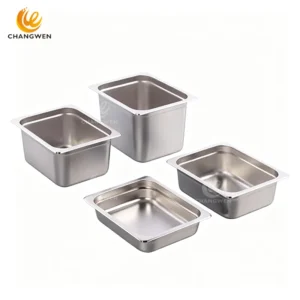
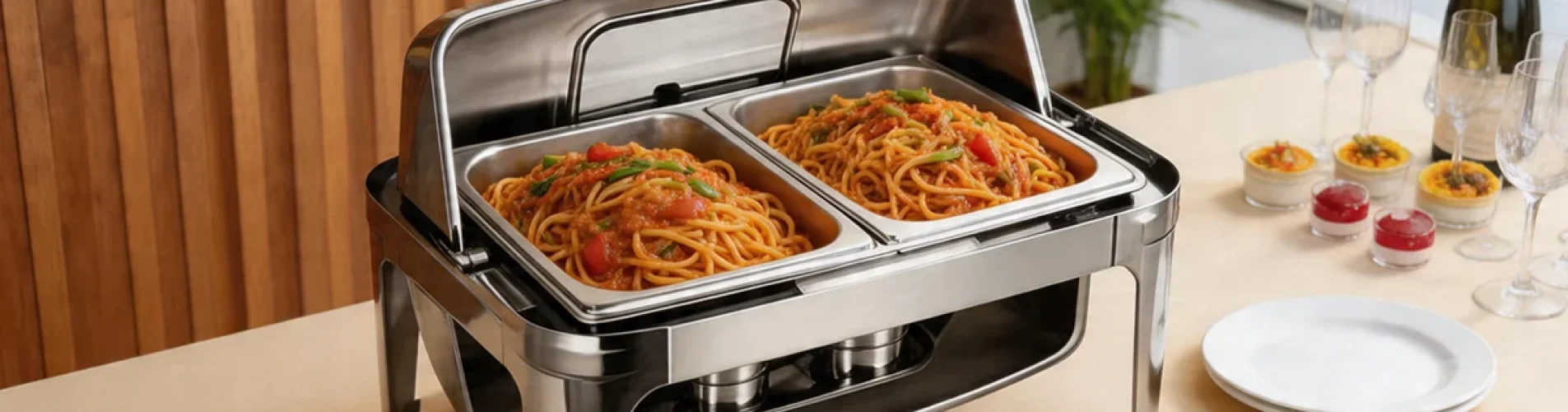
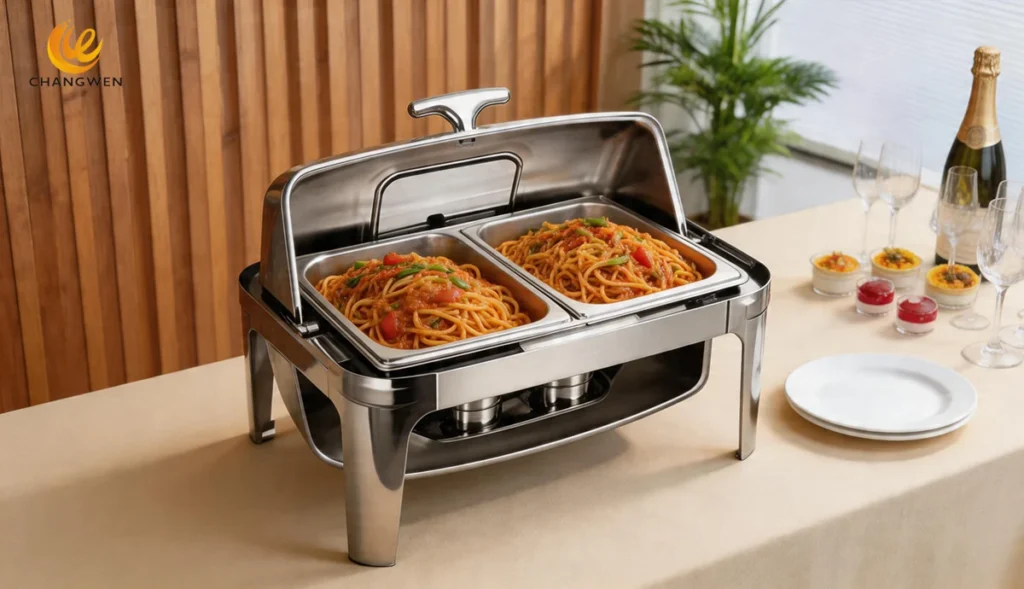
The rectangular full-size chafer is the commercial buffet standard. It holds a full GN 1/1 food pan, handles 8 qt to 9 qt of food capacity, and works for every main-course application: entrees, proteins, grains, and pasta.
This is the commercial chafing dish buffet workhorse — found in every hotel breakfast line, catering van, and restaurant buffet setup worldwide. If you’re building a buffet from scratch, rectangular full-size chafers are where you start.
Best for: Hotels, restaurants, catering companies, buffet service, large events
Half-Size Chafing Dish (4–5 Qt)
The commercial chafing dish 4 qt (and the similar commercial chafing dish 5 qt) is a half-size format — smaller footprint, less food capacity, same visual presentation as a full-size unit.
Half-size chafers are essential for:
- Side dishes (vegetables, starches, condiment items)
- Dessert stations
- Smaller buffet setups where full-size capacity is excessive
- Mixed buffet lines where you need more variety in the same table length
A chafing dish buffet set typically combines full-size rectangular chafers for mains with half-size units for sides — giving you a complete, balanced presentation.
Round Chafing Dish
The commercial chafing dish round format holds a circular food pan rather than a GN pan. Typical capacities run from 4 to 7 quarts.
Round chafers are used for:
- Soups and chowders (the round form factor suits liquid items better visually and functionally)
- Sauces and gravies
- Specialty dishes where round presentation matters (Asian soups, Indian dal, Mediterranean mezze)
- Decorative buffet layouts where alternating rectangular and round shapes creates visual interest
If your menu includes soup service, a round or marmite-style chafer is a non-negotiable item in your setup.
Square Chafing Dish
The square chafer is a variation on the half-size format — same capacity range, square footprint. Used in contemporary buffet designs where a cleaner, grid-based table layout is preferred over the traditional rectangular line.
Square chafers are popular in:
- Modern hotel buffet setups
- Corporate dining environments
- High-design catering presentations where table geometry matters
Soup / Marmite Chafer
Specifically designed for liquid service. Deep, insulated water pan construction maintains soups at safe temperatures for extended periods. Often paired with ladles and soup bowls at the buffet station.
Luxury / Ornate Chafers
Used in upscale wedding catering, black-tie events, and luxury hotel dining. Feature hammered copper or gold finishes, decorative legs, and ornamental lid handles. Made from the same 304 stainless steel as commercial models but with premium finishing.
Not suitable for: High-frequency daily commercial use (decorative finishes require more careful handling). Best for event-based catering where aesthetics are part of the service proposition.
Chafing Dish Sizes: From 4 Qt to 9 Qt
Size selection directly determines how many portions you can serve before needing to refill — which affects service flow, staff workload, and guest satisfaction.
Commercial Chafing Dish Size Chart
| Size | Capacity | Format | Best Application |
|---|---|---|---|
| 4 qt | 4 quarts / 3.8 L | Half-size rectangular | Sides, desserts, small buffet stations |
| 5 qt | 5 quarts / 4.7 L | Half-size rectangular or round | Sides, soups, mid-volume service |
| 8 qt | 8 quarts / 7.6 L | Full-size rectangular | Main courses, high-volume buffet |
| 9 qt | 9 quarts / 8.5 L | Full-size rectangular | Main courses, hotel breakfast, large events |
The 9 quart commercial chafing dish is the most common full-size format for hotel and large-event catering. The chafing dish 8 qt is virtually the same in use — the difference is minimal and comes down to manufacturer specification rather than meaningful functional difference.
The 5 quart commercial chafing dish is a versatile mid-range format — larger than a 4 qt side dish unit but smaller than a full-size main course chafer. Useful for medium-volume service or where space is limited.
How Many Chafing Dishes Do You Actually Need?
A practical framework:
- Small catering events (under 50 guests): 4–6 chafers (mix of full-size mains + half-size sides)
- Mid-size events (50–150 guests): 8–12 chafers
- Large hotel breakfast buffet (daily service): 12–20 chafers minimum — accounting for rotation during service
- High-volume catering operation: Calculate by station × service duration × refill frequency
Always buy more than your minimum estimate. Undersupplied buffet lines create guest experience failures that cost far more than the extra chafer.
Key Materials: Stainless Steel 201 vs 304
This is the most important specification decision you’ll make — and the one most frequently skipped by buyers focused on price.
The Short Version
304 stainless steel for commercial use. Always.
Why Material Grade Matters
Both 201 and 304 stainless steel look identical in photographs, in showroom conditions, and in the first few months of use. The difference shows up at month eight, when the 201 unit starts showing rust spots on the water pan rim, or the welds begin discoloring, or the finish goes dull and patches.
This isn’t a cosmetic problem — it’s a food safety problem. A corroding water pan in a buffet station means rust particles entering the heating water, degrading food safety, and failing health inspections.
201 Stainless Steel: What It Is and When It’s Acceptable
201 stainless steel is a lower-nickel, lower-chromium alloy in the 200 series. Key characteristics:
- Chromium content: 13–15% (vs 18% in 304)
- Nickel content: Very low (0.5–3.5%) — this is the primary cost-saving substitution
- Corrosion resistance: Moderate — deteriorates under frequent cleaning, moisture, and acidic environments
- Cost: Significantly lower than 304
- Appearance: Identical to 304 when new
201 is acceptable for: Decorative-only applications, very occasional use, or markets where appearance matters more than longevity (one-time event rental, disposable/short-lifecycle programs).
201 is not acceptable for: Daily hotel buffet use, high-frequency catering, any application where the chafer is cleaned daily, or any food service environment where health code inspections occur.
304 Stainless Steel: The Commercial Standard
304 stainless steel (also expressed as 18/8 — 18% chromium, 8% nickel) is the commercial kitchen standard. Key characteristics:
- Chromium content: 18% — forms a passive oxide layer that resists rust
- Nickel content: 8–10% — provides corrosion resistance and maintains surface luster
- Corrosion resistance: Excellent — maintains food-safe surface under daily commercial cleaning cycles
- Cost: Higher than 201, significantly lower than 316
- NSF compliance: 304 meets NSF food contact standards
304 is required for: Hotels, restaurants, commercial catering operations, any application where the chafer is used more than occasionally, and any jurisdiction where health code compliance is inspected.
How to Verify Material Grade When Sourcing
Claiming “stainless steel” in a product listing proves nothing about grade. Request:
- Mill Test Certificate (MTC) from the steel supplier — confirms the actual chromium and nickel content of the batch used
- Third-party material test report — SGS, Intertek, or Bureau Veritas can verify grade through elemental analysis
- Grade marking physically stamped on the product — not just on a sticker or label
Do not accept verbal assurances or catalog claims of “304” without documentation on significant wholesale orders.
430 Stainless Steel: The Induction Option
430 stainless steel (18% chromium, 0% nickel — ferrite grade) is magnetic, making it induction-compatible. It’s less corrosion-resistant than 304 but is sometimes used for the exterior base of induction-compatible chafers. Not suitable as the interior food contact surface.
Heating Options: Fuel vs Electric
Your heating choice affects where you can deploy your chafers, your operational costs, the consistency of your food holding temperature, and your compliance with venue restrictions.
Fuel-Based Chafing Dishes (Chafers and Sternos)
Fuel-based chafers — also known as chafers and sternos — use canned combustible gel or liquid alcohol fuel to heat the water pan beneath the food pan.
How it works: The fuel canister sits in a holder beneath the water pan. The flame heats the water to near-boiling. Steam rises to heat the food pan from below. Indirect heat prevents scorching and maintains food at 140–165°F (60–74°C) — the safe holding temperature range.
Fuel types:
- Ethanol (ethyl alcohol): Most common, burns clean, moderate heat output, burns for 2–4 hours per canister
- Diethylene glycol (DEG) wick-type: Considered safest (non-combustible liquid, burns via wick), gentle heat, burn time 4–6 hours
- Methanol (methyl alcohol): Produces highest heat output, faster warm-up, but more toxic if ingested
Fuel capacity planning: One fuel canister typically provides 2–4 hours of heating. For a 4-hour catering event, plan 1–2 canisters per chafer.
Advantages of fuel-based chafers:
- No power outlet required — deploy anywhere
- Outdoor and off-site catering ready
- Simple setup (no wiring, no power management)
- Lower upfront equipment cost
- Standard for weddings, outdoor events, and mobile catering
Disadvantages:
- Temperature less precisely controlled than electric
- Open flame — venue restrictions may apply (hospitals, schools, some event spaces prohibit open flames)
- Ongoing fuel cost (a significant operational cost for high-frequency users)
- Flame can be affected by wind in outdoor settings (windguards recommended)
Commercial Electric Chafing Dish
A commercial electric chafing dish uses an integrated heating element — either directly heating the water pan or using an induction base — to maintain food temperature without an open flame.
How it works: An electric heating element (typically 300–500W) heats the water pan. A thermostat or control panel allows temperature adjustment, typically 86°F–200°F (30°C–93°C). Most commercial electric models include a temperature display and variable heat settings.
Advantages of commercial electric chafing dishes:
- Precise, consistent temperature control — critical for delicate foods (sauces, custards, dairy-based items)
- No open flame — complies with venues that prohibit fuel
- No ongoing fuel purchasing cost
- More professional appearance for fixed buffet stations
- Thermostat prevents overheating — reduces food quality degradation over long service periods
Disadvantages:
- Requires power outlet — limited to venues with electrical infrastructure
- Power cord management — cords create safety and aesthetic challenges
- Higher upfront cost than fuel-based models
- Not suitable for remote outdoor use without generator access
Which Should You Choose?
| Application | Recommended Heating |
|---|---|
| Outdoor catering events | Fuel (with windguards) |
| Mobile / off-site catering | Fuel |
| Hotel breakfast buffet (fixed station) | Electric |
| Restaurant lunch/dinner buffet (fixed) | Electric |
| Weddings and formal events | Fuel (traditional aesthetic) or Electric |
| Venues with open-flame restrictions | Electric only |
| High-frequency daily use (consistent temp critical) | Electric |
| Mixed indoor/outdoor operation | Buy both types |
Many commercial operators maintain both fuel-based and commercial electric chafing dishes to cover all deployment scenarios.
MOQ and Pricing Factors
If you’re sourcing commercial chafing dishes for sale at wholesale or distribution scale, understanding the pricing structure prevents costly ordering mistakes.
What Drives Commercial Chafing Dish Pricing
Material grade: 304 stainless steel costs 30–50% more per unit than 201 at equivalent gauge. A “low-price” chafer that doesn’t specify 304 is almost certainly 201 or lower.
Steel gauge (thickness): Commercial chafers range from 0.5mm (economy, dents easily) to 1.2mm+ (heavy-duty commercial). Heavier gauge means better heat retention and longer service life. Request the gauge specification in writing.
Lid mechanism: Standard roll-top lids are the most common and lowest-cost. Hydraulic soft-close lids (slow, controlled opening and closing) cost 20–40% more but significantly reduce staff injury risk and equipment damage over time.
Finish type: Mirror polish is the commercial standard. Satin/brushed finish costs similarly but is more resistant to visible fingerprints. Gold, hammered copper, and decorative finishes add significant cost.
Heating type: Fuel-based models are less expensive. Electric models with thermostat controls cost more upfront but eliminate ongoing fuel cost.
Shape complexity: Rectangular standard chafers are lowest cost to produce. Oval and ornate designs require more complex tooling and are priced higher.
Typical Wholesale Price Ranges
The following ranges represent factory-direct wholesale pricing for 304 stainless steel commercial chafers. Retail and domestic distributor pricing is significantly higher.
| Chafer Type | Factory-Direct Wholesale (per unit) |
|---|---|
| Standard fuel chafer (201 SS) | Budget tier — light duty only |
| Full-size rectangular (304 SS, standard lid) | Mid-commercial tier |
| Full-size rectangular (304 SS, hydraulic lid) | Commercial premium tier |
| Commercial electric chafing dish | Commercial-electric tier |
| Luxury / ornate (304 SS, decorative) | Event/hospitality premium tier |
Request itemized pricing from your supplier for each specification — material grade, gauge, lid type, finish, and heating method — so you’re comparing equivalent products.
MOQ by Order Type
Standard designs (stock models):
- Minimum order quantity: typically 50–200 units per model
- Custom color (gold, copper, matte): 200–500 units minimum
- Private label / OEM branding: 1000 units minimum
Ornate and luxury designs:
- Higher MOQ (1,000 units) due to production complexity
- Longer lead time (45–60 days vs 25–35 days for standard models)
Sample orders:
- Request 5–10 units before committing to bulk
- Reputable factories provide samples at near-cost pricing
- Sample lead time: 7–15 days from China
Lead Time Planning
Standard production and ocean freight timeline for China-sourced commercial chafing dishes:
- Production: 25–40 days
- Ocean freight to US West Coast: 15–20 days
- Ocean freight to US East Coast: 20–28 days
- Ocean freight to Europe: 25–35 days
- Ocean freight to Australia: 20–30 days
Total door-to-door: approximately 6–10 weeks from order placement. Plan accordingly for seasonal demand peaks (hotel renovations, catering season openers, holiday event catering demand).
How to Find a Reliable Supplier
Getting the product spec right matters. Getting the supplier right matters equally — because a well-specified order from a bad supplier still results in damaged goods, delayed delivery, and repeated quality variation.
Here is the framework used by professional commercial kitchen equipment buyers.
Step 1: Verify Factory vs. Trading Company
This is the most important step. Trading companies present themselves identically to manufacturers online but source from factories they don’t control, adding 15–30% markup while providing zero production oversight.
How to verify a genuine factory:
- Request an unscripted video call showing the production floor — not a pre-recorded video
- Ask for business registration documents (manufacturers register as “manufacturing companies”)
- Check Alibaba Gold Supplier + Verified Manufacturer status, or Made-in-China Audited Supplier badge
- Ask specific technical questions: “What gauge steel do you use for the water pan?” “What is your welding process for the lid hinges?” Real factories answer immediately. Trading companies need to “check with their supplier.”
Step 2: Confirm Material Certifications
For commercial chafing dishes sourced in bulk, require:
- Mill Test Certificate confirming 304 grade for all stainless steel components
- NSF food contact compliance (for US commercial market)
- CE marking on any electric components (for EU market)
- LFGB food contact certification (for German/European market)
A serious factory provides these without hesitation. Requests for documentation that are met with excuses or delays are a strong warning sign.
Step 3: Request Physical Samples
Never place a bulk order without evaluating physical samples. For commercial chafing dishes, assess:
- Steel weight and feel: 304 commercial-grade has substantial weight. Thin, lightweight units are a sign of low-gauge or 201 material.
- Weld quality: Examine all weld points — frame-to-leg connections, handle attachments, lid hinge mounts. Clean, full welds. No gaps, no rough edges.
- Lid mechanism: Open and close the lid repeatedly. A good hydraulic lid moves smoothly and stops gently. A poor mechanism catches, sticks, or drops suddenly.
- Finish consistency: Check for uniform mirror or satin polish with no visible tool marks, pits, or inconsistent areas.
- Water pan fit: The food pan should sit securely in the water pan with no wobble. Imprecise pan sizing is a common quality indicator.
Step 4: Review Production Capacity and Delivery Track Record
Ask for:
- Current monthly production capacity for your specific model
- References from current wholesale buyers in your region
- Delivery performance on the last 3–5 orders (on-time rate)
- Peak-season production planning (can they handle a 2× volume order in Q4?)
Step 5: Pre-Shipment Inspection
For any wholesale order above $5,000 USD, commission a third-party pre-shipment inspection through SGS, Bureau Veritas, Intertek, or QIMA.
An independent inspector visits the factory before shipment, checks:
- Product quantity against purchase order
- Material and construction quality against your specification
- Packaging and carton marking
- Random unit sampling for defect rate
Cost: approximately $250–$450 per inspection. ROI: avoiding a full container of non-conforming product.
Red Flags to Watch For
- Unable or unwilling to provide Mill Test Certificate for the steel
- Pricing significantly below market for “304 stainless steel” — almost certainly 201
- Cannot provide factory floor video
- Reluctance to accept third-party inspection
- No verifiable export history to your target market
- Samples take more than 20 days without explanation
FAQ
What is a commercial chafing dish and how is it different from a regular chafing dish?
A commercial chafing dish is designed and constructed for daily high-frequency use in professional foodservice environments — hotels, restaurants, catering operations, and institutional kitchens. The key differences from consumer or event-rental models are: 304 stainless steel construction (not 201 or lower-grade), heavier steel gauge (0.8mm–1.2mm vs 0.4–0.6mm for consumer grade), riveted or welded handle attachments rated for full-capacity loads, and NSF food safety compliance. Consumer chafing dishes are built for occasional home use and will fail rapidly under daily commercial service conditions.
What is the difference between a commercial chafing dish 4 qt and a 9 quart commercial chafing dish?
A commercial chafing dish 4 qt is a half-size format designed for side dishes, desserts, and smaller portions — typically 12″ × 10″ in footprint. A 9 quart commercial chafing dish is a full-size format designed for main courses and high-volume service — typically 20¾” × 12¾” in footprint, fitting a standard GN 1/1 food pan. For a complete buffet setup, most operations combine full-size (8–9 qt) chafers for mains with half-size (4–5 qt) units for sides and specialty items.
What are chafers and sternos and how do I use them together?
Chafers are the stainless steel food warming units (frame, water pan, food pan, and lid). Sternos are the brand name commonly used generically for gel fuel canisters — the fuel source that heats the water in a fuel-based chafer. To use them together: place 1–2 fuel canisters in the chafer’s fuel holders beneath the water pan, fill the water pan with 1–2 inches of hot water, add the food pan with prepared food, and light the fuel. The flame heats the water, which produces steam that maintains food temperature. Standard fuel canisters burn for 2–6 hours depending on the fuel type and size.
What is a commercial electric chafing dish and when should I use one?
A commercial electric chafing dish uses an electric heating element — integrated into the base or water pan — to maintain food temperature without an open flame. It includes a thermostat for precise temperature control, typically 86°F–200°F (30–93°C). Use electric chafers when: your venue prohibits open flames (hospitals, schools, certain event spaces), you need consistent, precise temperature for delicate foods (sauces, dairy-based items), or you’re operating a permanent fixed buffet station with reliable power access. For outdoor catering and mobile service, fuel-based chafers remain the more practical choice.
What is the best stainless steel grade for a commercial chafing dish?
304 stainless steel (18/8) is the commercial standard for chafing dishes in professional foodservice use. It contains 18% chromium and 8% nickel, providing excellent corrosion resistance against the moisture, frequent cleaning, and acidic food contact that commercial chafers experience daily. 201 stainless steel looks identical but has significantly lower corrosion resistance — it is acceptable for occasional event use but fails over time in daily commercial environments. Always request a Mill Test Certificate confirming 304 grade when purchasing commercial chafing dishes wholesale.
How do I source commercial chafing dishes for sale at wholesale pricing?
For commercial chafing dishes for sale at wholesale pricing, the most cost-effective approach is factory-direct sourcing from verified Chinese manufacturers — primarily in Guangdong Province (Chaozhou, Guangzhou areas), where the majority of global commercial chafing dish production is concentrated. Verify factory status (not a trading company), require 304 stainless steel Mill Test Certificates, request physical samples before bulk order, and use a pre-shipment inspection service for orders above $5,000. Factory-direct wholesale pricing for 304 stainless steel commercial chafers is typically 30–50% below domestic distributor pricing in the US or Europe at comparable quality. Contact our team directly for current wholesale pricing and product catalog.
Conclusion
Choosing the right commercial chafing dish for your business isn’t complicated — but it does require making the right decisions in the right order.
Start with the type that matches your application (rectangular full-size for mains, half-size for sides, round for soups). Select the right size (4 qt for sides, 8–9 qt for mains). Require 304 stainless steel documentation — not 201. Choose fuel or electric based on your service environment. Then evaluate suppliers on factory verification, material certification, and delivery track record, not on price alone.
The commercial chafing dishes that last a decade in daily hotel service aren’t dramatically more expensive than the ones that fail in a year — but they are specified correctly from the start.
We manufacture and export commercial stainless steel chafing dishes — full-size rectangular, half-size, round, electric, fuel-based, and luxury ornate models — in 304 stainless steel with NSF-compliant materials, hydraulic lid options, and OEM/private label capability.
Contact us for wholesale pricing →
We’ll respond within 24 hours with pricing, specifications, and sample availability for any model in our commercial chafing dish range.