Introduction
If you’re looking to buy stainless steel comal wholesale, you’re not alone — demand from taco stands, food trucks, restaurants, and kitchen equipment distributors across Latin America has grown steadily, and so has the number of suppliers offering them.
But not every wholesale comal is built the same. Buyers sometimes receive products that warp under sustained high heat, develop rust spots despite being labeled “stainless steel,” or arrive with handles that loosen after regular use. Knowing what to look for before you place a bulk order can save you from costly returns, customer complaints, and damaged business relationships.
This guide covers everything wholesale buyers need to know: material grades, comal types, commercial sizes, what to verify before committing to a supplier, and how to order directly from a factory with over 20 years of export experience to Latin America and South America.
Whether you’re placing your first bulk order or looking for a more reliable source, this guide will help you buy with confidence.
KEY TAKEAWAYS
•Material grade matters: Always verify 304 stainless steel — not 201 — for commercial use. 304 resists heat, corrosion, and heavy daily use far better.
•Know your comal types: Flat, convex, and concave comals serve different cooking methods. Choosing the right type reduces returns and complaints.
•Size drives your buying decision: Sizes range from 520mm to 570mm+ depending on burner setup and cooking volume. Match size to use case before bulk orders.
•MOQ starts at 100 units: Factory-direct wholesale orders typically start at 100 pieces, with flexible options for mixed sizes.
•Request samples first: Always verify material, thickness, and finish before committing to a full order — regardless of supplier reputation.
What Is a Stainless Steel Comal — and Why Does Material Matter?
A comal is a flat or slightly curved cooking surface traditionally used in Latin American kitchens to heat tortillas, cook quesadillas, roast chiles, sear meats, and prepare a wide range of street foods. The word comes from the Nahuatl comalli and remains central to Mexican, Central American, and South American cuisine.
While traditional comals were made from clay or carbon steel, commercial kitchens today overwhelmingly prefer stainless steel — and for good reason.
304 vs. 201 Stainless Steel: What Wholesale Buyers Must Know
Not all stainless steel is equal. The two grades you will encounter most in the comal market are 304 and 201, and the difference matters significantly for commercial use:
| Property | 304 Stainless Steel | 201 Stainless Steel |
| Nickel content | 8–10.5% | 3.5–5.5% |
| Corrosion resistance | Excellent | Moderate |
| Heat resistance | High (up to 870°C) | Lower |
| Rust risk | Very low | Higher, especially near coast/humidity |
| Ideal for | Commercial kitchens, daily high-heat use | Light-use or indoor-only applications |
| Price | Higher | Lower |
For distributors supplying restaurants in humid coastal regions of Latin America, the Caribbean, or Southeast Asia, 304 stainless steel is the only advisable option for long-term customer satisfaction.
Types of Stainless Steel Comals Available for Wholesale
Understanding the different comal styles helps you match the right product to your customers’ cooking needs — and avoids the mismatch returns that cost distributors money.
1. Flat Comal (Plancha / Griddle)
The most common style. A completely flat cooking surface ideal for tortillas, quesadillas, pancakes, eggs, and grilled meats. Also called a plancha or flat-top griddle. Widely used by taco stands and restaurant kitchens across Latin America.
2. Convex Comal (Comal Bola / Comal Convexo)
Features a raised center dome. As fat renders during cooking, it flows naturally to the rim, keeping the cooking surface drier and reducing flare-ups. Ideal for carnitas, chicharrones, and high-fat meats. Particularly popular in Mexico and Central America.
3. Concave Comal
The opposite of convex — the center is lower, forming a shallow bowl. Useful for dishes where retaining liquid or fat in the center is desirable, such as certain braised or sauced preparations.
4. Round vs. Rectangular
Round comals are designed to sit over a single round burner — the standard configuration for taco carts, food trucks, and small restaurant setups. Rectangular comals span multiple burners and offer a larger cooking surface, better suited for high-volume restaurant ranges and catering operations.
Size Guide for Commercial Buyers
Choosing the right size comal is one of the most important decisions in a wholesale order. A comal that does not fit the customer’s burner or cooking volume leads to returns and lost repeat business.
| Model | Dimensions | Rim Depth | Best For |
| Convex Comal | 520 × 60 mm | — | Single burner, carnitas, chicharrones, taco stands |
| Flat Comal — Standard | 570 × 130 mm | 60 mm deep rim | Tortillas, quesadillas, general restaurant use |
| Flat Comal — Medium | 570 × 150 mm | 80 mm deep rim | Higher-volume kitchens, catering setups |
| Flat Comal — Large | 570 × 170 mm | 100 mm deep rim | Large-scale catering, tortillerias, commercial ranges |
How to Choose the Right Size for Your Customers
- Food trucks and taco carts:The 520mm convex comal is the standard. It fits most single-burner propane setups and handles the high-fat cooking these operations rely on.
- Small to mid-size restaurants:The 570 × 130mm with 60mm rim is the most versatile starting point — enough surface for tortillas and quesadillas without overwhelming a single burner.
- High-volume restaurants and catering:The 570mm models with 80mm or 100mm deep rims provide greater cooking capacity and better oil containment during heavy service.
- Tortillerias and commercial bakeries:The largest rim depth (100mm) gives maximum sidewall height, reducing spillage during continuous high-volume production.
What to Check Before Placing a Wholesale Order
Before committing to a bulk comal order — especially when sourcing from overseas — run through this checklist to protect your investment and your reputation with customers.
✅ Material Certification
Request a Mill Test Certificate (MTC) confirming 304 stainless steel composition. Do not accept verbal assurance alone. A legitimate factory will provide documentation without hesitation.
✅ Steel Thickness
Thicker steel means more even heat distribution and longer product lifespan. For commercial use, a minimum of 1.5mm is acceptable; 2mm or above is preferable for heavy daily use. Thin-gauge comals are more prone to warping under sustained high heat.
✅ Handle and Rim Construction
Handles should be riveted, not welded. Riveted handles maintain structural integrity through repeated heat expansion and contraction cycles. Welded handles can develop stress fractures over time with heavy commercial use.
✅ Surface Finish
Brushed (satin) finishes are more practical for commercial kitchens — they hide minor scratches and are easier to maintain than polished mirror finishes. For outdoor cooking applications, brushed finishes also reduce glare.
✅ Packaging
Confirm how units are packaged for shipping. Individual boxing protects against transit damage; bulk packing reduces shipping cost. Choose based on whether your customers will resell individually or use directly in-house.
✅ MOQ and Lead Time
Before placing an order, please make sure you clearly understand the minimum order quantity and production lead time.
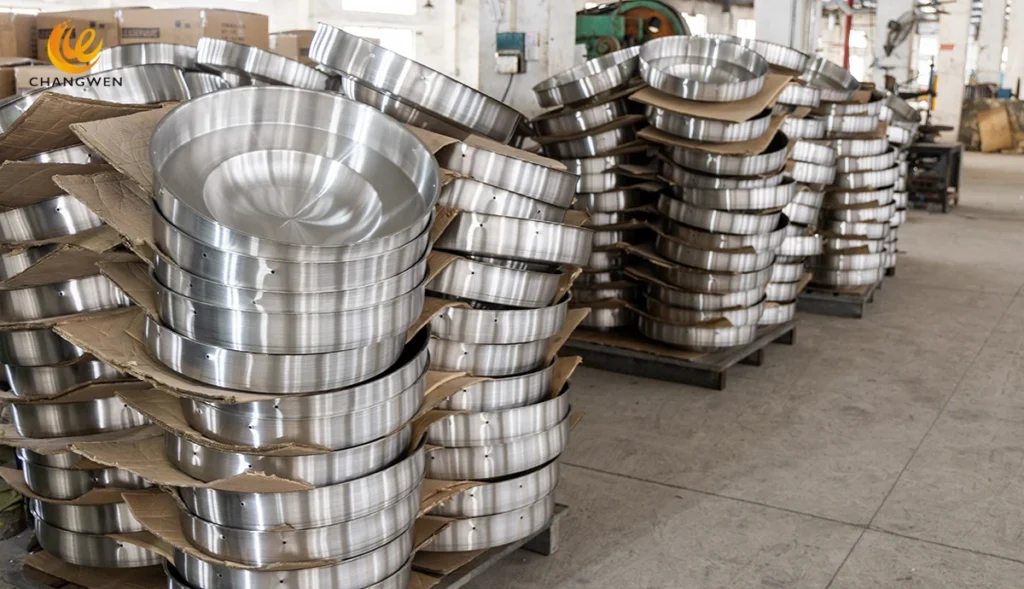
The factory-direct wholesale MOQ for Changwen stainless steel comals is 100 units, with a delivery time of 30–45 days, depending on the order volume and customization requirements.
How to Source Stainless Steel Comals from a Factory
Ordering directly from a manufacturer — rather than through a trading company or middleman — typically reduces your per-unit cost significantly. Here is how the process works step by step.
Step 1 — Define Your Specifications
Before reaching out to any factory, prepare a clear spec sheet including: comal type (flat, convex, concave), dimensions, rim depth, material grade (304 SS), thickness, handle style, surface finish, and required quantity. The more specific you are upfront, the faster you will receive accurate quotes.
Step 2 — Request Samples
Always request physical samples before placing a bulk order. Evaluate the material, finish, handle attachment, and heat performance. A factory confident in its product quality will provide samples readily. This step is non-negotiable for first-time orders with a new supplier.
Step 3 — Confirm Material and Certifications
Once samples arrive, request the MTC for the steel batch used. If you have access to a spectrometer or local materials lab, third-party verification adds an extra layer of assurance for larger orders.
Step 4 — Confirm Packaging and Labeling
Specify whether you need neutral packaging, custom-branded boxes, or retail-ready packaging. For distributors reselling under their own brand, custom packaging is available with most factory-direct suppliers.
Step 5 — Agree on Shipping Terms
The two most common international trade terms for this type of order are:
- FOB (Free on Board):The factory is responsible for getting goods to the port of origin. You arrange and pay for ocean freight and insurance. Gives you more control over shipping costs.
- CIF (Cost, Insurance, Freight):The factory arranges shipping and insurance to your destination port. Simpler for buyers new to direct import.
Step 6 — Payment Terms
For factory-direct orders from Changwen, the payment terms are 30% T/T deposit upon order confirmation, with the remaining 70% balance to be paid before shipment.
For long-term partners, we offer more flexible payment terms based on cooperation history and order volume.
FAQ
What is the MOQ for stainless steel comal wholesale orders?
Our minimum order quantity is 100 units per model. Mixed orders across different sizes can be arranged — contact us to discuss your specific requirements.
What is the difference between a comal, plancha, and griddle?
They are the same product described in different languages. Comal is the Mexican and Central American Spanish term derived from Nahuatl. Plancha is the broader Spanish-language term used across Latin America and Spain. Griddle or flat top is the English equivalent.
Are your comals made from 304 stainless steel?
Yes. All our stainless steel comals are manufactured from 304-grade stainless steel. We provide Mill Test Certificates (MTC) upon request to confirm material composition.
Can I order custom sizes or custom packaging?
Yes to both. Custom dimensions can be produced for orders meeting minimum quantity requirements. Custom-branded packaging is available for distributors who sell under their own brand.
Which countries do you export to?
We have been exporting kitchen equipment to Latin America and South America for over 20 years. Primary markets include Mexico, Guatemala, El Salvador, Honduras, Colombia, Peru, Chile, and Brazil, among others.
How long does a stainless steel comal last in a commercial kitchen?
With proper care, a 304 stainless steel comal used in a commercial kitchen typically lasts 5 to 10 years or more. Longevity depends on frequency of use, cleaning practices, and whether the comal is used over the correct burner size.
Conclusion
Sourcing stainless steel comal wholesale is straightforward when you know what to look for. The key decisions — material grade, comal type, size, and supplier reliability — are all manageable with the right information.
With over 20 years of factory-direct export experience to Latin America and South America, we manufacture and supply stainless steel comals, planchas, and a full range of commercial kitchen equipment to distributors, restaurant supply companies, and importers worldwide.
If you’re ready to discuss a wholesale order — or just want to request samples and a price list — reach out using the contact information below.
Request a Free Wholesale Quote
Tell us your product requirements, quantity, and destination country.
Contact us: info@cwchangwen.com | WhatsApp: +86-18022963948