Every piece of equipment in your commercial kitchen should work as hard as you do, and the right commercial tray rack is no exception. Whether you’re running a bustling bakery, a high-volume restaurant, or a busy cafeteria, choosing the right tray rack can dramatically improve your kitchen’s efficiency and organization. A well-designed commercial kitchen tray rack keeps your cookware protected, your workspace organized, and your staff working efficiently during even the busiest service. This comprehensive guide will walk you through everything you need to know about selecting, using, and maintaining commercial tray racks that will serve your business for years to come.

Key Takeaways
- Choose the Right Type for Your Operation: Commercial tray racks come in several configurations including mobile racks, wall-mounted units, and specialized bakery racks. Match the rack type to your workflow—mobile units for flexibility, wall-mounted for space savings, and heavy-duty models for high-volume operations.
- Material Matters for Longevity: Invest in commercial stainless steel racks or aluminum models for durability and hygiene. Stainless steel offers superior rust resistance and easy cleaning, while aluminum provides lightweight strength. Wire tray racks offer excellent ventilation but may not be suitable for all environments.
- Size and Capacity Planning Prevents Problems: Calculate your daily tray usage and add a 20% buffer for peak times. Standard full-size sheet pans measure 18″ x 26″, while half-size pans are 13″ x 18″. Ensure your rack can accommodate your most commonly used tray sizes with proper spacing between shelves.
- Look for NSF Certification and Quality Construction: NSF certified tray racks meet strict food safety and sanitation standards. Premium racks feature all-welded construction, smooth surfaces for easy cleaning, and heavy-duty casters with locks for mobile units.
- Proper Placement Maximizes Efficiency: Position your commercial kitchen shelving away from heat sources and in high-traffic prep areas. Allow adequate clearance for loading and unloading trays, and ensure mobile racks can navigate doorways and tight spaces in your kitchen layout.
What Is a Commercial Tray Rack?
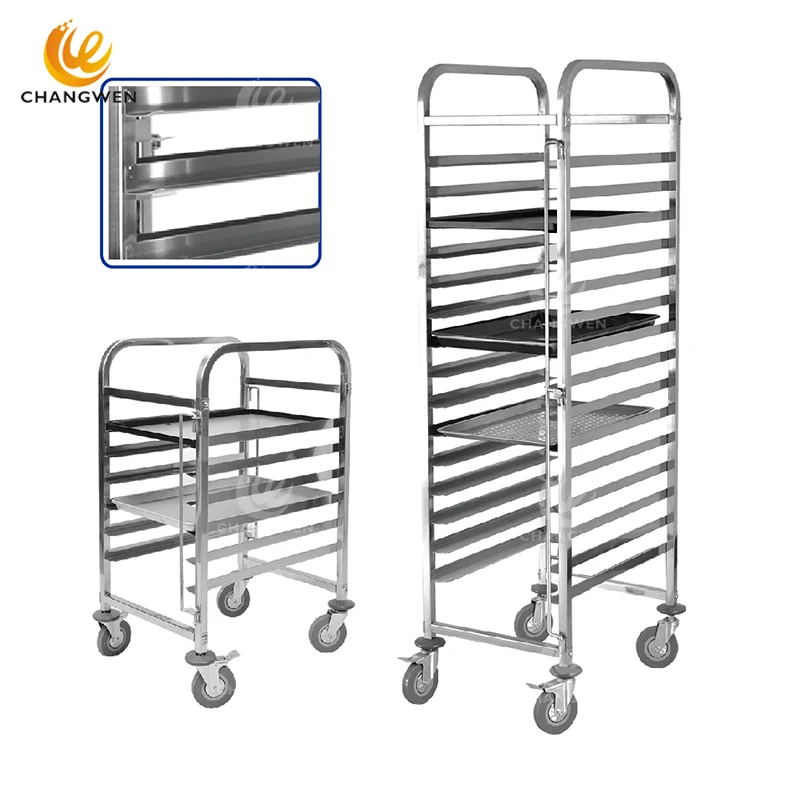
A commercial tray rack is a specialized storage solution designed to hold multiple sheet pans, baking trays, or food service trays in an organized, accessible manner. Unlike standard kitchen shelving units, commercial baking tray racks feature angled or slotted supports that allow trays to slide in and out easily while maximizing vertical storage space. These racks are essential equipment in any professional kitchen where efficiency and organization directly impact productivity.
Commercial food tray racks serve multiple critical functions beyond simple storage. They protect your valuable cookware from damage by preventing stacking that can cause warping or scratching. Proper tray organization reduces the time your staff spends searching for the right pan size, which translates directly into faster service during rush periods. Many commercial oven tray racks are designed to hold hot pans safely, allowing baked goods or roasted items to cool properly without taking up valuable counter space.
The right commercial dish tray rack also plays an important role in food safety and sanitation. By keeping trays off the floor and away from other potential contaminants, these racks help you maintain health code compliance. Commercial tray drying racks with open construction allow proper air circulation, preventing moisture buildup that could lead to bacterial growth or mold.
Understanding Different Types of Commercial Tray Racks
The commercial kitchen equipment market offers several distinct types of tray racks, each designed for specific applications. Bakery and speed racks are tall, mobile units that typically accommodate 15 to 20 full-size sheet pans. These restaurant tray shelving units feature casters for easy movement between prep areas, ovens, and cooling zones. Their open-frame construction allows maximum air circulation, making them ideal for cooling baked goods or transporting prepared items.
Wall-mounted commercial tray racks maximize floor space in compact kitchens by utilizing vertical wall areas. These fixed units work well for storing frequently used pans near specific work stations. Many commercial kitchen shelving systems offer modular wall-mounted components that can be configured to meet your exact needs. While they lack the mobility of wheeled racks, their permanent installation provides stability and consistent organization.
Enclosed cabinet-style racks provide protection from dust and debris, making them suitable for clean storage of sanitized pans and trays. These units typically feature solid or mesh doors that keep stored items clean while still allowing some air circulation. Some commercial cafeteria tray racks are specifically designed to hold standard cafeteria trays, with spacing and angles optimized for their unique dimensions.
How to Determine the Right Size Commercial Tray Rack for Your Business
Selecting the appropriate size for your food service shelving begins with a thorough assessment of your tray inventory and daily usage patterns. Start by counting every sheet pan, baking tray, and serving tray your kitchen uses regularly. Don’t forget specialty items like hotel pans, oval platters, or custom-sized baking sheets. This inventory will give you a baseline for your minimum storage needs.
Next, analyze your peak production times to understand when you need maximum tray capacity. A breakfast-focused bakery might need all trays available early in the morning, while a restaurant might require peak capacity during dinner service. Consider your production schedule and workflow patterns. If you’re baking multiple batches throughout the day, you’ll need enough rack space to accommodate trays at various stages—some holding ingredients, others cooling, and still others ready for washing.
Calculating Your Daily Tray Capacity Requirements
Professional kitchens should plan for their busiest operational periods, not average days. Calculate your peak tray usage by tracking how many trays are in use simultaneously during your highest-volume service. For bakeries, this might mean counting every tray in use from initial prep through final cooling. For restaurants, consider how many sheet pans you need for mise en place, active cooking, and plated service during a typical Friday or Saturday evening.
Industry standards suggest planning for 1.5 to 2 times your average daily usage to accommodate unexpected busy periods and allow for proper rotation. For example, if you typically use 30 sheet pans during normal operations, your commercial kitchen storage rack should accommodate 45 to 60 pans. This buffer prevents the common problem of having trays stacked on counters or floors during rush periods.
Remember to factor in your dishwashing cycle time. If it takes 30 minutes to wash and sanitize a load of trays, you’ll need enough extras to keep production moving while the cleaning cycle completes. Many operations find they need double their working inventory to maintain smooth operations throughout the day.
Choosing Between Full-Size and Half-Size Rack Configurations
Full-size commercial shelf racks designed for standard 18″ x 26″ sheet pans are the most versatile choice for general commercial kitchens. These heavy-duty steel tray racks can typically accommodate both full-size and half-size pans, giving you maximum flexibility. A standard full-height rack can hold 15 to 20 full-size sheet pans with three-inch spacing between shelves, providing ample capacity for most operations.
Half-size racks take up less floor space and work well in smaller kitchens or specialized applications. These compact units typically hold 10 to 15 half-size pans and fit easily in tight corners or narrow prep areas. While they offer less total capacity than full-size racks, their smaller footprint makes them ideal for coffee shops, small bakeries, or supplemental storage in larger operations.
Consider your available floor space carefully when choosing rack size. Mobile racks need clearance to move through doorways and around equipment. Measure your narrowest passage points and ensure your chosen rack can navigate these spaces when fully loaded. Allow at least four inches of clearance on each side for comfortable maneuvering.
Essential Features to Look for in Commercial Tray Racks
The construction quality of your restaurant shelving directly impacts its durability and performance over years of daily use. All-welded construction provides superior strength compared to bolted assemblies, with no loose fasteners to work free over time. Look for racks with smooth, rounded corners that won’t catch on clothing or cause injury during busy service periods.
Quality commercial stainless steel racks feature 16 to 18-gauge steel construction, providing excellent strength without excessive weight. The frame should feel substantial and rigid when you push on it—any flexing or wobbling indicates inadequate structural support. Check weld quality carefully, looking for smooth, complete welds without gaps or rough edges that could harbor bacteria.
Material Selection: Stainless Steel vs. Aluminum vs. Wire
Stainless steel remains the gold standard for restaurant tray shelving due to its exceptional durability, corrosion resistance, and professional appearance. Commercial stainless steel racks withstand the harsh environment of busy kitchens, resisting rust even with constant exposure to moisture and cleaning chemicals. The smooth, non-porous surface cleans easily and won’t absorb odors or stains. While stainless steel racks cost more initially, they typically outlast other materials by many years.
Aluminum tray racks offer an excellent balance of strength and weight, making them popular for mobile applications. Modern aluminum alloys provide durability comparable to steel at roughly half the weight, which makes moving fully loaded racks much easier for your staff. Aluminum naturally resists corrosion without additional coating, though it can show cosmetic wear over time. These racks work particularly well for bakeries where frequent movement between work stations is required.
Wire tray racks constructed from heavy-gauge chrome or epoxy-coated steel provide maximum air circulation and visibility of stored items. The open construction allows hot pans to cool more quickly and helps prevent moisture buildup. However, wire racks can be harder to clean thoroughly and may not provide adequate support for very heavy loads. They work best for light-duty applications or temporary cooling stations.
Critical Components: Casters, Slides, and Frame Design
High-quality casters make the difference between a smoothly mobile rack and a frustrating piece of equipment. Look for heavy-duty casters rated to support the rack’s full load capacity plus a safety margin. Five-inch diameter polyurethane wheels provide the best combination of smooth rolling and floor protection. Rubber wheels offer better grip but may leave marks on some floor surfaces.
Every mobile commercial kitchen shelving unit should have at least two locking casters, positioned diagonally for maximum stability. The locks should engage and release easily even when the rack is fully loaded. Test the locking mechanism several times—it should click into place positively and hold the rack firmly without any movement. Swivel casters on all four corners provide maximum maneuverability, while two fixed and two swivel casters offer more stable straight-line movement.
Pan slides or supports should be welded to the frame rather than inserted into slots, which can work loose over time. The spacing between slides typically ranges from 2.5 to 3 inches, with closer spacing offering more flexibility for different pan sizes. Angled slides make loading and unloading easier by tilting pans slightly toward you, while flat slides maximize capacity and work better for heavy loads.
How to Choose the Right Commercial Tray Rack Material
The material of your food tray rack significantly impacts its performance, longevity, and suitability for your specific operation. Each material offers distinct advantages and trade-offs that you should understand before making a purchase decision. Your choice should consider not just initial cost, but also long-term durability, maintenance requirements, and how the rack will be used daily.
Stainless steel construction delivers unmatched durability and sanitation benefits that justify its higher price point for most commercial operations. The non-porous surface doesn’t absorb moisture, odors, or bacteria, making it ideal for strict food safety environments. Stainless steel handles temperature extremes well, allowing you to roll hot pans directly from the oven onto the rack without concern. The material’s natural luster maintains a professional appearance year after year, though it can show fingerprints and water spots without regular polishing.
Comparing Durability and Maintenance Requirements
Heavy-duty steel tray racks provide excellent strength and typically cost less than stainless steel alternatives. Many steel racks feature powder-coated or epoxy finishes that protect against rust and provide a smooth, cleanable surface. However, these coatings can chip or scratch over time, exposing the underlying steel to corrosion. Regular inspection and touch-up of any damaged coating areas extends the rack’s service life significantly.
Aluminum racks require minimal maintenance beyond regular cleaning, as the material naturally resists corrosion without protective coatings. The lightweight construction reduces workplace injuries from moving heavy racks, which can lower your insurance costs and improve worker safety. While aluminum may dent more easily than steel, it doesn’t rust and won’t show the same degradation around high-moisture areas like dish stations.
Wire construction requires more thorough cleaning to remove debris from the many crevices between wires. A pressure sprayer or dishwasher works best for deep cleaning wire racks, as hand washing often misses accumulated grime in tight spaces. Chrome-plated wire offers better corrosion resistance than epoxy-coated wire but costs more. Inspect wire racks regularly for any broken welds or loose wires that could scratch pans or pose safety hazards.
Understanding NSF Certification and What It Means
NSF certification indicates that a commercial kitchen shelving unit meets strict standards for materials, design, construction, and performance in food service environments. NSF International, a non-profit public health organization, tests and certifies equipment to ensure it can be effectively cleaned and sanitized. An NSF certified tray rack has been evaluated for safety, structural integrity, and sanitation.
The certification process examines factors like surface smoothness, drainage capability, and accessibility for cleaning. Certified racks must be constructed from approved materials that don’t react with food or harbor bacteria. Joints and corners must be designed to prevent food or moisture accumulation. For many jurisdictions, NSF certification isn’t just a nice feature—it’s a legal requirement for commercial kitchen equipment.
When evaluating racks, look for the NSF mark and certification number, which verifies the product has passed rigorous testing. Some manufacturers claim their racks are “NSF-equivalent” or “built to NSF standards,” but these statements don’t carry the same weight as actual NSF certification. Health inspectors may require documented certification, especially in institutional settings like hospitals, schools, or government facilities.
Strategic Placement and Configuration of Commercial Kitchen Shelving
The location of your kitchen storage rack dramatically affects workflow efficiency and food safety. Proper placement reduces steps, prevents bottlenecks during service, and keeps your kitchen organized during the busiest periods. Consider the flow of work in your kitchen—from receiving and storage through prep, cooking, and plating. Position racks to support this natural workflow rather than forcing staff to work around them.
Keep commercial oven tray racks at least six inches away from walls to allow adequate air circulation and cleaning access behind the units. Heat-generating equipment like ovens, ranges, and dishwashers should be at least 24 inches from any tray rack to prevent heat damage and ensure food safety. Hot environments can cause aluminum to warp and compromise structural integrity over time, while excessive heat near food storage areas creates potential for bacterial growth.
Optimizing Your Kitchen Layout for Maximum Efficiency
Position your commercial baking tray rack between your mixing area and ovens to minimize the distance staff must carry heavy loaded pans. This placement reduces physical strain and speeds up production during busy baking periods. For cooling operations, place racks in an area with good air circulation but away from direct airflow that might dry out products. Many bakeries dedicate a specific cooling zone with multiple racks arranged to facilitate easy rotation of products.
Restaurant tray shelving works best when positioned near prep stations where pans are most frequently accessed. Consider installing wall-mounted racks above work tables to keep frequently used half-sheet pans within arm’s reach without taking up valuable floor space. Mobile racks should have designated parking spots when not in use, preventing them from becoming obstacles in high-traffic areas.
For operations that use commercial dish tray racks for clean storage, position them near your dishwashing station but in a clean area separate from soiled dish handling. Create a clear separation between dirty and clean zones to prevent cross-contamination. Stack clean trays with the cooking surface facing down or inward to protect them from airborne contaminants while in storage.
Creating a Safe and Compliant Storage System
Food safety regulations require storing all food contact surfaces at least six inches off the floor. While most commercial tray racks easily meet this requirement, ensure your specific model complies with local health codes. Some jurisdictions have additional requirements for spacing, materials, or certification that you must verify before installation.
Secure any wall-mounted units according to manufacturer specifications, using appropriate anchors for your wall type. Hollow walls may require toggle bolts or wall studs for adequate support, while concrete or masonry walls need different fastening systems. An improperly mounted rack poses serious safety risks and could fail during use, potentially causing injuries and product loss.
Mobile racks should always have wheel locks engaged when stationary, especially during loading or unloading operations. Position racks so they don’t block emergency exits, fire suppression equipment, or safety eyewash stations. Maintain clear aisles at least 36 inches wide to allow safe passage and emergency egress from all kitchen areas.
Maintenance and Care for Long-Lasting Commercial Tray Racks
Regular maintenance extends the life of your food service shelving and prevents costly repairs or replacements. Establish a cleaning schedule that includes daily wipe-downs and weekly deep cleaning, with monthly inspections of structural components. This consistent care keeps racks looking professional, functioning smoothly, and meeting health code requirements throughout their service life.
Daily cleaning should include wiping down all surfaces with appropriate food-safe sanitizer, paying special attention to areas where food debris might accumulate. For commercial stainless steel racks, use cleaners specifically formulated for stainless steel to maintain the finish and prevent spotting. Avoid abrasive scrubbers that can scratch surfaces and create places for bacteria to hide. Always follow cleaning product manufacturer instructions regarding dilution, contact time, and rinsing requirements.
Establishing a Cleaning and Inspection Routine
Weekly deep cleaning involves removing all trays and thoroughly cleaning every surface of the rack. For mobile units, roll them to an easily cleaned area where you can access all sides. Spray down the entire rack with appropriate cleaner, let it sit for the recommended contact time, then scrub all surfaces with a non-abrasive brush or cloth. Pay special attention to welded joints, corners, and any crevices where debris accumulates.
Inspect casters and wheels during each deep cleaning session. Remove any string, food waste, or other debris wrapped around wheel axles that could impair movement. Spin each wheel to ensure it rotates freely without catching or grinding. Apply food-grade lubricant to wheel bearings and swivel mechanisms according to manufacturer recommendations, typically every three to six months depending on usage frequency.
Check all welds and joints for any signs of stress, cracking, or separation. Look for any bent or damaged pan supports that could cause trays to sit unevenly or fall through. Tighten any loose bolts or fasteners, and replace damaged components promptly. Small problems caught early prevent larger failures that could damage stored pans or injure staff members.
Preventing Common Problems and Extending Equipment Life
Prevent rust and corrosion by ensuring racks dry completely after cleaning. Water left standing on shelves or in corners promotes rust formation even on stainless steel in some conditions. Use clean, dry towels to wipe down racks after sanitizing, or position them in well-ventilated areas to air dry. For humid environments, consider installing fans to improve air circulation around rack storage areas.
Never overload racks beyond their rated capacity, as this stresses joints and can cause structural failure. Most commercial racks specify maximum weight per shelf and total rack capacity. Distribute weight evenly across all shelves rather than loading only the bottom shelves, which can make the rack unstable and prone to tipping. If you find you’re consistently exceeding rack capacity, invest in additional units rather than risking equipment failure or safety incidents.
Protect your investment by training all staff on proper rack use and care. Show employees how to load trays correctly, avoiding dropping pans or slamming them onto supports. Demonstrate proper technique for moving mobile racks, emphasizing the need to push rather than pull and to navigate corners slowly. Create clear guidelines about what can be stored on racks—for example, forbidding storage of chemicals or non-food items that could contaminate food contact surfaces.
Cost Considerations and Return on Investment
Understanding the total cost of ownership for commercial kitchen shelving helps you make informed purchasing decisions that benefit your business long-term. While initial purchase price matters, factors like durability, maintenance requirements, and operational efficiency significantly impact the true cost over a rack’s service life. A higher-quality rack that lasts 15 years with minimal maintenance provides better value than a budget model requiring frequent repairs or replacement after five years.
Entry-level commercial tray racks typically range from $200 to $500, offering basic functionality suitable for light-duty applications or small operations. Mid-range models from $500 to $1,200 provide better construction, additional features, and improved durability for most commercial kitchens. Premium racks costing $1,200 to $3,000 or more deliver commercial-grade construction, advanced features, and the longevity required by high-volume operations.
Evaluating Quality vs. Price Trade-offs
Consider how the rack will be used when evaluating price versus quality. A bakery moving racks constantly between work stations benefits most from premium-quality casters and lightweight construction, even at higher initial cost. The reduced staff fatigue and faster service justify the investment. Conversely, a wall-mounted rack for infrequent use might not require the same premium features, making a mid-range model more appropriate.
Calculate the cost per year of ownership by dividing the purchase price by expected service life. A $1,500 rack lasting 15 years costs $100 annually, while a $400 rack replaced every three years costs $133 annually plus the labor and disruption of replacement. Factor in maintenance costs, replacement parts, and the value of reliability when comparing options. Premium racks typically require less frequent maintenance and fewer replacement parts, adding to their value proposition.
Don’t overlook the indirect costs of poor-quality equipment. Wobbly or difficult-to-move racks slow down service and frustrate staff, reducing productivity during peak periods. Racks that rust or deteriorate create food safety concerns and poor impressions during health inspections. These hidden costs can far exceed any initial savings from choosing budget equipment.
Financing Options and Budget Planning
Many commercial kitchen equipment suppliers offer financing programs that spread the cost of quality equipment over manageable monthly payments. Restaurant equipment financing often provides better terms than general business loans, with programs specifically designed for foodservice operators. Interest rates and terms vary, but typical programs range from 12 to 60 months with competitive rates for qualified buyers.
Consider timing larger equipment purchases to align with seasonal cash flow patterns or tax advantages. Year-end purchases might provide tax deductions, while buying before your busy season ensures you have adequate capacity when you need it most. Some suppliers offer volume discounts for multiple units, making it cost-effective to purchase several racks simultaneously rather than adding units piecemeal.
Evaluate whether buying used or refurbished equipment makes sense for your operation. Quality commercial racks from reputable manufacturers can provide years of additional service when purchased used at significant discounts. Inspect used racks carefully for structural damage, excessive rust, or bent components. Verify that critical parts like casters function properly and that the rack will meet your operational needs before committing to purchase.
Common Mistakes to Avoid When Buying Commercial Tray Racks
One of the most frequent errors is purchasing racks without carefully measuring available space and access points. A rack that fits perfectly in your storage area becomes useless if it can’t navigate through doorways to reach that location. Measure all passages the rack must traverse, including doors, hallways, and equipment gaps. Remember that fully loaded racks require even more clearance than empty ones for safe maneuvering.
Failing to verify compatibility with your existing sheet pans and trays leads to frustration and potential safety issues. Not all “standard” sheet pans are identical—small variations in size can prevent pans from sliding smoothly into rack supports or cause them to tip when loaded. Bring a sample of your most commonly used pans when shopping for racks, and test the fit before purchasing. Verify that spacing between supports accommodates your pans without excessive gaps that might allow smaller items to fall through.
Overlooking Important Specifications and Standards
Ignoring weight capacity specifications creates serious safety hazards. Manufacturers rate racks based on specific weight limits per shelf and total capacity. Exceeding these limits can cause structural failure, damaged equipment, and potential injuries. A rack rated for 200 pounds per shelf might seem adequate, but remember that wet sheet pans with food can weigh significantly more than empty pans. Calculate realistic loaded weights including pans, food products, and any moisture to ensure adequate safety margins.
Purchasing racks without NSF certification may seem like a cost-saving measure but can lead to health code violations and required equipment replacement. Many health departments require NSF-certified equipment in commercial kitchens, especially for food contact surfaces. Verify local regulations before purchasing non-certified equipment to avoid costly compliance issues. Even where not legally required, NSF certification provides assurance that equipment meets important sanitation and safety standards.
Selecting the wrong rack type for your application reduces efficiency and may require purchasing additional equipment later. Wall-mounted racks work great for permanent storage locations but offer no flexibility for changing kitchen layouts. Mobile racks provide versatility but take up floor space and can become obstacles if not managed properly. Carefully consider your workflow, available space, and likely future needs before committing to a specific rack style.
Neglecting Long-Term Operational Needs
Underestimating growth and expansion plans often results in inadequate capacity within a year or two of purchase. If your business is growing or you plan to expand your menu, build in extra capacity now rather than purchasing additional racks later. It’s more cost-effective to buy one larger rack or an extra unit initially than to add capacity piecemeal as you discover you need it.
Focusing solely on price without considering total cost of ownership leads to false economies. That budget rack might seem appealing at half the cost of a premium model, but if it requires replacement in three years instead of lasting fifteen, you’ll spend far more money over time. Include expected maintenance costs, potential downtime, and replacement frequency in your purchase decision to identify true value.
Failing to involve staff who will actually use the racks regularly results in purchasing equipment that doesn’t match real-world needs. The people loading pans, moving racks, and cleaning them daily have valuable insights about what features matter most. Consult with your bakers, cooks, and dishwashers before making final decisions to ensure you select equipment that truly supports their workflow and meets practical requirements.
Industry-Specific Applications and Recommendations
Different foodservice operations have unique requirements that influence the ideal commercial tray rack configuration. Understanding these industry-specific needs helps you select equipment perfectly matched to your operation type. A commercial bakery has very different priorities than a hospital cafeteria, even though both might use similar basic equipment.
Bakeries and pastry shops benefit most from tall, mobile racks with close-spaced pan supports to maximize cooling capacity. Speed racks with 20 or more pan positions allow efficient cooling of multiple batches while conserving valuable floor space. Look for racks with casters rated for frequent movement, as bakery staff typically reposition racks many times daily between mixing stations, ovens, cooling areas, and display cases. Aluminum construction provides the lightweight strength ideal for constant movement without sacrificing durability.
Restaurants and Catering Operations
Restaurant kitchens need versatile commercial kitchen shelving that accommodates various pan sizes and adapts to changing menu requirements. Consider racks with adjustable or multiple-spacing pan supports to handle everything from full sheet pans of vegetables to half-sheet pans for individual protein portions. Wall-mounted racks near prep stations keep frequently used pans accessible without consuming precious floor space in compact kitchens.
Catering operations benefit from enclosed racks that protect food and equipment during transport to off-site venues. Look for racks designed to fit in delivery vehicles, with dimensions compatible with standard van or truck cargo areas. Lockable casters prevent unwanted movement during transport, while bumpers protect both the rack and vehicle interior. Some catering specialists use racks with built-in covers or doors that shield contents from dust and contamination.
Institutional and Healthcare Facilities
Schools, hospitals, and correctional facilities require heavy-duty construction to withstand intensive daily use and rigorous cleaning protocols. Stainless steel construction provides the durability and sanitization capability essential in healthcare environments. Look for racks with antimicrobial finishes or materials that inhibit bacterial growth, particularly important in hospital settings where immune-compromised patients receive meals.
Large-volume production kitchens benefit from specialized racks designed for specific tasks. Cafeteria tray racks with angled supports make self-service areas more efficient by allowing customers to easily grab trays. Heated holding racks keep prepared foods at safe serving temperatures, while refrigerated racks maintain cold items properly chilled. Invest in racks specifically designed for your primary use rather than trying to adapt general-purpose equipment.
Related Resources for Commercial Kitchen Equipment
Understanding commercial tray racks is just one piece of creating an efficient, well-equipped kitchen. Many other equipment categories work together with your shelving and storage systems to create a cohesive workspace. Learning about complementary equipment helps you make informed decisions about your complete kitchen setup.
Commercial prep tables provide essential work surfaces where much of your tray loading and unloading occurs. Selecting prep tables with undershelf storage maximizes space efficiency by combining work surfaces with storage for frequently used pans and tools. Stainless steel prep tables match well with stainless steel tray racks, creating a unified, professional appearance while meeting sanitation requirements.
Food warming equipment and holding cabinets maintain proper food temperatures, often working in conjunction with tray racks for buffet service or catering applications. Understanding how warming cabinets integrate with your tray storage system ensures seamless workflow from production through service. Some warming cabinets accept the same sheet pans used in your racks, creating efficiency through standardization.
Work table and equipment stand selections affect how you use your tray racks in daily operations. Positioning work tables adjacent to tray racks creates efficient prep stations where staff can easily transfer ingredients between storage and active work areas. Choose table heights that align with your rack configuration for comfortable, ergonomic transfers that reduce physical strain.
Frequently Asked Questions About Commercial Tray Racks
What’s the difference between a commercial tray rack and a regular shelving unit?
Commercial tray racks feature specialized pan supports or slides designed specifically for holding sheet pans, baking trays, and food service trays. Unlike standard shelving units with flat, solid shelves, tray racks use angled or slotted supports that allow trays to slide in and out easily while maximizing vertical storage density. The spacing between supports is optimized for standard commercial pan sizes, and the construction meets food safety standards for direct food contact. Regular shelving units lack these specialized features and may not provide adequate support, spacing, or sanitation for professional foodservice applications.
How do I know if I need a mobile rack or a wall-mounted rack?
Choose mobile racks when you need flexibility to reposition equipment, transport items between work areas, or use the same rack for multiple purposes throughout the day. Bakeries, catering operations, and kitchens with changing layouts benefit most from mobile units. Wall-mounted racks work best when you have dedicated storage locations that won’t change and want to maximize floor space. They’re ideal for storing pans near specific work stations where the same types of pans are used consistently. Consider your workflow patterns and available space—if you’re constantly moving items around, mobility is worth the floor space trade-off.
Can I use commercial tray racks for hot pans straight from the oven?
Yes, most commercial racks are designed to accommodate hot pans safely, but verify the specific temperature rating for your chosen model. Stainless steel and aluminum racks handle high temperatures well, though you should distribute hot pans evenly across multiple shelves rather than loading them all in one area. Avoid placing extremely hot pans on plastic components or wheels, which could melt or deform. Always use proper pan handling equipment and allow adequate spacing between hot pans for safe air circulation and cooling. Never overload a rack with hot items, as the combined heat can affect structural integrity.
How often should I replace my commercial tray rack?
With proper maintenance, quality commercial tray racks should last 10 to 15 years or longer in typical commercial use. Replace racks when you notice structural damage like cracked welds, bent frames, or supports that no longer hold pans securely. Excessive rust or corrosion, especially in food contact areas, warrants replacement even if the structure remains sound. Wheels that no longer roll smoothly or locks that fail to engage properly can often be replaced individually rather than replacing the entire rack. Regular inspection and prompt repair of minor issues significantly extends rack life and prevents the need for premature replacement.
What weight capacity should I look for in a commercial tray rack?
Calculate weight capacity by considering your heaviest typical usage scenario. A standard full-size sheet pan can weigh 15 to 25 pounds when loaded with food and moisture. Multiply this by the number of pans you’ll store to determine total weight requirements. Add a 25% safety margin to this calculation—if you need to store 20 loaded pans averaging 20 pounds each (400 pounds total), look for racks rated for at least 500 pounds total capacity. Also verify the per-shelf weight rating, which typically ranges from 50 to 200 pounds. Premium heavy-duty racks offer higher capacities for operations handling very heavy loads like roasting pans full of meat.
Are there commercial tray racks specifically designed for bakeries?
Yes, bakery and speed racks are specifically designed for baking operations. These tall, narrow racks typically hold 15 to 20 full-size sheet pans with close spacing between supports to maximize cooling capacity in minimal floor space. They feature all-welded aluminum construction for lightweight strength, premium casters for easy movement between mixing stations and ovens, and open-frame designs that promote air circulation for faster cooling. Many bakery racks include angled pan supports that tilt pans toward you for easier loading and unloading. The slim profile allows multiple racks to fit in compact bakery spaces while providing substantial storage capacity.
What NSF certification means and why it matters?
NSF certification indicates equipment has been independently tested and verified to meet strict public health and safety standards for commercial foodservice. NSF International evaluates materials, design, construction, and performance to ensure equipment can be properly cleaned and sanitized. Certified racks are made from food-safe materials that won’t react with food or harbor bacteria, with design features that prevent food or moisture accumulation in hard-to-clean areas. Many health departments require NSF certification for commercial kitchen equipment, and health inspectors may cite or fine operations using non-certified equipment. Even where not legally mandated, NSF certification provides assurance of quality and sanitation standards.
How do I maintain commercial stainless steel racks to prevent rust?
While stainless steel resists rust better than regular steel, it’s not completely rust-proof, especially in harsh commercial environments. Clean stainless steel racks daily with appropriate stainless steel cleaners that remove mineral deposits and prevent spotting. Dry racks thoroughly after washing, as standing water can lead to rust in certain conditions. Avoid using chlorine bleach or abrasive scrubbers that can damage the protective chromium oxide layer that gives stainless steel its corrosion resistance. For any scratches or damage to the surface, apply stainless steel polish to restore the protective layer. Store racks in well-ventilated areas away from excessive moisture when not in use.
Can commercial tray racks be used outdoors or in humid environments?
Most commercial tray racks are designed for indoor use in climate-controlled environments. Using standard racks outdoors or in extremely humid conditions significantly accelerates corrosion and deterioration, even with stainless steel construction. If outdoor or humid use is necessary, look for racks specifically rated for these conditions, typically featuring marine-grade stainless steel, specialized coatings, or all-aluminum construction. Provide overhead protection from direct rain and sun exposure when possible. Increase cleaning and inspection frequency for any racks used in challenging environments, and apply protective treatments according to manufacturer recommendations to extend service life.
What’s the best way to organize multiple commercial tray racks in a kitchen?
Create zones in your kitchen based on workflow, positioning racks to support the natural flow from storage through preparation to cooking and service. Place racks near the areas where they’ll be used most—baking racks near ovens, prep racks adjacent to work tables, and clean storage racks by the dish station. Use a consistent organizational system across all racks, such as storing similar pan sizes together or arranging pans by use frequency. Label rack positions for specialty pans or specific menu items to help staff quickly find what they need. Establish designated parking spots for mobile racks when not in use to prevent them from blocking traffic flow during busy service periods. Color-coding or numbering racks helps staff communicate clearly about equipment location and organization.